Wer kontrolliert das außer Kontrolle geratene Token?
Since the beginning of this year, the concept of token economy has caused a great stir worldwide. However, at the end of last month, Amazon decided to shut down the internal AI usage list "KiroRank".
This list was originally supposed to statistically record the token consumption of employees on the Kiro development platform. However, after the list was introduced, some employees made the AI perform meaningless tasks just to increase the usage volume.
Amazon's senior vice - president, Dave Treadwell, then warned employees not to use the AI just for the sake of usage. Foreign media reports that Amazon has shifted the focus of evaluation from the original token consumption to "standardized implementation", which means how many usable results the engineers have actually delivered with the AI.
In the first wave of corporate AI adoption, corporate management most frequently asked whether employees had used AI, whether departments had integrated AI, and whether business processes had used agents. After the closure of KiroRank, the first companies that have adopted AI on a large scale are facing another question: Who can prove that the increased AI usage has actually brought business results?
At the beginning of this month, a new term has spread in the American corporate AI scene: AI sticker shock.
After the introduction of AI products billed by consumption, corporate users have found that their expense bills are difficult to predict. After the introduction of agents in companies, they also have to deal with the increased costs due to high token consumption.
Therefore, the question is constantly being asked: What should an agent platform that a company really needs look like?
This systemic problem caused by the agent ecosystem is waiting for an answer from the next - generation corporate AI platforms.
01
Uncontrolled Token Consumption
Behind the closure of Amazon's internal AI list "KiroRank" lies the reality that token consumption is "controlled" after companies have adopted AI on a large scale.
Amazon originally hoped that the list would motivate engineers to use the Kiro development platform. However, the result was that some employees made the AI perform meaningless tasks to increase the usage volume.
This is the first difficulty that companies have to face after implementing AI: The usage volume may be inaccurate. How much AI employees have used and how many agents departments have set up can appear in reports. However, what companies really care about is whether the project has progressed, how many results the agents have achieved, and whether the manual process has been shortened.

The Swedish FinTech company Klarna has experienced similar difficulties in the customer service scenario.
In 2024, Klarna announced that the AI customer service had taken over the work of 700 full - time employees. One year later, the company began to re - hire manual customer service employees. Klarna's CEO, Siemiatkowski, admitted that the switch to AI had affected the service quality.
Klarna's two steps have made the industry rethink: If the cost savings from AI lead to higher review costs, this cannot be regarded as reliable productivity.
On the organizational side, problems with resource allocation have also emerged after the large - scale introduction of AI in companies.
Matt Comyn, the CEO of the Commonwealth Bank of Australia, recently mentioned that the costs of using AI for more complex tasks are more difficult to predict. He also criticized the increasing production of low - value AI content and referred to those that seemingly complete tasks but actually have limited value as "work slop".
In other words: The AI consumes a lot of tokens, but the organization may not get more results.
This is also the reason why some consulting companies have lowered their expectations for agent projects.
The international research and consulting firm Gartner estimates that by the end of 2027, more than 40% of agentic AI projects will be aborted due to rising costs, unclear business values, or insufficient risk control. Whether agent projects can continue depends not only on the model's capabilities but also on whether companies can integrate them into the real production process.
In addition to costs and efficiency, security issues have come to the fore after agents were introduced into the corporate production process.
At the beginning of this month, a security researcher found that an AI customer service robot of Meta for Instagram accounts has security vulnerabilities. Attackers made the AI perform incorrect actions through specially designed conversation flows and finally gained control over several high - profile accounts, including Barack Obama's White House account and accounts of well - known brands such as Sephora.
When agents are connected to corporate systems, these incorrect actions can trigger a longer chain of reactions. It's not just about giving a wrong answer, but it can also incorrectly change account information, trigger business operations, or access data that should not be accessed.
Cost is also an unavoidable factor.
Previously, a study by a team from Nanyang Technological University in Singapore mentioned that in a scenario with a chain of tool calls, an agent may be brought into an extremely long call chain. In the experiment, the cost per query increased by 658 times and the energy consumption increased by 100 to 560 times. With the integration of agents into MCP, plug - ins, and corporate internal systems, traditional token - based billing methods are facing new challenges.
Today, companies not only have to solve the simple problem of "AI integration" but also think about how agents can really achieve effective results.
"The more difficult task in the second half of the AI era is to find good problems, good scenarios, and good environments."
At the recently held 2026 Tencent Cloud AI Industrial Application Conference, Yao Shunyu, the chief AI scientist of Tencent and the leader of the Tencent Hunyuan Large Language Model and AI infrastructure, said so.

In the face of the rapid changes in the industry, models can handle more and more tasks, but companies still have to answer the question of which problems are worth being solved by agents.
02
Only reliable agents can be integrated into the system level
"The inference costs for AI - native services are still relatively high, and the cost differences between different tasks requested by users are also very large." In an interview after the conference, Tang Daosheng, the senior executive vice - president of the Tencent Group and the CEO of the Cloud and Smart Industry Group, attributed the problem to the implementation of corporate AI.
This also explains why corporate agents are facing "pain points". When agents are actually integrated into the production process, companies mainly care about three things: Which business scenarios are worth it, whether the agents can be safely managed after being integrated into the system, and whether measurable business results can be achieved in the end.
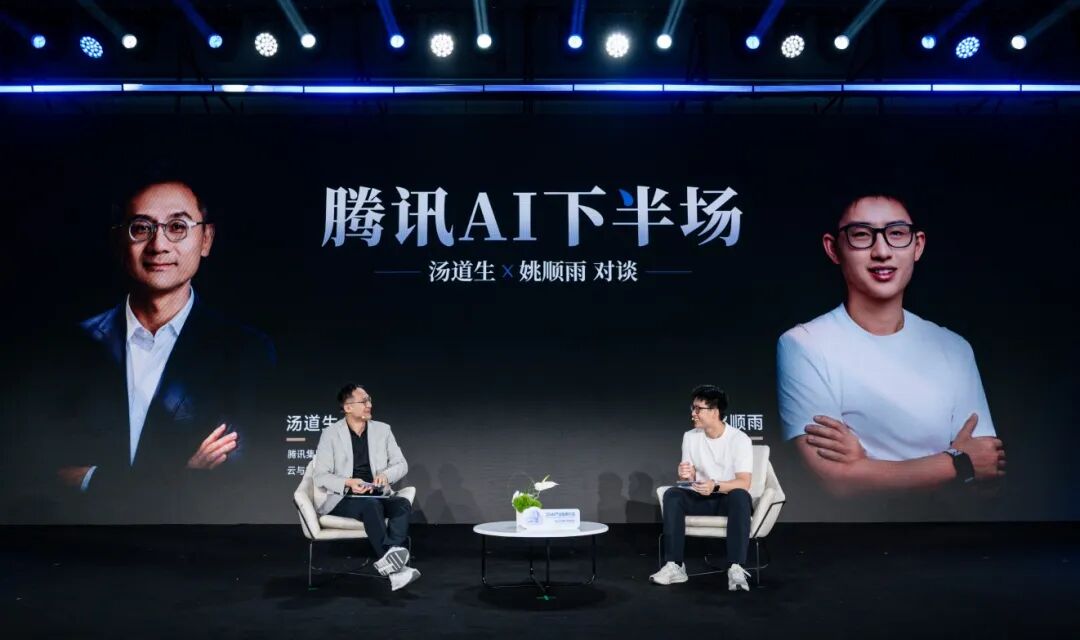
The presentation of the Tencent Cloud Agent Development Platform 4.0 at the conference has sparked the discussion again. It is specifically aimed at the problems that agents have in the corporate production process and is designed as a corporate AgentOps platform that covers the entire lifecycle of corporate agents from creation, connection, distribution to governance.
The goal of ADP 4.0 is to integrate these problems into a manageable production process.
The first step is to find suitable scenarios.
Currently, a common problem in the industry is that many companies have AI budgets but don't know which processes are suitable for using agents.
ADP 4.0 offers over 50 scenario - specific templates and industry - proven applications. Nearly 40 selected connectors will be launched first, and over 150 capabilities will be supported. Companies can integrate existing resources such as CRM, ERP, OA, ticketing systems, customer service, corporate file management systems, knowledge databases, and document systems into the agents, instead of manually transferring data or reorganizing materials.
This fundamentally reduces the costs of corporate trials. There are corresponding scenarios and capabilities for both the requirements of customer service in handling high - frequency questions and ticket processing, as well as for the product rating scenarios of marketing agents.
The Claw model further lowers the threshold for creating complex agents.
Based on the three existing creation models (LLM + RAG, Workflow, and Multi - Agent), ADP 4.0 additionally supports the Claw model with an agentic loop mechanism. The creator doesn't need to configure complex forms but only needs to describe the requirements in natural language. The platform can then automatically generate prompt texts, connect knowledge databases, configure tools, and organize workflows.
The Claw model is designed for complex and long - term business tasks. The agents can autonomously code and execute in a cloud sandbox, call corporate capabilities, and perform long - term tasks. After creation, they can be integrated into corporate business systems via API interfaces or forwarded to employees and customers via corporate WeChat, WeChat, and other channels.
The Tencent Industrial Quality Inspection Platform TI - AOI provides an example. Traditional visual inspection depends heavily on the experience of on - site engineers. Data verification, log viewing, model evaluation, and parameter adjustment often require switching between multiple pages.
The quality inspection agent based on the Claw model can handle a series of industrial processes in a closed - loop process. Engineers only need to enter queries in natural language, and the agent can automatically check data integrity, evaluate training opportunities, and give suggestions for further optimization.
The second step is risk management.
Before an agent is integrated into the core process of a company, one needs to know what it can and cannot do.
ADP 4.0 incorporates governance capabilities into the development phase. The platform supports a hierarchical permission architecture at the corporate, space, and application levels and combines it with an RBAC role - permission matrix to separate function and data permissions.
Companies can configure the access scope based on the organizational structure, departments, positions, and roles to ensure that the permission boundaries between different teams, applications, and knowledge databases are clearly defined.
The governance of capabilities is also integrated into the production process. Custom capabilities submitted by employees must undergo a series of security checks such as static code analysis, data access control, network egress control, and whitelist checks, as well as multi - level approval before they can be called in the corporate zone. Capabilities are no longer personal tools but approved, shared, and controllable corporate resources.
The Agent Portal is responsible for cross - platform management. Companies can centrally manage agents in different platforms and business scenarios, report calls, activity, answer quality, operating costs, and errors, and identify the causes of problems.
The way of implementation also matters in whether agents can be integrated into the core data flow. ADP 4.0 supports four implementation modes: Public Cloud, Private Cloud, Hybrid Cloud, and Dedicated Cloud. The private cloud solution of the intelligent workplace and the secure sandbox also enables the secure execution of code, the calling of capabilities, and the execution of long - term tasks in a corporate intranet.
The third step is the evaluation of results.
When implementing ADP, Yili created an agent matrix for sales consultation, ordering, and marketing. After the introduction of the sales consultation agent, the click - through rate of product links in the community increased by 15.7%, and the number of orders through the sales consultant increased by 26.02%. After the integration of speech recognition, intention assessment, product ratings, and order redirection, the intelligent ordering agent achieved a 93% accuracy in recognizing requirements and increased order conversion by 39%.
In the hotel and travel sector, Huazhu updated "Hua Xiao AI" based on the Tencent Cloud Agent Development Platform and jointly created 38 workflows. After a guest makes the request "I need a bottle of water", the system can understand and respond to the request within five seconds, automatically create a ticket, and deploy a robot for delivery.
Currently, "Hua Xiao AI" is in over 10,000...