In einer Stadt werden pro Woche 20 neue Filialen eröffnet – Pinduoduo-Stores lösen einen Boom bei stationären Geschäften aus
Just like the business ideas around Gokubana stores, frisbees, and all other trends that are brought into the public eye through social media, saving with plastic granules is ultimately a temporary hype that arises from the combination of hobby economics and low startup barriers.
In the Qingnianhui building in Chaoyang, Beijing, the elevator door opens, and two girls who look like middle - school students step out. They have just taken out their mobile phones to check the reservation information when an employee of a savings store approaches them: "Where do you want to do your savings? I'll take you there."
This is a central business district near the Joy City shopping center in Chaoyang with a very high pedestrian flow. In the past two months, savings stores have sprung up like mushrooms after the rain in the area: from one store at the beginning, to three stores on the same floor, and at least ten stores in the entire building. Some employees wait directly at the elevator to attract customers: "Cancel your other reservation, you can do your savings just as well here."
The fierce competition results from the rapid rise of savings. This handicraft activity, in which one arranges plastic granules into patterns and then joins them together by ironing, became one of the most popular offline consumption activities among young people in 2026. The hashtag #Savings on Douyin has nearly 30 billion views, savings ranks second on Taobao in the list of the ten most popular products, and the number of group bookings has increased by 9018% compared to the previous year.
The abundant recommendations on social media continuously steer the online public back to offline stores. As a result, savings has become a popular starting point for startups.
Currently, there are over 2,200 companies related to savings across China, and nine out of ten were founded in the past six months. There are already over 240 savings stores in Beijing alone. A Shanghai operator mentioned in a public event that over 20 new savings stores opened in Shanghai in a week, not counting the handicraft shops that offer savings as one of the experiences. An operator of a handicraft shop in a third - tier city in Sichuan mentioned that during the Chinese New Year, there was only one shop in the city offering savings experiences, and now there are already thirty to forty new stores.
A group of enthusiastic young people quit their jobs, invest their savings, and open their own small savings stores in their hometowns or in an office building in a metropolis. On social media, there are stories everywhere about "recouping the investment in 30 days" and "monthly profits of 30,000 yuan."
Most of them are also savings enthusiasts, and this hobby - based startup movement is not new. The Gokubana stores have followed the same pattern in the past two years: online sensation, imitation due to low barriers, store expansion, price wars, and mass bankruptcies. In 2025, over 155 Gokubana stores across China closed in just six months, and more than half were private startups. The same scenario is now playing out at an accelerated pace for offline savings stores. If you search for "savings startup - warnings" on social media, the screen is full of stories about losses, sales, and liquidations. Operators who didn't make it through the first month sold their goods on Xianyu and left the market.
The new consumption trends among young people mostly disappear like the wind. Some operators are already aware that success in this business depends on speed. Entrepreneurs must be smart: they must know that they are in a trend phase, be able to calculate the payback period of their investment, and recognize the exit opportunities. In this sense, starting a savings business is more of an extreme test of judgment and perseverance.
1
A Startup Dream That Can Come True in a Week
Although it is mocked as the "cross - stitch of young people," savings obviously has more potential to become a successful offline business than cross - stitch.
It is stress - relieving and therapeutic, has a low entry barrier as one simply has to arrange the granules according to a pattern, and can thus appeal to different age groups and population segments. It is good for taking photos and sharing on social media and meets the need for offline socialization. On the other hand, it requires granules in different colors and materials as well as special equipment such as ironing machines. The materials are much more complex than in cross - stitch, and ironing the granules also requires a certain amount of skill for normal players, which justifies the need for an offline experience.
With a hardware cost of a few thousand yuan and a daily turnover of over 2,000 yuan on weekdays and over 3,000 yuan on weekends, the savings business is cost - effective, quickly profitable, and flexible. Many young people see the enticing possibility of starting their own business with little capital.
In February of this year, Xiao Ye from the suburbs of Taizhou in Zhejiang first came into contact with savings. He once played in an offline store with friends in Hangzhou and found adjusting the parameters when ironing and creating a smooth and seamless pattern more interesting than arranging the granules. After he returned home, he decided to buy an automatic ironing machine of the Leleke brand for over 2,000 yuan and a batch of granules and do savings at home.
After he received the machine, he thought it was "too expensive to use it just for himself." Since there was no savings store in his hometown, he quickly recognized a business opportunity. So he founded a savings store next to the middle school with a high - school friend.
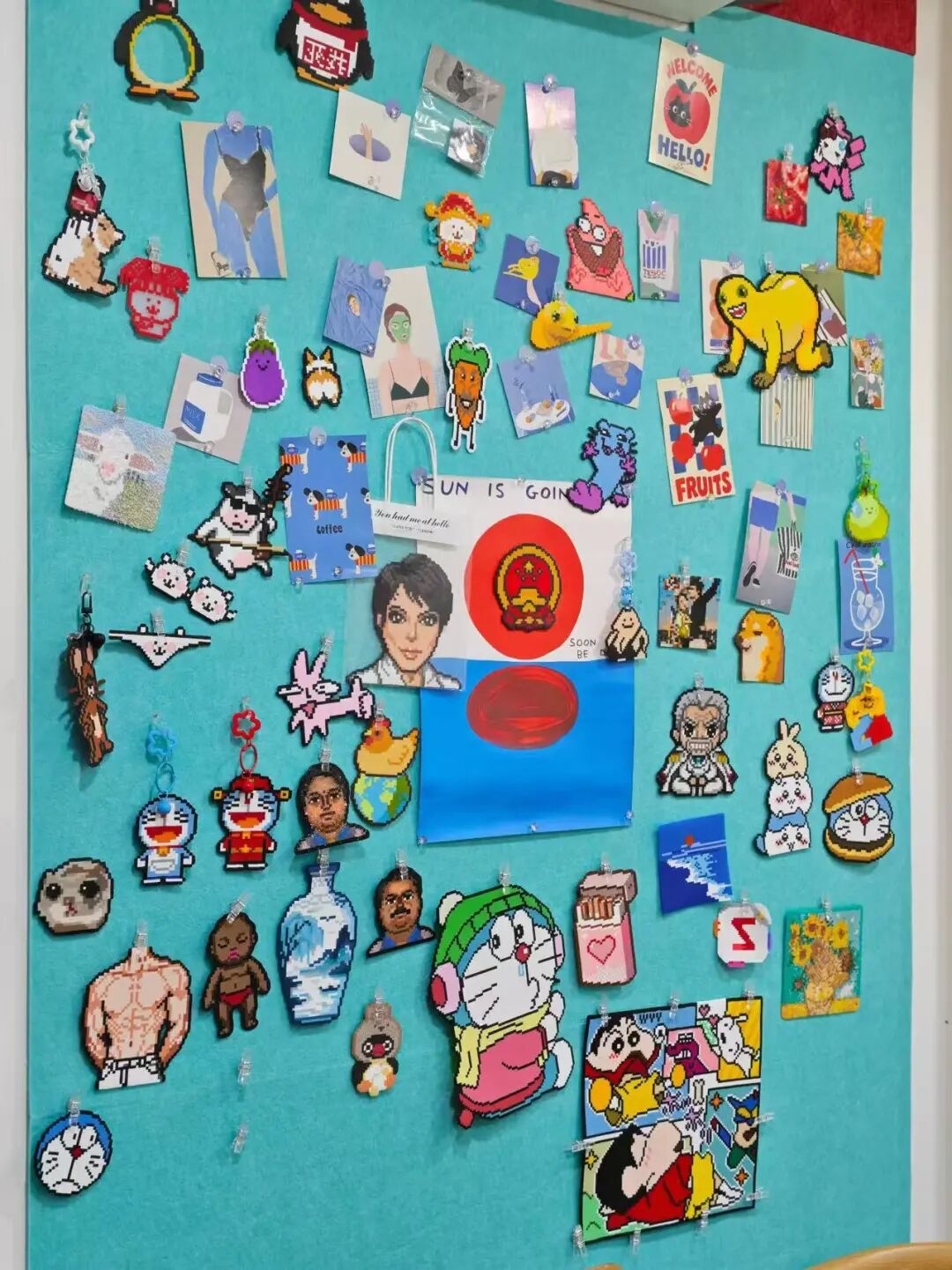
The savings wall in Xiao Ye's store
"Savings probably won't be popular for very long; it's more of a short - term and profitable business. So we acted very quickly." Xiao Ye says that he is usually rather hesitant, but when founding this store, he completed the site selection in three or four days, the renovation in a week, and started the trial opening in less than 10 days. On the third day after the opening, all 16 seats in the store were occupied, and he had to urgently reorder the most used black and white granules.
Xiao Ye will pursue a doctorate in sociolinguistics at King's College London. He originally planned to operate the store only until June. Before the founding, he and his partner made a balance sheet: he calculated the profit model backwards from June and only invested after ensuring that the investment could be recouped. In fact, he recouped the investment in the first month, and the popularity of the store has not diminished. So he decided to postpone his departure to England until September.
They have positioned themselves very smartly. In metropolises, the competition in the savings sector is very fierce, and some stores even have very low prices. Since Xiao Ye is the only operator in the city, he finally set a price of 15.9 yuan per hour on weekdays and 69 yuan for the whole day, which is cheaper than in city centers but not so cheap as to start a price war. Their total initial investment was only 12,000 yuan, and the monthly rent was less than 1,700 yuan. Now Xiao Ye thinks that the store may exist for even longer.
At about the same time, several savings stores are also being planned in Qingnianhui in Beijing.
In contrast to Xiao Ye, who has a cost - effective business model thanks to his geographical location, the cost of starting a store in Beijing is much higher. For example, starting a store in Qingnianhui in Chaoyang in the initial phase costs almost 100,000 yuan. The main cost components are not only the more expensive rent on the central business street but also the renovation materials and tools, and the furniture is also no small matter.
In order to reduce costs and open as soon as possible, many offline savings stores only aim to meet the basic requirements during renovation.
A few stores provide each seat with a complete set of granules and tools. However, most savings stores only have a material wall from which customers can pick the granules in different colors themselves. The handicraft tables are also put together, and no versatile design is required. In the Qingnianhui area, the price for an hour of savings in the stores is generally between 20 and 30 yuan, and the daily price varies greatly, from 50 yuan to 100 yuan.
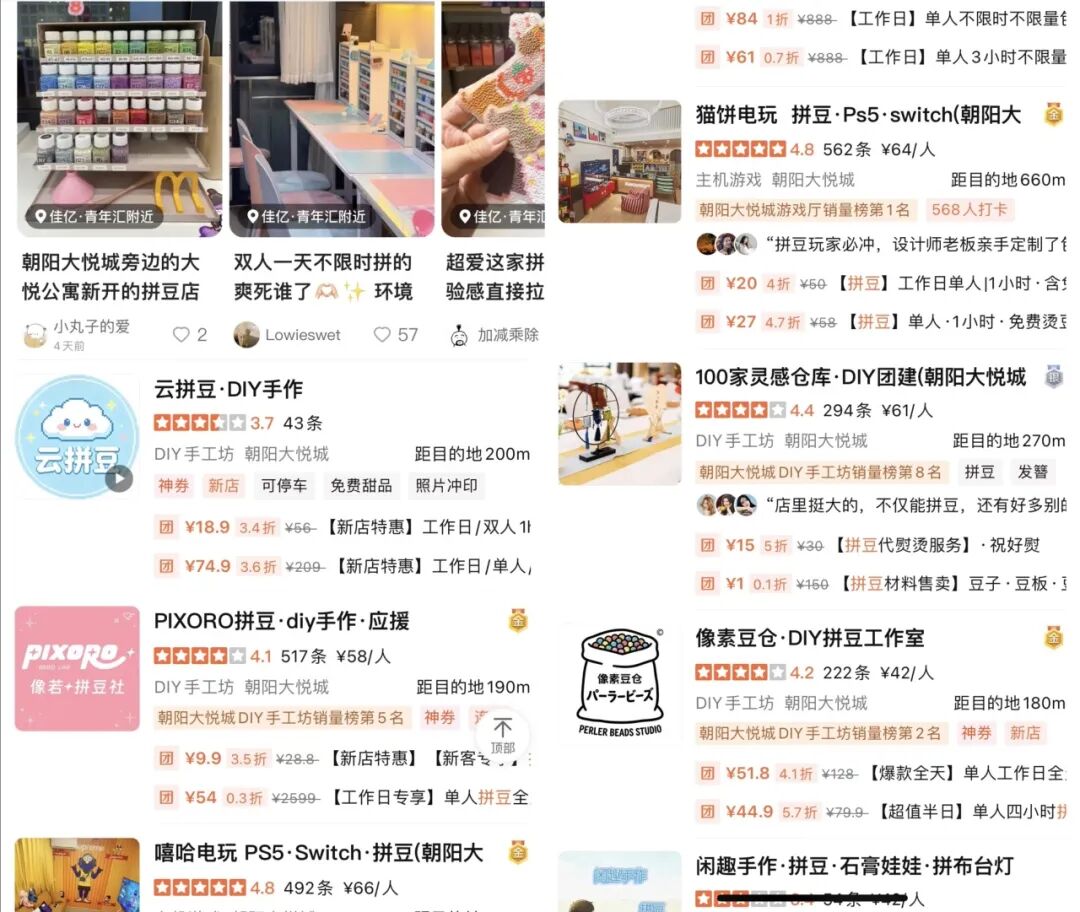
From "trying it once" to "opening a store" - these young people made a decision in the shortest possible time. The entry barrier is low, one can start with a few thousand yuan; it's fast, some only need two weeks from planning to opening; the stories are enticing, there are posts everywhere on social media about "recouping the investment in 30 days." But behind the hype, the actual operating situation is much more complex than expected.
2
The Market Quickly Enters into Competition
What leads these people to the same decision is almost the same assessment: the entry barrier is low. Compared to restaurants and beverage shops, there are no inventories in savings, almost no material storage costs, the granules are standard products, and enthusiasts know the product itself. As Xiao Ye says: "Compared to traditional restaurants or beverage shops, the investment is relatively small, and there are almost no material storage costs. At least the losses can be minimized."
On a weekend at the end of May, there were a dozen guests in Xiao Ye's small store. Most were middle - school students, there were also some working people and parents with children. On weekdays, he reads literature in his store, and when he gets tired, he mixes the granules and tests new ironing methods. "I don't feel so old," he says with a smile, "I have contact with young people."
On weekends, he is so busy that he has no time to eat. He and his partner work in shifts. When it's busiest, all 16 seats are occupied, and he has to ask friends to help him. He even made a surprising discovery: "My mother was very skeptical at first, but since the second week of the store's operation, she's completely in love with savings and comes three times a week." Now she doesn't want the store to close.
But in markets like Chaoyang in Beijing, where the competition is fiercer, savings operators see a completely different world.
According to our own investigations, at the beginning of the Labor Day holiday in Qingnianhui, there was only one savings store. By the end of May, there were already three stores on the same floor, and at least ten in the entire building. A blogger on Xiaohongshu specifically counted: In the Shuangjing Uptown Area, where there are particularly many stores, there were about 15 savings stores in March, and now there are over 20.
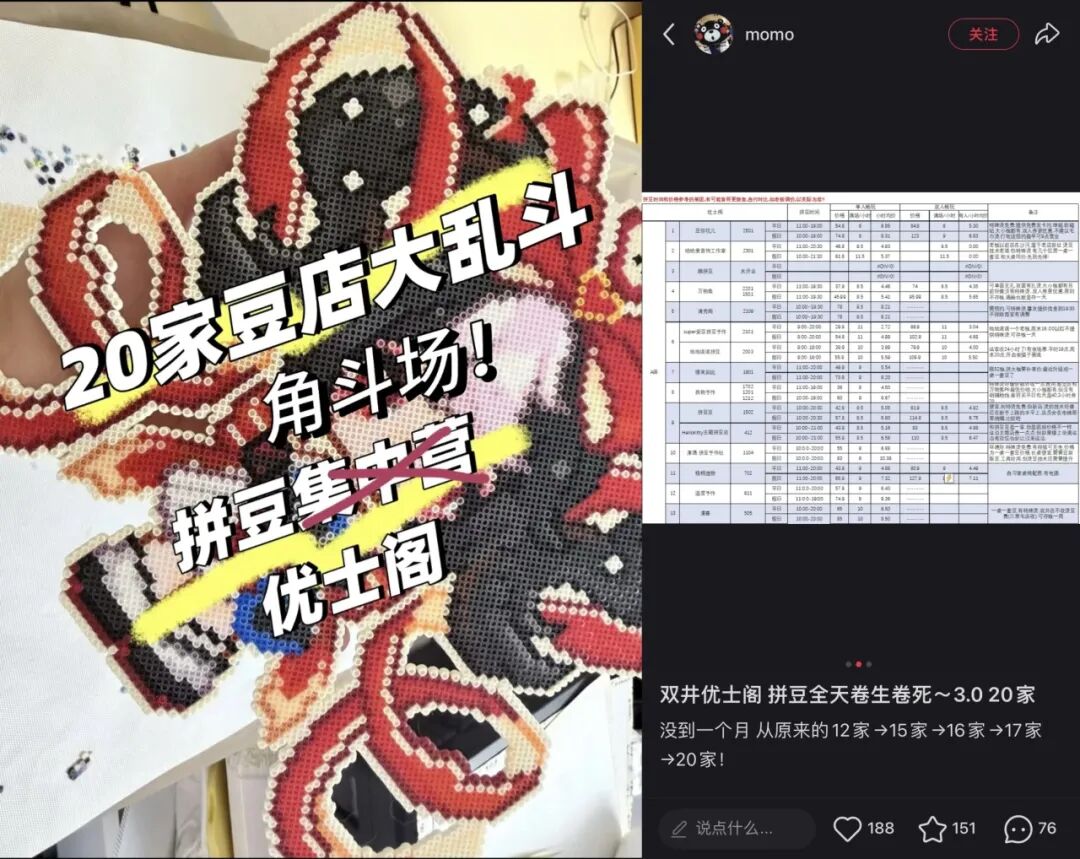
The entry barrier for starting a store is low. Many people open a store as soon as they notice the trend, and it can take only two weeks from planning to opening. Some stores even directly convert a self - study center into a handicraft workshop and only need to order granules to open the business. However, if one makes more thorough preparations, it can take one to two months and also includes details such as testing different granules and optimizing the table and chair arrangement. For example, 221 different colors of granules are divided into over 10,000 small bottles for each seat. At the same time, the seats are spacious, and each table is equipped with a socket and a small lamp, and an electrician is hired to lay the wires.
Most savings stores calculate the price based on the number of hours, and there are also daily packages. The prices are cheaper on weekdays and increase on holidays. According to our knowledge, most savings stores reach a peak of about thirty people on weekends, but the pedestrian flow on weekdays is very irregular. So some operators start to offer 9.9 - yuan group bookings, while others focus on quality. "Starting a business is not easy," complains an operator, "in the past, I only had to think about the company, now I have to think about everything in the store, even about a socket."
Most savings operators who have been in business for one to two months have not yet recouped their investments. Some are considering adding other handicraft projects, offering team - building activities, or selling daily and weekly cards. Given the continuously opening new stores in the same building and the fierce competition for customers at the elevator, it is unclear how long the advantages of each individual branch can last.
Xiao Ye knows that his advantage lies in...