27 Provinzen haben ihre BIP-Ziele für den 15. Fünfjahresplan festgelegt: Guangdong und Jiangsu könnten die Marke von 18 Billionen Yuan durchbrechen, Tibet führt mit einer Wachstumsrate von 7 %
Currently, the planning drafts for the "15th Five - Year Plan period" of all 31 provinces have been released, making clear the development goals of the regions for the next five years.
An analysis by a reporter from "Time Weekly" showed that 27 out of the 31 provinces have released the average annual growth targets for their regional gross domestic product (GDP) for the "15th Five - Year Plan period". Although the remaining four provinces have not specified specific average annual growth targets, they have also announced their respective major development goals.
Among the 27 provinces that have released the average annual growth targets, Tibet has set an average annual growth of about 7%, which is the highest target in the whole country. Hainan follows with about 6%. Xinjiang has set a growth between 5.5% and 6%, while most other provinces have set their targets between 5% and 5.5%.
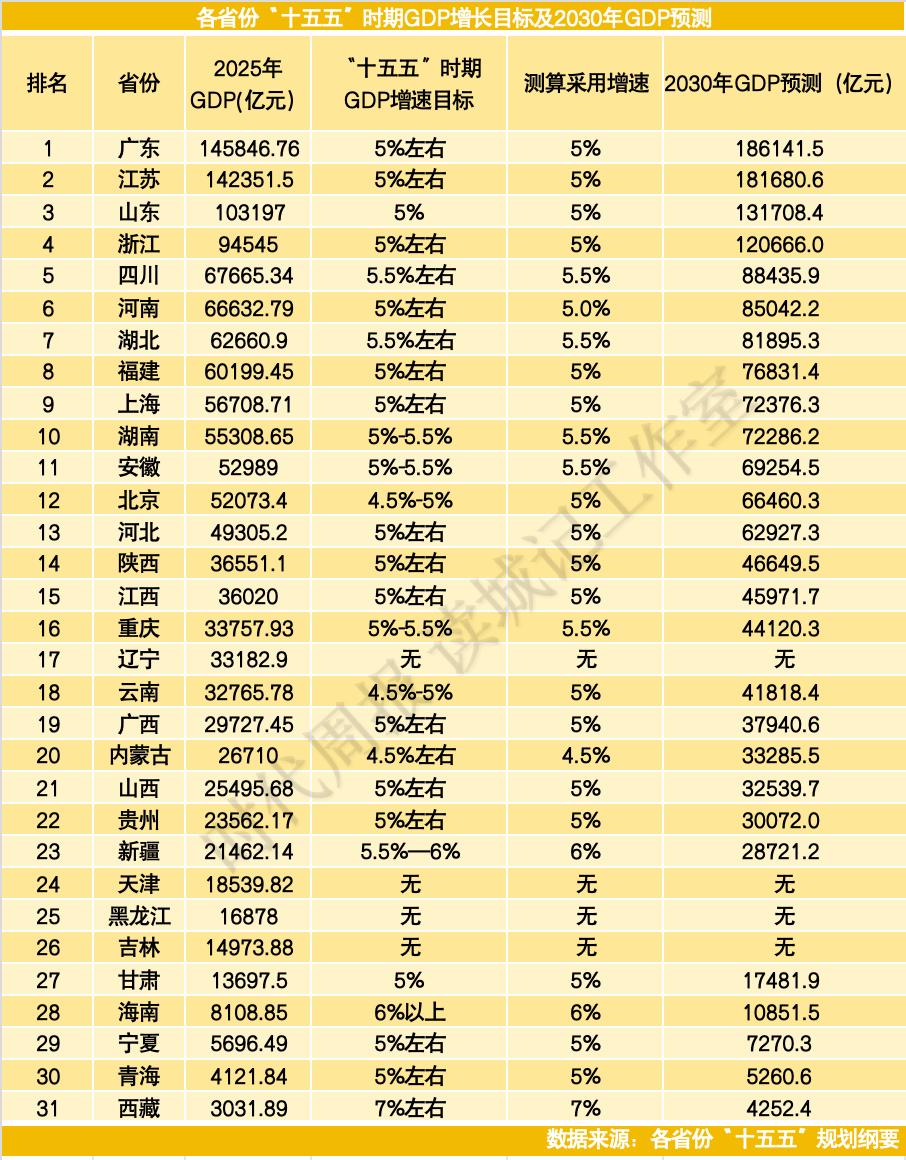
A simple estimate based on the regional planning targets shows that by the end of the "15th Five - Year Plan period", the economic sizes of some provinces will reach a new level. Guangdong, Jiangsu and Shandong will still rank in the top three in the whole country.
Guangdong's GDP could rise from 14.58 trillion yuan in 2025 to about 18.6 trillion yuan, which means an additional economic growth of more than 4 trillion yuan in five years. Jiangsu's GDP will also exceed 18 trillion yuan, while Shandong's will be over 13 trillion yuan.
Guangdong and Jiangsu's GDP could exceed 18 trillion yuan
The competition among provinces is an important window to observe regional development in China.
From the planning targets released by the provinces for the "15th Five - Year Plan period", it can be seen that by 2030, the ranking of the provinces with the largest economic sizes is not expected to change significantly. The economic sizes of large provinces will still play a key role.
An estimate based on the growth targets set by the regions shows that by the end of the "15th Five - Year Plan period", the top ten provinces with the highest GDP will still mainly consist of Guangdong, Jiangsu, Shandong, Zhejiang, Sichuan, Henan, Hubei, Fujian, Shanghai and Hunan. The agglomeration effects of the leading provinces will become even more obvious.
As the largest economic region in China, Guangdong is expected to further expand its leading position in economic size. In 2025, Guangdong's regional GDP reached 1,458.4676 billion yuan. Assuming an average annual growth of about 5% during the "15th Five - Year Plan period", Guangdong's GDP could rise to about 18.6 trillion yuan by 2030, which means an additional economic growth of more than 4 trillion yuan in five years.
Another region whose GDP will exceed 18 trillion yuan is Jiangsu. In 2025, Jiangsu's regional GDP reached 1,423.515 billion yuan. Assuming an average annual growth of about 5% during the "15th Five - Year Plan period", Jiangsu's GDP could also exceed 18 trillion yuan by 2030.
As a province with a strong manufacturing industry, Jiangsu has leading clusters of advanced manufacturing industries and a complete industrial supply system. In recent years, Jiangsu has continuously promoted the modernization of traditional industries and the development of strategic emerging industries, and created strong competitive advantages in areas such as high - tech equipment, new - type information technology and renewable energy, which provides a solid foundation for continuous economic growth.
In 2025, Shandong, which ranked third, became the first northern province whose economic size exceeded the 1 trillion yuan mark. Zhejiang ranked fourth in the whole country with 945.45 billion yuan. Sichuan (676.65 billion yuan), Henan (666.33 billion yuan), Hubei (626.61 billion yuan) and Fujian (601.99 billion yuan) were in the range of 6 - 7 trillion yuan, while Shanghai (567.09 billion yuan) and Hunan (553.09 billion yuan) were in the range of 5 - 6 trillion yuan.
An estimate based on the GDP growth targets of these provinces for the "15th Five - Year Plan period" shows that Shandong's GDP will exceed 13 trillion yuan by 2030, Zhejiang's will exceed 12 trillion yuan, Sichuan's, Henan's and Hubei's will exceed 8 trillion yuan, and Fujian's, Shanghai's and Hunan's will exceed 7 trillion yuan. In terms of economic size and growth potential, the southeastern coastal regions and the central region are still important engines for China's future economic growth.
From the planning drafts of the "15th Five - Year Plan period" of these provinces, it can be seen that the common keywords for the growth of the economic sizes of large provinces are technological innovation and industrial modernization.
Shandong focuses on promoting emerging industries such as high - tech equipment, renewable energy and new materials. Zhejiang bets on artificial intelligence and the digital economy. Shanghai focuses on the three leading industries of integrated circuits, biomedicine and artificial intelligence and continuously promotes the development of the high - tech service industry. Provinces such as Sichuan, Hubei and Henan are also accelerating the development of advanced manufacturing industries and future industries.
With the increasing transformation of traditional growth engines, emerging industries will become an important engine for the further growth and modernization of the economic sizes of large provinces.
Tibet has set a growth target of 7%
While the leading provinces are further expanding their advantages, some mid - sized provinces are accelerating their catch - up process and have the potential to improve their development level during the "15th Five - Year Plan period".
Especially in central and western China, some provinces have shown significantly stronger growth and will become important factors in China's regional economic landscape. Anhui and Chongqing have particularly stood out.
In 2025, Anhui produced 3.6865 million cars, including 1.7941 million electric vehicles. Both figures led the country. Anhui's automobile export volume also ranked first in the whole country. In terms of cities, Hefei led the country in electric vehicle production and outperformed several strong automobile industry centers.
In addition to the electric vehicle industry, Anhui has also developed strategies for the development of emerging industries such as integrated circuits, new - type display technologies, artificial intelligence and advanced structural materials.
As the capital city of Anhui, Hefei has received a lot of attention due to several successful projects in promoting and introducing important industries. From BOE to the accumulation of the electric vehicle industry and finally to the memory chips of Changxin Technology, Hefei has gradually established a development model that promotes industrial modernization through technological innovations, thus providing new impetus for Anhui's economic growth.
An estimate based on the growth target of 5% - 5.5% set by Anhui in its planning draft for the "15th Five - Year Plan period" shows that the province's GDP could reach nearly 7 trillion yuan by 2030, thus further narrowing the gap with the leading provinces.
Similar to Anhui, Chongqing has also shown strong growth resilience in recent years. In 2025, Chongqing's GDP reached 337.5793 billion yuan, which was higher than that of Liaoning (331.829 billion yuan). Chongqing thus rose to the 16th place in the whole country and was the only province whose ranking improved last year.
As an important manufacturing base in China, Chongqing is currently accelerating the transformation of the automobile industry to electric vehicles and connected vehicles and at the same time strengthening the development of strengths such as the electronics and equipment industries. An estimate based on the growth target of 5% - 5.5% during the "15th Five - Year Plan period" shows that Chongqing's economic size could rise above 4.4 trillion yuan by 2030.
Provinces with resource - based economies are also looking for new growth engines.
In 2024, Inner Mongolia's economic size reached 263.146 billion yuan, exceeding that of Shanxi. In 2025, Inner Mongolia's economic size rose to 267.1 billion yuan, while Shanxi's was 254.9568 billion yuan. The gap between the two provinces remained.
Over a longer period, the economic growth of both regions has been highly dependent on the coal and other resource industries. In recent years, both regions have started to adjust the energy supply and restructure the industries, accelerating the development of renewable energy, new materials and modern energy equipment. Inner Mongolia uses its rich wind and solar energy resources to promote the production of energy equipment and the development of green energy. Shanxi focuses on the comprehensive reform of the energy industry to get rid of its dependence on the traditional coal industry.
An estimate based on the respective planning targets shows that the economic sizes of Inner Mongolia and Shanxi could both rise above 3 trillion yuan by 2030.
In western China, Xinjiang's GDP increased by 5.5%, Gansu's by 5.8% and Tibet's by 7.0% in 2025, all higher than the national average growth. This is due to both the relatively low base of the economic size and the investments in important projects and industrial planning in recent years.
For example, Xinjiang, Gansu and Tibet have promoted the development of wind and solar power plants, and important projects such as the hydropower project at the lower reaches of the Yarlung Zangbo have been launched. The infrastructure development such as railway and road construction in western China has been accelerated, which has supported the economic growth in these regions.
Therefore, Tibet has set an average annual growth target of about 7% in its planning draft for the "15th Five - Year Plan period", Xinjiang between 5.5% and 6%, and Gansu, Ningxia and Qinghai have all set a target of about 5%, indicating strong development potential.
In addition, Hainan has also set a relatively high growth target of about 6%. With the accelerated completion of the customs area of the Hainan Free Trade Port, the advantage of institutional opening - up may become even more prominent, and the modern service industries, high - tech industries, tourism and consumption industries will have new development opportunities.
This article is from the WeChat account "Time Weekly" (ID: timeweekly), author: Li Hang, published by 36Kr with permission.