Global Top 10 Semiconductor Players, the Q3 rivalry kicks off

Remember to star the official WeChat account ⭐️, so you will not miss the first-time push notifications.
The Q3 of 2026 is arguably the most remarkable quarter for the semiconductor industry in the past decade.
Jensen Huang stepped down from his post abruptly and returned in just 11 days, during which NVIDIA released its quarterly earnings report for the first time without his leadership; ChangXin, which went public only in July, has broken into the TOP 10 of global semiconductor market capitalization; AMD's revenue guidance for the next quarter is higher than that of Intel, Broadcom's custom AI chips and network business have expanded rapidly, with its AI semiconductor revenue surging 221% year on year.
Samsung released an earnings report full of contrasts: its semiconductor division DS achieved an operating profit of 106.5 trillion won, while the DX division covering mobile phones, TVs, home appliances and other businesses posted a loss of 0.8 trillion won. In the same company, the semiconductor business earned huge profits, but the end-user business fell into losses. The price increase in the upstream turned into cost pressure in the downstream, and the AI boom did not bring good days to everyone.
01
Global Top 10 Semiconductor Players Release Q3 Results
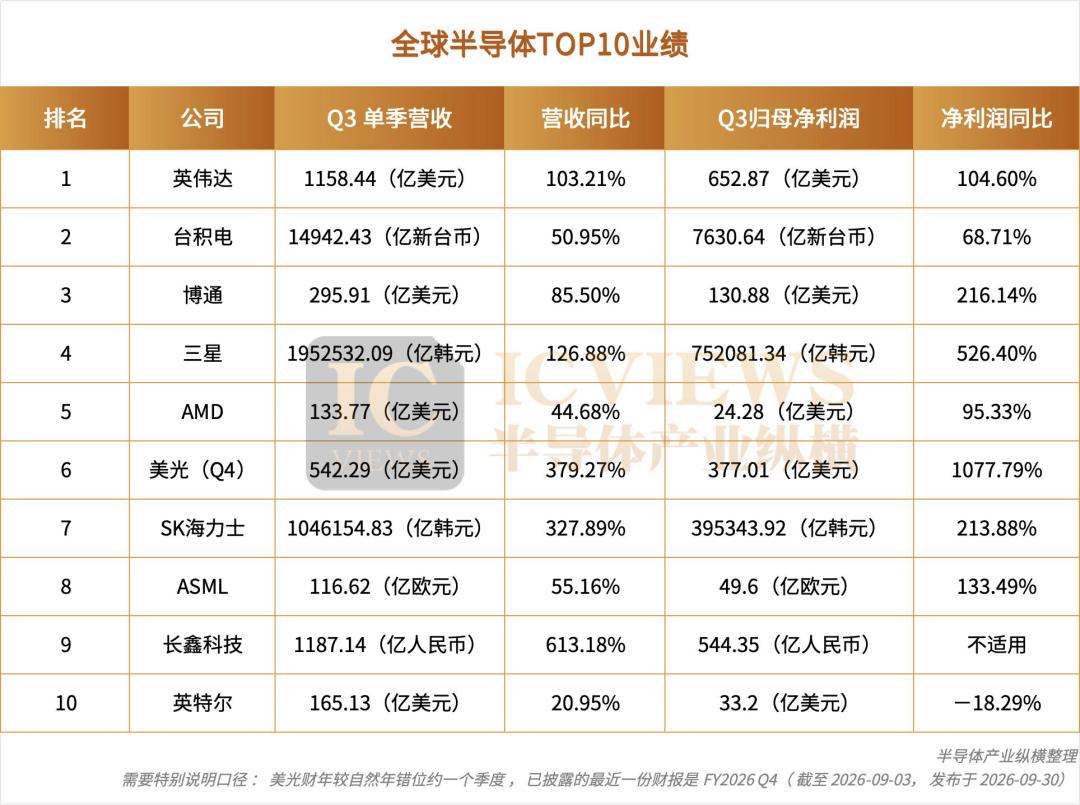
In terms of market capitalization, the current top 10 semiconductor enterprises are: NVIDIA, TSMC, Broadcom, Samsung, AMD, Micron, SK Hynix, ASML, ChangXin and Intel.
NVIDIA released its first performance report "without Jensen Huang". NVIDIA's Q3 revenue reached 115.8 billion US dollars, up 103% year on year, marking the first time in history that its single-quarter revenue exceeded 100 billion US dollars. The data center business is its most important growth engine.
TSMC's growth remains strong. Its Q3 revenue hit 46.72 billion US dollars, up 41.2% year on year. The demand for advanced computing continues to drive the performance of the world's largest wafer foundry.
Broadcom recorded revenue of 29.591 billion US dollars in the third fiscal quarter, up 86% year on year; net profit reached 13.088 billion US dollars, up 216% year on year. Among them, the semiconductor business revenue was 20.839 billion US dollars, up 127% year on year, and the AI semiconductor revenue reached 16.7 billion US dollars, up 221% year on year. Custom accelerators and network business have contributed about 80% of the revenue of the semiconductor division.
Samsung Electronics posted Q3 revenue of 195.3 trillion won and operating profit of 107.4 trillion won. Among them, the semiconductor division DS generated revenue of 147.1 trillion won and operating profit of 106.5 trillion won, almost supporting the entire group's operating profit; the DX division covering mobile phones, TVs, home appliances and other businesses recorded an operating loss of 0.8 trillion won.
AMD achieved Q3 revenue of 13.377 billion US dollars, up 45% year on year; net profit was 2.428 billion US dollars, up 95% year on year. Data center revenue reached 8.5 billion US dollars, accounting for nearly two-thirds of the group's total revenue. The data center business has become a key segment of AMD.
Micron announced that its revenue in the fourth fiscal quarter of fiscal year 2026 reached 54.229 billion US dollars, with a year-on-year increase of about 379%. Its gross profit margin reached 86.8%, and operating profit margin hit 80.7%, with both revenue and profit setting new single-quarter records in the company's history.
SK Hynix posted Q3 revenue of 104.62 trillion won and operating profit of 83.33 trillion won, both hitting new single-quarter highs, with an operating profit margin of 80%. The rising sales of server DDR5, large-scale shipment of HBM4, and the growth of enterprise-level SSD business jointly pushed up this strong performance.
ASML recorded net sales of 11.662 billion euros in Q3, net profit of 4.960 billion euros, and gross profit margin of 57.5%, higher than 54% in the previous quarter. Some customers have begun to consult and pre-order equipment for 2029 and even 2030.
ChangXin Technology achieved Q3 revenue of 118.714 billion yuan, up 613.18% year on year; net profit attributable to shareholders reached 54.435 billion yuan, with a gross profit margin of 89.53%. This year, the company has achieved the world's first launch of LPDDR6 products on top-tier mobile phone brands, and the shipment scale continues to climb.
Intel posted Q3 revenue of about 16.5 billion US dollars, up 21% year on year; GAAP net profit attributable to Intel was about 3.3 billion US dollars, down 18% year on year. Server business saw obvious growth, while the PC business still faces pressure.
Overall, three points are clear for this year's Q3:
First, the memory sector is still profitable, but the momentum of the memory market is cooling down. Four of the ten enterprises are memory manufacturers, which demonstrates the high value of the memory cycle. All four memory enterprises delivered positive growth results in Q3, but the market began to warn of falling memory prices in late Q3.
Second, the data center market is huge, but many companies are shifting their focus to agent AI. In fact, from the Q3 results, for enterprises including AMD, NVIDIA and Intel, data center related businesses account for the largest proportion of their revenue, and the profitability of the data center sector is very prominent. However, judging from the products released, all three companies are talking about AI Agent this year, aiming at the huge market cake of agent AI.
Third, orders for TSMC, ASML and other players are still growing, but the market is worried about the semiconductor demand prospect under the AI boom. After ASML released its earnings report, US stocks fell by 4%; after TSMC released its earnings report, its stock price dropped by 5.2%.
02
Memory Market: Is Crisis Looming?
For the memory market, there have been many recent news that prices will fall in 2027 or 2028.
Goldman Sachs recently released a global memory chip industry research report, stating that with the gradual release of new supply and weakening consumer electronics demand, the industry prosperity in 2028 will be significantly weaker than that in 2027, and the prices of traditional DRAM and NAND may both fall by about 20%.
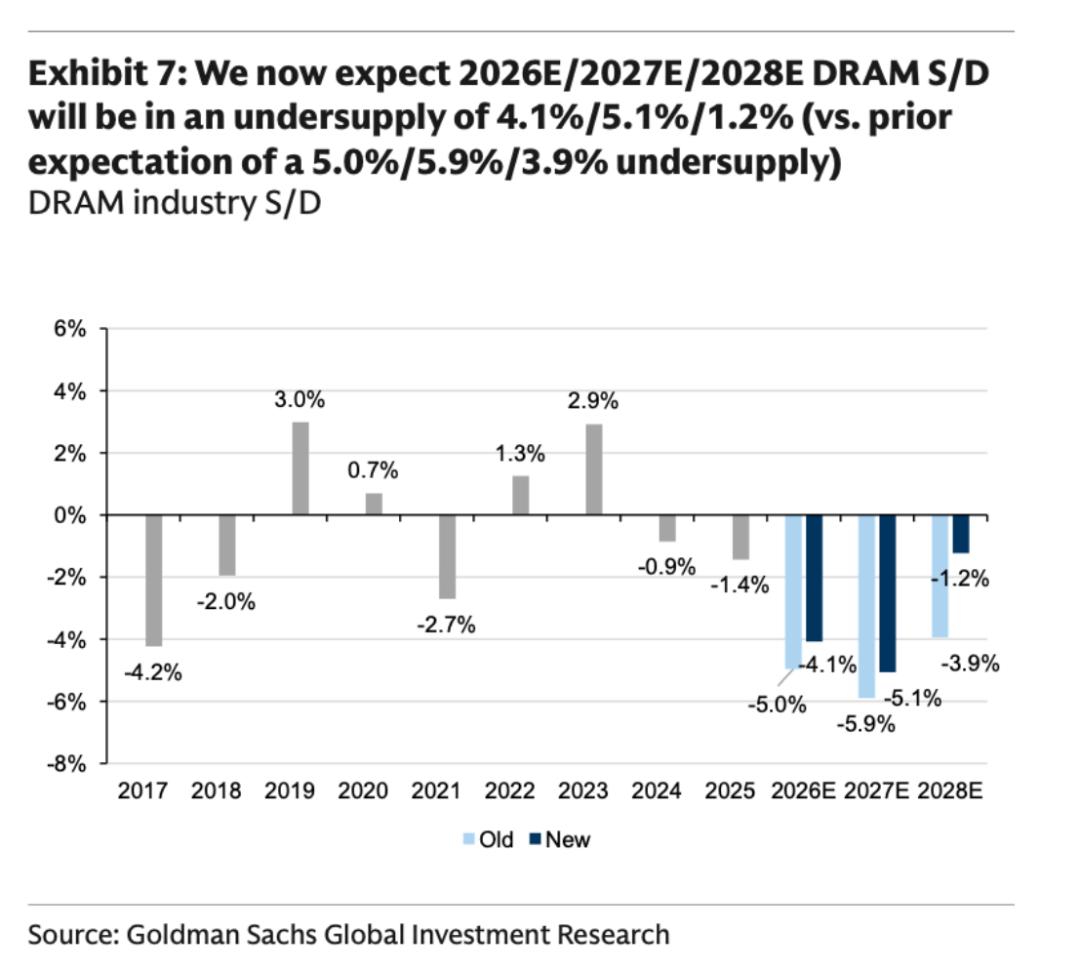
The global DRAM supply gap will reach 5.1% in 2027, and narrow significantly to 1.2% in 2028
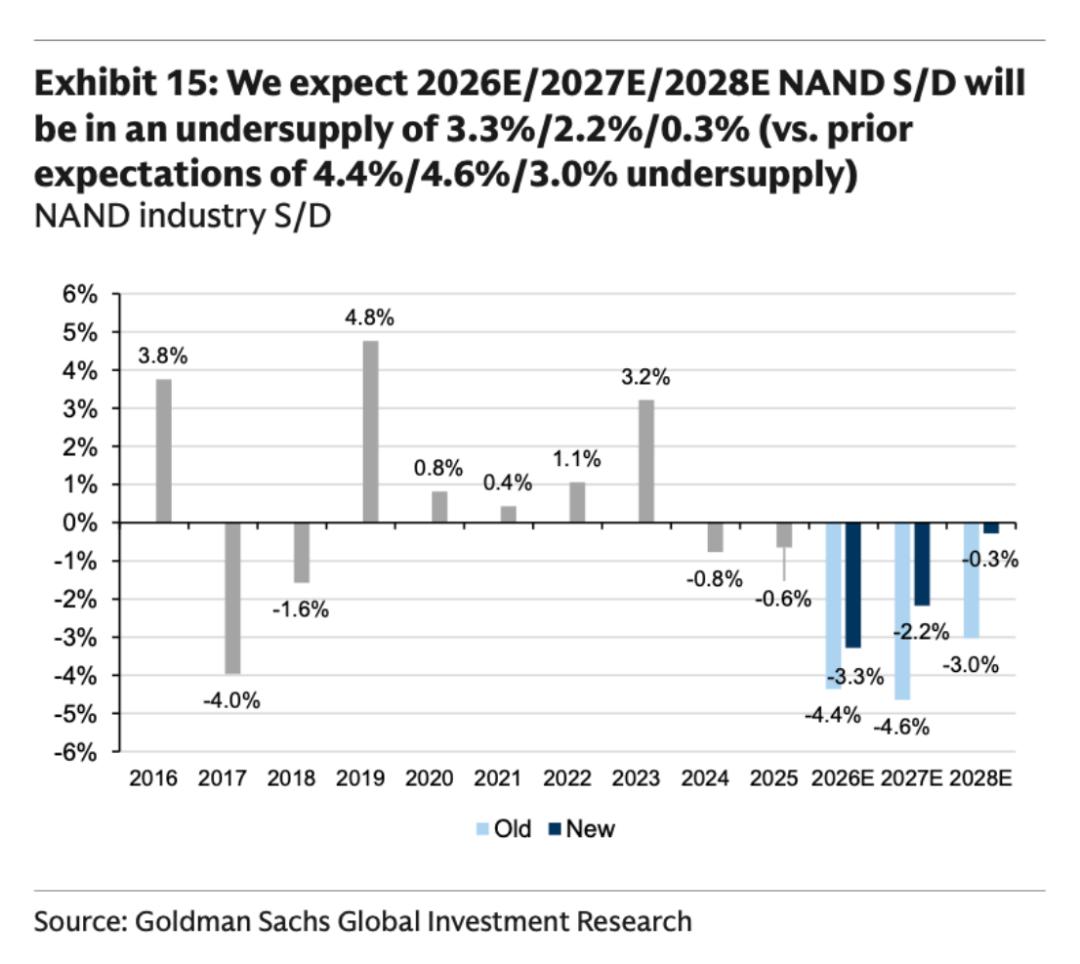
The global NAND supply gap will shrink from 2.2% in 2027 to 0.3% in 2028, and the market will be close to supply-demand balance
Let's first look at how supply, demand and prices will change. For DRAM, the supply gap is expected to be 4.1%, 5.1% and 1.2% in 2026, 2027 and 2028 respectively, with the most severe shortage in 2027 and a significant narrowing in 2028. For NAND, the NAND supply gap from 2026 to 2028 is 3.3%, 2.2% and 0.3% respectively, with the most severe shortage in 2026.
In terms of prices, the DRAM contract price is expected to rise by 32% in 2027, but will turn to a 19% drop in 2028 (previously only a 5% drop was expected); the NAND price growth forecast is lowered from 30% to 20%, and a 21% drop is expected in 2028.
TrendForce also released a report stating that NAND will enter a price reduction cycle due to oversupply in 2027, with its output value lowered to 419.3 billion US dollars; although DRAM will continue to be in short supply, the price increase will converge quarter by quarter, and the 2027 output value forecast is revised down to 1.15 trillion US dollars.
However, memory manufacturers' views are more focused on the period after 2028.
For next year, SK Hynix believes that the memory supply shortage may continue until 2030. At the performance meeting, SK Hynix said that the bit shipment of DRAM in the fourth quarter is expected to grow in the mid-20% range quarter on quarter, and NAND shipment will grow in the mid-single-digit percentage; the proportion of HBM4 in HBM shipments and revenue is expected to exceed that of HBM3E.
Samsung's judgment for the future is: tight supply will continue until 2028. Compared with SK Hynix's 2030 forecast, this time node is more conservative. Samsung predicts that the quarter-on-quarter bit growth of DRAM in the fourth quarter will reach mid-to-high teens percentage, and NAND will grow by mid-teens percentage.
ChangXin expects the company's gross profit margin to remain stable in Q4. This judgment is mainly supported by two aspects: first, the supply-demand pattern will continue to be tight, and the coordination between revenue and cost control provides guarantee. Second, product generation upgrading continues to advance.
It is worth mentioning that there is one difference between this cycle and previous cycles: memory manufacturers now have an extra "new card" in their hand, the long-term supply agreement (LTA).
According to disclosure, SK Hynix has signed long-term supply agreements with about 10 customers; Samsung has signed long-term supply agreements with 10 major customers, and negotiations with another 10 customers are in progress, with the goal of including 60% to 70% of its medium and long-term production capacity into the framework of long-term agreements; ChangXin is also negotiating long-term supply agreements with many top customers to lock in medium and long-term certain demand.
03
Agent AI Becomes the Battlefield for NVIDIA, Intel and AMD
Judging from the Q3 earnings reports, the data center businesses of NVIDIA, Intel and AMD are all outstanding.
In NVIDIA's Q3 earnings report, the data center business recorded revenue of 107.6 billion US dollars in the third quarter, up 21% quarter on quarter and 110% year on year, the data center business has become NVIDIA's most important revenue source.
In AMD's Q3 earnings report, the data center business became the main growth driver this quarter, with revenue reaching 8.546 billion US dollars, up 97% year on year, and its proportion in the company's total revenue rose to 64%. Lisa Su said that the fourth quarter will usher in an important turning point: data center AI revenue will for the first time significantly exceed server CPU revenue.
In Intel's Q3 earnings report, the Data Center and Artificial Intelligence (DCAI) division achieved revenue of 7.3 billion US dollars, with a year-on-year increase of nearly 80%.
The three companies have all set their sights on the same target: AI Agent.
NVIDIA mentioned on the earnings call that the weekly Token usage on OpenRouter has increased 35 times year on year, and 3.5 times in the past three months, of which agent workload accounts for about 80%. At the same time, as Token prices drop, usage and computing power demand continue to increase instead.
AMD said that agents continue to work in parallel in applications and enterprise systems, which not only increases the demand for accelerators, but also significantly boosts the demand for CPUs. The adoption rate is only in its early stage at present, we expect that as agents are more widely deployed and undertake more complex work, demand will surge sharply.
Intel CEO Pat Gelsinger said bluntly, considering the total number of digital agents and the number of agents that each CPU can serve, it is not difficult to foresee that the CPU market will see huge growth in dollar value and shipment volume in the next five years. Driven by agent workloads, the total addressable market (TAM) for server CPUs is expected to expand from about 40 billion US dollars to more than 200 billion US dollars in the next five years.
The three enterprises are making great efforts to develop around agent AI.
This year, Intel built a new intelligent computing center centered on CPUs, oriented to agent AI demand. From CPU to GPU, IPU and memory, all components are designed for agent AI operation. This year, Intel launched the Xeon 6+ processor, a single chip can stably support the deployment of more than 1000 agents at most. In terms of memory, Intel launched the innovative G3.5 memory solution, which builds a memory capacity expansion and high-performance shared KV Cache storage pool, and also launched the KV Cache intelligent acceleration suite.
This year, around agent AI, AMD launched the Zen 6 architecture, the 6th generation EPYC processor Venice, and the Helion rack. In terms of memory, AMD adopted the MEXT memory optimization technology. In specific agent AI workloads, DRAM usage is reduced by 50%, while the system performance can still reach 99% of