SHEIN has been trading below its issue price for three months: Has the inflection point for valuation recovery arrived?
November 27 marks Black Friday, which is the biggest promotional event of the year for cross-border e-commerce sellers targeting European and American markets. All platforms have entered a pre-war state: the promotion schedules for Amazon, AliExpress, TikTok Shop, Temu and other platforms were submitted and finalized as early as over a month ago, while SHEIN and Temu even kicked off their campaigns in advance in late October.
This major promotion coincides with the implementation of new regulations: the EU will permanently impose a processing fee of 2 euros per product category on declarants (platforms, sellers or carriers, etc.) for cross-border e-commerce parcels mailed directly from overseas to EU consumers, based on product category. The timing chosen by Brussels leaves no breathing room for cross-border platforms.
For SHEIN (00625.HK), this is its first "Black Friday and Cyber Monday" since it listed on the Hong Kong Stock Exchange on September 1. Over the past nearly three months, its share price has continued to fall. As of the closing price on November 27, it stood at HK$35.34, representing a cumulative drop of about 27% from its issue price of HK$48.56. At its lowest point, it fell to around HK$29.90, with a decline once approaching 40%.
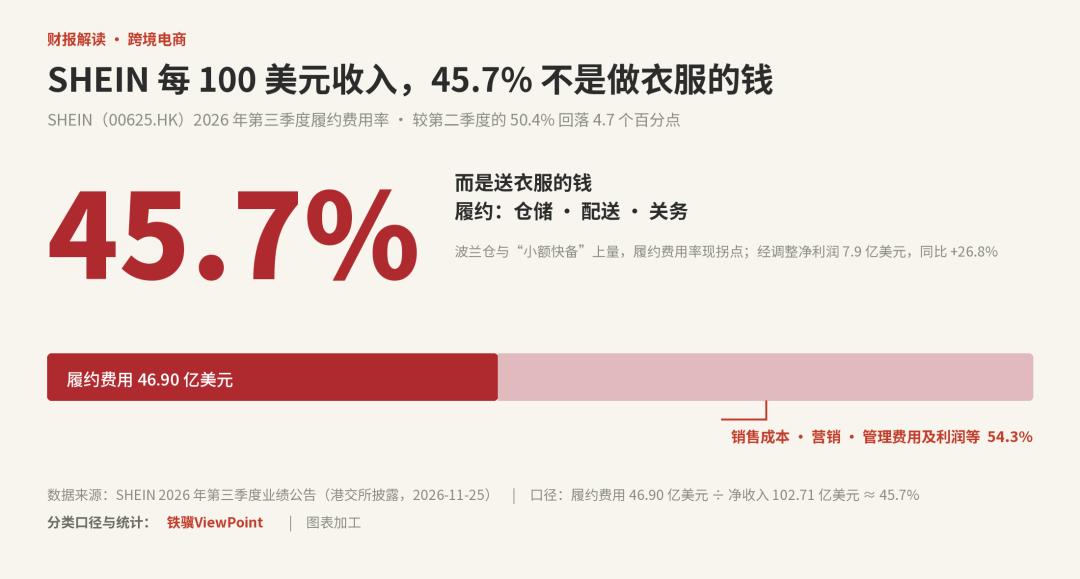
However, according to its third-quarter 2026 financial report released on the evening of November 25, its adjusted net profit for the third quarter reached 790 million US dollars, a year-on-year increase of 26.8%. The fulfillment expense ratio dropped from 50.4% in the second quarter to 45.7%, and the pool of 291 million active customers in the past 12 months has not shrunk.
On one hand, the share price has fallen by more than a quarter, and on the other hand, core profits have risen by more than a quarter. Behind this divergence, is it an "emotional mispricing" caused by liquidity stampede, or a "rational exit" after capital sees through the cycle?
New Share That Fell Below Issue Price, Financial Report at Inflection Point
On September 1, SHEIN was listed on the Hong Kong Stock Exchange at an issue price of HK$48.56 per share, corresponding to a market value of about 26.2 billion US dollars. This figure does not seem small, but during its Series D financing in 2022, the market valued it at 98.2 billion US dollars, meaning its valuation shrank by 70% in four years.
The pricing itself was reluctant: the prospectus range was set at HK$47.60-HK$49.50, and the final closing price was only slightly higher than the midpoint of the range. To attract late investors to buy shares, the company also provided an additional layer of guarantee: the difference between the issue price and the previous entry price of investors will be compensated at two annualized rates of 8% and 12%, totaling about 1.3 billion US dollars. The fact that a company will make up the price difference for investors at the time of listing fully demonstrates the characteristics of a buyer's market.
SHEIN's cornerstone investors are well-known, including Boyu Capital, Tiger Global, Tencent, Greenwoods Asset Management and other institutions, which collectively subscribed for about 22.1% of the offered shares. So what was the result? On the first trading day after listing, the price fell by 9.96% during intraday trading, and the endorsement of institutions failed to prevent it from falling below the issue price.
Greater pressure came the day after the release of its first interim report: on September 29, the company's share price fell by 10.71% to close at HK$31.50, hitting a new low since listing. Later in October, Jefferies lowered its target price from the original HK$26 to HK$23, maintaining its "underperform" rating, citing the deterioration of regional mix and pressure on profit margins, while also indicating that general market expectations for 2026 to 2027 still have room for downward adjustment.
In essence, the shrinking issuance valuation does not reflect market sentiment fluctuations, but real changes in the company's financial data.
SHEIN's revenue growth rate has declined year by year: it was 41.1% in 2023, dropped to 20.7% in 2024, and only grew by 8% in 2025. In the first quarter of this year, the growth rate was only 1.1%, and the quarter also recorded a net loss of 99 million US dollars.
What about the interim report? It is a set of data with conflicting hot and cold performances.
On one hand, the net revenue for the first half of the fiscal year was 20.134 billion US dollars, a year-on-year increase of only 1%. The total number of orders was 549 million, a year-on-year increase of 6.4%. The adjusted net profit was 499 million US dollars, a year-on-year decrease of 55.6%. The adjusted net profit for the second quarter was 228 million US dollars, with the decline expanding to 66.6%.
On the other hand, the book net profit for the first half of the year was 2.299 billion US dollars, a year-on-year increase of 111.7%, but this sum was mainly brought by the change in fair value of preferred shares, contributing a net amount of 1.861 billion US dollars in the first half of the year. The third-quarter report also verified this: among the 4.648 billion US dollars of book net profit, there is a 4.075 billion US dollar gain from the change in fair value of convertible redeemable preferred shares. The notes to the financial report clearly state that after the completion of the global offering on September 1, all preferred shares have been converted into ordinary shares, and this adjustment item will no longer apply in the future, leaving the adjusted net profit after exclusion at 790 million US dollars.
The biggest suspense of the previously released interim report is only one: why did a company with halved profits see its orders increase?
The answer lies in the mall model. For orders completed on the mall, the payment for goods will not be included in SHEIN's financial statements, and only the service fee extracted by the platform is counted as revenue. The more products sold on the mall, the slower the revenue growth rate appears to be. The data for the second quarter exactly matches this: product sales revenue was 9.676 billion US dollars, a year-on-year decrease of 3.4%. Service revenue was 1.406 billion US dollars, a year-on-year increase of 44.2%, and its proportion in net revenue rose from 8.9% in the previous year to 12.7% this year. Although the revenue growth rate is almost zero, it does not mean that no one is buying clothes. Instead, the accounting method is different: the original payment for goods in the statements has now become service fees.
It should be noted that this accounting explanation diverges in the third-quarter report: it still holds true in the US market. Net revenue in the US in the third quarter fell by 9.4% year-on-year, and the financial report clearly attributes this to the rising proportion of the mall model rather than loss of demand, and the total number of US orders still achieved a mid-single-digit year-on-year growth. However, the trend has reversed in Europe: service revenue in the third quarter was 902 million US dollars, down 19.0% year-on-year and 35.8% quarter-on-quarter, and its proportion in net revenue fell from 12.7% in the second quarter to 8.8%. The financial report attributes this to the declining proportion of the mall model in Europe.
The reasons for being bearish on SHEIN are also sufficient: net revenue in the first half of the year only grew by 1% year-on-year, adjusted net profit almost halved, and the adjusted net profit margin dropped from the original 5.6% to 2.5%. Where do these bad data come from? Most of them are concentrated in the fulfillment link. Fulfillment expenses in the first half of the year were 9.909 billion US dollars, a year-on-year increase of 15.7%, while the revenue growth rate was far lower than this figure. Converted, for every 100 US dollars of revenue, 49.2 US dollars are used to pay for distribution costs, and in the second quarter, this figure even reached 50.4 US dollars, while in the same period last year it was only around 43 US dollars.
The company's official explanation covers two aspects: first, the Iran war led to higher crude oil prices and increased transportation costs, which are external factors, and freight rates will fall after the conflict ends. Second, as mall sales volume continues to rise, this form of transaction naturally pushes up the expense ratio, which is a structural reason that will not show a downward trend. However, the judgment that it "will not decline" soon got a counterexample in the third-quarter report: the fulfillment expense ratio in the third quarter has fallen back to 45.7%.
Coupled with changes in tariff policies, these two layers of costs have been further increased.
The United States canceled the duty-free treatment for small parcels under 800 US dollars in 2025. Starting from July 1, 2026, the EU will impose a temporary tariff of 3 euros on each product with a value of less than 150 euros within its territory, plus the aforementioned 2-euro processing fee for each product, totaling 5 euros. The cheaper the parcel, the more severe the impact. According to AFP reports, after the new tariffs took effect in July, imports of related small parcels in the EU dropped by about 64%. On September 3, the Council of the European Union listed overseas e-commerce platforms such as SHEIN and Temu as statutory importers, requiring them to assume full responsibilities for declaration, compliance and return, with a maximum fine of 6% of the total import value for repeated violations.
France also moved quickly: the "Anti-Fast Fashion Act" was passed in the Senate on June 29. The bill stipulates that starting this year, each product will be subject to an ecological tax ranging from 0.25 to 6 euros, which will rise to a maximum of 20 euros by 2030, with the total amount not exceeding half of the tax-exempt price of the product.

Image source @unsplash
There is also a positive side in the cost breakdown: the company's gross profit margin in the first half of the year was 70.1%, up 5 percentage points year-on-year, and the company attributes this to the increase in mall proportion and cost reduction.
As of the end of June, the company held 15.248 billion US dollars in cash, an increase of 3.1% compared to the beginning of the year, and there was no interest-bearing bank loan on its books. The third-quarter report shows that this state continued until the end of the third quarter: as of the end of September, the total cash resources stood at 13.834 billion US dollars, with no bank loans or debt securities at all, and the capital-liability ratio was zero. These are the "positive" parts in the financial report, but they are enough to illustrate one thing: this company is not declining, it is exchanging profits for structural optimization.
However, it needs to be supplemented: the picture of "halved profits and fulfillment costs eating into earnings" outlined in the interim report has shown a clear inflection point in the third-quarter report released on November 25. The stall in revenue growth continues: net revenue in the third quarter was 10.271 billion US dollars, down 5.9% year-on-year. However, adjusted net profit rebounded to 790 million US dollars, up 26.8% year-on-year and 246.5% quarter-on-quarter, and the fulfillment expense ratio also dropped significantly, marking the first divergence between revenue and earnings.
At the end of the day, it was the interim report that drove down the share price, while the third-quarter report is dismissing the "charges" in that interim report one by one. The data on which pricing is based has changed, but the price itself has not yet reflected this. Roughly annualizing the total adjusted net profit of about 1.29 billion US dollars in the first three quarters, the full-year figure is around 1.7 billion US dollars. Even if the cumulative decline of the closing price on November 26 from the issue price exceeds 30%, the market value has shrunk from 26.2 billion US dollars at the time of issuance to about 18.3 billion US dollars, corresponding to a price-earnings ratio of just over 10 times, for order-of-magnitude reference only. This is probably the most direct misalignment of SHEIN at the moment.
Poland Warehouse Built Ahead of Tariffs
Facing the impact of tariffs, SHEIN's response is to build warehousing and logistics facilities. On December 12, 2025, its e-commerce logistics center in Wroclaw County, Poland, was put into use. With an area of about 740,000 square meters after completion, it is one of the largest e-commerce warehousing facilities in Europe.
This is about 6 months earlier than the implementation of EU tariffs, and more than 10 months earlier than the 2-euro processing fee. It not only avoids these two costs, but also shortens the average fulfillment time for EU customers from 15 days to 3 to 5 days.
The decision to enter Poland was not made on a whim: SHEIN has been laying out its presence there since 2022.
SHEIN chose Poland not only for tariff advantages: the local labor cost is about one-third of that in Western Europe, which is cost-effective in comprehensive calculation. Xu Yangtian, the founder, did try other countries and regions: production capacity in Turkey, Brazil, Mexico and other places has been successively launched, and the plan to build a factory in Vietnam has been postponed due to the 20% tariff imposed by the United States on Vietnamese exports. In the final analysis, the industrial cluster collaboration in these places is not as good as that in the Pearl River Delta, and the garment production capacity cannot be transferred, which led to the aforementioned launch of production in Poland.
There is another set of accounts inside the warehouse: robot picking, automatic sorting lines, and the intelligent joint cutting system on the production side all use automation at both ends of the circulation link to offset the rise in labor and transportation costs.
The basis of this capability is SHEIN's original "large-scale automated small-batch quick response" model. The gameplay is relatively simple: for each new product, 100-200 samples are first made to test market response. If sales perform well, capital can be quickly recovered in the shortest possible time. According to company disclosures, this model is supported by a collaborative network of more than 7,500 contract manufacturers. How large is the scale? In the first quarter of 2026, the platform launched about 4,700 new products on average per day.
Image source @unsplash
This system is being opened to independent brands through SHEIN Xcelerator. In the second quarter, the company also completed the full acquisition of US apparel brand Everlane for about 80 million US dollars.
Applying this model to individual suppliers brings obvious changes. According to a report by China Business Journal, Wang Kai, the owner of a jersey factory in Panyu, calculated the time account: when processing orders for the Qatar World Cup four years ago, customers generally placed orders 5 to 6 months in advance, and his capital and inventory faced two-way pressure for half a year. But for this year's USA-Mexico-Canada World Cup, he only needs 10 days to test the market recognition of a new design.