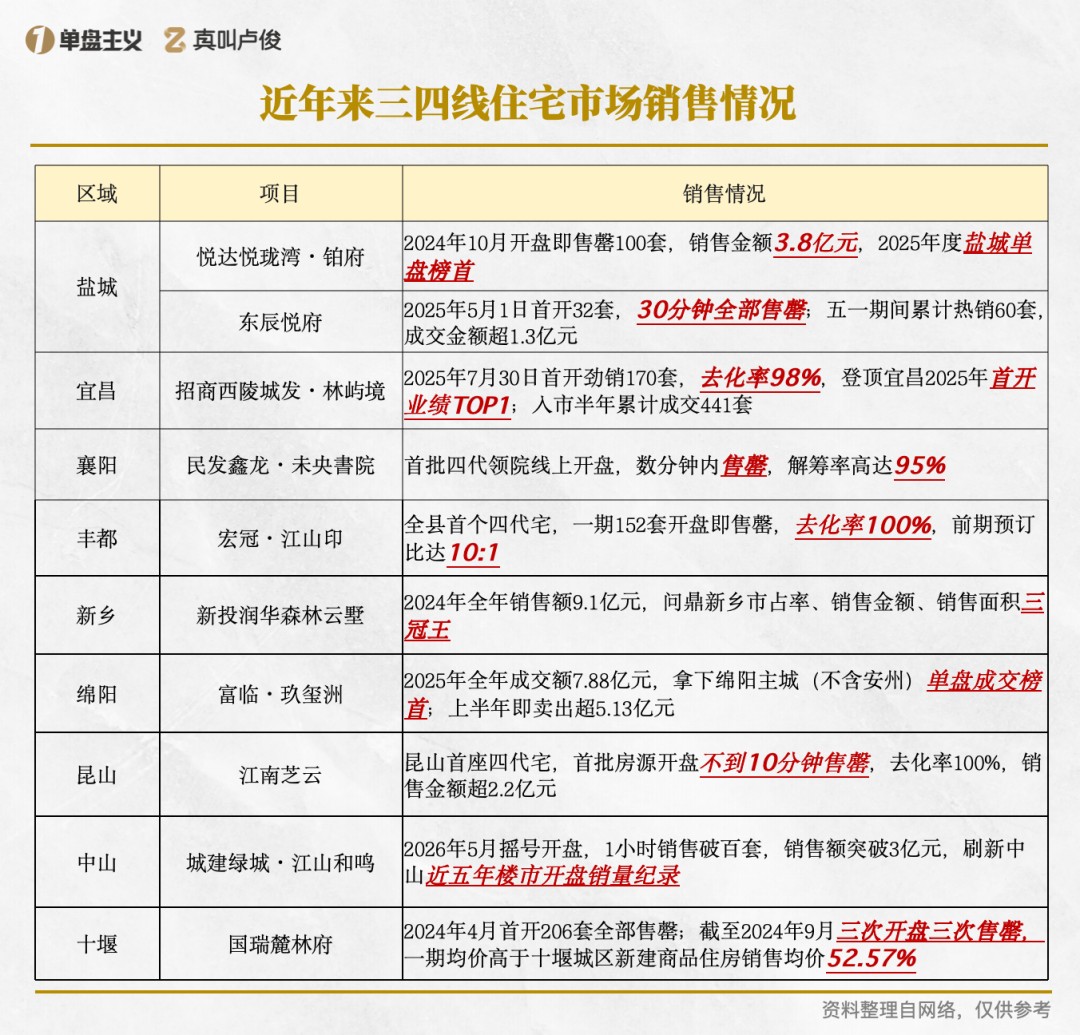
I didn't expect that the real estate developments in third- and fourth-tier cities have already been in such a situation.
Recently, we have been visiting real estate projects across the country and found an interesting phenomenon. We originally thought that the property market in county-level cities like Qidong would face relatively tough conditions, but unexpectedly, we came across a project there that exceeded our expectations — China Merchants · Qiyuan. This project enjoys a very good local reputation. From the organization of indoor circulation lines to the openness of the entire space, it easily delivers a living experience far beyond what is usually offered by properties of the same size range.
From the perspective of unit layout, you will find that when you walk out of the elevator hall, one side leads to the residence, and the other side connects to the sky garden. This design of independent elevator hall + dual access circulation lines was something I used to only see in high-end residences in first- and second-tier cities. Now, such spatial arrangement has appeared in improved-type residences in Qidong, which can create richer spatial layers and living experience even with a limited unit area.
Behind these projects, there is actually a clear signal: the property market in third- and fourth-tier cities is turning the tide by relying on product strength. In the past, design concepts that mostly appeared in high-end residences in first- and second-tier cities have now begun to be applied in improved-type projects in third- and fourth-tier cities. When the area and cost have clear boundaries, how much additional product value a project can deliver depends on how deeply the developer understands every square meter of the space.
01 Bonus Space, Extending More Scenarios for Daily Life
Residential products in third- and fourth-tier cities have a very practical feature: customers have increasingly higher requirements for living quality, but they have their own considerations for unit area and total price. Even under such high standards, almost every county-level city across the country still has one or two projects recognized by the local market with excellent product strength.
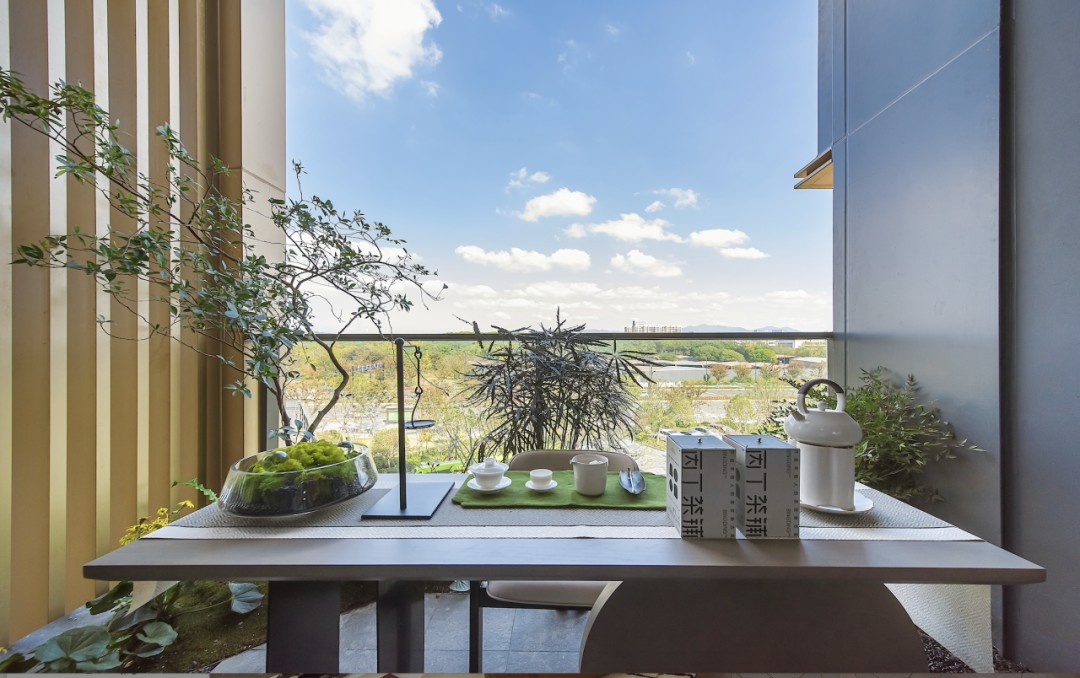
The emergence of fourth-generation residences has brought new room for exploration of such products. Improving the actual usage scenarios and spatial acquisition sense through high area bonus has become a very obvious trend in this round of product iteration. China Merchants · Qiyuan has a detail that left a deep impression on us: on one side of the balcony, a water bar and green plants are specially arranged, with sofas and tea tables placed next to them. During the daytime, this can be a small corner for drinking tea and resting; at night, when the projection screen is slowly lowered, the balcony turns into a private movie-watching space.
There is also a very life-oriented detail in this design: the water bar is connected to the indoor sink. Fruits can be washed indoors first, and drinks and wine can be prepared in advance, then conveniently passed to the water bar on the balcony, so there is no need to walk back and forth frequently. The convenience of the indoor space and the relaxation of the outdoor space are well connected. Even the arrangement of just a water bar can reflect the project's careful planning of spatial functions.
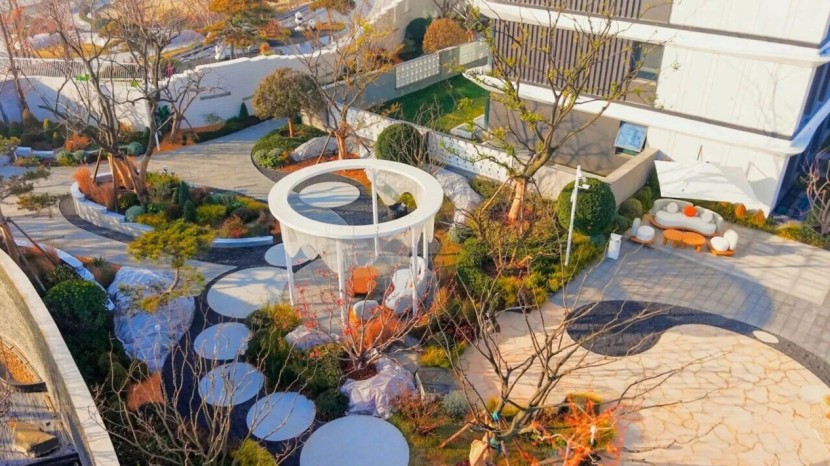
This idea is presented in different forms in other projects. For example, the Shujing Yunmu project in Yiwu combines the bonus space with the staggered-facade ecology, extending the natural landscape into daily life. Owners can put a deck chair on the terrace, enjoy the scenery, read books and drink tea in their spare time, or turn it into a sky garden to make green plants part of their home. Whether it is relaxing alone or taking care of flowers and plants on weekends, residents get an extra life scenario to get close to nature.
Based on such scenario construction, some developers have even taken a step further. For example, in the recent project Splendid Garden in Xi'an, Geshang not only gave owners a large terrace with an overhang of about 4 meters, but also specially designed a steel structure covering with soil, with a load-bearing capacity of 200kg/㎡. Why did they put so much effort into this? Because Geshang hopes that after owners get the terrace, they can use it just like a ground garden, lay soil on it, plant their favorite flowers and plants, and even create their own small garden by themselves. From giving away area to studying how to use the bonus space, developers have gone a step deeper in their thinking about products.
02 Scenario Segmentation Makes Space More Life-friendly
Fully utilizing the space is only part of the product strength. Another way to improve the spatial experience is to divide life scenarios in a more detailed manner. In the past, residential design usually organized spaces according to traditional functions such as living room, dining room and kitchen, but in real daily life, the same space often undertakes more than one function.
In the design of the dining and living room, China Merchants · Qiyuan combined the local family living habits in Qidong and made more targeted arrangements. Qidong has always had a family atmosphere that attaches great importance to education, and children's learning and growth are also an important part of daily life for many families. Therefore, Qiyuan specially considered the demand for parent-child companionship.
For example, when parents are preparing meals in the kitchen, they can see their children doing homework next to them at any time; when children encounter problems, parents can respond in time. If parents still need to handle work, they can sit next to their children, busy with their own things while taking care of each other. In this way, children can sit aside and do their homework, while parents prepare dinner and chat with their children about what happened in school. Without deliberately arranging parent-child time, such moments can naturally occur in daily life.
This is actually where the real value of scenario segmentation lies. Good product design needs to translate these localized life demands into spatial language. When residences start to organize scenarios around people's real life, the value of unit layouts will have more dimensions.
03 More Refined Property Services and Community Operation
For developers in third- and fourth-tier cities, the competition of product strength has extended to property services and community operation. After all, gardens need long-term maintenance, facilities need continuous operation, and all kinds of things that owners encounter every day need to be handled carefully.
Bangtai Group, which focuses on development in third- and fourth-tier cities, has been thinking about how to let more owners enjoy a better living experience over the years. From basic community management to daily services, Bangtai has established a relatively complete service system. In addition to intelligent systems such as face recognition and smart communities, it also covers multiple scenarios such as parking, patrol and security.
In terms of soft services, considerate services such as occasional small surprises, greetings on festivals, and care for the elderly in the community are constantly provided. Moreover, there are four major happiness plans built around owners, including the "Sheng Tai" tourism plan for owner trips, and the Dandelion Plan that creates fun activities to help young owners grow up happily and healthily.
Since property services are ultimately completed by people, only when service personnel are willing to stay in the community for a long time, can owners continuously obtain stable and meticulous services.
Take Jinsha, which is deeply rooted in the Henan market, for example. There is a straightforward summary: Steady Jinsha has three treasures: excellent architecture, landscape and property services. Jinsha's requirements for property services have been refined to specific positions and daily actions. In addition to 24-hour on-duty, security personnel also need to pay attention to community details such as fire-fighting facilities, sundries in corridors and decoration management; cleaning personnel also have clear cleaning standards and professional training, and even what tools to use in different areas and how to wipe have specific requirements.
More interestingly, Jinsha also takes the initiative to solve small troubles in owners' daily lives beyond conventional property services. For example, it builds a clothing care center in the community to reduce owners' trips for sending and picking up laundry; it also specially builds an underground car wash room to provide more convenient and affordable car washing services. These services that used to be only seen in first- and second-tier cities can now be easily enjoyed in third- and fourth-tier cities.
The product strength can impress people at the moment of residential delivery, but in every day after that, property services determine whether such quality can truly stay in owners' lives. The product strength in third- and fourth-tier cities has begun to extend to deeper levels. When developers start to include all these things into their product planning, the product strength of the project will naturally have more possibilities worth looking forward to.
04 Luxury Residence Design Concepts Are Also Entering Third- and Fourth-tier Cities
In addition, many luxury residence design concepts that could only be seen in high-end residences in first- and second-tier cities in the past are now appearing in residential projects in third- and fourth-tier cities. Moreover, this change has extended from simple unit layout design to the overall project.
The first is the first gate when entering the community. The gate is the most intuitive image expression of a project, and it is also the first impression that the entire community leaves on the city. For example, Tianyi in Lianyungang has built a 100-meter-long dragon-scale gate, matched with an embracing blue diamond welcome waterscape, and even transplanted an ancient Spanish tree to the gate hall as the visual focus of the entire homecoming interface, so that owners can feel the quality expression beyond the city's tier from the first moment they arrive at the community. Walking inward from the gate, you will see the building facade next.
In the past, some high-end residences used materials such as glass curtain walls and metal aluminum panels to create a sense of modernity and quality for buildings. Now, similar facade designs have begun to appear in third- and fourth-tier cities, and have gradually formed their own expression methods.
Ningxiu · Manyun Shangyuan in Huaxian, Henan is a representative example. The project builds the building facade with the concept of 4.5th-generation residences, adopts an overall gray and white color matching in the 10,000-yuan price range products, and shapes the layering of the building through large overhanging roofs, horizontal lines, glass railings and large floor-to-ceiling windows. In particular, the combination of curved corners and floor-to-ceiling windows adds a sense of fluidity to the originally regular building facade, making it more integrated from a distance, and giving the building a more distinct recognition in the city interface. Further inward is the garden landscape of the entire community.
Nowadays, more and more projects are re-examining local natural resources, and through refined landscape design, these resources are transformed into truly participatory community life. Gold Coast in Heze, Shandong is a very representative project.
The project is located at the intersection of Zhaowang River and Renmin Road, with a south-facing waterfront shoreline of about 44 kilometers. In terms of design, through deck-style viewing platforms, as well as techniques such as borrowing scenery and framing scenery, the riverbank landscape is introduced into the community, making the natural resources that originally belonged to the city part of the living experience.
What is more noteworthy is that it does not stop the landscape at the level of distant viewing. Through sunken landscapes, multi-layered vegetation, and scenario designs such as children's activity spaces and elderly gardens, residents of different age groups can participate in it. The riverbank is no longer just a scenery, but also part of the daily life of the community.
Finally, there are community supporting facilities. In the past, many people's impression of residences in third- and fourth-tier cities may still stay at the basic clubhouses and simple community functions, but now some projects have begun to align their supporting investment with high-end residences in first- and second-tier cities. For example, Donghai International in Dezhou has arranged a 900 ㎡ semi-national standard constant-temperature dual swimming pool and a 450 ㎡ fitness center with imported equipment on the two underground floors, and is also equipped with a star-level private banquet hall and a private director meeting room.
These supporting facilities are quite competitive even in high-end residences in many big cities. What is really worth paying attention to in this change is that the luxury residence concept has begun to transform from a single high-end configuration to a more complete living experience. This also means that residential products in third- and fourth-tier cities are gaining greater room for quality imagination.
05 Conclusion
The biggest feeling from this trip to visit real estate projects across the country is that more and more developers in third- and fourth-tier cities have begun to seriously study products, spend time thinking about spaces and researching daily life, and bring designs that were previously only considered for high-end residences into the daily life of more ordinary families.
Behind this, there is actually a change in the logic of real estate development. When the market gradually returns to the product itself, developers need to re-understand one thing: no matter which city people live in, their expectations for home are always specific. They hope the space is more comfortable, the time spent with the whole family is more relaxed, and they can feel the real quality of life that belongs to themselves every day when they get home. These expectations should not be divided into high and low levels just because the tier of the city is different.
How to make the product better under the local market conditions is exactly the key focus that developers really need to study. A good house should not be exclusive to a few cities and a few people. When more ordinary families can enjoy the living experience brought by product progress, this is perhaps the most expected thing for the real estate industry to keep moving forward.
This article is from the WeChat official account "Zhen Jia Lu Jun", written by the Zhen Jia Lu Jun team, and authorized for release by 36Kr.