The last piece of the grand unification puzzle, GPT-6 Astra has consumed 400 million tokens.
There are four fundamental forces in nature. The electromagnetic force, the strong force and the weak force were incorporated into the framework of quantum mechanics in the last century; only gravity, like a steep cliff stretching across the depths of the universe, has remained unintegrated for nearly a hundred years. When you attempt to quantize it using conventional methods, the equations blow up into uncontrollable infinities at extremely small scales. Incorporating all four forces into a single unified theory is the "Grand Unification" that physics has long pursued, and gravity is precisely the final puzzle piece hanging over humanity's head.
On November 26 Beijing time, a paper directly targeting this puzzle piece was uploaded to arXiv. The full 83-page paper has only one author: Venkatesa Chandrasekaran, a researcher at OpenAI. When OpenAI announced the proof of the millennium problem, the Navier-Stokes equations, in September, he was the one who presented the proof to the public. This time, he launched a head-on assault on the gravity of the four-dimensional spacetime we live in, and proposed a quantization scheme: in the desperate situation where conventional methods previously yielded infinities, he derived a finite number; for a key coefficient in black hole entropy, he took a unique alternative path and arrived at the exact same number that previous researchers obtained 13 years ago.
Turning to the acknowledgments at the end of the paper, there is a sentence that strikes a chord:
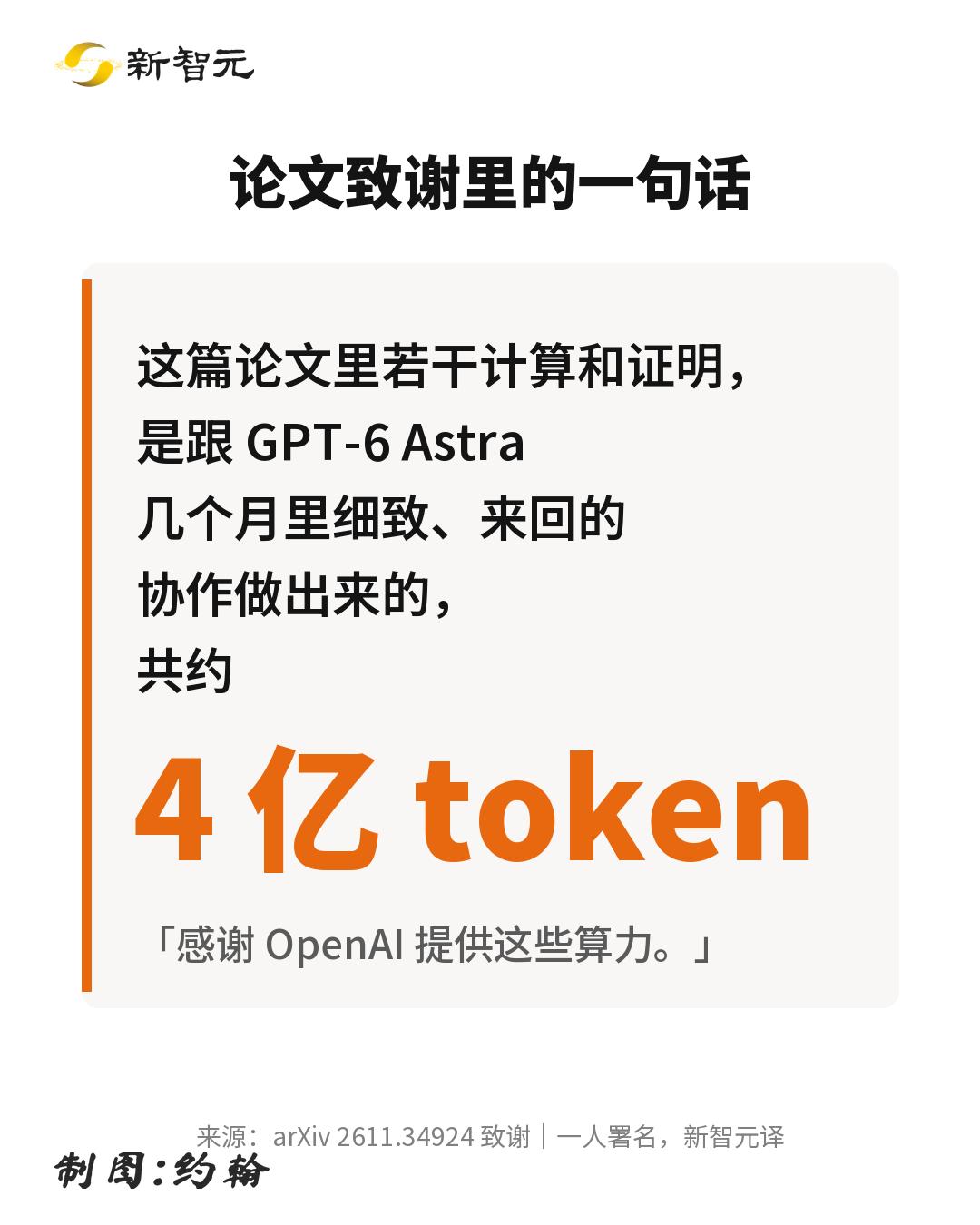
In the acknowledgments, he first listed 15 physicists who participated in discussions and provided feedback on the initial draft, then thanked Sam Altman, Sebastien Bubeck and "my colleagues at OpenAI", followed immediately by that sentence. The consumption of about 400 million tokens is listed right after the thanks to his colleagues.
In 2000, science fiction writer Ted Chiang published a short story titled *The Evolution of Human Science* in the journal *Nature*. In the future depicted in the story, the last time humans submitted an original research paper to a journal was 25 years prior; human scientists remaining in the scientific research field have switched to "hermeneutics", specializing in interpreting post-human research results. 26 years later, that once fictional future has arrived like the first ripple spreading from a gravitational wave: the paper is still signed by a human scientist, and the months of iterative discussions between humans and models in the deep sea of computing power have been written into the acknowledgments.
Affiliated with Stanford, but a member of OpenAI
Chandrasekaran has a formal background in theoretical physics: he obtained his doctorate at UC Berkeley, conducted research at the Institute for Advanced Study in Princeton, and even co-authored a paper with Edward Witten. Although the affiliation line of this paper only lists the Leinweber Institute for Theoretical Physics at Stanford University, he is also a member of OpenAI. In a sharing video released on the OpenAI forum in October, the host introduced his title as "Physicist and Researcher on the OpenAI Reasoning Team"; in the acknowledgments of this paper, he also specifically thanked "my colleagues at OpenAI" and expressed gratitude to OpenAI for providing computing power for this research.
Why has gravity been so slow to be integrated into quantum mechanics? In general relativity, gravity is the smooth, continuous curvature of spacetime; while in quantum mechanics, everything in the microscopic world is discrete, and undergoing ceaseless, violent fluctuations. When these two sets of frameworks collide head-on, the result is the infinity mentioned at the beginning. String theory and loop quantum gravity have each explored possible paths, but both have encountered their own bottlenecks. The path Chandrasekaran chose this time is to directly perform quantization on general relativity itself.
106/45: Taking a different path to arrive at the same number
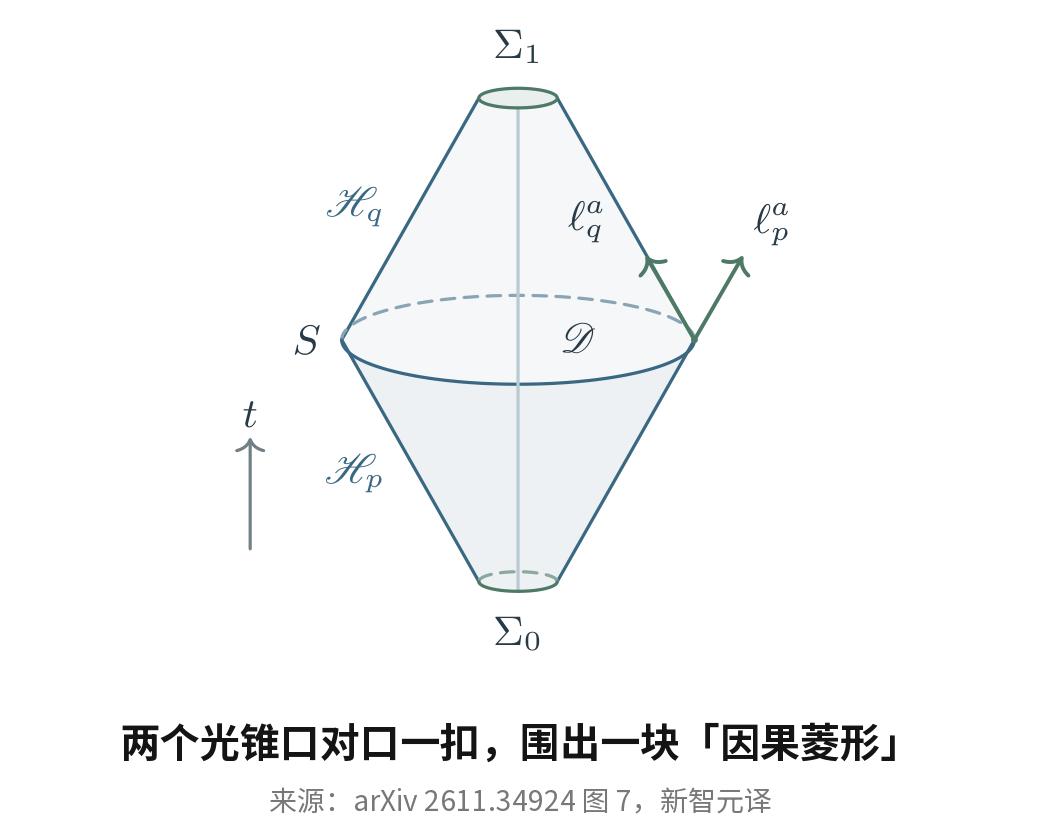
How is this done specifically? He cut spacetime into many "causal diamonds": draw a future-directed light cone from one point, then draw a past-directed light cone from another point, and when the two light cones are joined mouth to mouth, the enclosed area in between is a causal diamond. He only records gravitational data on the light cone surfaces of the diamonds, quantizes these data, then sews the diamonds together along their shared boundaries to reconstruct the entire spacetime.
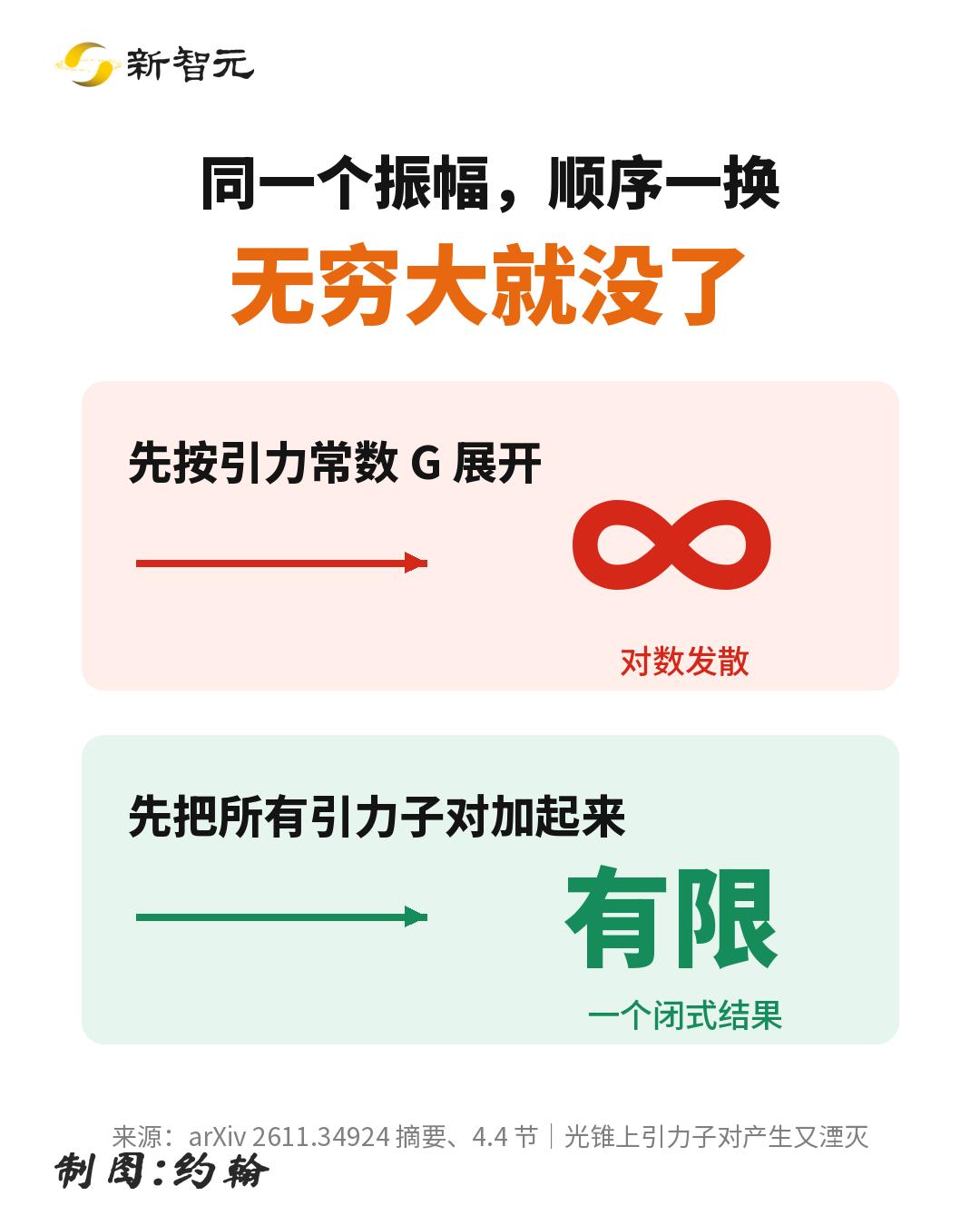
The first test is to calculate the amplitude of a pair of gravitons emerging and then annihilating on the light cone. According to conventional methods, you expand first along Newton's constant and calculate term by term, resulting in a logarithmic divergence that keeps growing and cannot be contained; he changed the order, summing up all cases first without prior expansion, and derived a finite number that can be written as a neat closed-form expression.
The second test uses black holes as the subject. In the 1970s, Bekenstein and Hawking discovered that the entropy of a black hole is proportional to the area of its event horizon. This paper not only rederives this area law, but also goes one step further: the entropy of a large black hole contains a logarithmic correction term, and he calculated that the coefficient in front of this correction is exactly 106/45.
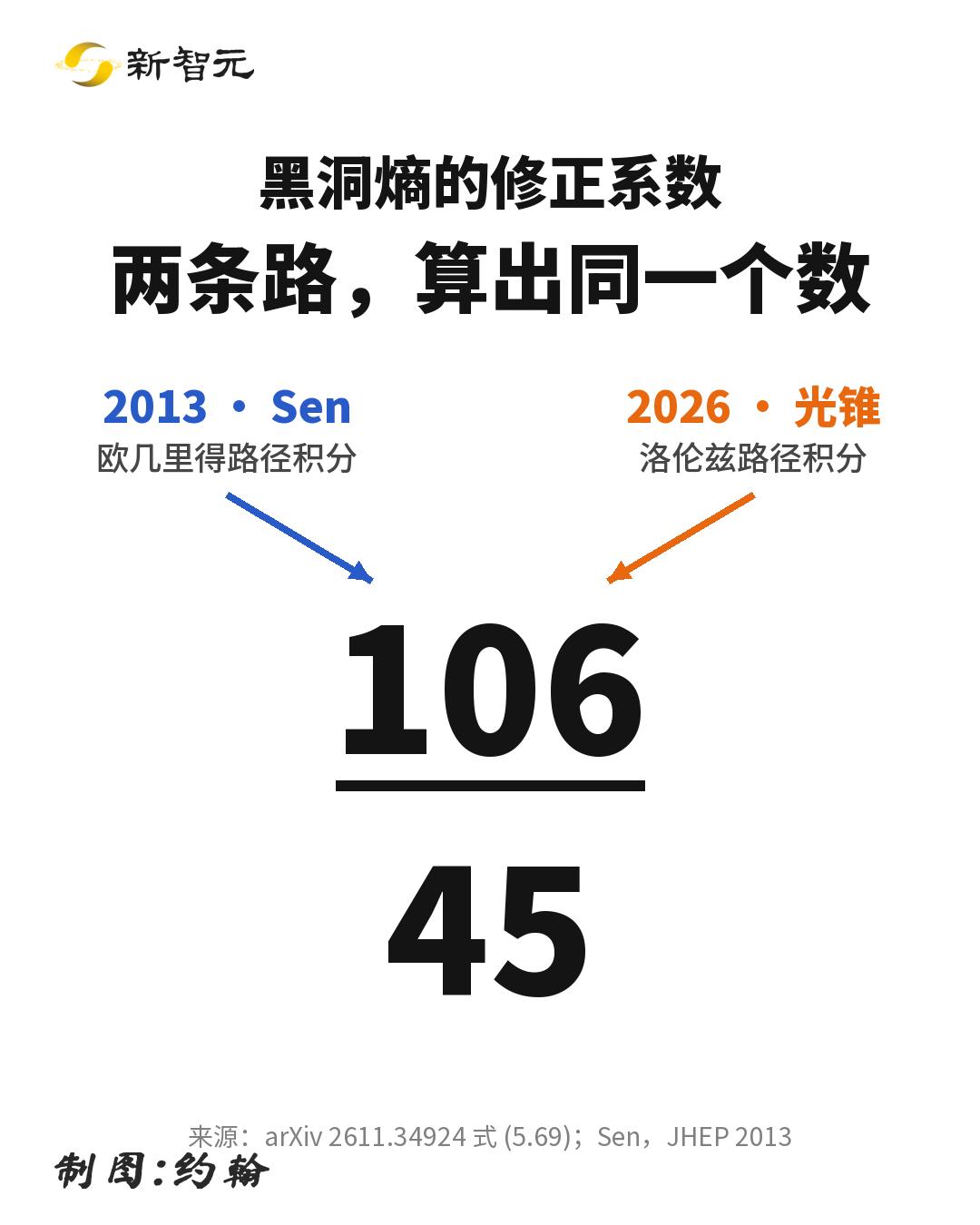
In 2013, physicist Ashoke Sen calculated the exact same coefficient using the Euclidean path integral method, and arrived at the same number. One path starts from the light cone surface, the other uses the Euclidean path integral: these two completely different challenging routes, each passing through minefields of complex equations and infinities, finally land on the exact same number without the slightest deviation, achieving a resounding convergence. The original paper only states one sentence: "This is consistent with Sen's classic result." The final test is to verify whether this theory can connect to the familiar gravitational framework when the energy drops: in the low-energy limit, the paper rederives the semiclassical Einstein equations with one-loop quantum corrections.
As for which parts of these derivations were done by humans and which by the model, the paper does not break it down in detail. The acknowledgments only clarify that "several calculations and proofs" were completed in collaboration with GPT-6 Astra.
What is still missing to reach Grand Unification
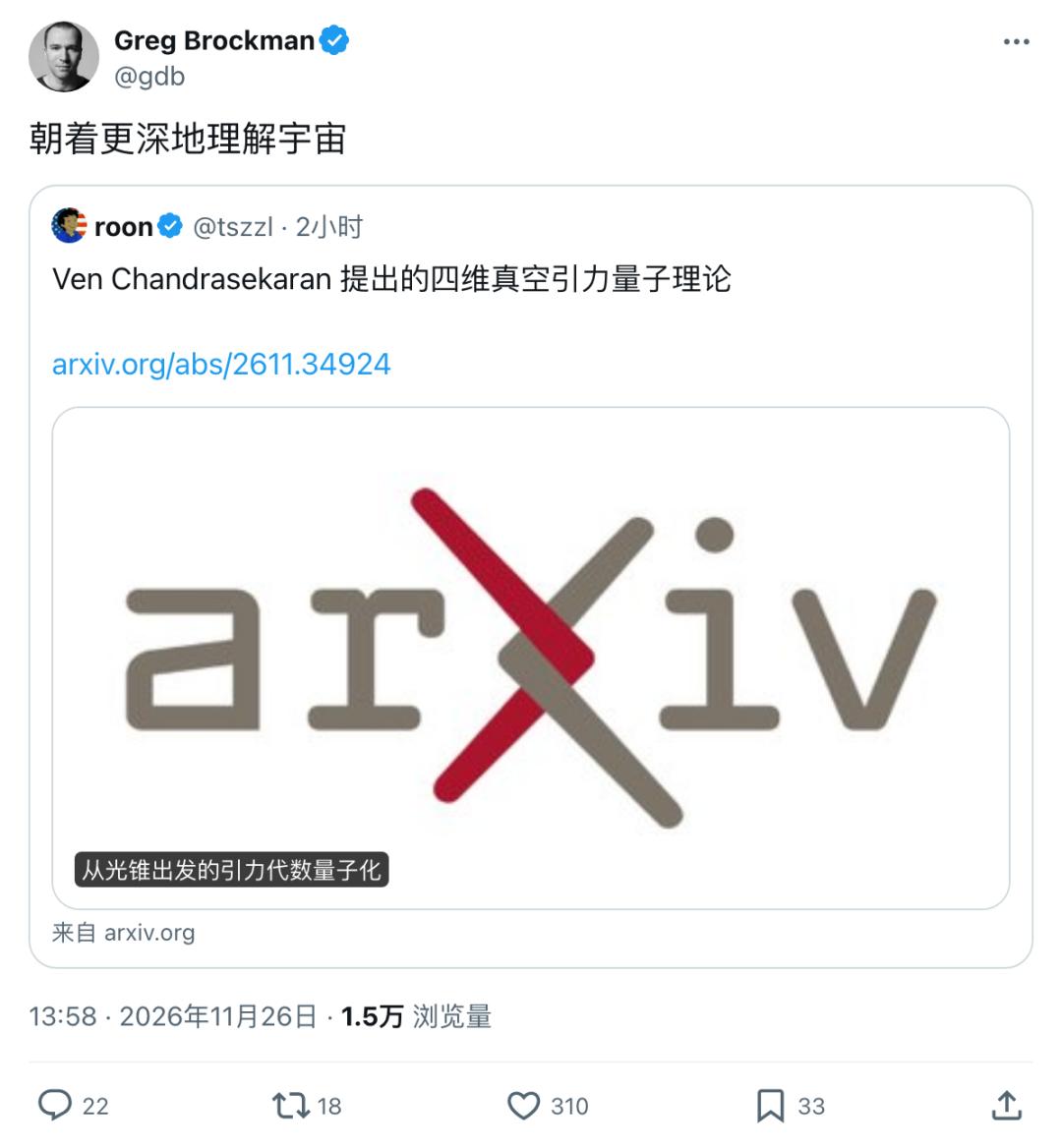
roon posted the link to the paper on X, and the views quickly exceeded 400,000; OpenAI CEO Greg Brockman immediately reposted and quoted it, with the caption "Towards a deeper understanding of the universe".
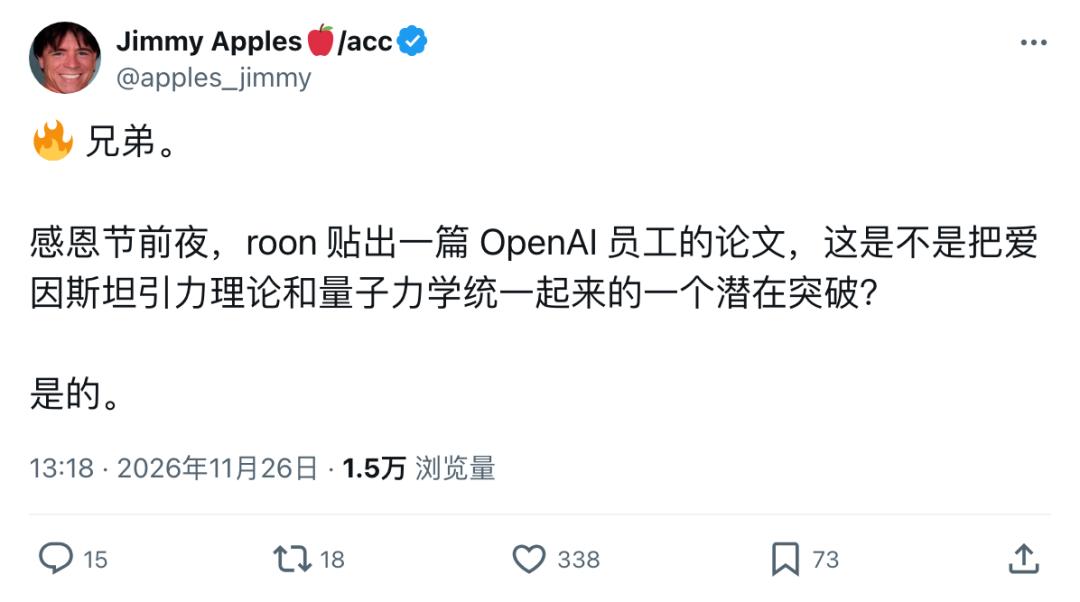
The insider account Jimmy Apples asked more directly: Is this a potential breakthrough that unifies Einstein's theory of gravity and quantum mechanics? He immediately replied to his own question below: Yes.
But if you go through the original paper and check every point, the widespread excitement outside needs to be tempered.

This paper only addresses the part of gravity, and it only quantizes pure gravity in a "vacuum". The theoretical framework has not yet incorporated matter such as electrons and quarks. To truly piece the puzzle together seamlessly, gravity still needs to be connected to matter and the other three fundamental forces, a step that has not been completed in this paper; roon himself wrote when posting the paper that it is "a quantum theory of four-dimensional vacuum gravity". Under his post, netizens quickly pointed this out:

Similarly, this paper is by no means "discovered by AI". There is only one author, and the acknowledgments clearly state that "several calculations and proofs" were completed through iterative collaboration between him and GPT-6 Astra. Scholars named in the acknowledgments such as Juan Maldacena, Andy Strominger, Eva Silverstein and Xi Dong only discussed the work with him and provided feedback on the initial draft; having read the draft does not mean they endorse it, and their final recognition will have to wait for their own public statements. Furthermore, not every step of the paper provides a rigorous proof: the author notes in a footnote in Section 5.1 that one estimation step uses a heuristic argument. At present, it is only a preprint that has not undergone peer review.
Even roon, who posted the paper himself, kept a cautious attitude:
I am not a theoretical physicist. I hope that in the coming days, models and physicists can better figure out how significant this work really is.
Over the next period of time, the dozens of people in the world who know the most about gravity will verify this derivation line by line.
Humans provide judgment, AI provides derivation
The specific details of how the work was polished over these months are not written in the paper. However, in the sharing session released on the OpenAI forum in October, he once used another black hole paper he published a few months ago as an example to break down how he usually conducts research with the model. According to him, he works on "research projects that take several months to complete, which would have taken decades in the past", and he does not just throw a difficult problem to the model and wait passively for it to return an answer.
At that time, the host asked him whether these capabilities could only be achieved by internal models. He said that it was not necessary, and the public version of Astra is sufficient: throwing a problem to the model and letting it run all the way on its own is the strength of internal models, which is suitable for tackling open problems in mathematics; while physics and biological research require humans to stay fully involved throughout the process, and iterate with the model over several months.
When working, he usually keeps multiple conversation threads open at the same time: one is dedicated to running derivations, one is responsible for explaining what the derivation means physically, and another is used exclusively for drawing. Once his intuition tells him that another path might be more viable, he does not delete the original thread, but directly forks a new thread from it, adopts a different strategy to continue the derivation, lets the two threads communicate and cross-check with each other, and finally he himself compares the arguments from both sides to make the decision on the next direction.

Before starting the work, he will first set clear rules for the model, defining what counts as an incorrect result. As the conversation stretches, the model will change the propositions he set at the beginning halfway through; at that point, he will step in to stop it: "Step back, look at the big picture, this is not the proposition I gave you at the start."
As for choosing which problems to work on and defining what assumptions to set, he admits that the model cannot do this well yet, and humans must make the decisions. In his words:
All you really need to do is provide judgment.
It was originally invented by humans
In Ted Chiang's short story, human scientists have fully retreated to the role of readers, interpreting a scientific world they can no longer understand. Today, we are still far from that point: the paper is still signed solely by him, and it is humans who will verify the derivation line by line next. But when the flood of superintelligent computing power truly hits the ceiling of theoretical physics, and the long-suspended gravity puzzle bears the mark of humans and models working side by side to derive results, human physicists have begun to act as readers and verifiers of the derivations in which AI participates — an unprecedented expedition has already set off.
The last sentence of the story reads: "We should always bear in mind that the technology that created post-humans was originally invented by humans..."
This article is from the WeChat official account "Eden of New Wisdom", author: Paul, published with authorization from 36Kr.