The million-satellite computing power constellation has been approved, taking Elon Musk's space data center one step further.
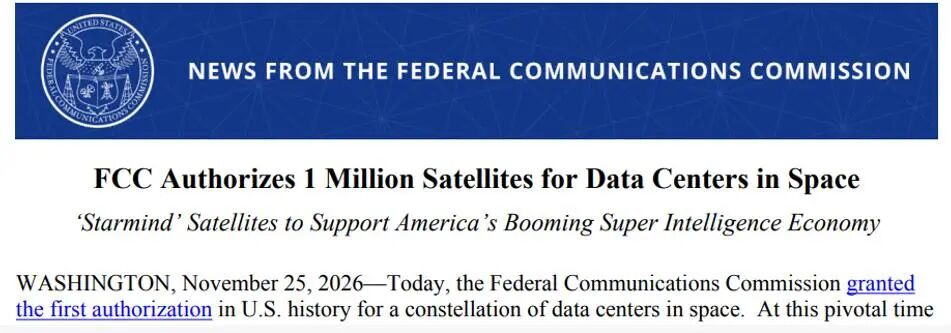
On November 25, the U.S. Federal Communications Commission (FCC) conditionally approved SpaceX's plan to deploy 1 million Starmind orbital computing satellites. The first satellite will be put into operation in 2033, 100,000 satellites will be deployed before 2035, 500,000 before 2038, and the full constellation of 1 million satellites will complete networking before 2040.
Starmind is a core strategic project strongly promoted by Elon Musk after xAI was merged into SpaceX, embodying SpaceX's ambition to break through the bottleneck of ground computing power. This is the first space data center constellation approved in the United States, which means that the AI computing power competition has officially extended from the ground to low Earth orbit, and it has also been accompanied by controversies over technology, environment and business models.
According to the plan, the satellites of this constellation will operate in low Earth orbit at an altitude of 500 to 1000 kilometers, be continuously powered by solar energy, and dissipate heat into space through radiation. Inter-satellite communication is dominated by laser links, and Ka-band radio frequency is only enabled for telemetry and emergency backup when the laser fails. In addition, all computing satellites will be equipped with NVIDIA Vera Rubin NVL72 systems adapted to the space environment, and all will be sent to orbit by Starship reusable rockets.
Despite the objections raised by Amazon, Viasat and the American Astronomical Society, the FCC still granted the above authorization. Opponents previously warned that the project may bring problems such as orbital debris and orbital congestion, radio frequency interference and environmental consequences. Amazon, which is building a competitor to SpaceX's Starlink, argued in its application that SpaceX's application lacks basic details and is more like a "grand ambition rather than a real plan".
It is worth mentioning that the FCC has only approved the plan below 600 kilometers this time, and satellites in higher orbits can only be deployed after SpaceX submits a complete final plan.
Different from traditional computing centers, space data centers bypass the physical ceiling of ground computing power.
At present, the expansion of ground AI data centers is restricted everywhere, land resources and power resources are becoming increasingly tight, heat dissipation also consumes a large amount of fresh water, and environmental protection approval is getting stricter.
After entering the outer space orbit, solar energy covers the whole day, radiation heat dissipation in vacuum does not consume a drop of water, and there is no local planning and construction approval at all. According to SpaceX's own calculation, this model can effectively greatly reduce the long-term operating cost of data centers.
It is worth mentioning that Starmind can also leverage mutual advantages with Starlink. At present, Starlink has more than 11,000 satellites in orbit, making it the world's largest satellite internet. The computing power nodes of Starmind are connected to Starlink through laser links, forming a space-ground integrated system integrating communication and computing power, which can not only process on-orbit data on the spot, but also output elastic computing power to ground users. In contrast, Google's Project Suncatcher is still in the experimental stage. With mature rocket and satellite engineering experience, SpaceX has obviously taken the lead in large-scale deployment.
But on the other hand, the feasibility of the space data center project has been repeatedly questioned by the industry.
First of all, the heat dissipation of high-power AI chips is still the top problem. Since there is no convection in vacuum, heat can only be radiated out slowly. Whether the outer space environment can support the long-term full-load operation of chips has not been verified by engineering.
Compared with ground data centers, satellites cannot be unpacked and replaced at any time like ground computer rooms, and can only rely on redundant design as a fallback, so the reliability and computing power utilization rate of chips throughout their life cycle will be discounted.
What is more worrying is orbital safety. Millions of satellites are crowded in low Earth orbit. Once a collision generates debris, it may trigger a chain reaction and drag all near-Earth spacecraft into trouble.
The cost of environment and ecology cannot be ignored either. Astronomers have long pointed out that large-scale satellite constellations will aggravate light pollution and damage ground-based astronomical observations.
According to the model estimation of the team from University College London, if SpaceX finally advances according to the scale of 1 million satellites, the high-altitude atmospheric pollution emissions brought by rocket launches and satellite re-entry may reach dozens or even hundreds of times of the current global level, which will have a great impact on the upper atmosphere.
Therefore, the FCC's lenient handling in the environmental review this time has also drawn widespread criticism from the outside world.
Finally, the manufacturing, launch and operation and maintenance costs of 1 million satellites are astronomical figures in themselves, and are highly dependent on the Starship that has not yet been fully mature.
At present, there are only more than 300 orbital launches in the world every year. To support the million-level constellation, about 5000 launches are required every year, and the capacity gap is extremely large. At present, AI technology is being updated on a monthly basis, but satellite deployment takes more than ten years. When the full networking is completed in 2040, today's chip architecture is mostly outdated. In addition, the financing attribute of space assets is relatively weak, and some lending institutions have clearly required that the mortgaged computing power chips must stay on Earth, which further narrows the funding space of the project.
From the perspective of the development process of space computing power, Starmind is undoubtedly a landmark event. Its idea of breaking away from the constraints of ground resources opens up new imagination for the long-term growth of AI computing power.
But for now, technical bottlenecks, environmental costs and commercial feasibility have not been verified, which essentially places bets on the situation more than a decade later.
This article is from the WeChat Official Account "Meku", author: Meku, published with authorization from 36Kr.