The Beijing-based power IoT "little giant" is sprinting for IPO, with State Grid as its top customer.
In recent years, the power system is undergoing a series of structural changes, for example, the proportion of new energy on the power generation side keeps rising, and large-scale access of electric vehicles and distributed photovoltaics appears on the load side. The power grid has changed from "one-way power transmission" to "two-way interaction", and the traditional mode of manual meter reading, regular inspection and post-fault repair can no longer keep up with the pace.
Against this backdrop, the business of providing intelligent accessories and digital upgrades for the power grid, making the power grid more "intelligent" and simplifying meter reading and power management has become very necessary.
Recently, a power Internet of Things enterprise from Fengtai District, Beijing has updated its IPO progress.
According to information obtained from Gelonghui, the official website of the Beijing Stock Exchange shows that Beijing Qianjing Wuyou Electronic Technology Co., Ltd. (referred to as "Qianjing Wuyou") is applying for listing on the Beijing Stock Exchange, has completed replies to two rounds of inquiries, and is currently in the "Inquired" stage.
The company submitted application materials to the Beijing Stock Exchange on March 26, 2026, received acceptance on May 6, and entered the inquired status on June 2. The sponsor institution for this issuance is Kaiyuan Securities.
01 Focus on carrier communication products and related fields, with State Grid as the largest customer
Qianjing Wuyou is a company focused on providing intelligent IoT products and digital solutions in the field of power distribution and consumption of the new power system.
The company mainly provides carrier communication products, metering products, distribution network products, and power digital solutions and services, applying digital technologies such as new sensing, measurement and metering, IoT communication, edge computing and artificial intelligence to the new power system.
Carrier communication products mainly include power carrier communication units, power carrier collection terminals, and other carrier products;
Metering products mainly include structural parts of metering devices and accessories for metering devices;
Distribution network products mainly include integrated complete sets of equipment, power distribution terminals and intelligent power fire extinguishing terminals;
Power digital solutions and service programs focus on the deep integrated application of big data, artificial intelligence and digital twin technology in all production links of the new power system, and are committed to the intelligent applications of intelligent operation and inspection of power equipment, intelligent power grid dispatching, and intelligent carbon asset management.
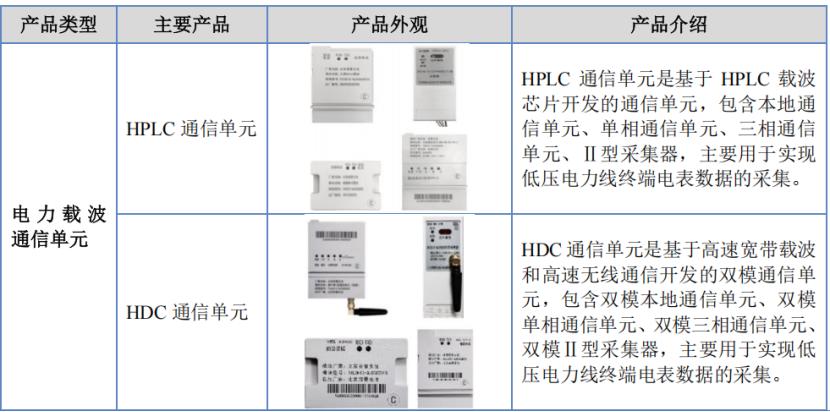
Examples of some of the company's carrier communication products, Source: Prospectus
In the first half of 2026, the revenues from the four business segments of carrier communication products, metering products, distribution network products, and power digital solutions and services were RMB 67.0057 million, RMB 81.3803 million, RMB 55.18 million and RMB 51.1827 million respectively.
In terms of revenue proportion, from 2023 to 2025 (the reporting period), the proportion of revenue from carrier communication products in main business revenue dropped from 43.93% to 31.88%; the revenue proportion of metering products dropped from 30.44% to 21.4%; the revenue proportion of distribution network products rose from 15.04% to 23.96%; the revenue proportion of power digital solutions and services rose from 10.59% to 22.76%.
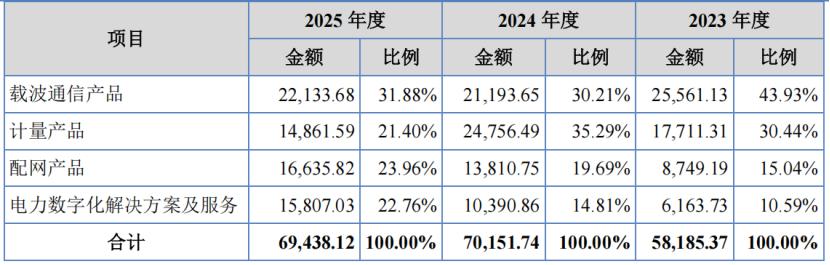
Main business revenue breakdown by product, Source: Prospectus
The company first conducts R&D and design of products based on market demand and industry standards, then purchases electronic components, modules, polycarbonate, customized parts and other materials and components from professional manufacturers, carries out subsequent production and manufacturing processes, and finally realizes the market application of products through sales.
The products produced by the company are mainly applied to the new power system, covering all links in the field of power distribution and consumption of the new power system. The customers are mainly State Grid and its subsidiaries, China Southern Power Grid and its subsidiaries, as well as other domestic and foreign power industry companies.
This also leads to high customer concentration of the company. During the reporting period, the sales amount to the top five customers accounted for 86.87%, 82.27% and 82.61% of the operating revenue respectively, of which the largest customer was State Grid, accounting for 56.79% of revenue in 2025.
The proportion of the company's revenue from the power system industry in operating revenue was 99.95%, 99.97% and 99.99% respectively.
02 State Grid increases investment during the 15th Five-Year Plan period, the carrier communication track is highly competitive
Power line carrier communication is a communication method that uses power lines as the information transmission medium, loads modulated high-frequency carrier signals for voice or data transmission, and is also a unique communication method for power systems.
In terms of market space, according to QYResearch survey data, the global power line carrier communication market size is expected to reach 5.83 billion US dollars in 2029, with a compound annual growth rate of about 4.87% from 2022 to 2029. With the advancement of China's new power grid construction and the implementation of IoT applications, China's power line carrier communication market will continue to grow rapidly.
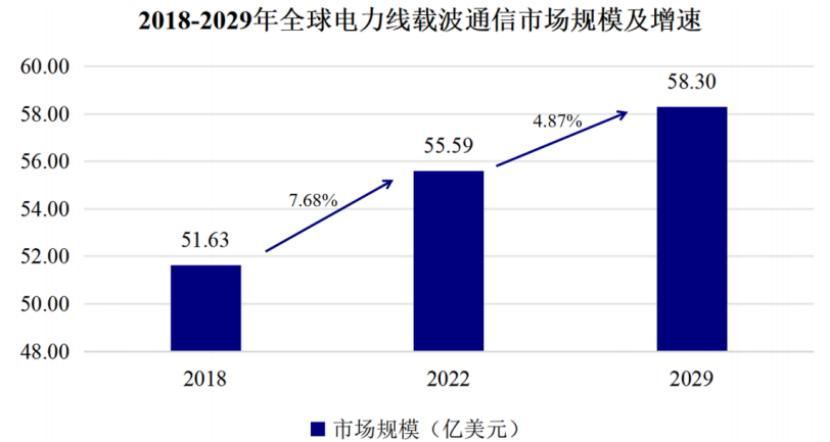
Global power line carrier communication market size and growth rate, Source: Prospectus
Smart meters are the main application scenario of carrier communication products.
Smart meters are mainly composed of three parts: structural parts, hardware and embedded programs. The company's metering products include structural parts of metering devices and accessories for metering devices, which are important components of smart meters, and are mainly used in metering industries such as water, electricity, gas and heat.
From the perspective of the global market, according to statistics from Fortune Business Insights, the global smart meter market size was 27.17 billion US dollars in 2025, and is expected to reach 48.04 billion US dollars in 2034, with a compound annual growth rate of 6.28%. The Asia-Pacific region dominates the global market with a share of 57.51%.
Domestically, the demand for smart meters mainly comes from the centralized bidding and procurement of State Grid, China Southern Power Grid and their subordinate provincial power companies.
Since State Grid launched unified bidding for smart meters in 2009, the cumulative investment amount has reached RMB 215.748 billion. By the end of 2024, the cumulative number of 2020 version smart meters tendered by State Grid was about 320 million, and there is large demand for renewal of existing meters.
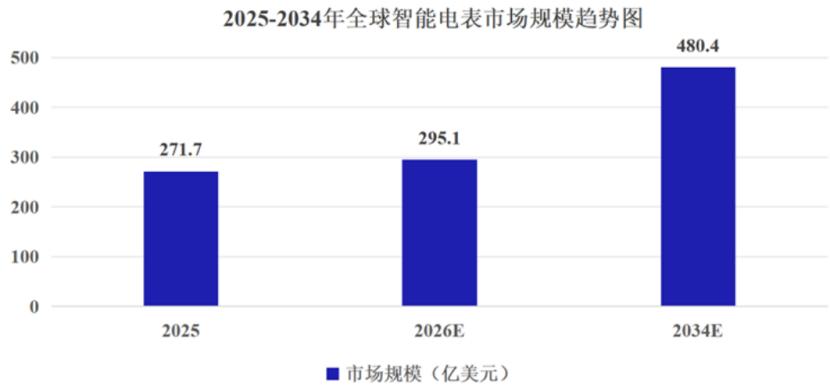
Global smart meter market size, Source: Prospectus
In terms of smart distribution network, the intelligent transformation of power grids has become a key task in the next stage of energy system development.
According to the calculation of China Merchants Industry Research Institute, China's smart grid market size grew from RMB 97.94 billion in 2022 to RMB 116 billion in 2024, and is expected to reach RMB 145.6 billion in 2027.
In terms of power digital solutions, according to statistics from EqualOcean Think Tank, China's power and energy digital market size was RMB 315 billion in 2024, a year-on-year increase of about 14.55%, which is expected to reach RMB 370 billion in 2025 and exceed RMB 1 trillion by 2030, of which the digital service market size was about RMB 262 billion in 2024, accounting for about 83%.
In terms of industry competition, comparable companies in the same industry include Neusoft Carrier, Vango Technologies, Youxunda and Yubon Power.
In 2025, the operating revenues of the four companies were RMB 1.052 billion, RMB 358 million, RMB 797 million and RMB 1.001 billion respectively, and their net profits were RMB 9.876 million, RMB 20.567 million, RMB 69.9522 million and RMB 75.1431 million respectively; in the same period, Qianjing Wuyou achieved operating revenue of RMB 694 million and net profit of RMB 111 million.
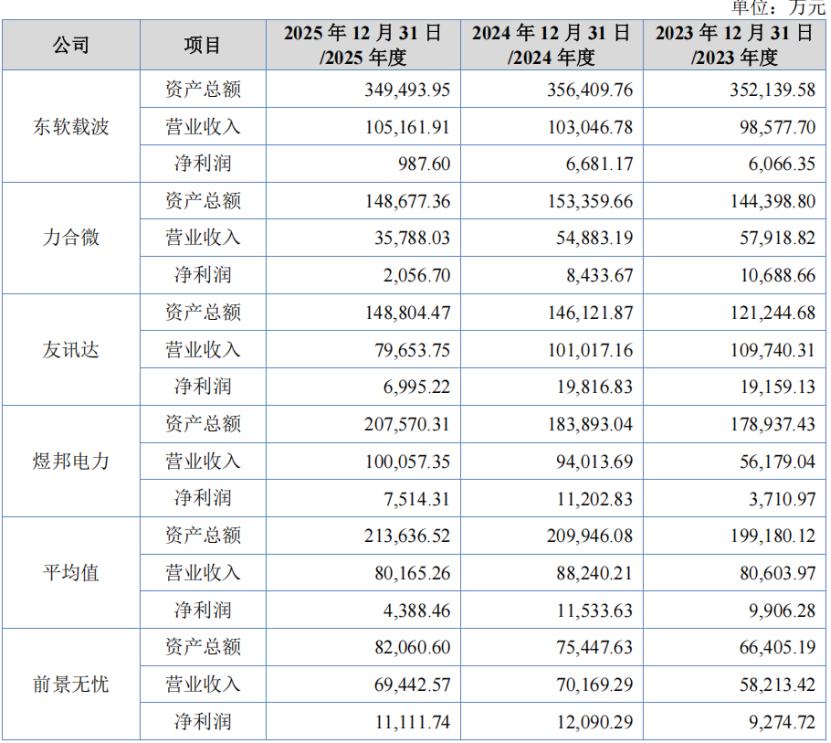
Comparison of operating data of comparable companies in the same industry, Source: Prospectus
In terms of winning bid share, according to the report data of Dianlimiao and Carrier Community, in the local communication module bidding of State Grid, the proportion of winning bid quantity of Qianjing Wuyou in 2023 was 2.91%, 3.59% in 2024 ranking the third, 2.75% in 2025 ranking the ninth; in the first half of 2026, the proportion of winning bid quantity of national HDC communication modules was 4.48% ranking the second, and the bid winning rate is on the rise.
03 Paying dividends while replenishing working capital, revenue declined slightly in 2025
Affected by industry fluctuations and changes in the company's business structure, the company's revenue has fluctuated in recent years.
During the reporting period, the company's operating revenue was RMB 582 million, RMB 702 million and RMB 694 million respectively, with a slight decline in revenue in 2025; the attributable net profit to shareholders of the parent company was RMB 87.3917 million, RMB 108 million and RMB 94.7803 million respectively.
In the first half of 2026, the company's operating revenue was RMB 255 million, and the attributable net profit to shareholders of the parent company was RMB 34.2457 million.
During the reporting period, the company's main business gross profit margin was 34.22%, 32.98% and 33.09% respectively. In the same period, R&D expenses were RMB 29.6742 million, RMB 29.5465 million and RMB 30.5158 million respectively, accounting for 5.10%, 4.21% and 4.39% of operating revenue respectively.
In terms of orders, as of June 30, 2026, the company's on-hand orders amounted to RMB 344 million, an increase of 67.52% compared with RMB 205 million at the end of 2025.
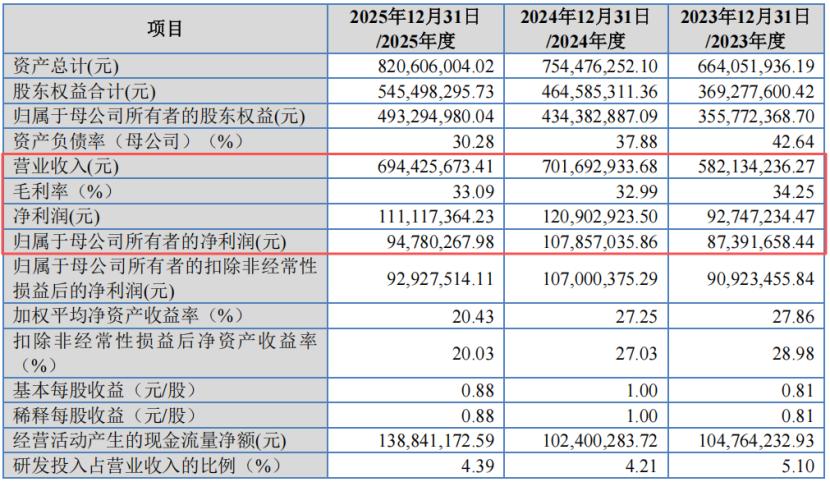
Key financial data during the reporting period, Source: Prospectus
The performance fluctuation in 2025 is mainly related to metering products. The prospectus discloses that the revenue of metering products dropped from RMB 248 million to RMB 149 million in 2025, with both domestic and export revenue declining, and the gross profit of this business decreased by RMB 45.4603 million year-on-year; in the same period, the company's credit impairment losses increased by RMB 5.8908 million.
It is worth noting that the company also faces certain pressure from accounts receivable. At the end of each reporting period, the book value of the company's accounts receivable was RMB 194 million, RMB 198 million and RMB 233 million respectively, accounting for 29.15%, 26.20% and 28.45% of the total assets at the end of each period respectively.
During the reporting period, the company implemented three equity distributions, distributing 2022 annual dividends of RMB 16.2 million in May 2023, 2023 annual dividends of RMB 27 million in June 2024, and 2024 annual dividends of RMB 32.4 million in July 2025, totaling about RMB 75.6 million.
The company plans to raise RMB 574 million in this IPO, which will be used for the construction project of the production and manufacturing base of intelligent IoT terminals for power distribution and consumption, the construction project of the new power system technology R&D center, and supplementary working capital.
After paying dividends, the company still arranges RMB 50 million to replenish working capital, and the Beijing Stock Exchange has inquired about the necessity of the investment projects.
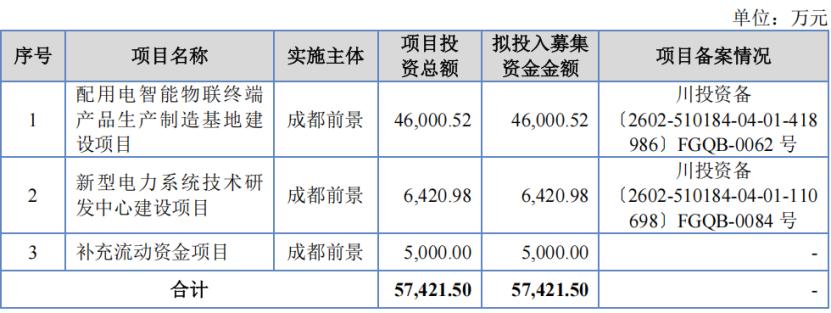
Use of raised funds, Source: Official website of Beijing Stock Exchange
It is worth noting that Qianjing Wuyou has experienced a change of major shareholder.
The predecessor of the company, Miya Microelectronics Technology (Beijing) Co., Ltd. (former name), was established in April 2009; in August 2022, the company was restructured into a joint-stock company as a whole, and was