Global asset volatility intensifies, and insurance capital "retreats" to high-dividend assets.
Against the backdrop of turbulence in the global capital market, the layout of insurance capital has shifted from offensive to defensive, and is entering a defensive stage.
Recently, a senior executive of a leading listed insurance company publicly stated that the company plans to moderately reduce the allocation proportion of stocks in the public market in the future, and invest more capital in fixed income and alternative assets, which has aroused widespread market attention and heated discussion.
Amid the ups and downs of this year's stock market, insurance capital, as the "ballast stone" of the capital market, every move draws market attention. Judging from the position adjustment rhythm of insurance capital this year, the core feature of the heavy positions held by insurance capital in the first half of this year is high dividend as the foundation, with increased allocation to growth stocks such as technology. However, in the third quarter, especially from October to mid-November, industry insiders revealed that insurance capital is expected to enter a concentrated position reduction stage, shifting from offense to defense, with positions flowing back from technology growth tracks to high-dividend targets.
According to the latest data on the use of insurance company funds disclosed by the National Administration of Financial Regulation (hereinafter referred to as "NAFR"), the balance of insurance company funds in use reached 41.64 trillion yuan, a 2% month-on-month increase from 40.82 trillion yuan at the end of the second quarter. Among them, the insurance funds invested in stocks amounted to 4.25 trillion yuan, a month-on-month increase of 3.57%.
This means that compared with the 4.1 trillion yuan invested in stocks in the second quarter of 2025, the net purchase of insurance capital in the third quarter was 146.4 billion yuan, a significant slowdown from 263.4 billion yuan in the second quarter. In the third quarter of 2025 and the third quarter of 2024, the net purchases of insurance capital were 552.4 billion yuan and 255 billion yuan respectively, both significantly higher than that in the third quarter of this year.
"In the first half of this year, we had sufficient confidence in the market. However, the stock market correction in the third quarter caught us off guard, and everyone was under great pressure." An investment manager of an insurance company talked about the twists and turns of insurance capital investment this year. In the third quarter, the Shanghai Composite Index fell from 4094.40 points at the beginning of the quarter to 3842.19 points at the end of the quarter, while the CSI 300, ChiNext Index, and STAR 50 fell by 12.49%, 27.80%, and 30.7% respectively in the quarter. This round of rapid correction that exceeded the boundary of conventional stress tests directly broke the previous income balance built by insurance capital.
In early November this year, an industry investment insider once revealed that the current main positions of mainstream domestic insurance enterprises are in the dividend sector, and the overall allocation proportion of the technology sector is relatively low. Even so, the decline of the technology track in the third quarter still had a significant impact on portfolio returns. According to his calculation, if dividend assets account for more than half of the insurance capital portfolio and technology assets are allocated in the 10%-15% range, a 30% to 40% pullback of the technology sector in a single quarter will quickly erode profits. When the overall absolute return of the portfolio quickly approaches zero, a large number of insurance capital accounts with absolute return as the core goal have to start the passive stop-loss process.
After experiencing the sharp market volatility in the third quarter, the main investment line of insurance capital has shifted to high-dividend assets.
"At present, the flow of capital from technology growth stocks to dividend stocks in the market is relatively obvious." Entering the fourth quarter, a person in charge of the investment side of a large listed insurance enterprise said that high-dividend varieties are the cornerstone of insurance capital and should be important varieties for the allocation of long-term funds such as life insurance. After the current valuation correction, the cost performance of allocation has improved. Coupled with the allocation demand for high-dividend assets under FVOCI (fair value changes included in other comprehensive income), insurance capital should make allocation moves when the time is right.
Increased positions by 146.4 billion yuan, why the rhythm slowed down
According to data disclosed by NAFR, the balance of insurance company funds in use reached 41.64 trillion yuan, a 2% month-on-month increase from 40.82 trillion yuan at the end of the second quarter.
From the perspective of equity allocation, the balance of insurance capital invested in stocks is 4.25 trillion yuan, a month-on-month increase of 3.57%; however, from the perspective of position increase rhythm, the net purchase of insurance capital in the third quarter was 146.4 billion yuan, a significant slowdown from 263.4 billion yuan in the second quarter. Data from NAFR also shows that in the third quarter of 2025 and the third quarter of 2024, the net purchases of insurance capital were 552.4 billion yuan and 255 billion yuan respectively, both significantly higher than that in the third quarter of this year. Overall, although the equity allocation proportion of insurance capital has hit a new high, the pace of position increase has slowed down significantly.
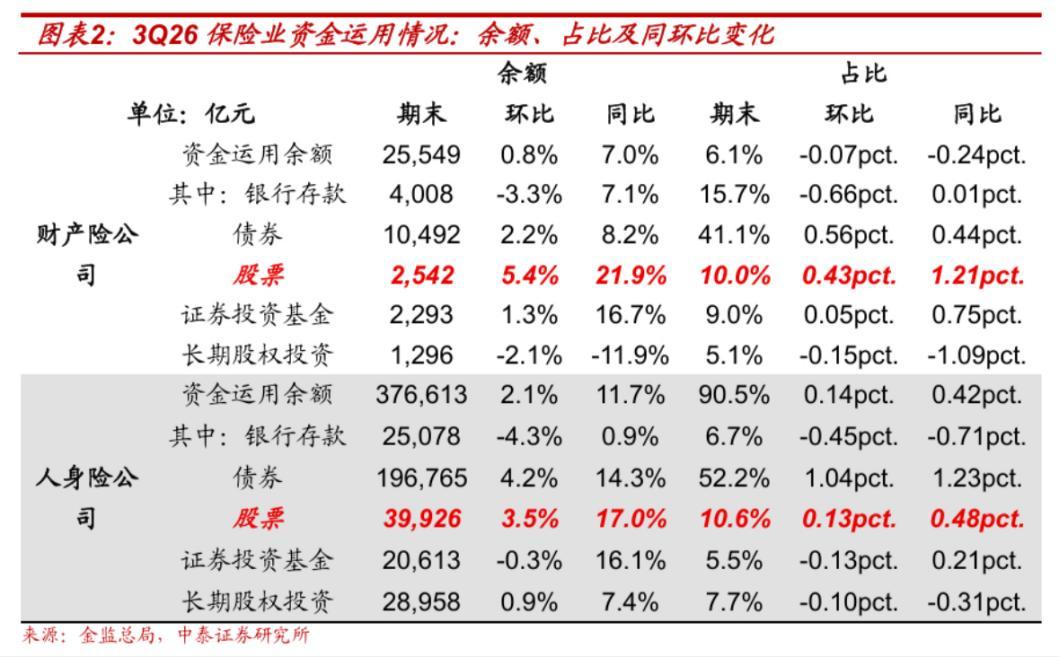
Judging from the position adjustment rhythm of insurance capital this year, the stock market warmed up and improved in the first half of the year, and insurance capital was in an "offensive" stage: the core feature of the heavy positions held by insurance capital is high dividend as the foundation, with increased allocation to growth stocks such as technology. Zhang Qi, an analyst at Galaxy Securities, said that insurance capital increased its allocation to the technology sector in the second quarter, focusing on increasing positions in technology and communication fields such as hardware equipment and telecommunications services.
However, after entering July, the technology sectors such as AI (artificial intelligence), semiconductors, and optical modules continued to correct. The Shanghai Composite Index fell from 4094.40 points at the beginning of the quarter to 3842.19 points at the end of the quarter, while the CSI 300, ChiNext Index, and STAR 50 fell by 12.49%, 27.80%, and 30.7% respectively in the quarter, and the position increase of insurance capital slowed down accordingly.
The results of market volatility are also reflected in the three quarterly reports of listed insurance enterprises: in the first three quarters of this year, the five A-share listed insurance enterprises achieved a total attributable net profit of 2765.77 billion yuan, down 35.08% year-on-year, of which the total attributable net profit in the third quarter was a loss of 40.81 billion yuan. The correction of the equity market directly led to a phased reversal of the investment returns of insurance capital, and the net profit of listed insurance enterprises in the first three quarters decreased by 20% to 47%.
An investment insider once said in early November this year that according to his understanding, the best performance of some private equity funds this year was close to 50 to 60 percentage points of profit, but by late October, even private equity funds with good performance were basically in a break-even state, and the average decline of private equity funds this year was about 15 percentage points.
Judging from the position adjustment of insurance capital in the third quarter, it adhered to the high-dividend base position and increased positions in some computing power, semiconductors, and low-valued cyclical resource stocks. In late August this year, Lu Haoyang, Deputy Chief Investment Officer of Ping An Insurance, once said that the company's equity investment adheres to the two main lines of "high dividend + technology growth". The technology growth track is the direction that the company focuses on and deploys, and it is optimistic about the long-term development opportunities of the industry. However, he emphasized that the recent market adjustment also reflects that the technology industry has shifted from a general rising market to a core driven by fundamentals, and the value of good companies with core competitiveness is further highlighted. Based on this, the company is actively optimizing its investment strategy, narrowing its focus on targets in the technology track, and selecting high-quality targets for layout.
It is understood that insurance capital experienced a anxious period between July and October: in a low interest rate environment, it is necessary to increase equity allocation to increase returns, but the high volatility of equity can easily affect current profits. According to an industry insider, the position reduction time of insurance capital this year was significantly advanced. Large insurance enterprises began to sell at the end of September, and it is expected to enter a concentrated position reduction stage from October to mid-November. At present, some insurance enterprises have completed most of the position reduction, with relatively abundant liquidity.
Solvency under pressure, why equity is a double-edged sword
It is worth noting that capital market volatility and equity allocation are affecting the risk bottom line indicator of insurance enterprises - solvency.
At present, the solvency of the insurance industry has declined month-on-month. Ge Yuxiang, Chief Analyst of Non-Banking Financial Industry at Zhongtai Securities, analyzed in the research report that this is expected to be related to the adjustment of the equity market and the continuous downward movement of the 750-day moving average Treasury bond yield curve. He said that at the end of the third quarter of 2026, the comprehensive solvency of property insurance and life insurance companies was 239.9% and 167.2% respectively, down 7.09 percentage points and 2.51 percentage points month-on-month; the core solvency was 206.7% and 118.1% respectively, down 7.58 percentage points and 1.50 percentage points month-on-month.
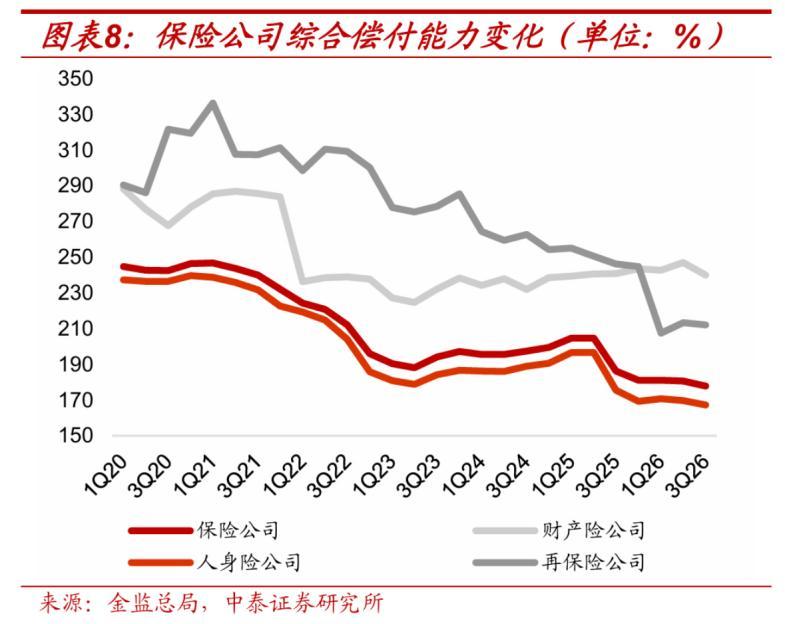
Equity investment has become an important starting point for insurance enterprises to cope with the low interest rate environment, but the core contradiction with solvency lies in: equity assets can not only increase returns, but also squeeze solvency indicators due to the dual pressure of high risk factors and market value fluctuations, which is a double-edged sword for insurance enterprises.
Judging from the current equity allocation proportion of insurance enterprises, a person familiar with insurance capital revealed that the equity allocation proportion of leading insurance enterprises is about 20%, and even close to 30%, including primary equity and other equity-related assets.
According to the latest data released by NAFR, the total allocation balance of stocks and securities investment funds of insurance companies reached 6.54 trillion yuan, an increase of 143.5 billion yuan over the end of the second quarter, accounting for 16.3% of the balance of funds in use, and the allocation proportion hit a new high again.
An investment insider of a life insurance company told the media that in the first half of the year, the A-share market fluctuated upward, with prominent structural market conditions. Life insurance companies with outstanding investment capabilities can seize the market opportunity and obtain the benefits of asset appreciation. At the same time, equity assets have higher risk factors, and the allocation of assets such as stocks and equity funds will significantly increase the minimum regulatory capital requirement for market risk. "If the investment direction is not selected well in the first half of the year, solvency will indeed be negatively affected to a certain extent."
Chen Yilun, Director and Executive Deputy General Manager of Taikang Asset Management Co., Ltd., wrote that the solvency of life insurance companies is facing dual pressure from assets and liabilities, which forms a hard constraint on equity asset allocation. On the asset side, the rising interest rate will lead to a decline in the book value of fixed income assets measured at market value; on the liability side, the 750-day moving average Treasury bond yield curve is still in a downward channel, which promotes the continuous increase of reserve accrual. The two together erode the net assets under the solvency caliber, putting pressure on the solvency adequacy ratio. Since the upper limit of the regulatory proportion of equity assets is linked to the solvency adequacy ratio, and equity assets occupy high capital, solvency constraints limit the allocation space for equity assets.
Ge Yuxiang believes that current insurance companies, especially life insurance companies, are facing the "impossible triangle" of capital constraints, that is, without exogenous capital supplementation, insurance capital needs to face the triangular dilemma of "improving solvency adequacy ratio - increasing equity allocation proportion - the continuation of the external sustained low interest rate environment", and we will further observe the possibility of the regulatory authority relaxing the solvency requirements for insurance enterprises to allocate stocks.
In August 2026, NAFR issued the "Measures for the Asset-Liability Management of Insurance Companies", which clarified the three major objectives of term structure matching, cost-income matching, and liquidity matching. The new regulation emphasizes that before making major investment decisions, insurance companies should comprehensively consider factors such as solvency constraints, risk appetite, market environment, and regulatory requirements, and evaluate and analyze the impact of investment activities on the company and the asset-liability matching status of corresponding accounts.
On September 6 this year, the Ministry of Finance injected capital into central-managed insurance enterprises through special national debt funds for the first time. At that time, China Life Insurance Group, PICC, China Taiping, China Export & Credit Insurance Corporation, and China Reinsurance Group collectively disclosed announcements that they would receive capital injection from the Ministry of Finance, involving a total of 70 billion yuan of funds.
Shift to defense, from growth to high dividend
After experiencing the sharp market volatility in the third quarter, coupled with the background of low interest rates and high solvency pressure on insurance enterprises, the layout of insurance capital has shifted from growth to high-dividend assets, which has become the core main line of current equity allocation.
Many insiders of insurance capital said that the subsequent position adjustment of insurance capital is expected to focus on stocks included in FVOCI, dividend assets that can be held for a long time and have stable dividend returns, which can also ease the impact of short-term market fluctuations on solvency.
Judging from the equity investment of insurance capital in the first three quarters of this year, most of the targets have high dividend levels and relatively stable return on net assets. For example, China Pacific Insurance increased its holdings in China Shenhua H shares and Shanghai Airport, Ping An Life successively increased its holdings in Agricultural Bank of China H shares, China Merchants Bank H shares, and China Life H shares, and New China Life increased its holdings in AVIC International H shares and Guotai Haitong H shares.
The management of PICC publicly stated that the next step will be to steadily increase the investment in FVOCI stocks on the equity side, increase the contribution of stable returns such as dividend income, and reasonably allocate the proportion of FVOCI and FVTPL (fair value changes included in current profit and loss) assets to smooth the performance fluctuation on the investment side.
Su Gang, Vice President and Financial Controller of China Pacific Insurance, said that under the premise of conforming to the long-term desirable range of strategic allocation, China Pacific Insurance's equity allocation will steadily optimize the tactical allocation space in a sub-account and rhythmic manner, will not take too many unilateral radical actions, but will better balance the constraints of returns, fluctuations, solvency, long-term return levels, and the challenges faced by the current annual finance. In this way, equity can provide more sustainable good returns for the entire asset allocation that fully cover the long-term liability cost.
New China Insurance proposed to increase the allocation of long-duration bonds, dividend and high-dividend assets. High-dividend stocks are still the main direction, and at the same time, build a reservoir through funds, and balance industries and styles to improve portfolio adaptability.
The investment in technology stocks this year once put insurance capital under the spotlight. According to people familiar with insurance capital, the reduction of technology stocks is mainly affected by internal risk control and assessment mechanisms. Some insurance capitals are not actively bearish on technology, but passively adjust under the constraints of position proportion, return fluctuation and solvency. Even if technology stocks rebound, it does not mean that insurance capital will immediately replenish positions.
How to balance the long-term return of equity allocation and the short-term performance impact in the future has also become a problem that insurance capital must face head-on. Zhou Jin, Managing Partner of Financial Industry Consulting at Tianzhi International, reminded that insurance enterprises need to hedge fluctuations through diversified equity allocation. Adhere to long-term, value, and robust investment, and smooth profit fluctuations through methods such as dividend and high-dividend base positions, long-term equity investment, and increased FVOCI allocation. At the same time, strengthen the matching of asset-liability duration and cost income. Take advantage of the implementation opportunity of the new regulatory rules on asset-liability management, improve the governance model and technical level, reduce the effective duration gap, balance cash flow and returns, adhere to the concepts of strategic vision, global vision and cycle vision, and do a good job in the dynamic balance of asset-liability management.