Has GPT-6 Astra potentially discovered the Theory of Everything? A physics paper from Stanford has sparked heated widespread discussion.
This impact could be even greater than proving the Riemann Hypothesis.
Just now, the technology and physics communities on 𝕏 and Reddit were ignited by a piece of news: the ultimate physics puzzle that troubled Einstein for the second half of his life seems to have found a breakthrough, with GPT-6 Astra appearing behind the scenes.
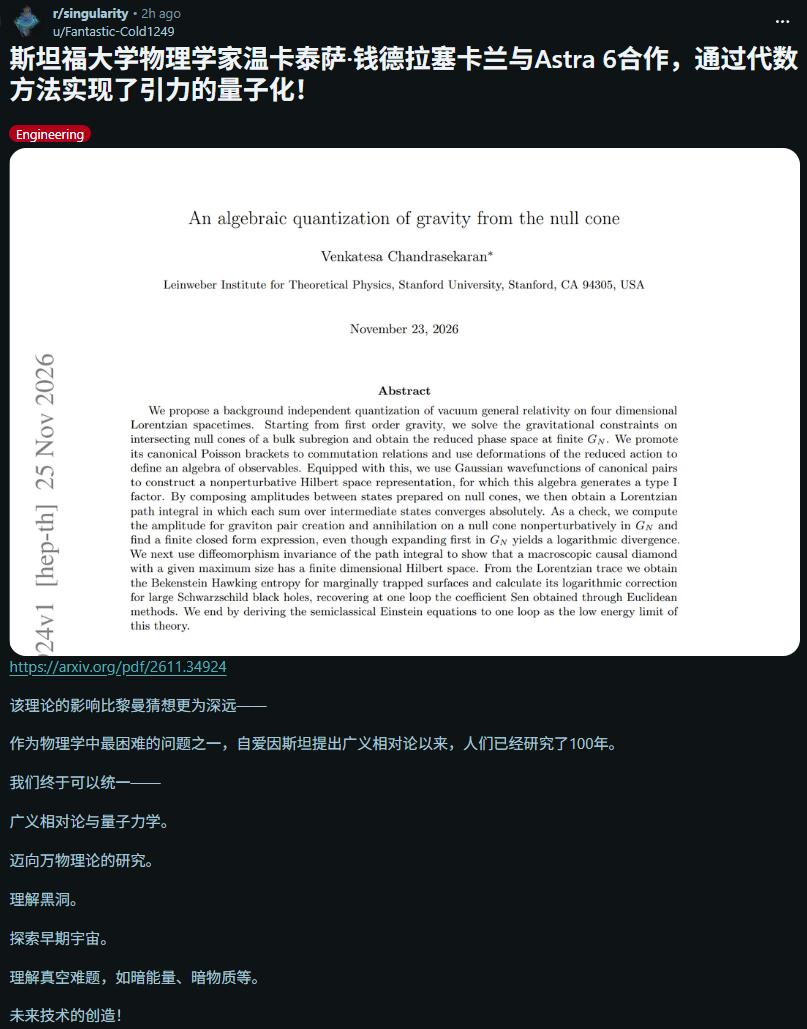
After the news spread, claims such as "GPT-6 Astra discovers the Theory of Everything" and "General Relativity and Quantum Mechanics are finally unified" quickly emerged on social media.
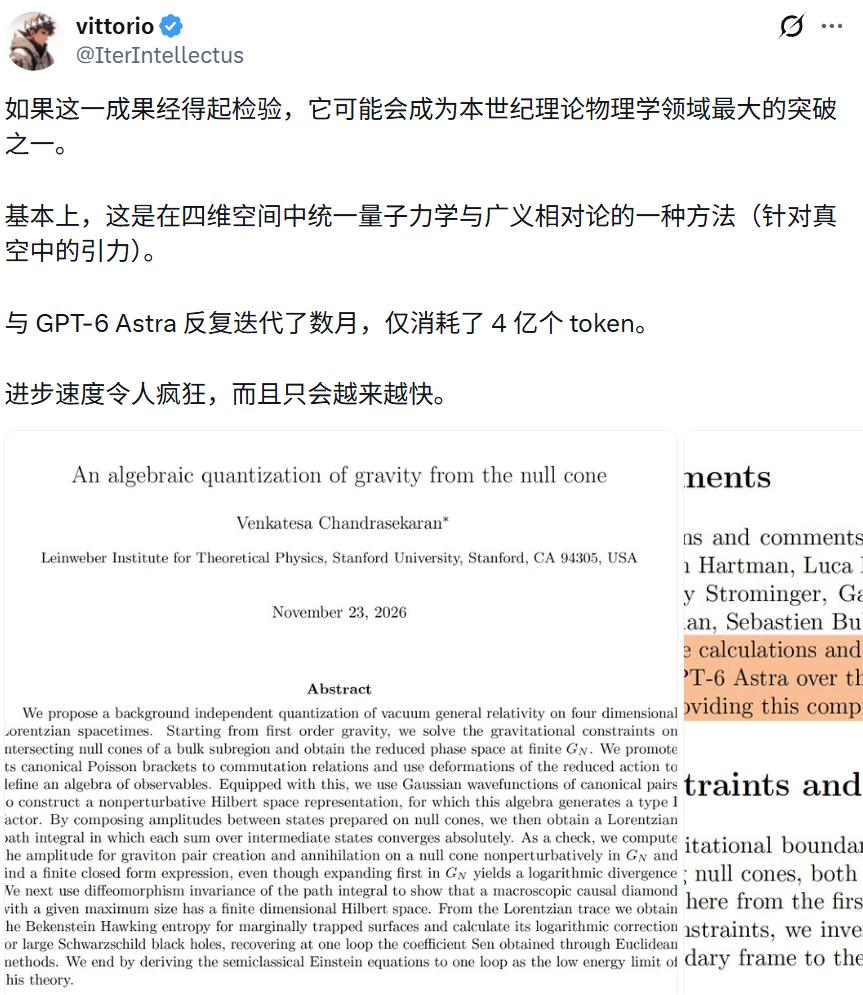
It also makes people sigh that this is truly the golden age of physics and mathematics.

This news comes from a newly uploaded paper on arXiv, which claims to have quantized gravity through algebraic methods, solving a century-old physics problem: general relativity is non-renormalizable and cannot be directly quantized.
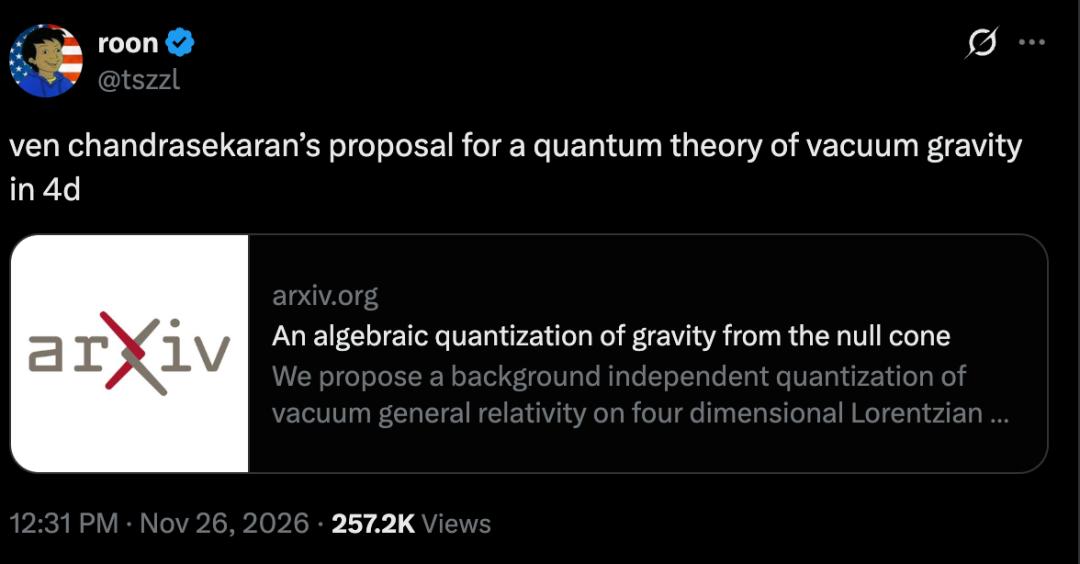
The paper is titled 《An algebraic quantization of gravity from the null cone》, with a total of 83 pages. The signed author is Venkatesa Chandrasekaran, a researcher on OpenAI's reasoning team and a theoretical physicist at the Leinweber Institute for Theoretical Physics at Stanford University. In October this year, Venkatesa also gave a lecture on "How to do theoretical physics with Codex" as an OpenAI researcher.
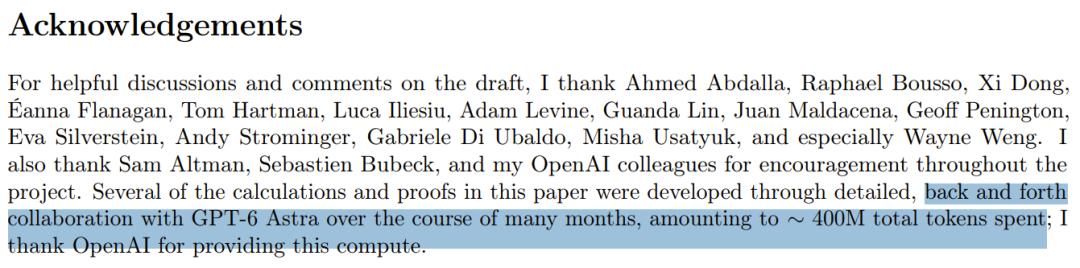
In the acknowledgements of the paper, the author disclosed that he collaborated with GPT-6 Astra for several months and consumed about 400 million tokens. Frankly speaking, compared with this achievement, the token consumption is not large. In addition, he also thanked Sam Altman, Sebastien Bubeck and his colleagues at OpenAI for their computing power and support.
Of course, most people cannot understand such theoretical physics achievements, and we have also made a simple interpretation with the help of AI. At the same time, it must be stated that this paper has not yet undergone peer review, and there is still a clear boundary between it and the "Theory of Everything". According to our AI-assisted interpretation: what it proposes is a non-perturbative quantization candidate scheme for four-dimensional vacuum general relativity (pure gravity), rather than the "Theory of Everything" that includes all fundamental interactions.
However, this by no means means that the weight of this paper is overestimated to the point of being irrelevant. On the contrary, the mere establishment of a reliable four-dimensional pure gravity quantum theory is enough to become a major event in theoretical physics in this century.
In lower-dimensional models (such as two-dimensional Jackiw-Teitelboim gravity or three-dimensional pure gravity), gravity has no locally propagating gravitons, and physicists have been able to write a relatively complete quantization construction; but once we step into the four-dimensional space-time where we actually live, gravitational waves and gravitons begin to carry real local propagation degrees of freedom, and the entire mathematical structure suddenly becomes extremely complicated.
Over the past few decades, the academic community has even long been unable to determine whether pure four-dimensional Einstein gravity itself can form a mathematically consistent quantum theory without introducing new structures such as extra dimensions, supersymmetry or strings.
If this scheme finally passes independent tests, it means that general relativity and quantum mechanics have for the first time obtained a background-independent, non-perturbative and self-consistent positive solution that can calculate finite amplitudes on the core four-dimensional gravity battlefield; even if the subsequent coupling of matter fields in the Standard Model still needs to be explored separately, this step alone is enough to rewrite the landscape of quantum gravity research.
Paper title: An algebraic quantization of gravity from the null cone
Why is it so difficult to unify general relativity and quantum mechanics
To understand what this paper is solving, you must first see clearly which wall it is facing.
Over the past hundred years, modern physics has been built on two major pillars:
General Relativity describes gravity as a smooth, continuous, dynamically curved space-time geometry;
Quantum Mechanics tells us that all physical quantities in the microscopic world are discrete, with uncertainty and quantum fluctuations.
Both theories have withstood extremely high-precision experimental tests in their respective domains, but they conflict violently when they try to be combined into one.
The most direct conflict comes from "infinity". The most common practice for particle physicists is to first select a flat and invariant space-time background, split gravity into the background plus tiny ripples (gravitons), and then calculate the loop diagram corrections of graviton collisions order by order according to perturbation theory. But once we calculate to the high energy scale, the loop diagrams of pure general relativity will produce an infinite number of unabsorbable ultraviolet divergences, which is the so-called "perturbative non-renormalizable".
To put it another way, it is like you plan to study the tiny ripples of water waves on a calm river, but when you zoom the lens to the extreme, you find that the riverbed itself is rolling and deforming violently. At this time, the "background water surface" and "water surface ripples" are completely inseparable, and the approximation algorithm based on the fixed background will naturally fail completely.
In order to bypass this wall, the physics community has explored multiple routes for decades:
String theory replaces point particles with one-dimensional strings, smoothing out divergences at the perturbative level, but it is difficult to give transition amplitudes for finite space-time regions in a non-perturbative sense;
Loop quantum gravity has advanced geometric quantization on spatial slices, but how to solve the Hamiltonian constraint and strictly recover Einstein's equations in the low-energy limit is still an open problem;
Although AdS/CFT correspondence provides a powerful non-perturbative tool, it highly depends on the special boundary structure of anti-de Sitter space-time (AdS).
Therefore, physicists have always wanted to find a "background-independent" and "non-perturbative" quantization framework: do not assume any fixed space-time in advance, directly deal with the violently fluctuating four-dimensional Lorentzian space-time under the finite Newton's constant G_N, and be able to smoothly return to Einstein's equations at low energy. This is exactly the goal targeted by Chandrasekaran's 83-page paper.
Who is the author, and what does 400 million tokens mean
When judging the weight of a highly difficult theoretical physics preprint, the author's academic context is often the first reference.
Venkatesa Chandrasekaran is not an amateur researcher who emerged out of nowhere. He received his Ph.D. in physics from the University of California, Berkeley in 2021, then served as a member at the Institute for Advanced Study (IAS) in Princeton until 2023. Currently, he is affiliated with the Leinweber Institute for Theoretical Physics at Stanford University, and is also active in OpenAI's cutting-edge scientific reasoning research team.

More importantly, this new paper is not a cross-border work inspired by sudden inspiration, but a continuation of his years of research route. As early as 2023, he co-published representative papers on von Neumann algebras, de Sitter space-time and generalized entropy with Edward Witten, Geoff Penington and others, and then worked with Éanna Flanagan for a long time to delve into the graviton region algebra and horizon phase space.
The discussion and draft review list listed in the acknowledgements of this paper also includes core scholars in the field of contemporary quantum gravity such as Juan Maldacena, Andy Strominger, Raphael Bousso, and Geoff Penington.
Putting this background into the detail of "GPT-6 Astra consuming 400 million tokens", the real form of human-machine collaboration becomes much clearer.
The wording used by the author in the acknowledgements is also very restrained: "A number of calculations and proofs were developed through detailed, repeated collaboration with GPT-6 Astra", and the paper is still independently signed by him alone.
Starting from the light cone: three key points of the paper
If the entire 83-page paper is compressed into several main lines, Chandrasekaran's scheme revolves around three core designs.
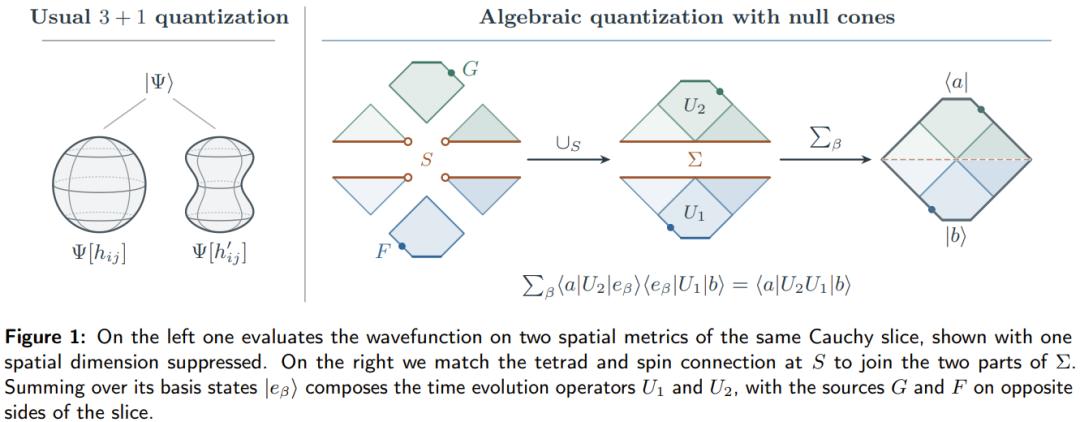
Schematic diagram comparing traditional 3+1 spacelike slice quantization and light cone algebraic quantization
First, abandon the traditional "simultaneous cross-section" and use intersecting "light cones" to splice space-time.
The traditional 3+1 quantization is like trying to take a global cross-sectional snapshot of the entire building at a certain moment. But once the space-time itself is in a quantum superposition state, "where is the same moment and where is the same position" in different space-times cannot be matched. The paper starts from first-order gravity (Plebański constraint BF theory), and splits four-dimensional space-time into finite-sized "causal diamonds", that is, the local area enclosed by the intersection of the past light cone and the future light cone.
The author directly solves the gravity constraint on the intersecting light cone (null boundary), and transfers the degrees of freedom originally entangled in the bulk to the boundary fields and the "edge modes" at the corners, so as to obtain a clean reduced phase space under the finite Newton's constant G_N. This is like no longer forcing to draw the global blueprint of the entire shaking building, but first accurately define the boundary interface of each standard building block room, and then seamlessly "glue" countless causal diamonds into space-time of any large range by matching the boundary geometry and the local Lorentz reference frame.
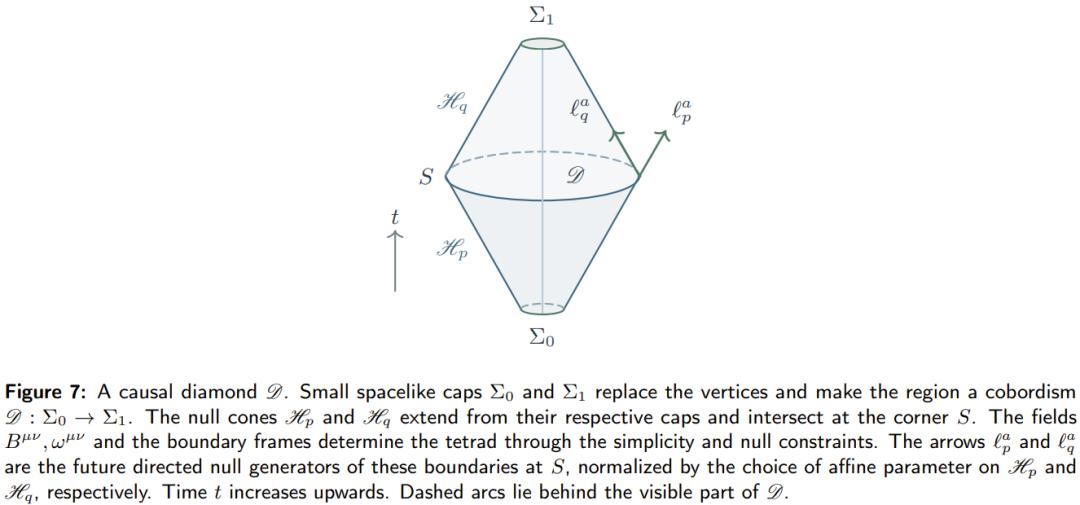
Schematic diagram of the structure of a causal diamond and its upper and lower spacelike caps, intersecting light cones and corner S
Second, follow the algebraic quantum field theory route to prove the absolute convergence of non-perturbative transition amplitudes.
In a violently fluctuating quantum space-time, even the unique "vacuum state" may not exist. Therefore, the paper adopts the idea of algebraic quantum field theory (AQFT): do not rush to select the quantum state first, but lift the Poisson bracket of the reduced phase space into a commutation relation, directly define the observable C* algebra through action deformation, and then use Gaussian wave functions to construct a non-perturbative Hilbert space representation, proving that it generates a Type I von Neumann factor.
Splicing and summing the quantum states of different causal diamonds on the shared boundary yields a Lorentzian path integral. The paper proves that under finite G_N, the summation of intermediate states at each step is absolutely convergent.
To explain why this does not contradict the traditional "perturbative non-renormalizable", the author made a very convincing test: non-perturbatively calculate the connected two-point function of graviton pair production and annihilation on a single incident light cone, and obtain a finite closed-form analytical result; but if you expand the expression according to G_N first and then sum all short-wavelength high-energy modes like the traditional perturbation theory, the result will produce the classic logarithmic ultraviolet divergence. In other words, the divergence does not necessarily mean that the theory itself is broken, but that the limit order of "expand first or sum first" is reversed.
Third, introduce the "gravitational clock" to derive the discrete area spectrum, black hole entropy correction and the semiclassical Einstein equation.
In quantum gravity where no external watch is available, the clock itself must be part of space-time. The paper defines an intrinsic "gravitational clock" by using the affine parameter of light rays on the light cone traveling from the past boundary to the intersecting corner. In four-dimensional space-time, the shear effect caused by gravitational radiation will focus the light rays and delay the clock reading through the Raychaudhuri equation; therefore, as long as the maximum clock reading of the causal diamond is limited, the allowed graviton radiation states in it can be locked in turn.
Based on this mechanism, the author continuously presents several key self-consistency verifications in the second half of the paper: proving that a macroscopic causal diamond of a given maximum size only has a finite-dimensional Hilbert space, and its corner area operator has a discrete spectrum; starting from the Lorentzian trace, deriving the Bekenstein-Hawking entropy for the edge trapped surface, and calculating that the one-loop logarithmic correction coefficient of a large Schwarzschild black hole at a fixed mass is 106/45, which is completely consistent with the classic result obtained by physicist Ashoke Sen in 2013 through the Euclidean path integral; realizing the algebraic criterion of "ER = EPR" in spatial topology analysis; finally, recovering the semiclassical Einstein equation to one-loop accuracy for coherent initial states in the low-energy limit.