Shortly after securing approval for a 1-million-satellite constellation, is Elon Musk giving away stocks to children across the United States?
There are 16,000 satellites in orbit, and Elon Musk plans to add another 1 million.
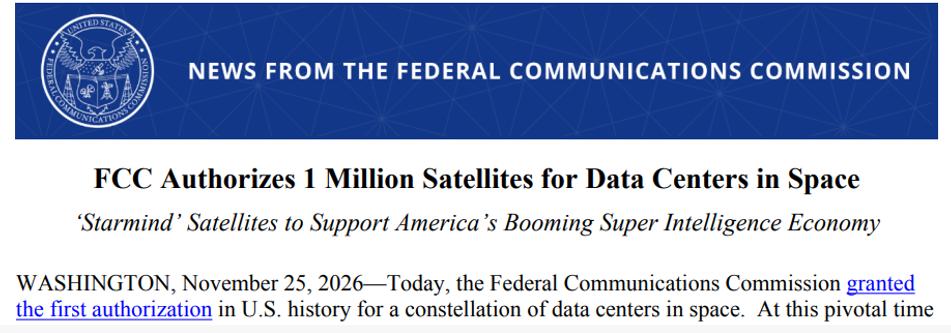
Source: FCC official website
On local time November 25, a conditional authorization issued by the U.S. Federal Communications Commission (FCC) has pushed Elon Musk's space territory a big step forward: SpaceX's in-orbit data center system "Starmind" has been officially approved, allowing the deployment of up to 1 million low-Earth-orbit satellites equipped with computing modules.
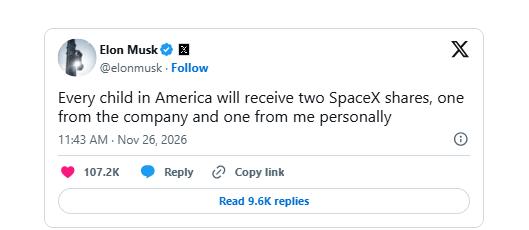
Source: X Platform
Shortly after obtaining the Starmind approval, Elon Musk rolled out a nationwide children's stock grant program in the U.S.: giving two shares of SpaceX stock to every child across the United States, one from himself and one from the company.
It has only been one month since he made the public promise of "one share for each child" last month, and the scale of the plan has directly doubled.
With the two major events landing one after another, Elon Musk may officially advance the grand vision of deploying data centers in space to reshape the foundation of AI computing power.
01 Approval for 1 Million Satellites, Ready to Start Construction?
The statement of "adding 1 million more satellites in space" is very impactful, but what is the real weight of this approval document?
The authorization numbered DA26-1273 issued by the FCC this time approves SpaceX to deploy up to 1 million non-geostationary orbit satellites for backup measurement, control and communication of in-orbit data centers. The core data transmission uses inter-satellite optical links, and radio frequency channels are only used for emergency backup.
This approval is not a full green light. The document also mentions that the satellite decommissioning and disposal plan has been temporarily suspended due to insufficient submitted information, and the deployment of orbits above 600 kilometers has also been postponed, which requires a separate application later.
The deployment schedule is also clearly specified: deployment must start before November 2033, 100,000 satellites (10% of the total) must be completed before 2035, more than half of the total must be deployed before 2038, and the networking of all 1 million satellites must be completed before November 2040.
According to real-time data from Orbinauts, there are currently about 16,400 active satellites in orbit worldwide, and 1 million is nearly 60 times the existing total.
Even SpaceX's own Starlink, which was originally planned to have a 42,000-satellite network, has just over 11,000 satellites in orbit so far.
In other words, this is not a construction order to "immediately build 1 million space servers", but more like a track option valid for more than ten years.
02 Data Centers in Space, Does the Math Add Up?
In Elon Musk's narrative, space data centers have three inherent advantages: First, low-Earth orbit has almost continuous sunlight, making solar energy almost "free"; second, the vacuum environment has low temperature, so no water or air is needed for heat dissipation; third, it is not restricted by ground land approval, power grid capacity and resident protests.
This sounds logically consistent, but every point will face a large discount in engineering and financial practice.
The core threshold is launch cost. There is a general consensus in the industry: for space computing power to be comparable to ground data centers, the cost of putting 1 kilogram of payload into orbit must be reduced to at least below $200.
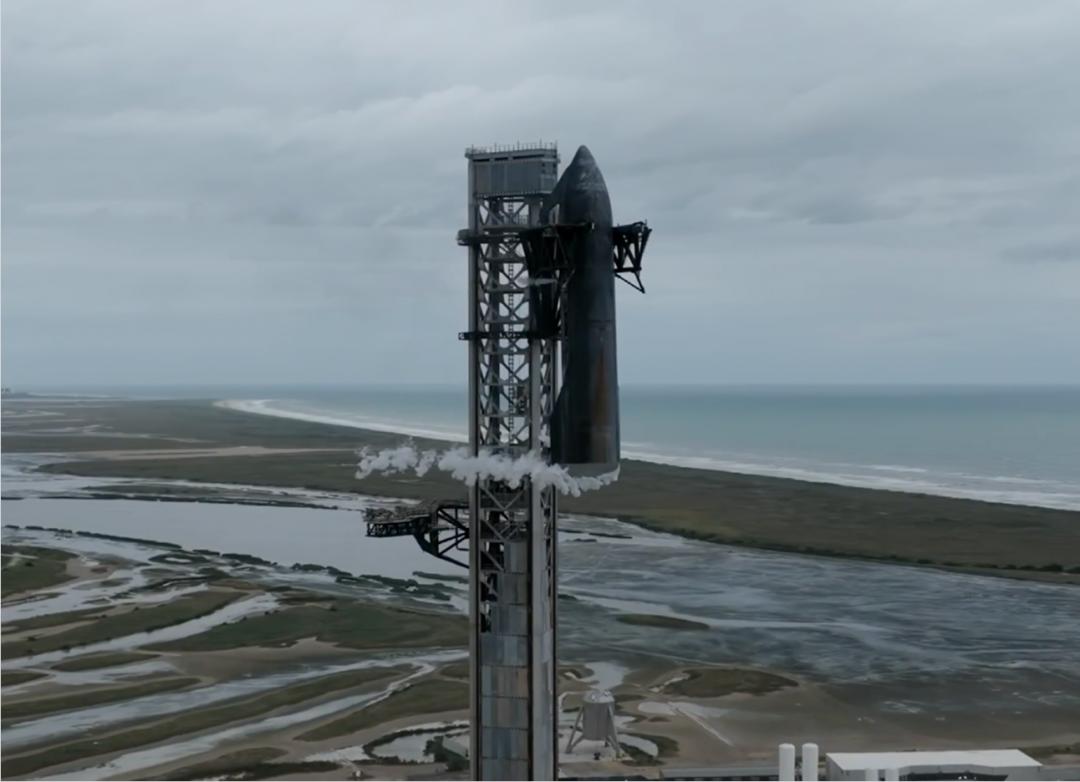
Source: SpaceX
At present, the main launch vehicle of SpaceX, Falcon 9, has an equivalent public listed price of about $2700–3300 per kilogram, which is an order of magnitude higher than the break-even line.
According to SpaceX's goal, after Starship is fully reusable, the cost of putting 1 kilogram of payload into orbit can be suppressed to less than $100, which is only one-thirtieth of that of Falcon 9.
However, long-term expectations cannot hide the current reality. According to the calculation of Novaspace *2026 White Paper on Space Data Centers*, for the same 1GW computing power, the total cost of the space solution in a five-year cycle is about 46 billion U.S. dollars, while that of the ground data center is about 16 billion U.S. dollars, and the former is nearly 3 times the latter.
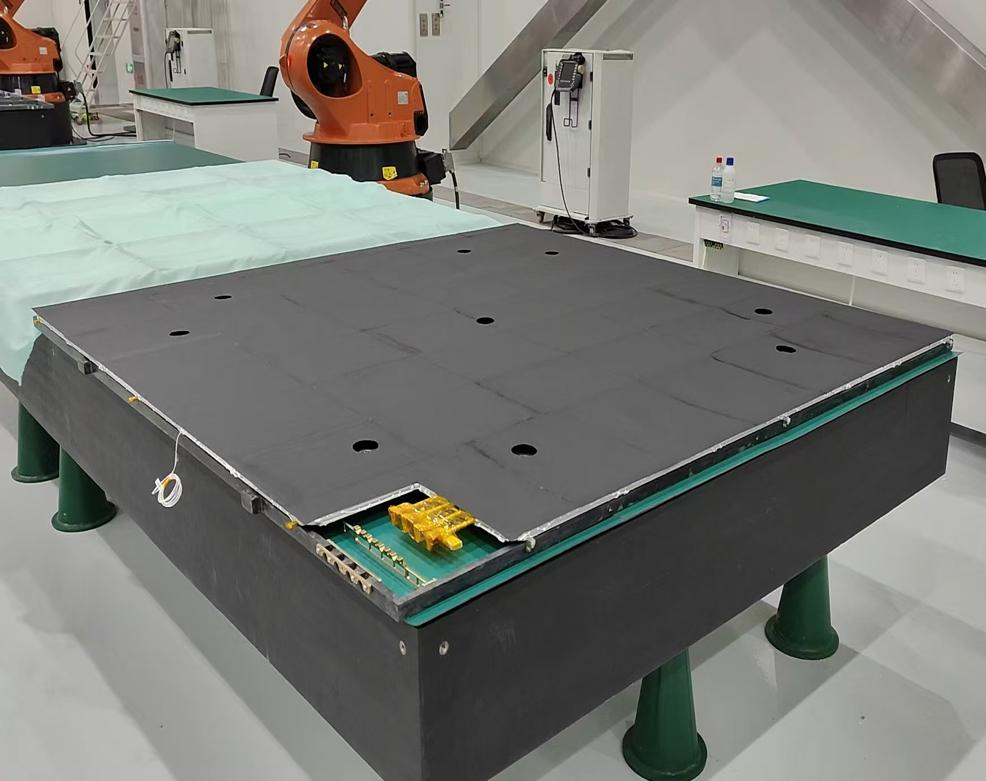
The picture shows the graphene thermal conductive film for space heat dissipation Source: Beijing Graphene Research Institute
In addition, since there is no air convection in the vacuum environment, heat dissipation can only rely on thermal radiation. 1MW of computing power requires about 1200 square meters of heat dissipation plates, which is close to a quarter of a football field; the larger the heat dissipation area, the higher the risk of being hit by space debris. The heat dissipation radiator of the International Space Station was previously hit by debris.
What is more tricky is that on-orbit maintenance is impossible. If a circuit board in a ground computer room breaks down, engineers can go downstairs to replace it; if a satellite in space breaks down, the whole satellite will be scrapped, or you have to wait for the launch window several months later.
Space facilities are usually depreciated over 5 years, while ground data centers are depreciated over 15 years. Only the depreciation cycle alone pushes the capital cost per GPU hour to about 17 times that of the ground.
For this reason, 1 million satellites is more like the "application upper limit" in industry practice, not the final landing target.
03 Why Is Amazon Jealous?
Such a big move cannot be unimpeded by competitors' obstruction, and the one who jumps to the forefront is Amazon.
Many people are not familiar with Amazon's aerospace layout, but it is actually the core competitor of Starlink in the global low-orbit satellite track.
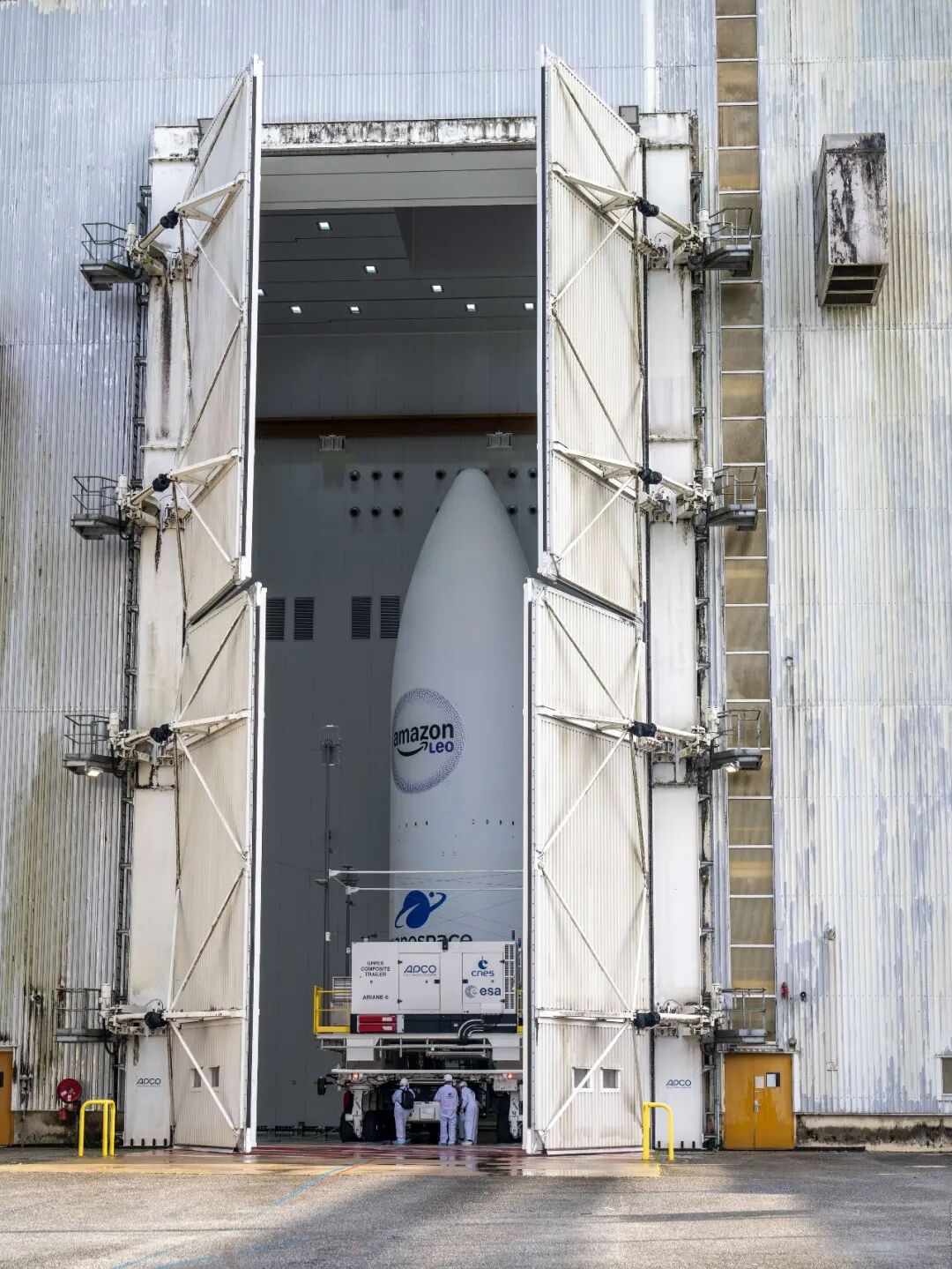
The picture shows the launch site of Amazon Leo satellite Source: Internet
Its satellite division Amazon Leo, formerly known as the famous Project Kuiper, was officially renamed in November 2025, positioning itself as a low-orbit broadband internet constellation benchmarking against Starlink.
At present, Amazon has built one of the largest satellite production lines in the world, with more than 1000 satellites rolled off the production line in total, and about 390 to 400 satellites deployed in orbit.
Seeing that SpaceX extends from satellite internet to space data centers and directly steps into the next-generation computing power track, Amazon will not stand by.
As early as during the Starmind approval process, Amazon submitted a petition for rejection to the FCC in the name of its subsidiary Kuiper Systems, pointing out that the three core problems of space data centers, namely heat dissipation, bandwidth and cost, are difficult to solve.
Satellite operator Viasat and the American Astronomical Society also stood in the opposition, worrying that millions of satellites will aggravate light pollution and interfere with radio astronomical observations.
But the FCC finally rejected all these petitions. For complaints about environmental impact and astronomical observation interference, the FCC directly determined that they are beyond its jurisdiction; for the risk of orbital debris, it determined that the system complies with existing regulations, and only postponed the deployment of orbits above 600 kilometers.

The picture shows FCC Chairman Brendan Carr Source: Social media screenshot
FCC Chairman Brendan Carr publicly pushed back against Amazon as early as March this year: "Amazon should first sort out its own launch plans and satellite constellations, instead of worrying about those who are actually launching satellites at SpaceX's pace."
For the entire commercial aerospace industry, the "ChatGPT moment" of space computing power is far from coming. But the battle for occupation of orbital resources, spectrum resources and track standards has already started in advance.
This article is from WeChat official account "Phoenix Finance", author: Phoenix AI Research Institute, released by 36Kr with authorization.