Why does Saizeriya, the popular casual dining chain playfully referred to as "poor man's restaurant", also embrace food delivery services?
In 2024, someone wrote an article titled "Saizeriya: The Eternal Pain of Food Delivery Platforms", which opens with the line, "Saizeriya exists in another dimension."
Two years later, things have changed.
"You can now order delivery from Saizeriya." Recently, a netizen living near the North Fourth Ring Road in Beijing posted a thread. In the comment section, many people expressed their feelings: "Finally no need to find personal shoppers", "Personal shoppers are total rip-offs", "Hope it stays available permanently".
Signs of Saizeriya going digital emerged long ago. Stores in Shanghai started a trial run as early as March, followed by some outlets in Guangdong. Since October, multiple Saizeriya locations including those on West Yuan Da Road in Haidian District and Shuangqiao Road in Chaoyang District have appeared on Meituan.
It is not an isolated case. Sushiro, another brand that once stayed "in another dimension", has also launched its delivery service on Meituan intensively at multiple stores in Beijing, Shanghai, Suzhou, Hangzhou, Shenzhen and other cities.
Why did these two brands suddenly change their minds now?
The Cautiousness of "Budget Dining Spots"
Saizeriya and Sushiro entered the food delivery market more than one full cycle later than the rest of the industry. The penetration of food delivery in the catering sector accelerated around 2015, and the industry later went through explosive growth, the expansion of chains with over 10,000 outlets, and the rise of instant retail. The two brands either stayed put or only made minor moves, until 2026 when they began rolling out delivery services intensively across the country.
The existence of personal delivery shoppers proves that the demand is strong enough. In the years when the brand did not embrace official delivery, third-party personal shoppers for Saizeriya were already widespread online. For the same five dishes, shoppers charged 100 yuan more than the official price, with a premium of over 70%. Some people even drove all the way to physical stores multiple times just to get a fruit pizza for their kids.
So why were they late to join the food delivery trend? It is closely related to their business models.
Saizeriya has pushed cost control to the extreme across its entire industrial chain. Upstream, it conducts independent R&D and self-supply, for example, it develops its own tomato seeds and operates supporting planting and breeding bases. Midstream, it uses unified distribution from central kitchens, with no kitchen knives or separate back-of-house areas in its outlets. Downstream, its service procedures are calculated by the second, with detailed rules such as the U-shaped mopping method.
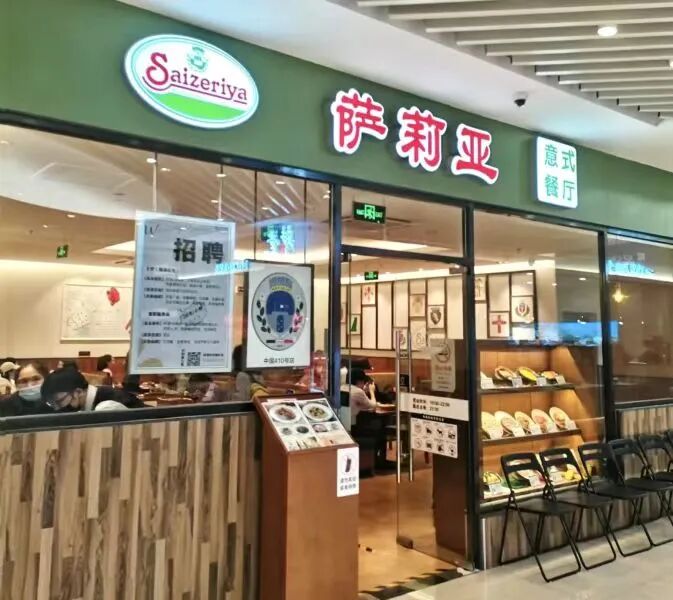
All these designs jointly support its pricing of 5-yuan bread, 6-yuan desserts, and pasta priced at just over 10 yuan, while maintaining extremely low profit per item.
Sushiro follows a different efficiency path. Equipped with robots that can make 3,600 servings of sushi per hour, plates embedded with IC chips, and a conveyor system that automatically retracts after running 350 meters, it has pushed the food waste rate from the industry average of 10% to 15% to nearly 0%. It has also eliminated central kitchens, using automated equipment to complete rice cooking, rice shaping and deep-frying, with staff only handling seafood preparation and seasoning.
This system supports its continuous high-frequency new product launches every year, and with a per-person spending of 100 to 200 yuan, it is still known as "budget sushi" for its extremely high cost-performance ratio.
The two models reach the same goal through different paths, both are players that calculate cost and efficiency down to several decimal places. It is exactly this business model that makes them extra cautious about food delivery.
The common point of the two models is that every cost is arranged extremely tightly. But food delivery will break this tight arrangement: packaging requires additional manpower and materials, delivery orders will disrupt the in-store dining flow and reduce table turnover rate... In addition, if raw cold seafood items such as sashimi, salmon and fresh shrimp of Sushiro have any mishaps during delivery, it will lead to after-sales issues and bring extra costs.
For them, food delivery is not a strategic yes-or-no choice, but an arithmetic problem that must be verified item by item: can the profit from delivery cover all the extra costs? Can the platform's fulfillment guarantee the bottom line of product quality? As a rational choice constrained by their business models, when the accounts could not be clearly calculated, caution was unavoidable.
The Profit Calculation of Food Delivery Has Been Worked Out
Why now? In 2026, the answer to this arithmetic problem has changed.
Meituan disclosed at the 2026 Food Delivery Industry Conference that among food delivery orders of catering merchants this year, the proportion of low-price orders below 15 yuan has halved year on year, and the average actual payment per order has rebounded. Behind the healthier order structure, each food delivery order has a larger profit margin.
The reality is that in actual operation, food delivery is increasingly proven to be not just a new channel, but also an efficiency tool.
The traditional catering business is burdened by three major fixed costs: rent, labor, and utilities. These costs have to be paid regardless of whether the restaurant is fully occupied or the order volume is high. Against the backdrop of slowing catering growth and fierce industry competition, the slowdown or even decline in order volume will naturally eat into profits.
Food delivery converts part of the fixed costs into variable costs that fluctuate with order volume. In terms of rent, stores no longer have to be located strictly in prime locations, and the store area no longer has to be blindly large. The flexibility of labor and utilities is more hidden but more direct than that of rent.
The flexibility of labor lies in scheduling working hours according to order peaks. The peak hours of in-store dining are fixed, but the order curve of food delivery can be smoother: accept pre-orders before the in-store dining peak, set an upper limit for order acceptance during the in-store peak, so as to stagger production capacity.
The logic for utilities is similar. The basic energy consumption for in-store dining is fixed, but food delivery can add more orders on the same production capacity to dilute the marginal energy consumption.
While fixed costs become more flexible, food delivery also changes the cost allocation method for each individual order. When the density of food delivery orders rises, the more orders that the same rent and the same back-of-house production capacity can handle, the thinner the fixed cost allocated to each single order will be. After the order volume stabilizes, costs for food procurement, warehousing and distribution will also be gradually optimized.
In this way, catering merchants can form a positive cycle of more orders, lower costs and more competitive products.
The Q3 financial report of Yum China is a proof of this profit calculation. In the third quarter, food delivery accounted for 54% and 53% of total revenue for KFC and Pizza Hut respectively, and food delivery has accounted for more than half of the company's revenue for consecutive quarters. Meanwhile, the restaurant operating margin reached 17.8%, up 0.5 percentage points year on year, and the operating margin hit 13.0%, marking the tenth consecutive quarter of year-on-year growth.
The management explained in the financial report that streamlined operations and favorable raw material prices more than offset the impact brought by high cost-performance products, decline in same-store sales, and increased rider costs due to the rising proportion of food delivery.
This proves that with operational efficiency as the foundation, food delivery can not only increase order volume and scale, but also boost profits.
Saizeriya and Sushiro are exactly efficiency-focused players. For them, against the backdrop of slowing in-store dining growth and rigid fixed costs, food delivery is an inevitable choice to leverage incremental revenue with relatively low marginal costs.
Food Delivery Has Become the New Main Battlefield
The choices of Saizeriya and Sushiro are not isolated cases in the industry. Scaling up food delivery services has become a unified move for many catering enterprises.
Food delivery has become a stable channel for many catering enterprises to obtain incremental revenue. According to the 2026 H1 Briefing on the Development of Chain Catering Enterprises released by the China Chain Store & Franchise Association, 54.4% of the sampled enterprises have food delivery orders accounting for more than 30% of their total orders.
Data shows that during the same period, the proportion of delivery revenue of Haidilao rose from 4.5% in the previous year to 9.2%, that of Jiu Mao Jiu reached 21.9%, Green Tea Group hit 24.3%, and the proportion of delivery orders of directly-operated restaurants of Meet Noodle was 25.8%. Among international catering brands, Tims China recorded 65.7% of delivery revenue from directly-operated stores in Q2; Domino's Pizza China's delivery sales accounted for 51.7% in the first half of the year, breaking the 50% mark for the first time.
Facts have proved that food delivery has gone beyond the stage of being a supplementary channel, and has become the main battlefield of the catering industry. Why is that?
Half of the answer lies on the consumer side.
Catering consumption in China is entering a stage that values cost-performance ratio more. Consumers are not simply looking for cheap prices, but want to get better experiences with less money. This preference, when applied to dining choices, translates to high demand for convenience and instant access: for weekday lunches, people prefer to eat at their workstations; when they want a nice meal on weekends, they may not be willing to wait in a queue for three hours.
Food delivery releases the supply capacity of restaurants from the restrictions of in-store tables and operating hours, capturing the demand that was once blocked by physical space.

The other half lies on the enterprise side.
As the position of food delivery becomes increasingly stable, more and more enterprises, like Yum China, begin to redesign their business around food delivery, rather than just uploading their menus online. Food delivery platforms themselves are also considering how to act as a qualified helper for catering merchants, helping them improve efficiency in more processes and links.
For example, Meituan has launched a new generation of professional delivery store format "Super Kitchen", which can meet higher demand with larger space and richer product categories. It also provides merchants with support including business district site selection, product selection, kitchen layout and dining flow design, and connects food preparation, production and sorting through a production scheduling system. Data shows that a Super Kitchen can process thousands of orders per day. In the coming year, Meituan Delivery plans to build the first batch of 1,000 Super Kitchens with more full-service catering brands.
For all catering enterprises, the question is no longer whether to do food delivery, but how to do it better. With more cost-conscious brands such as Saizeriya and Sushiro entering the market, the dominant position of food delivery will become even more solid.
Conclusion
The entry of "budget dining spots" into the food delivery market, with their extremely strict business models, has cast a vote of confidence for the food delivery industry.
As the scale competition of chains with 10,000 outlets becomes a thing of the past, efficiency competition has become the mainstream, and the food delivery business is being understood more and more thoroughly. If a few years ago, the role of food delivery was only adding value to in-store dining; now, food delivery is gradually embedded in the store operation model, supply chain efficiency and cost structure, multiplying the value of the entire catering industry and becoming a key part of efficiency competition.
This article is from the WeChat Official Account "Yidian Caijing" (ID: yidiancaijing), written by the Yidian Consumer Research Team, and published with authorization from 36Kr.