Shanxi's high-speed rail construction is shifting into a new gear: its first 350 km/h high-speed railway will open next year, connecting Taiyuan to Beijing's 2-hour economic circle.
Another central Chinese province is set to join the "350 km/h High-Speed Rail Club".
Recently, the construction of the Shanxi section of the Xiong'an-Xinzhou High-Speed Railway has entered the joint commissioning and testing phase, which is scheduled to take 66 days and is expected to meet the operation opening conditions by the end of March 2027.
This is the first high-speed railway in Shanxi built according to the standard of 350 km/h. It starts at Xiong'an Station in Xiong'an New Area, Hebei Province in the east, passes through Baoding City, Hebei Province, and connects to Xinzhou West Station in Shanxi Province, with a total main line length of about 342 kilometers. Among them, the Shanxi section is about 122 kilometers long, with 3 newly built stations: Dingxiang North Station, Wutai Station and Wutaishan Station.
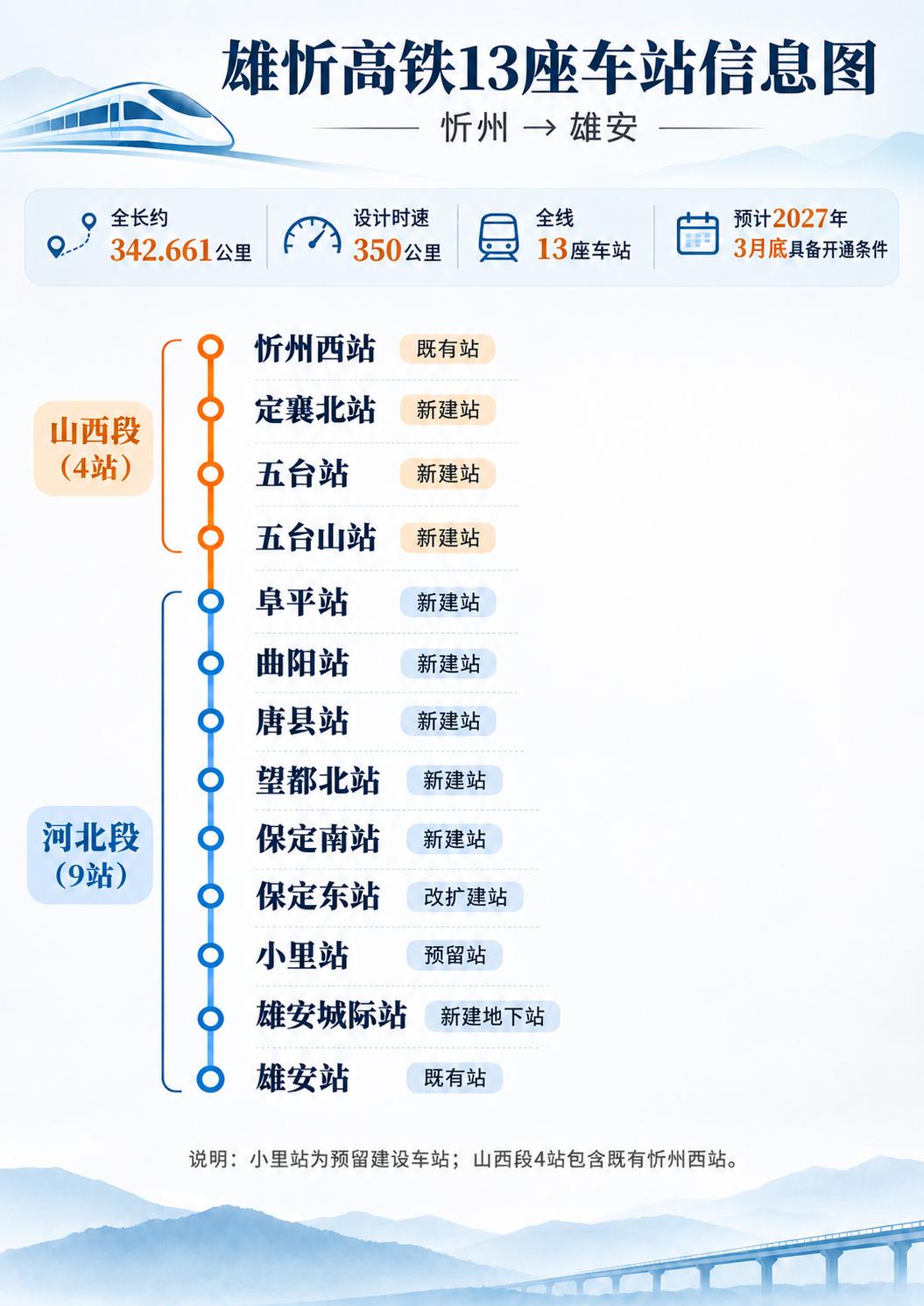
Image source: Shanxi News Broadcast
The construction and opening of the Xiong'an-Xinzhou High-Speed Railway is of great significance for Shanxi to improve its high-speed rail network and strengthen connections with the Beijing-Tianjin-Hebei region.
XIE Xiaowen, an expert member of the New Technology Promotion Branch of China Communications and Transportation Association, said in an interview with Time Weekly that after the Xiong'an-Xinzhou High-Speed Railway opens, the rail travel time from Taiyuan to Beijing is expected to be reduced to about 2 hours, the journey from Xinzhou to Xiong'an will take about 1 hour, and travel from northern Shanxi to the Beijing-Tianjin-Hebei region will be more convenient.
Closer transportation connections will create more opportunities for industrial development and regional cooperation along the line.
XIE Xiaowen believes that the Xiong'an-Xinzhou High-Speed Railway is conducive to promoting two-way flow of people, driving the joint development of cultural and tourism resources along the line, promoting Shanxi's characteristic agriculture, cultural tourism and health care industries to better connect with the Beijing-Tianjin-Hebei market, and helping Shanxi undertake industrial spillovers and deepen regional coordination.
Shanxi's high-speed rail construction progresses relatively slowly
As soon as the news that the Xiong'an-Xinzhou High-Speed Railway has entered the joint commissioning and testing phase was announced, the most frequently asked question in the comment section was: Will it be more convenient to go to Wutaishan in the future?
As a tourist province rich in ancient architectural resources, the construction progress of high-speed railways in Shanxi is not only related to the travel of local residents to visit relatives, but also affects the travel accessibility of non-local tourists.
To attract more tourists, Shanxi needs a sufficiently complete high-speed rail network. Looking back at the development history of Shanxi's high-speed railways, the construction speed is not fast.
In 2009, the Shijiazhuang-Taiyuan Passenger Dedicated Line opened, marking Shanxi's entry into the high-speed rail era. After that, the high-speed rail network gradually extended within Shanxi Province. In 2014, the Taiyuan South-Xi'an North section of the Datong-Xi'an High-Speed Railway opened; in 2018, the Taiyuan South-Yuanping West section of the Datong-Xi'an High-Speed Railway opened.
The expansion in this stage was mostly the extension of existing lines, with few new lines. It was not until the Datong-Zhangjiakou High-Speed Railway in 2019 and Zhengzhou-Taiyuan High-Speed Railway in 2020 were opened to traffic one after another that Shanxi ushered in a concentrated launch of trunk lines.
The relatively slow progress of high-speed rail construction in Shanxi is not only restricted by terrain conditions, but also related to the long-term formed industrial structure and economic development model.
XIE Xiaowen analyzed to reporters from Time Weekly that a large part of the reason for the relatively slow progress of high-speed rail construction in Shanxi is related to its geographical location. "Shanxi is located on the Loess Plateau, where mountains and hills account for about 80% of the whole province, which not only raises the construction difficulty and cost, but also limits the operating speed of lines," he said.
The deeper reason lies in Shanxi's industrial structure. Shanxi has a developed coal industry and a well-developed freight railway network, but this also makes Shanxi lack sufficient impetus for the construction of passenger high-speed railways.
XIE Xiaowen also pointed out that high-speed rail projects feature large investment scale and long payback period, which place high requirements on local finance and passenger flow along the line. For some regions with small population size and relatively weak economic foundation, the construction and operation of high-speed railways are facing practical pressure.
In terms of economic aggregate, Shanxi does not have great advantages. In 2025, Shanxi's GDP reached 2,549.568 billion yuan, ranking last among the six central provinces and 21st among all 31 provincial-level regions in China.
Looking at the permanent resident population, at the end of 2025, Shanxi had 34.2401 million permanent residents, ranking 18th in China, with a decrease of 219,500 people throughout the year.
The small total population means that the passenger flow growth space in some regions is limited.
This also explains the long-term problem faced by Shanxi's high-speed rail construction: the terrain increases the construction cost, the economic and financial strength restricts the investment capacity, and the population and passenger flow affect the operation benefit of the projects. The superposition of multiple factors makes it take longer for Shanxi to improve its high-speed rail network.
New lines will be launched one after another
Shanxi will not welcome its first high-speed railway with a designed speed of 350 km/h until next year, and this node is not early.
At present, 11 provinces across China, including Fujian, Anhui, Jiangxi, Hebei, Guangdong, Henan, Hunan, Hubei, Guangxi, Liaoning and Guizhou, have achieved "high-speed rail access in every city" in the strict sense.
In comparison, by the end of the 14th Five-Year Plan period, Shanxi has only realized EMU access in every city. The EMU trains in many prefecture-level cities run on existing ordinary-speed railways, not dedicated high-speed rail lines.
Among the six central provinces, five provinces including Anhui, Hunan, Henan, Jiangxi and Hubei all have high-speed rail operating mileage exceeding 2000 kilometers. According to the closing data of the 14th Five-Year Plan released by Shanxi Province, by the end of 2025, the operating mileage of high-speed railways in Shanxi reached 1347 kilometers, which still lags behind other central provinces.
Jiangxi, which is also located in central China, had 1505 kilometers of operating high-speed railways with a speed of 350 km/h by the end of 2025.
Shanxi's high-speed rail construction is shifting gears and speeding up.
The Xiong'an-Xinzhou High-Speed Railway will open in March next year. As a key part of the Beijing-Kunming corridor in the national "Eight Vertical and Eight Horizontal" high-speed rail network, the Xiong'an-Xinzhou High-Speed Railway connects multiple trunk lines such as the Beijing-Xiong'an Intercity Railway, Datong-Xi'an High-Speed Railway, and Tianjin-Baoding Railway, opening up the high-speed passenger transport corridor of Beijing-Xiong'an-Taiyuan-Xi'an-Kunming.
It connects the Beijing-Xiong'an Intercity Railway to the east and the Datong-Xi'an High-Speed Railway to the west, so that Shanxi can connect to the Beijing-Tianjin-Hebei region to the east and the Central Plains to the south, and play a hub role radiating to the northwest at the same time.
More importantly, after the Xiong'an-Xinzhou line is opened to traffic, Shanxi will add a third high-speed rail channel to Beijing, with the fastest travel time from Xinzhou to Xiong'an reaching 1 hour, and the journey from Taiyuan to Beijing reduced to about 2 hours.
For the counties along the line, the changes are equally direct.
The Shanxi section of the Xiong'an-Xinzhou High-Speed Railway has three newly built stations: Dingxiang North Station, Wutai Station and Wutaishan Station. After the line is opened, Wutai County will end its history of no railway access, and local people no longer need to transfer multiple times, and can take trains right at their doorstep.
Wutaishan will also be connected to the national high-speed rail trunk line with a speed of 350 km/h for the first time. It becomes possible for tourists from Beijing and Xiong'an to travel on weekends and make a round trip on the same day. The direct access of high-speed railways to counties and scenic spots not only changes the travel mode, but also expands the customer source radius of homestays, cultural and creative industries, and health care industries along the line.
After the Xiong'an-Xinzhou High-Speed Railway is put into operation, Shanxi will continue to improve its high-speed rail construction.
The "Development Plan for Modern Comprehensive Transportation System of Shanxi Province during the 15th Five-Year Plan Period" issued by the Shanxi Provincial Government in September 2026 clearly states that during the 15th Five-Year Plan period, the Xiong'an-Xinzhou High-Speed Railway will be completed, the Taiyuan-Suide High-Speed Railway will start construction, and preliminary work for projects such as Yuncheng-Sanmenxia High-Speed Railway and Changzhi-Handan-Liaocheng High-Speed Railway will be promoted.
The plan also proposes to build a radial high-speed rail network framework with Taiyuan as the hub, radiating the whole province and connecting surrounding areas. According to the planned target, the operating mileage of high-speed railways in Shanxi will reach 1486 kilometers by 2030.
Among these projects, the Taiyuan-Suide High-Speed Railway has a particularly special status.
The Taiyuan-Suide High-Speed Railway is the first high-speed railway with a designed speed of 350 km/h planned by Shanxi to the west, and it is also an important section of the national Qingdao-Yinchuan corridor. At present, Shanxi already has high-speed rail channels to the east, south and north, but lacks a fast passenger trunk line to the west, so people need to make a detour when traveling to northern Shaanxi, Ningxia and Gansu.
When the Taiyuan-Suide High-Speed Railway is completed, this short board will be filled.
XIE Xiaowen said that different from the Xiong'an-Xinzhou High-Speed Railway which focuses on connecting to the Beijing-Tianjin-Hebei region and integrating into the Bohai Rim, the Taiyuan-Suide High-Speed Railway focuses on connecting the Guanzhong region, radiating the northwest, and opening up the corridor in the direction of the Silk Road.
"These two railways extend outward from the Taiyuan hub, one to the east and one to the west, upgrading Shanxi from the 'single line of the north-south Datong-Xi'an High-Speed Railway' to a 'cross-shaped / meter-shaped' framework, connecting innovation and markets to the east, and energy and land corridors to the west. The whole province will change from a transportation end to a conversion hub between North China and Northwest China, and the factor allocation radius of the regional economy will be expanded as a whole," XIE Xiaowen said.
This article is from the WeChat official account "Time Weekly" (ID: timeweekly), Author: Li Hang, Editor: Liang Li, published by 36Kr with authorization.