Shocking: OpenAI has cracked the matrix multiplication exponent, the answer is 9/4, consecutively breaking 8 major century-old unsolved mathematical mysteries.
In 1979, in *The Hitchhiker's Guide to the Galaxy*, Douglas Adams wrote about a supercomputer named "Deep Thought".
It spent a full 7.5 million years calculating "the Ultimate Answer to Life, the Universe, and Everything", and finally output the number: 42.
And just now, OpenAI announced: the exponent of matrix multiplication is — 9/4!
This answer is as straightforward as 42 (it is not the 2 that humanity has been looking forward to for more than half a century).
A model that survives on matrix multiplication personally calculated the fastest possible limit of matrix multiplication, which is incredibly peculiar.
After the paper, Ryan Williams, a leading authority on complexity theory at MIT, spoke with deep feeling: "It turns out Strassen was right: the exponent of matrix multiplication is exactly 2.25."

Not only that, OpenAI has just broken 8 century-old unsolved problems in a row!
In the official GitHub code repository (openai/math), they uploaded 9 AI-generated papers.
These papers are divided into two major research lineages, which have solved 8 of the most intractable open problems in the fields of human mathematics and theoretical computer science at one stroke:
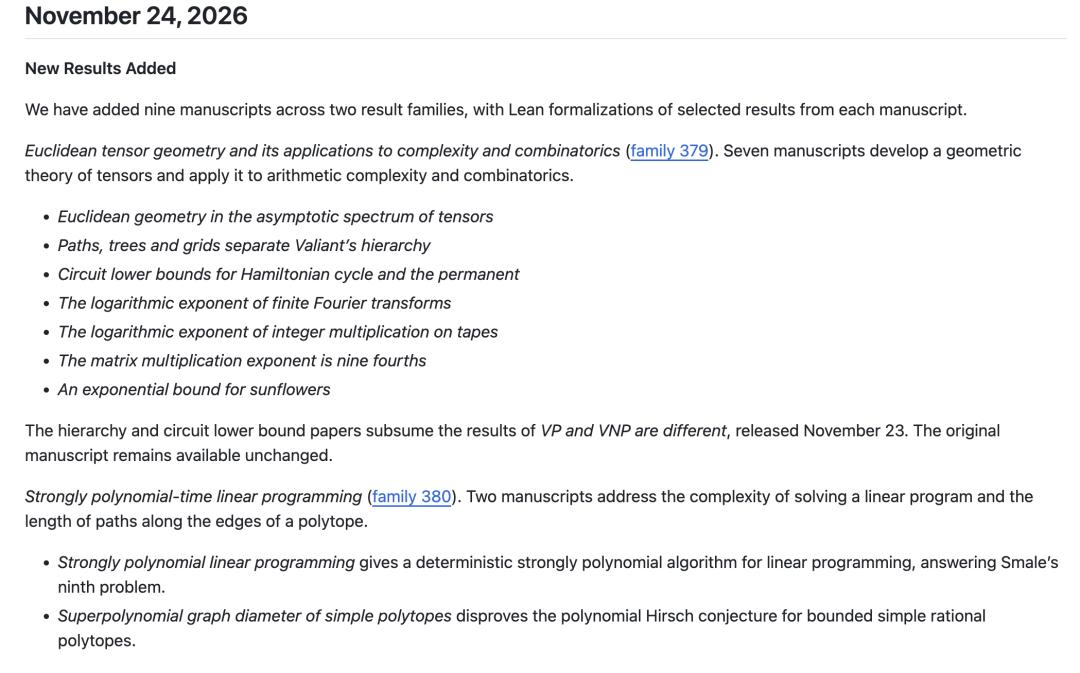
The 57-year-old limit of matrix multiplication that has puzzled humanity is precisely locked; Smale's 9th problem is perfectly solved; the sunflower conjecture has reached its final conclusion...
Moreover, OpenAI also released the Lean formalized proof synchronously.
Mathematics research has entered a new stage: within 37 hours, three parties submitted their results one after another: yesterday Claude published the proof of VP≠VNP, then OpenAI released 9 papers, followed by Google's 6 papers.
In the past, whether a proof was valid was decided by reviewers and journals. Now the machine submits both the proof and the Lean formalization (the Lean part has not been made public yet), the papers are directly posted on GitHub, and reviewers have become acceptance inspectors.
What did the 9 papers crack?
In the update list, the 9 papers are clearly divided into two major camps. Each camp corresponds to the ultimate truth that humanity has been pursuing painstakingly for more than half a century.
Tensor Geometry and Computational Complexity (Family 379)
This lineage includes 7 manuscripts:
Euclidean Geometry in the Asymptotic Spectrum of Tensors
Paths, Trees, and Grids Separate the Valiant Hierarchy (VP≠VNP)
Circuit Lower Bounds for Hamiltonian Cycles and Permanents
The Logarithmic Exponent of the Finite Fourier Transform
The Logarithmic Exponent of Integer Multiplication on Tapes
The Exponent of Matrix Multiplication is 9/4
Exponential Bounds for Sunflowers
AI has built a brand new theory, and used it as a weapon to solve multiple century-old problems in the fields of arithmetic complexity and combinatorics.
In the first paper, *Euclidean Geometry of the Asymptotic Spectrum of Tensors*, the AI is not solving a specific problem, but creating a "ruler" out of thin air.
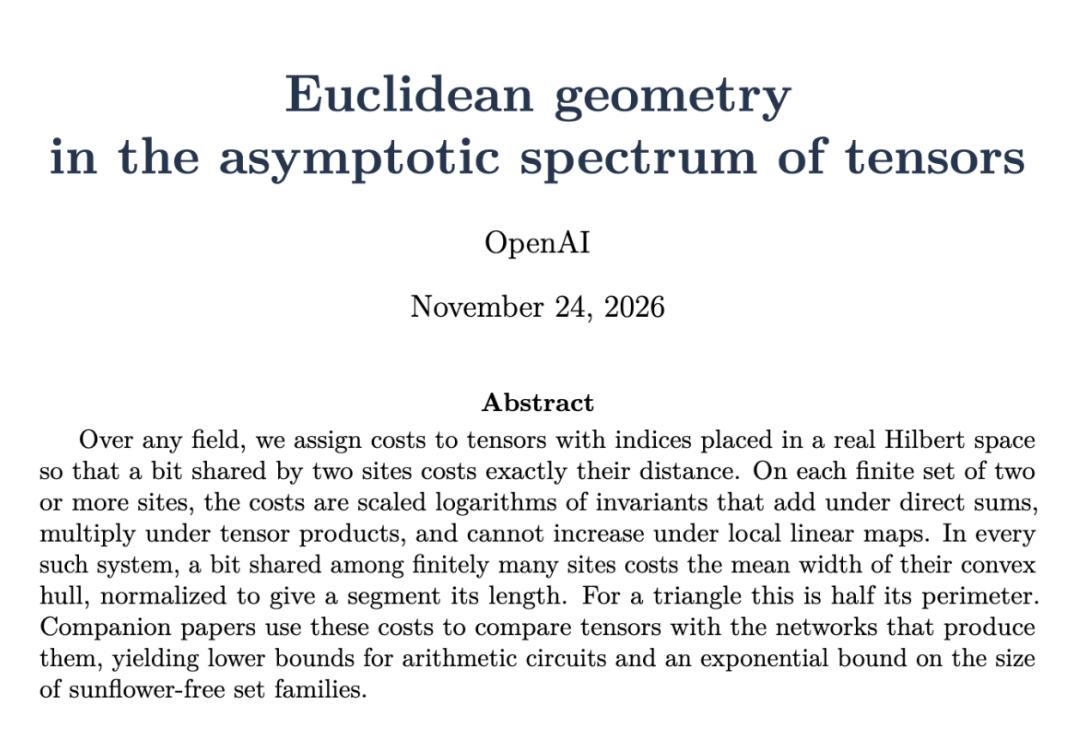
It places the abstract "tensor indices" in algebra into space as geometric points.
If two points share one bit, the computational cost is exactly equal to the distance between the two points; if three points share one bit, the cost is half the perimeter of the triangle.
After creating the ruler, the remaining 6 papers began to use this ruler to measure several cornerstones of modern computer science: matrix multiplication, fast Fourier transform, integer multiplication, Hamiltonian circuits...
After measuring them one by one, the ceiling of what computers can compute is directly clarified.

The most shocking result is that the 57-year long journey of matrix multiplication has come to an end!
Matrix multiplication is the most fundamental cornerstone of modern computing. All training and inference of large models run on it at the bottom level.
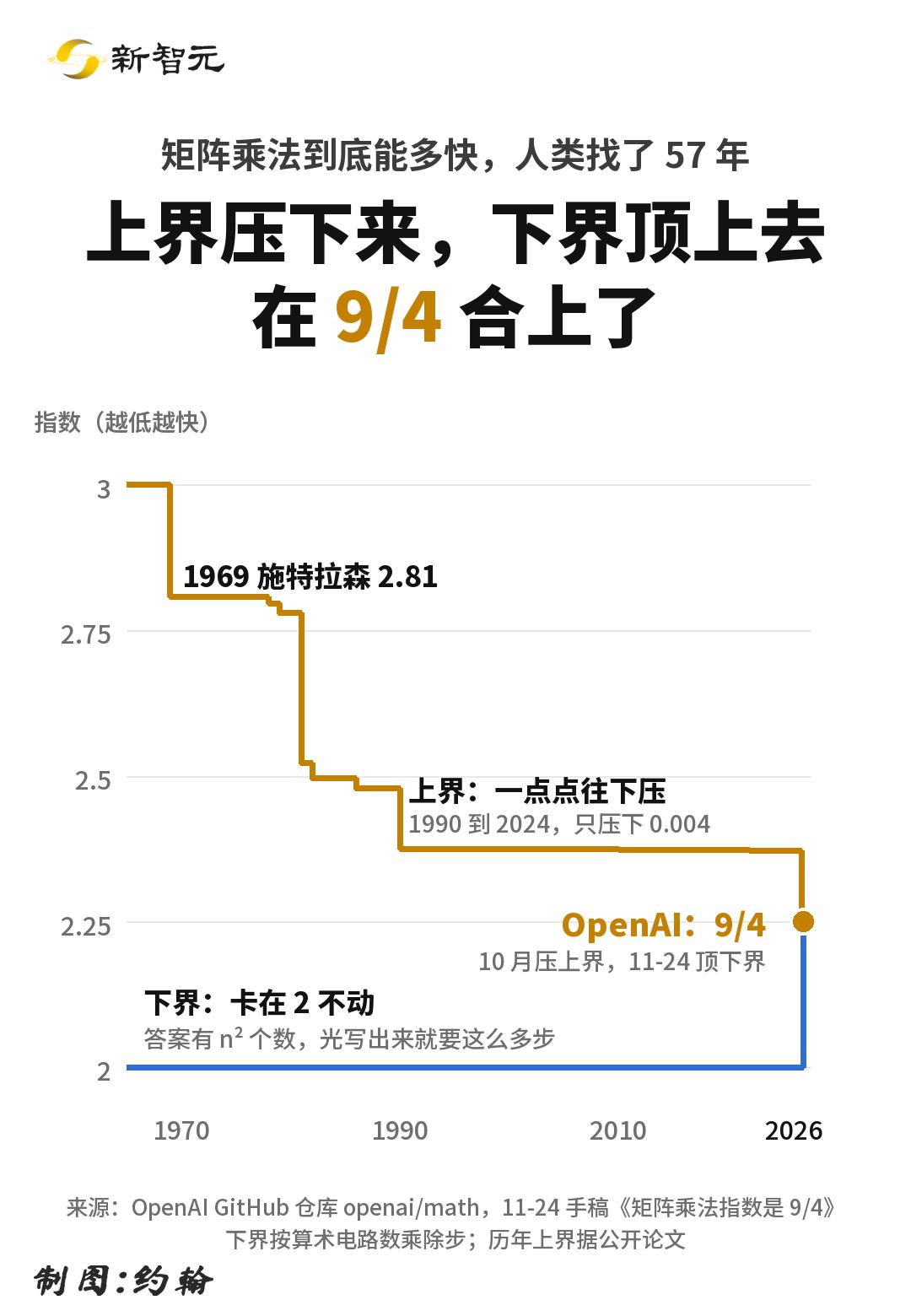
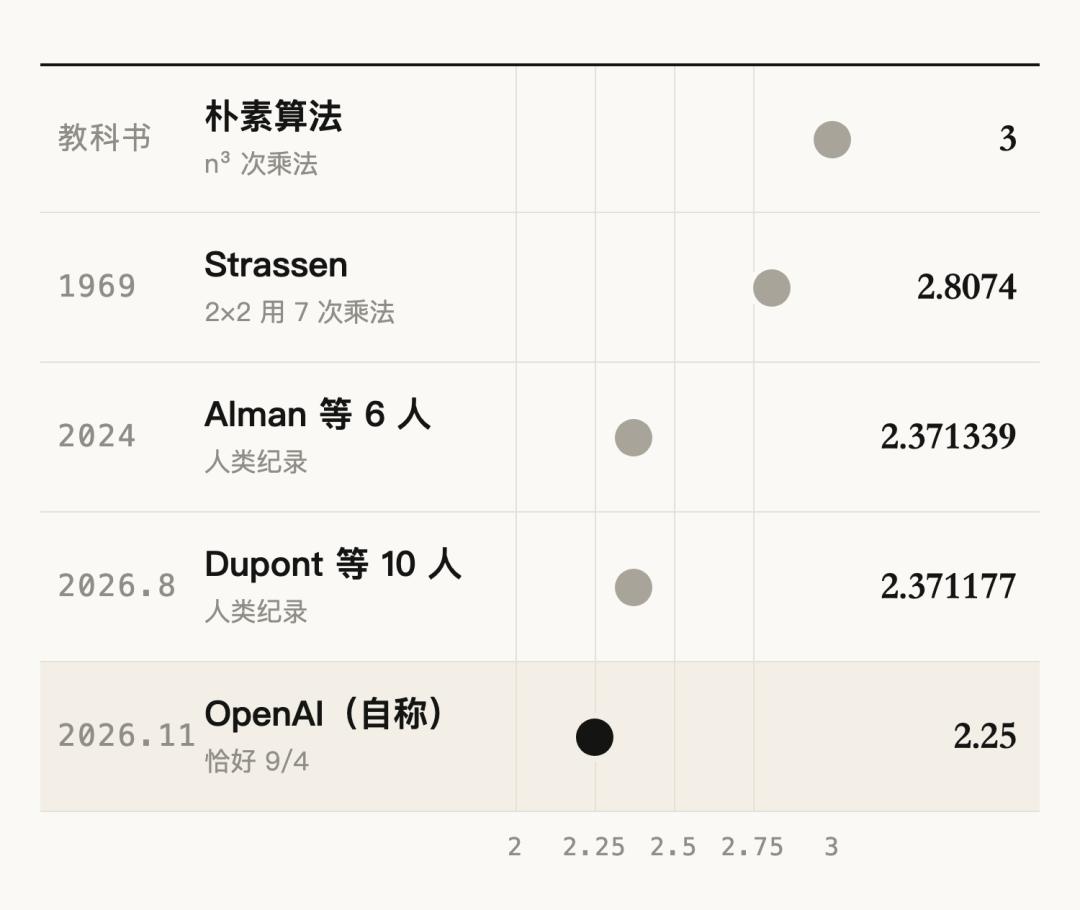
If we use the naive algorithm in textbooks, multiplying two n×n square matrices requires a total of n³ multiplications. At this time, the operation exponent is 3.
For a very long time, everyone thought that n³ could not be changed.
It was not until 1969 that German mathematician Volker Strassen discovered that multiplying two 2×2 matrices does not require 8 multiplications at all, 7 is enough.
He reduced the computational complexity of matrix multiplication to O(n^2.807) (the exponent is approximately 2.8074).
Since that day, mathematical geniuses all over the world have started a "squeezing toothpaste" competition that lasted for more than half a century. Since the output result itself has n² elements, the algorithm must at least read or write all these numbers. Therefore, ω=2 is the absolute theoretical lower bound.
Humanity has always been hoping to push ω all the way down to 2?
But the reality is very cruel. After decades of hard work by generations of mathematicians, each breakthrough can only dig out a few more digits after the decimal point.
In 2024, the record was pushed to 2.371339; this August, the record was just pushed to 2.371177. For a full 57 years, humanity barely locked the range between 2 and 2.371177.
Today, OpenAI's model made a final decision directly: the end point is not 2, it is 9/4 (2.25), and it cannot be lower!
Interestingly, this "2.25" is actually put together by two halves.
The upper bound half was proven by OpenAI in the complex field in October this year, and then human mathematicians Houxi Lü, Amanov and others took over to extend it to every field.
The paper released this morning fills in the most critical lower bound: multiplying two n×n matrices requires at least

multiplications and divisions.
The authors use proof by contradiction to prove that any faster operation will violate the known mathematical bottom line, so the existing scheme has reached the cosmic limit. The unsolved case that has lasted for more than half a century has come to an end.
If matrix multiplication is "a little slower" than what humanity expected, the answers to the other two basic computations are just the opposite — they are even faster than what is taught in textbooks!
The Fast Fourier Transform (FFT) proposed by Cooley and Tukey in 1965 is the lifeblood of signal processing and communications. Every algorithm textbook says that it requires operations of the order of N⋅logN.
And in 2019, mathematicians just achieved integer multiplication of two n-digit numbers at the complexity of n⋅logn, and many people thought this was the bottom line.
As a result, the AI directly takes the square root of logN in the new paper.
In a linear circuit that only allows two-way weighted addition, FFT requires at most
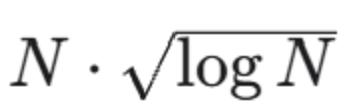
gates of this order; integer multiplication on a multi-tape Turing machine also only requires
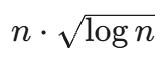
time of this order.
Therefore, when the data size N is one million, logN is about 20, and the result is less than 5, which directly saves a huge amount of theoretical computing power.
In addition, in another set of papers, the AI also cracked the "P vs NP" in the algebraic field (proving that VP and VNP in the Valiant hierarchy are strictly different).
It can be said that AI has issued an absolute order in the mathematical universe: Some ciphers and complex problems can never be cracked quickly with simple calculations, even if you compute until the universe is destroyed!
By the way, AI also finished the "sunflower conjecture" in combinatorics.
In 1960, mathematical masters Erdős and Rado proposed that as long as the number of a set of sets exceeds an exponential threshold, a group of structures like sunflowers can definitely be selected from it — there is a common core in the middle, surrounded by a circle of non-overlapping petals.
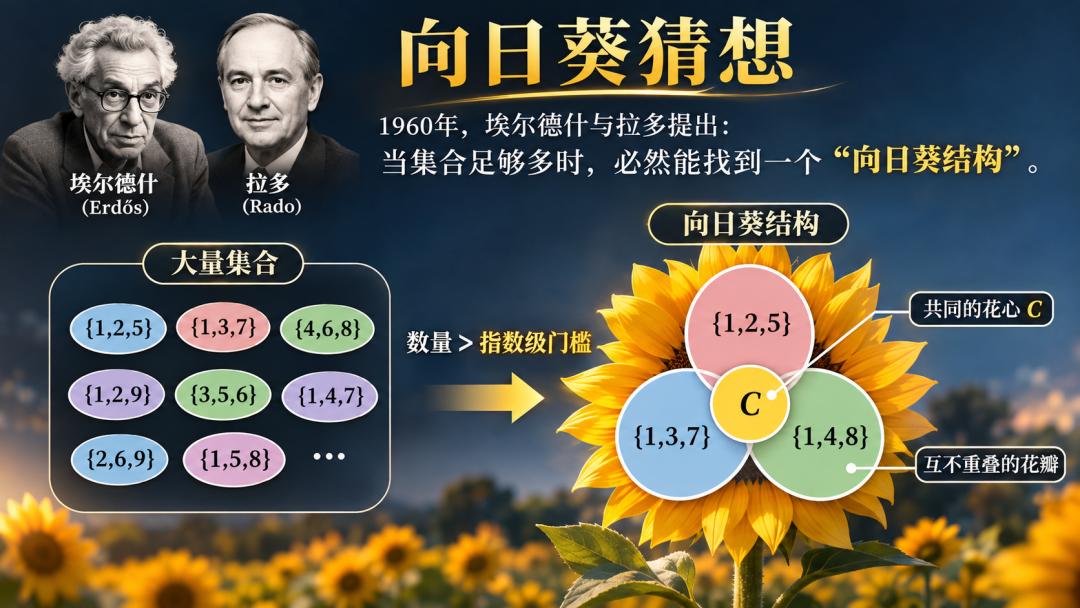
Just half a month ago on November 12, this conjecture was still marked as "unsolved" on the list. Today, with the number of petals fixed, the AI has completed the proof: they guessed correctly.
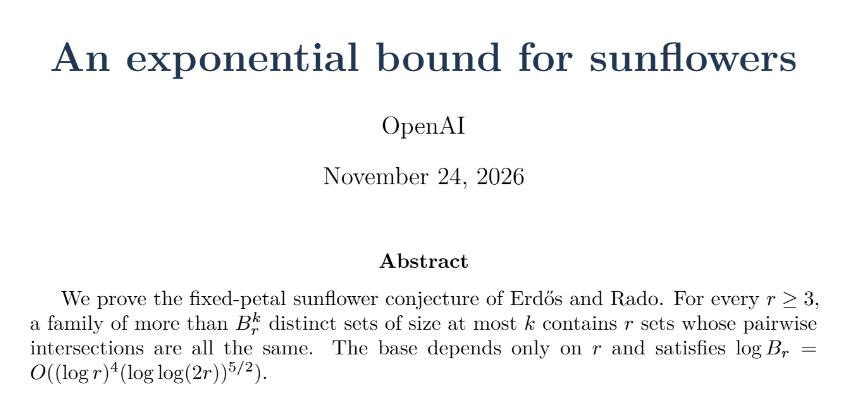
In the midst of extremely vast chaos, order is bound to be born.
The other path is completely blocked
If the first 7 papers are "deciding the life and death" of computers, the other 2 papers (Family 380) target the most valuable "operations research and optimization" in the real world.
How can logistics vehicles run with the least fuel consumption? How can food delivery platforms dispatch orders the fastest? Mathematically, these are all called linear programming.
In 1947, Dantzig invented the famous "simplex method".
You can imagine all feasible solutions as diamonds (polyhedrons). What the algorithm needs to do is to start from a vertex, walk step by step along the edges until you reach the optimal vertex.
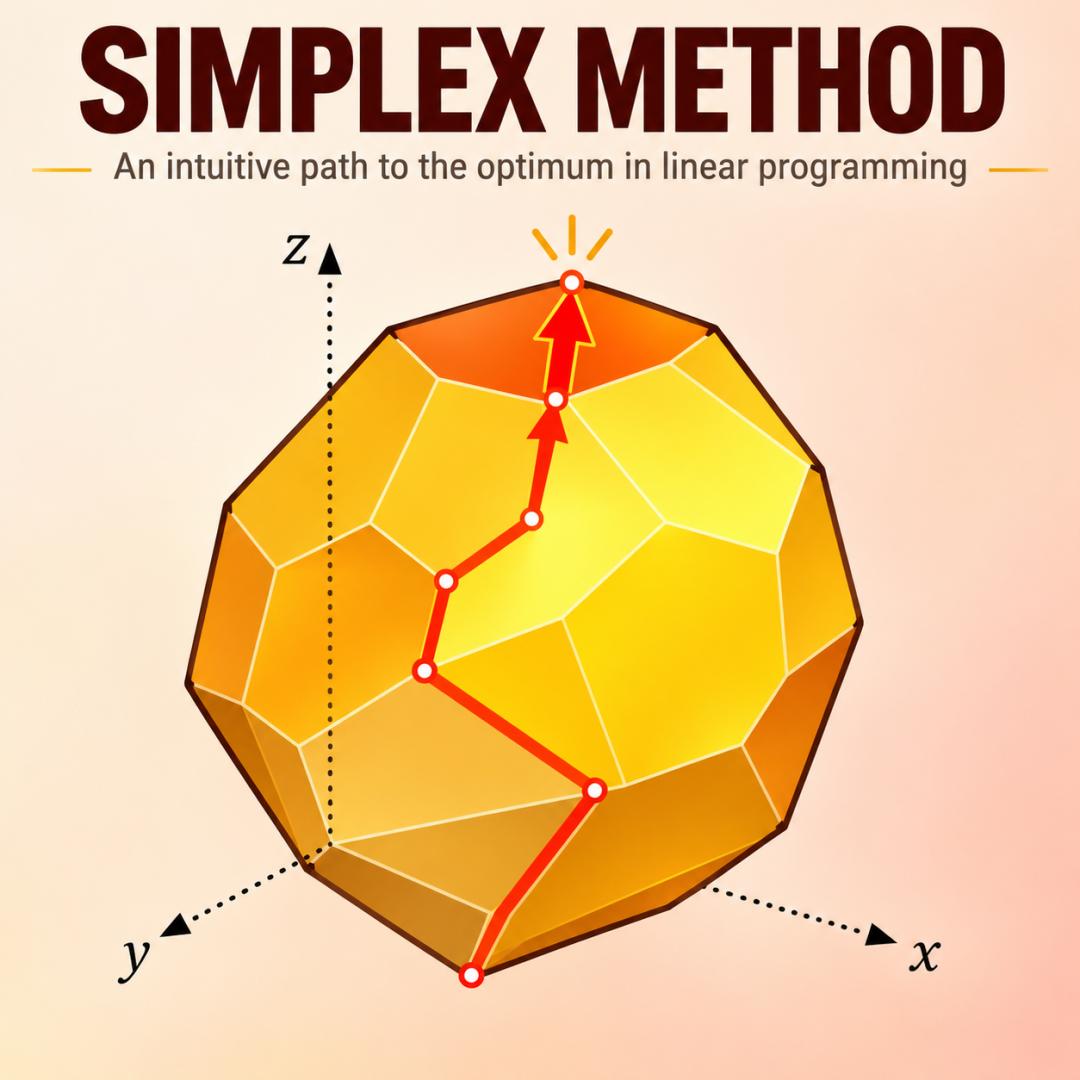
Later, people found that although linear programming can be solved, the number of calculation steps often increases with the length of the digits of the numbers.
In 1998, Fields Medalist Smale listed 18 major problems left for the 21st century.
The 9th problem is: Is there a super algorithm that calculates the optimal solution in time that only depends on the number of variables in the problem, and has nothing to do with how large the numbers inside are?
Today, AI gives a resounding answer in *Strong Polynomial Linear Programming* — Yes!
Not only does such an algorithm exist, it is also a deterministic algorithm, and the coefficients can be any real numbers. Along with it, convex quadratic programming and deterministic average payoff games are also made to run in strong polynomial time.
This means that in theory, no matter how extreme the financial or supply chain data is, the computer can give a perfect answer within absolutely controllable time.
But immediately after that, another paper poured a basin of cold water on humanity.
AI went back to measure the old path of the "simplex method". It constructed a class of polyhedra with n faces, and then proved that in this kind of high-dimensional maze, walking along the edges, the farthest distance between two vertices will be longer than any fixed power of n.
The "polynomial Hirsch conjecture" that has plagued humanity for decades has thus been overturned.
It's like two papers singing a duet: the first one tells you "the top of the mountain