With a generous donation of 17.8 billion US dollars, SpaceX has obtained the first "Space Data Center License".
As the approval of ground computing power projects continues to face mounting pressure, the space computing power track has witnessed a milestone regulatory breakthrough.
On November 25, the U.S. Federal Communications Commission (FCC) conditionally approved SpaceX to deploy up to 1 million satellites to form a computing power constellation named "Starmind" for on-orbit AI data processing.
This marks the first-ever issuance of a license for a space data center in U.S. history.
Boosted by this news, SpaceX's stock price, which once plunged more than 9% during intraday trading, was pulled back sharply, closing up 1.3% at $127.44.
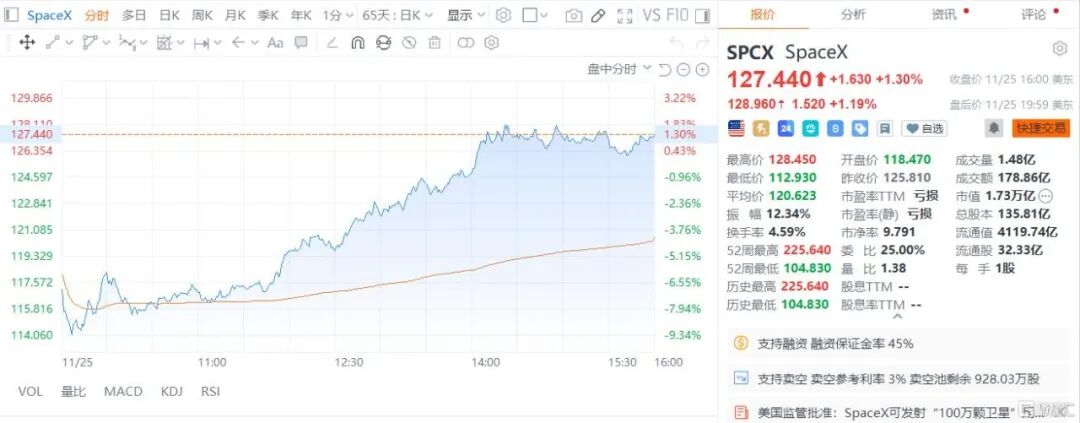
SpaceX Space Data Center Approved
This license is not an unrestricted one-time authorization.
According to the approval document, SpaceX needs to complete the on-orbit operation of the first Starmind satellite before November 2033, finish the networking of 100,000 satellites by 2035, complete half of the deployment scale by 2038, and finally realize the online operation of all 1 million satellites by 2040.
The technical path follows Musk's consistent idea of "bypassing ground constraints": the satellites operate in low Earth orbit at 500 to 2000 kilometers, obtain solar energy through continuous sunlight, and dissipate heat relying on space radiation, without consuming huge amounts of fresh water resources like ground computer rooms.
Laser links are used to transmit data between satellites. The FCC additionally approved radio frequency communication as a backup, with a downlink range of 18.8 to 19.3 GHz and an uplink range of 28.6 to 29.1 GHz.
However, the approval is only partial: to place satellites in orbits above 600 kilometers, SpaceX needs to submit a separate change application attached with a complete debris mitigation plan.
FCC Chair Brendan Carr stated bluntly that the United States is leading the world into the "superintelligence era", and this decision "opens up a bold new field" for computing power infrastructure.
At present, many researchers in the aerospace field remain cautious about this.
Data from the European Space Agency shows that there are about 16,900 satellites in orbit currently, and the approved upper limit is equivalent to 60 times the existing total.
It took Starlink seven years to send 11,195 satellites into space, and now it needs to sprint to the scale of one million satellites within 14 years.
Atmospheric scientists estimate that such a constellation requires about 5,000 Starship launches per year, while the total number of global orbital launches in 2025 is only about 330.
Astrophysicist Adam Becker pointed out that there is no air convection in vacuum, so heat can only be dissipated slowly by radiation, which has a physical limit. Once a debris cloud is formed by on-orbit collision, the chain reaction may affect meteorological and communication satellites.
"This will not come true, it is purely a fantasy."
It is reported that the FCC received more than 1,500 public comments during the publicity period, and the American Astronomical Society, Viasat and Amazon's Kuiper Systems jointly requested to reject the application.
Planned to Donate Approximately 17.8 Billion U.S. Dollars to "Trump Accounts"
Disclosed at the same time as the "Starmind" license is SpaceX's share donation plan for "Trump Accounts".
On Wednesday, SpaceX announced that it will donate one newly issued Class A share to each currently active "Trump Account".
In addition to the company's donation, Musk will also donate the same number of shares in his personal name, and Gwynne Shotwell, the company's President and Chief Operating Officer, has also made additional personal donations of more than 2 million shares.
Calculated based on the closing price of $127.44 on Wednesday and about 70 million accounts, the company and Musk each donated about 8.9 billion U.S. dollars, totaling about 17.8 billion U.S. dollars, which is more than twice the total donations received by the accounts as of October.
In response, the company stated that this donation aims to let the next generation of Americans share the company's ownership.
"SpaceX is building infrastructure for the future, committed to realizing the multi-planetary survival of mankind."
Some analysts pointed out that these shares cannot be disposed of until the children reach the age of 18, which is equivalent to adding a long-term lock-up to the floating share capital, and the short-term selling pressure is limited.
However, the risks cannot be ignored: the rights and interests of the accounts are directly tied to the fluctuation of SpaceX's valuation, and the decline in stock price will directly erode the assets of these minors. At the same time, large-scale equity dispersion to the public will also increase the communication and coordination costs in subsequent corporate governance and capital operation links.
Nevertheless, the impact brought by the donation event is medium and long-term, while there is another layer of supply pressure in the short term.
Around December 8, about 798 million restricted shares of SpaceX will usher in the lifting of the ban window.
Coinciding with the fact that the stock price is more than 40% lower than its 52-week high, the market is worried that the positive sentiment will be hedged by the supply impact of the lifted shares.
At present, analysts rate the stock as "Moderate Buy" with an average target price of $243.64.
Retail sentiment is relatively optimistic. On the Stocktwits platform, retail sentiment towards SpaceX has shifted from "Neutral" to "Bullish" in the past 24 hours.
This article is from the WeChat Official Account "Gelonghui Finance Hotspot" (ID: glh_finance), written by Shanding de Taiyang, and authorized for release by 36Kr.