With growing expectations of industry reshuffling, are robots eyeing retail offers?
Co-founders of multiple leading embodied intelligence companies including Qianxun Intelligence, Galaxy Universal, and Star Era recently gathered at a roundtable to discuss how embodied intelligence companies can survive through industry cycles, focusing on topics such as the impact of large language models and industry prospects.
How to balance technological R&D and commercial implementation has become the focus of this discussion. The widespread consensus among speakers is that embodied intelligence has entered its second half, and enterprises need new commercialization models to survive. The industry will also conduct more rigorous assessments of new scenarios and new implementations behind each enterprise's technological innovation.
Wang He, founder of Galaxy Universal, predicts that the industry will face a reshuffling period in 2027, with resources rapidly concentrating towards top players. "This track is a vast ocean of opportunities. If we only focus on implementation at this stage, without reducing technology costs, we still need to build a solid hardware-software closed loop and achieve continuous implementation."
The Fourth Wave has observed that since the middle of this year, embodied intelligence manufacturers have begun to more extensively seek POC scenarios or pursue commercial closed loops. More and more robots are "walking" into production lines and logistics warehouses to complete corresponding instruction tasks.
At the same time, another commercialization competition experiment is quietly unfolding on urban streets. Enterprises represented by Galaxy Universal, SenseTime, and Zhipingfang have all deployed robots in retail scenarios such as pharmacies, convenience stores, and cafes.
Different from the relatively closed industrial environment, retail scenarios feature frequent product updates, random orders, and diverse interaction forms with customers, which adds more variables to the on-site service of robots.
Since the beginning of this year, The Fourth Wave has visited multiple robot retail scenarios at different time periods, and found that the robots of some manufacturers are still limited to display functions, with problems such as the final delivery of orders to customers still requiring manual assistance, robots being forced to stop "working" due to overheating during operation, or being unskilled in operation links leading to long time consumption.
Of course, a small number of manufacturers have passed the POC stage and gradually carried out large-scale deployment. On the whole, in retail scenarios, most robots are "demonstrating work", while very few can actually help "generate profits".
Robots Take Over as "Store Clerks"
In the embodied intelligence industry, attempts in retail scenarios are not new.
Long before this round of embodied intelligence wave, business formats such as unmanned convenience stores and vending machines had gone through multiple rounds of commercialization attempts. An industry insider who has long paid attention to embodied intelligence said that unlike the previous retail automation promotion that transformed the environment, this round of attempts by embodied intelligence enterprises to enter retail needs to transform robots to adapt to scenarios if they want to "succeed", "otherwise, it will mostly stay at the level of brand display, and may not even bring positive effects."
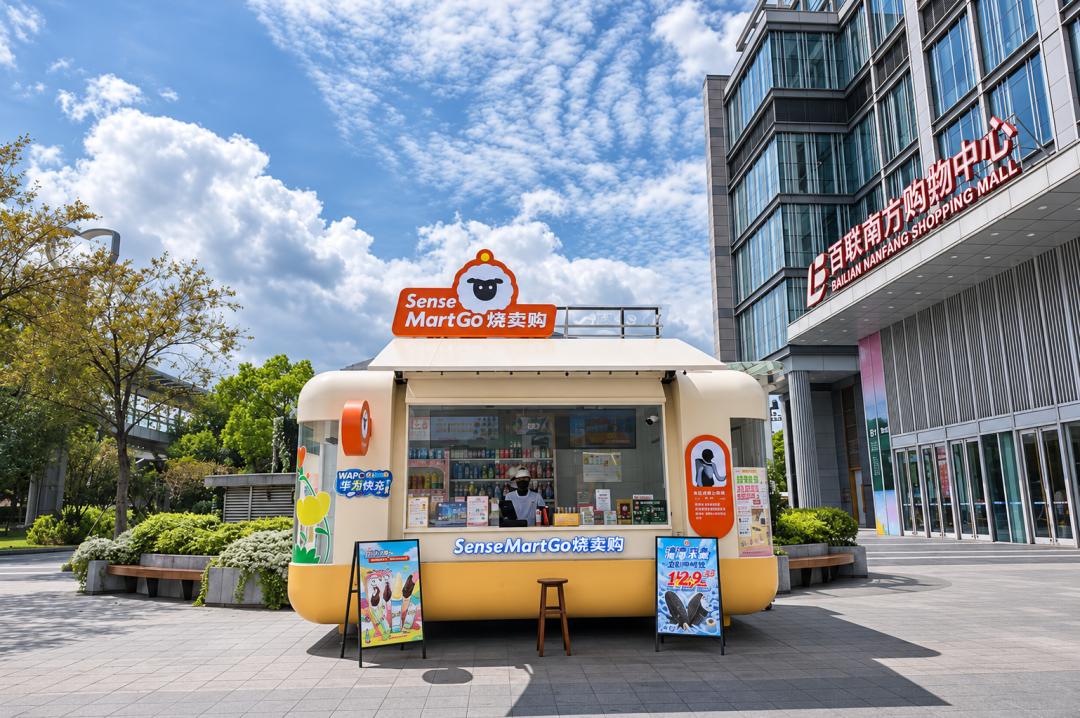
The Shaomai Go robot store launched by SenseTime Shanhui
According to incomplete statistics from The Fourth Wave, at least 10 domestic robot and embodied intelligence enterprises have extended their commercial reach to the retail sector, covering segmented scenarios such as pharmacies, convenience stores, catering, and supermarkets.
Classified by role, they can be roughly divided into three categories: instant retail and product fulfillment type represented by Galaxy Universal, Dome Intelligence, and Ant Lingbo; scenario service type for convenience stores, cafes and catering represented by SenseTime, Zhipingfang, and Sharpa; brand display type represented by enterprises such as Unitree Robotics.
Many industry insiders, including Zhao Hao, assistant professor of the Institute for Intelligent Industry Research of Tsinghua University, mentioned when communicating with The Fourth Wave on the topic of real or false demands for robots entering retail scenarios that at this stage, when deploying robots in retail scenarios, it is necessary to observe the incremental value for users, merchants and manufacturers.
Scalability is the assessment criterion for manufacturers unanimously mentioned by the above industry insiders. Previously, Wang Xiaogang, founder of Daxiao Robot, also mentioned in exchanges with institutions including The Fourth Wave that by the end of this year, Daxiao Robot will achieve the deployment plan and target of 1000 units in retail scenarios.
Wang Xiaogang also mentioned that hotels and retail are relatively realistic scenarios, and the greatest value lies in the data generated by robot interaction in real scenarios. In his view, the premise for manufacturers to successfully deploy robots in batches in retail scenarios is sustainability and cost control. This requires robots to not only grasp goods, but also have more abundant skills such as heating sandwiches and making coffee to improve consumer experience. "Only this model can be widely accepted, scaled up, and achieve profitability within the specified period."
In the industry, according to publicly disclosed data, Galaxy Universal is a referential sample that has started large-scale implementation and deployment. This startup that bets on "full-stack self-developed general brain" chooses a differentiated scenario route of prioritizing retail first, then industry.
The Galaxy Universal Capsule retail outlet, its core product for commercial implementation, was deployed in August 2025, and its core "store manager" is the company's self-developed embodied large model robot Galbot. According to the introduction, Galbot can complete full-process services such as purchase reception, order placing and payment, product delivery, and multi-language interaction.
The Fourth Wave saw at the Galaxy Universal Capsule operation point in Zhongguancun, Beijing that in addition to a wheeled Galbot, there is also a staff member in the capsule, which mainly sells hot drinks, bottled beverages, and a small number of snacks and cultural and creative products.
Customers place orders through the tablet, and Galbot completes the entire process of picking up and delivering goods. For finished bottled beverages, it takes about 30 seconds from order placement to receipt; for hot drinks, customers can get the products in about 2 minutes including production time. "The capsule meets the retail demand of immediate purchase and takeaway, which is more convenient than convenience stores that are a certain distance away," said a consumer.
According to Zhang Zhizheng, co-founder of the company, Galaxy Capsule has completed deployment of 200 sites in 50 cities across China. In March this year, Galaxy Universal also cooperated with FamilyMart to launch a normalized robot service project in Beijing, allowing robots to participate in real commodity transactions, and verifying product capabilities and business models through continuous operation.
Manufacturers Set Sights on More Segmented Retail Scenarios
It is worth mentioning that in the retail market with many segmented business formats, multiple embodied intelligence enterprises have unanimously set their sights on pharmacies. In addition to Galaxy Universal, Dome Intelligence, Ant Lingbo, Dobot, and Qianxun Intelligence have also officially announced their progress in smart pharmacies respectively.
During this year's WAIC, Galaxy Universal brought the pharmacy scenario to the venue for external display. According to the staff, after an offline takeaway order is received in the pharmacy, Galbot will independently find the corresponding shelf, identify and grab the medicine, check the product information, then complete the packaging and send it to the intelligent pickup cabinet. The whole process only takes about 90 seconds. This solution obtained the Pharmaceutical Business License in March this year, and Galbot has become the first "certified" robot salesperson in pharmacies across the country.
Dome Intelligence also demonstrated its smart pharmacy solution at WAIC. It focuses on the "embedded upgrade" mode, which allows robots to deeply participate in the daily fulfillment of stores without breaking the original operation mode of the stores.
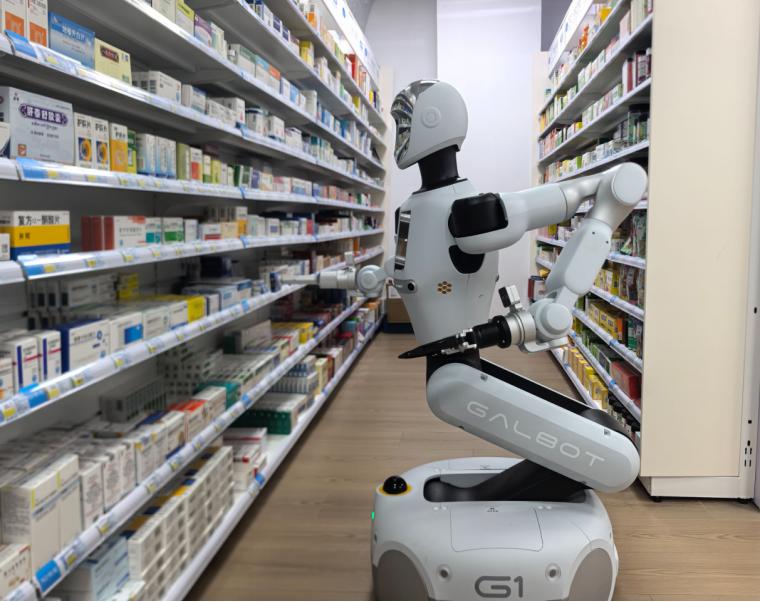
Galaxy Universal deployed at Laobaixing Pharmacy in Shanghai
According to public data, among the above five manufacturers, only Galaxy Universal has achieved normalized operation and multi-site deployment across regions. Galaxy Universal stated that its Shanghai model store fulfills 400-500 orders per day on average, with an average order fulfillment time of 68 seconds, and 100% picking accuracy. This warehousing and logistics robot has been deployed in more than 30 cities across China, mainly to solve the problem of night shift on duty in pharmacies. In addition to meeting emergency medication needs, it has cumulatively served more than 1 million orders and delivered more than 3 million boxes of medicines.
Dome Intelligence stated that its solution has been put into trial operation in Shenyang, with a picking success rate of 99%, 100% shipment accuracy, an average picking time of about 120 seconds per order, and a maximum daily fulfillment of more than 100 orders; Ant Lingbo has not disclosed the actual daily order volume; Dobot is still in the scenario verification stage, stating that it has completed the full-process operation verification of smart retail stores; Qianxun Intelligence only officially announced the strategic cooperation news with JD Pharmacy.
The fact that multiple embodied intelligence enterprises have set their sights on pharmacies indeed provides space for the industry to observe the commercialization of embodied intelligence. For example, the common feature of the implementation exploration of Galaxy Universal and Dome Intelligence is to retain the original shelves and operating systems of pharmacies as much as possible, without making structured transformations, so that robots can adapt to existing stores.
In Zhao Hao's view, although the industry has not reached a consensus on robots entering convenience stores, for pharmacies with increasing instant retail orders, using robots to participate in operation is "an obvious new idea to improve efficiency".
Specifically, pharmacies have a large number of SKUs, but their fulfillment process is relatively standardized. Each link including product identification, picking, verification, and packaging has clear task objectives. This is neither a highly structured industrial scenario nor a household scenario with many variables. Instead, it is a "natural examination room" that can simultaneously test the generalization capabilities of manufacturers and their ability to translate technical performance into quantifiable operating indicators.
The application scope of embodied intelligence is expanding continuously, from convenience stores, ice cream production to more segmented pharmacy scenarios. At the aforementioned roundtable event, Wang Donglin, founder of Westlake Robot Technology (Hangzhou) Co., Ltd., said that the law of commercialization is not that large-scale and extensive application suddenly appears one day after the technology matures, but that commercialization is carried out in a gradual and penetrating way.
Wang Zhongyuan, Dean of the Institute of Intelligent Computing, also mentioned that the technology has not yet reached a stage where it can be used for large-scale commercialization. It is necessary to distinguish which belong to demonstrative verification and which belong to real demand-driven verification. Those orders that only rely on demonstrative verification are not enough to support the entire industry.
Although the exploration of "Galaxy Universal" and other players in retail scenarios is still some distance from the final answer, the pioneers have already provided some experience that can be used for reference.
After all, before stepping into a more open physical world, robots need to experience enough real orders, random tasks and business cycles. Whether it can run stably in real scenarios for a long time, generate continuous orders and achieve large-scale delivery will more directly determine the future commercial space of this enterprise.
This article is from the WeChat official account "The Fourth Wave", written by Qiu Hui, and published with authorization from 36Kr.