36Kr Exclusive | Oxford PhD Team Bypasses Lithography Equipment to Fabricate High-Dimensional Optical Computing Chips Using Glass, Secures Exclusive Angel Investment from Inno Fund
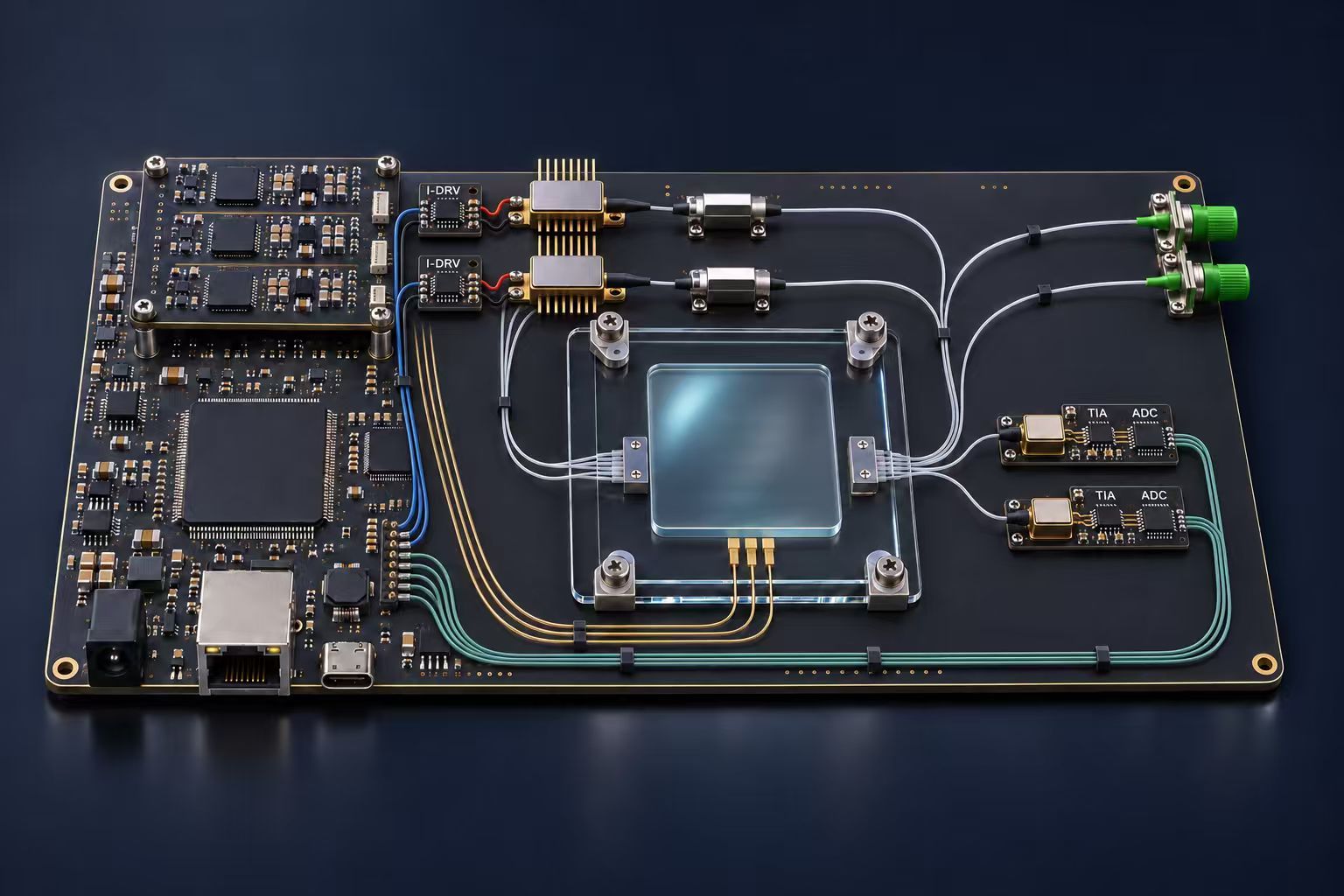
Image Source / Enterprise
This article contains approximately 2400 words, with an estimated reading time of 6 minutes
Author | Ou Xue
Editor | Yuan Silai
Hard Krypton learned that Wanxiang Constant, an optical computing chip company, has recently completed tens of millions of yuan in angel round financing, exclusively invested by Inno Fund. The funds from this round will be mainly used for the prototype development of optoelectronic hybrid verification boards, the construction of femtosecond laser direct writing equipment and optoelectronic laboratories, and the expansion of the core R&D team. Taihe Capital served as the financial advisor for this round of financing.
Founded in 2026, Wanxiang Constant is committed to building the next-generation optical AI accelerator with glass. The company's core team consists of several doctors from the University of Oxford. Among them, founder Han Qihao holds a doctorate in optoelectronics from the University of Oxford. He has been engaged in analog and digital integrated circuit design during his undergraduate and master's stages, and turned to the field of optoelectronics during his doctorate. The research group has accumulated decades of scientific research experience in various optoelectronic applications.
In the current optical computing track, the technical routes are far from converging. Solutions such as silicon photonics, thin-film lithium niobate, phase change materials, metasurfaces, and spatial optical computing are blooming, but all are facing the practical tests of engineering and mass production costs. The path chosen by Wanxiang Constant is quite differentiated, creating the world's first optical computing technology path with a piece of glass.
"If the whole process is made of glass, it is equivalent to bypassing the lithography machine process, so we will not be restricted by external supply barriers," Han Qihao told Hard Krypton. Advanced process silicon photonic chips rely on overseas tape-out, which has a long cycle and high cost. With glass substrate and femtosecond laser direct writing, a chip can be produced in a few hours once the equipment is in place.
This feature gives Wanxiang Constant natural advantages in prototype verification and iteration speed. "Compared with silicon-based chips, we make chips faster, and verification is easier and more convenient," Han Qihao said.
The cost advantage is more intuitive: glass substrates are dozens of times cheaper than silicon-based bare chips. In addition, the glass solution also provides a feasible engineering scheme for the subsequent 3D stacking of optical chips. By writing waveguides layer by layer inside the glass with a femtosecond laser, each layer can participate in the calculation, thereby improving space utilization and computing power density.
Han Qihao believes that glass substrate is currently the best solution to realize 3D stacking of optical chips. "When you realize 3D stacking, the computing power density will definitely increase, and the space utilization rate will also improve."
In terms of the supply chain, Wanxiang Constant has connected with many photonics chip, LCD industry chain and femtosecond laser equipment manufacturers. Looking at the whole link, every part has mature suppliers in China.
At present, the company has completed the verification of the principle stage, and is promoting the prototype development of the optoelectronic hybrid verification board, which is expected to be sampled by the end of this year. In addition, the company has basically run through the entire upstream link, and the entire design of computing chips from processing, packaging to forming is self-developed.
As the optical computing industry as a whole is still in its early stage, it is difficult to achieve large-scale revenue relying on optical computing chips in the short term. Wanxiang Constant's strategy is to "walk on two legs": on the one hand, promote the joint verification of optical computing boards in data centers, and on the other hand, use the optical path modulation capability of materials to take the lead in landing derivative optical products such as OCS (Optical Circuit Switching) and spatial light modulators.
Han Qihao said that the derivative business will not affect the ultimate goal of optical computing, but can form a certain commercial transformation in the early stage.
In Han Qihao's view, the optical computing industry currently has four notable characteristics: first, the technical routes are far from converging, everyone is groping in the dark, but the market expectation is extremely high; second, optical computing is good at specific operations such as matrix multiplication and addition, cannot perform complex calculations in AI training, and nonlinearity is a bottleneck to be broken through; third, optoelectronic collaboration is the core of the product, and pure optical storage and computing is still far away; fourth, from small-scale demonstration to available products, the engineering difficulty gradually increases, and the yield, accuracy, calibration and consistency will all be affected.
"There is no fully mature engineering solution in the optical computing industry, and many things need to be explored by ourselves," Han Qihao believes that this is the company's biggest challenge at present — the team has a solid academic background, but the array expansion and engineering problems before chip mass production need to be solved from scratch.
For future plans, Han Qihao said that the most realistic goal in the near term is to complete the large-array optical computing engineering prototype, optoelectronic hybrid verification board and joint verification, complete product verification and large-scale iteration of single-core computing in real scenarios (such as robots, drones, cameras, industrial vision, etc.), and then use the multi-core solution to meet the computing power demand of data centers, launch AI inference acceleration boards or computing modules, which can be used in cooperation with general-purpose computing chips such as CPU/GPU. "The rigid interest of data centers in optical computing has laid the largest application market in the medium and long term," Han Qihao believes.
"Our long-term goal is to solve the energy efficiency and speed problems in AI inference scenarios, especially the requirements of high parallelism, low latency and low power consumption. But at this stage, we are still in the stage of technical and engineering verification," Han Qihao admitted.
The following is an excerpt of the conversation between Hard Krypton and Han Qihao, the founder of the company (edited):
Hard Krypton: There are many technical routes in the optical computing track. What is the core consideration for Wanxiang Constant to choose "glass + femtosecond laser direct writing"?
Han Qihao: Initially, at relevant events, I saw many peers also doing optical computing, and realized that this direction already has an entrepreneurial ecosystem in China. After returning to conduct research, I found that all technical paths have not completely converged, and they are still in the exploration period of rapid development with diverse solutions emerging.
Our technology uses glass substrates, which is highly innovative, and there is no completely identical solution in the world for the time being. Using glass can realize 3D stacking, which is a great advantage.
Hard Krypton: You mentioned that the industry's technical routes have not converged, so how does Wanxiang Constant judge that the direction it has chosen is correct? Are there phased verification nodes?
Han Qihao: We won't wait for the routes to converge before taking action, but use the method of small steps and fast iterations for verification. We have completed principle verification and small sample tests in the laboratory stage, and are now promoting the prototype of the optoelectronic hybrid verification board, which will be sampled by the end of this year; we will enter the data center for joint verification after the Spring Festival.
The advantage of glass substrates is fast verification. Silicon photonic tape-out requires queuing for several months, and we can produce a chip in a few hours, with much lower iteration cost.
We look at three nodes in stages: whether the prototype can run smoothly, whether the data center verification is passed, and whether the yield and accuracy can be stabilized after the array is expanded. If these nodes are gradually fulfilled, it means that the path is feasible. Of course, we also recognize the industry consensus that optical computing is good at matrix multiplication and addition, nonlinearity is still a bottleneck, and optoelectronic collaboration is the core. We will not describe potential advantages as verified results.
Hard Krypton: At present, leading manufacturers in the optical computing track have begun to bind the supply chains of large customers. As an early team, what does Wanxiang Constant rely on to cut into the customer system?
Han Qihao: We do not seek to compete head-on with NVIDIA and Huawei in general scenarios. Our strategy is to seize the differentiated advantages of specific application scenarios — for example, the demand for low power consumption and fast response in vertical inference scenarios, our solution has obvious advantages in energy consumption, computing power and cost in these scenarios. To do the same thing, our cost is lower and energy consumption is lower, and we can take the lead in applying after running through in several scenarios. At present, we have had early communication with some data centers, but it is still in the product verification stage.
Investor's View:
Inno Fund said: With the accelerated popularization of AI applications, the demand for computing power is growing rapidly. Optical computing is expected to become an important supplement to the next-generation computing power system by virtue of its advantages in energy efficiency and parallel processing. The core team of the company all have doctorate backgrounds from the University of Oxford, with majors covering optics, materials science, 3D photonic chips and integrated circuits, with solid scientific research accumulation and complementary capabilities. The company independently develops a 3D reconfigurable optical computing architecture that takes into account both linear and nonlinear computing and has the advantage of low power consumption. Relying on the mature domestic industrial chain, this technical route is expected to reduce mass production costs and expand to various types of computing power scenarios, with the potential to develop into a platform-based company.