Just now, Google released six major mathematical results, ushering in a new breakthrough in integer factorization algorithms for the first time in 34 years.
Everyone, pause for a moment from discussions about the Riemann Hypothesis and other Millennium Prize Problems.
Because Google has dived headfirst into the mathematics community, bringing its own AI along for the show!!!
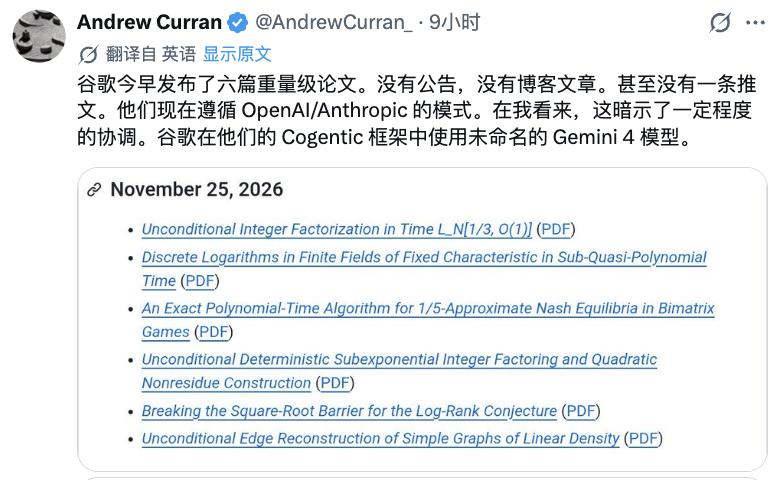
Just recently, Google publicly released 6 research results independently completed by Cogentic, a mathematical research Agent system driven by Gemini 4.
From the underlying hard problems of modern cryptography to classic conjectures that have plagued the mathematics community for more than half a century, this time Gemini 4 specifically picks the toughest nuts to crack:
It might not feel intuitive at first, let's take a direct look at how "impressive" Google's achievements are this time ——
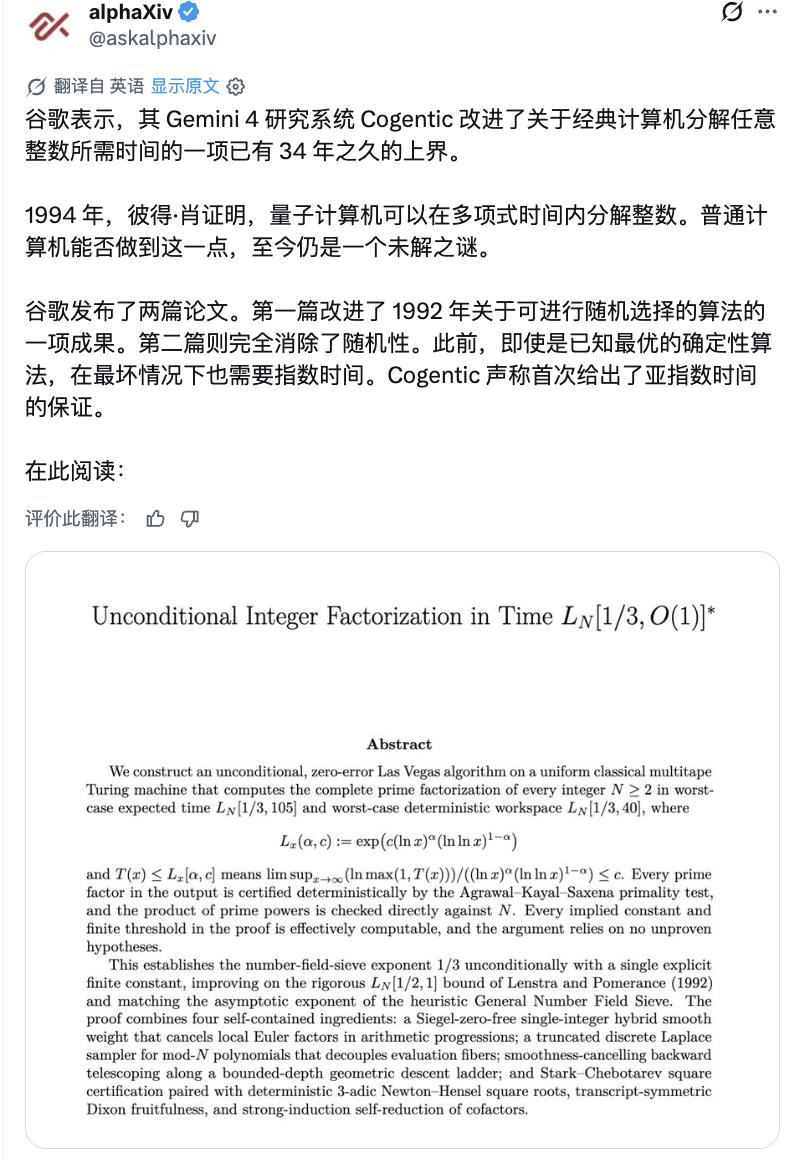
Random Integer Factorization: The strict theoretical complexity exponent is reduced from 1/2 to 1/3, improving the classic result from 1992.
Deterministic Integer Factorization: It is claimed to have achieved unconditional sub-exponential time deterministic integer factorization for the first time.
Discrete Logarithm: The discrete logarithm calculation algorithm in specific finite fields is improved.
Nash Equilibrium: The accuracy of the polynomial-time approximation algorithm in two-player games is further improved.
Log-Rank Conjecture: The square root upper bound barrier that has stood since 2014 is broken.
Edge Reconstruction Conjecture: The provable scope of the classic graph theory conjecture proposed in 1964 is further expanded.

The most astonishing part is that according to the disclosure in the papers, humans only provided one initial Prompt in the whole process, and the complete mathematical proof was completed independently by the AI.
Moreover, Google also announced that all 6 achievements have completed Lean 4 formal verification, and relevant documents will be released later.
Google, better late than never, this is absolutely brilliant!!!
Tackling 6 Major Mathematical Problems in One Go
Let's first look at the transcript Google handed in this time.
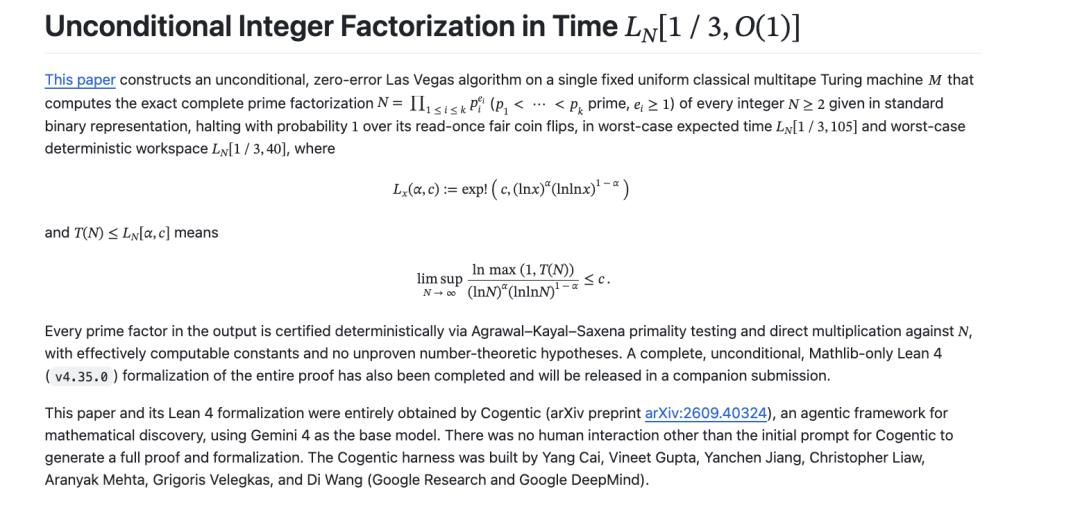
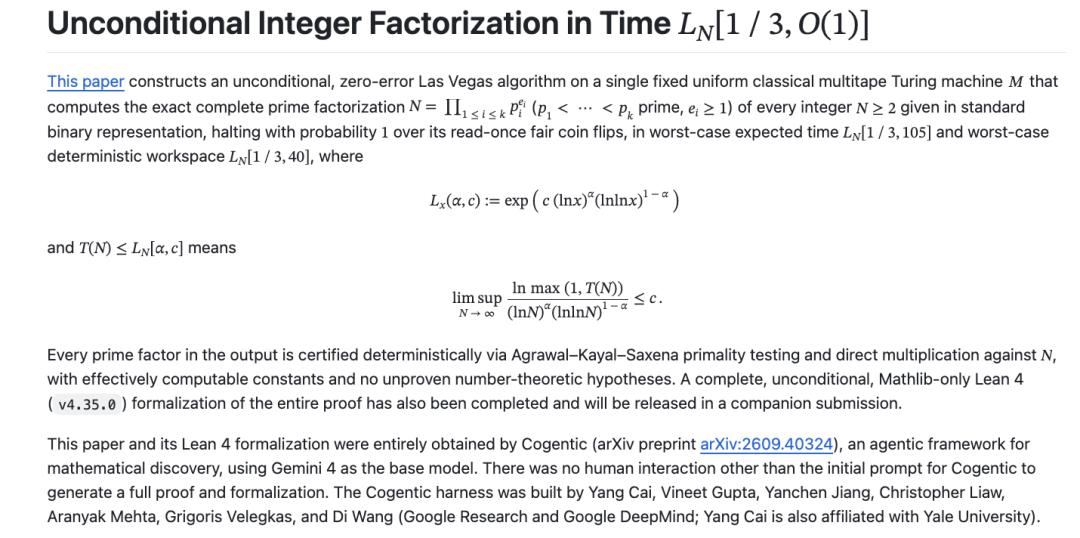
All 6 papers are produced by Google's mathematical research agent system Cogentic, with the base model being Gemini 4.
The rules of the game are as follows, according to the disclosure on the front page of this integer factorization paper ——
Researchers only provided one initial Prompt, requiring Cogentic to generate a complete proof, and there was no further human intervention after that.
Up to now, this system has publicly released 10 mathematical research papers in total, and the 6 newly added papers this time add up to a full 274 pages???
Moreover, from number theory, cryptography to game theory, communication complexity and graph theory, Gemini 4 is almost conducting scientific research across different disciplines.
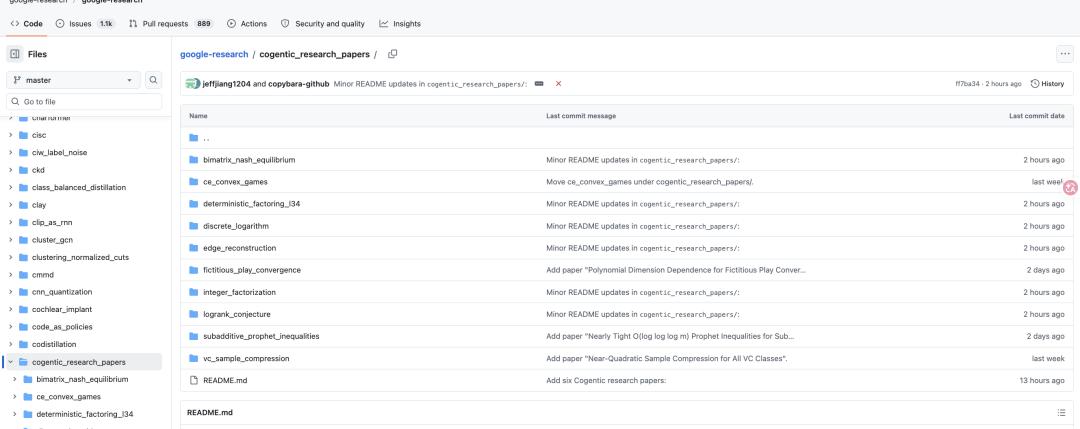
One of the most high-value achievements is the mathematical problem that is directly related to the underlying foundation of modern cryptography —— "Integer Factorization".
For this single problem alone, Gemini 4 has presented new theoretical breakthroughs from two directions: random algorithm and deterministic algorithm respectively.
It should be noted that the widely used RSA encryption system today has its security built on the basis that large integers are difficult to factorize quickly.
When multiplying two large prime numbers, a computer can easily output the result, but it is extremely computationally difficult to reverse and find the two original prime numbers.
For decades, mathematicians have been trying to reduce the computational complexity of this problem.
One of the unsolved hard problems is:
How to make the integer factorization algorithm run faster without relying on any unproven mathematical assumptions?
At present, the fastest general-purpose classic integer factorization algorithm in practical applications is the General Number Field Sieve (GNFS).
But the awkward part is that although mathematicians can estimate its operating efficiency through heuristic analysis, they have not been able to give an unconditional strict proof of the same complexity order.
For random algorithms with strict theoretical guarantees, the upper bound of complexity has long stayed at the classic result given by Lenstra and Pomerance in 1992.
This record has stood firm for 34 years.
Now, in a 54-page long paper, Gemini 4 claims to push this complexity upper bound directly from:
[ L_N[1/2,1] ]
to:
[ L_N[1/3,105] ]
Don't underestimate the change from 1/2 to 1/3.
As the scale of the integers to be factorized continues to expand, the gap in the exponent will continue to widen, and the growth rate of the computational cost required by the two algorithms will gradually diverge.
This is equivalent to Gemini 4 trying to translate the algorithm efficiency that mathematicians have pursued for decades into a rigorous mathematical proof.
And it does not need to rely on any unproven number theory assumptions!!!

In comparison, another paper on "Integer Factorization" may have an even greater theoretical leap. (OMG)
The so-called random algorithm allows computers to use random sampling in the solving process to find answers.
Every operation of a deterministic algorithm follows clear rules, and the same input corresponds to the same calculation process.
It claims to push the time complexity of the unconditional deterministic integer factorization algorithm from exponential level to sub-exponential level.
After removing randomness, can we still make integer factorization run fast enough?
The answer Gemini 4 gives is: Yes.
It claims to have constructed the first unconditional sub-exponential time deterministic integer factorization algorithm, pushing the theoretical complexity in this direction from exponential level to sub-exponential level.
That is to say, for the single problem of integer factorization alone, Gemini 4 has tried to break through two long-standing theoretical barriers.
When Gemini 4 shifts its research direction to game theory, it sets its sights on another classic hard problem in the field of computer science —— "Nash Equilibrium".
Simply put, in the scenario where two parties are playing games against each other, how to efficiently find a state where no one has much incentive to unilaterally change their strategy?
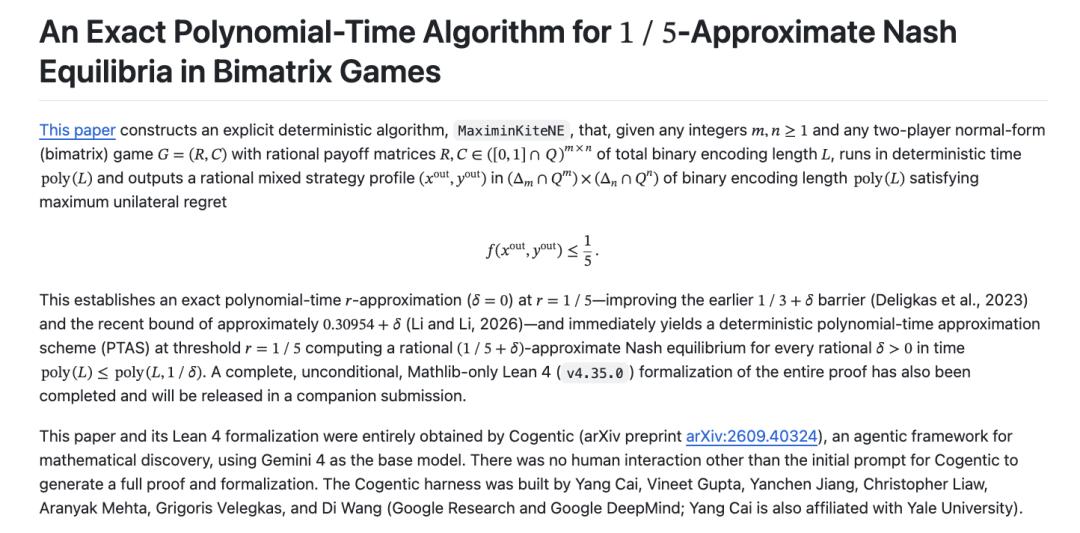
In the past, the error of polynomial-time approximation algorithms long hovered around 1/3, but now Gemini 4 claims to have pushed it down to 1/5 in one go.
While maintaining polynomial time complexity, further improving the solving accuracy is also a noteworthy theoretical progress for computational game theory.
Coupled with the new results on the log-rank conjecture and the edge reconstruction conjecture, from algorithm efficiency to solving accuracy, and then to the provable scope of classic conjectures ——
Gemini 4 has basically demonstrated several typical tackling methods of mathematical research this time.
And according to the information disclosed by Google, all 6 papers have completed Lean 4 formal verification, and relevant documents will be released later, we are looking forward to it~
Google Lets a Group of AIs Conduct Mathematical Research on Their Own
Being able to make achievements in so many different mathematical fields at the same time, this Agent system behind Gemini 4 is really worth talking about in detail~
Cogentic was first unveiled at the end of September this year, and it was jointly developed by 7 researchers from Google Research and Google DeepMind.
At that time, this system was equipped with Gemini 3.1 Pro and the early version of Gemini 4 Argon.
As soon as it was unveiled, it had already solved multiple open research problems in the fields of online learning, auction theory and mechanism design, and the results were independently verified by experts in relevant fields.
Now the base model is upgraded, and the research scope is further expanded to fields such as number theory and cryptography, which is absolutely amazing.
So what exactly is special about Cogentic?
In fact, when Google was building this system, it aimed at a core pain point of current large models conducting mathematical research ——
No matter how strong the single reasoning ability is, it is difficult to independently support the long scientific research process.
After all, real cutting-edge mathematical research often requires exploring multiple conjectures at the same time, repeatedly finding proof loopholes, and even overthrowing a large number of previously accumulated research results.
Therefore, Google simply lets multiple Agents form a team to conduct research.
The entire system is controlled by an Orchestrator, which is responsible for assigning research directions and scheduling other Agents, but it does not participate in mathematical derivation itself.
The real brainwork is handed over to multiple groups of Agents working in parallel.
Some are responsible for consulting literature and collecting existing theorems.
Some are responsible for putting forward conjectures and writing proofs, while others are specifically responsible for pointing out errors for other Agents.
Especially for the Agents in charge of verification, Google has even arranged a fairly strict set of working principles for them:
By default, every step of mathematical derivation is wrong, and every literature citation is problematic, until they are fully verified.

Each proof also needs to go through two rounds of review: one round checks the proof itself independently, and the other round cross-compares proofs submitted by multiple Agents to find common blind spots in thinking.
Only when both checkpoints are passed, will the proof be accepted by the system.
And according to the data previously disclosed by Google, Cogentic only needs hundreds of model calls to solve most of the early research problems ——
Even for the most difficult problem among them, it only requires thousands of calls, which feels quite cost-effective...
So who on earth said Google can never catch up with the latest trends in time?
Better late than never, and this time it comes with a whole table of top-tier achievements.
Reference Links:
[1]https://github.com/google-research/google-research/tree/master/cogentic_research_papers?
This article is from the WeChat official account QbitAI, author: Meng Yao, authorized for release by 36Kr.