10,000-word In-depth Review: The WeChat Official Accounts ecosystem is reshuffled, the most comprehensive practical playbook for AI+OPC
Now that AI can write articles, do WeChat Official Accounts, this long-established content format, still have opportunities?
I have run this official account for 11 years, enjoying the process of content output and gaining huge commercial value. After publishing more than 100 articles this year, my feeling is: The official account ecosystem is experiencing a major reshuffle.
With the arrival of AI, the supply, consumption and platform strategies of official accounts have all changed. Even if you have no followers, you still have the chance to quickly grow your account with a single viral post.
In this 10,000-word long article, I will systematically clarify:
Where the opportunities lie for starting an official account now, and the specific operation methods.
This is a broad topic, so I will first explain the structure of this article:
The main line focuses on the changes of supply, demand and connection before and after the advent of AI, from which we can identify opportunities and find execution methods.
To put it in plain terms, it refers to how platform traffic is distributed, how user preferences change, and how you should create your content.
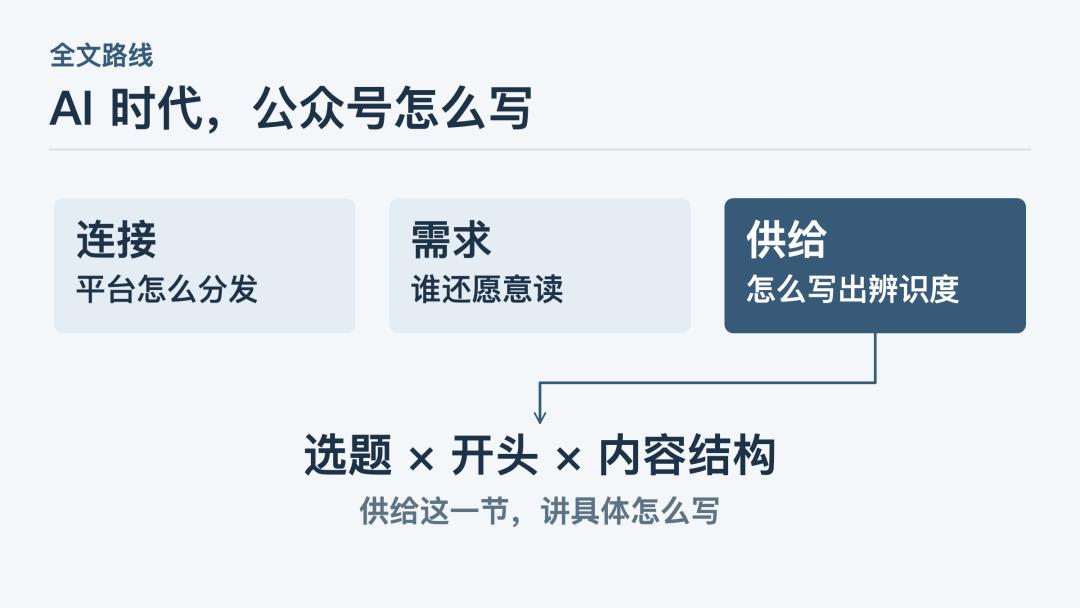
Part 1: Connection - The Public Domain Orientation of Traffic Distribution
In the past, after an official account published an article, all subscribers could receive it. But this is no longer the case now, as the platform has adopted a recommendation-based distribution strategy.
For example, if you had 100 subscribers in the past, all 100 of them would receive your content as soon as you published an article.
Now, after algorithm-based distribution, only 10 people may receive it.
The underlying logic behind this is: who owns the traffic.
Previously, traffic belonged to creators. As long as users subscribed to you, they entered your private domain and became your deterministic traffic.
Creators were happy with this rule, but the platform did not see it that way.
This would lead to a situation where a very small number of top creators could control most of the platform's traffic. The platform would then lose the ability to allocate traffic, have no say, and cannot implement its own will.
For example, the platform expects the content supply to be rich and diverse, covering content of all industries, types and styles, so that the entire ecosystem remains vibrant, with a steady stream of new creators joining, and it is acceptable for old creators to fade out.
This is the logic of the pyramid, where upward mobility from the bottom to the top reflects the health of the platform.
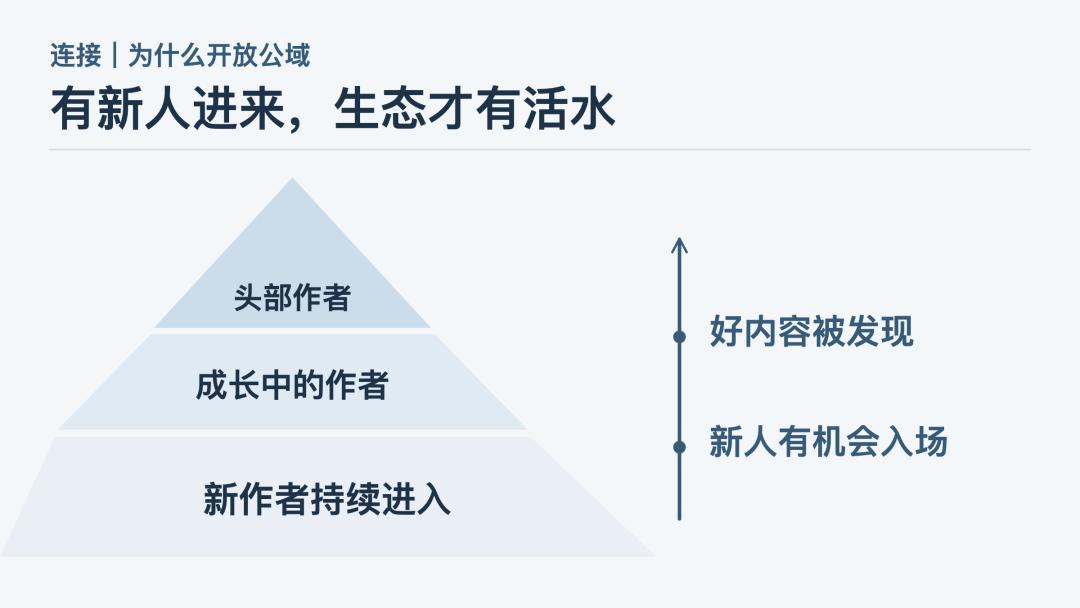
This is based on a prerequisite: new creators keep joining, and are willing and confident to run official accounts.
However, if the traffic of the official account platform is occupied by a group of long-established stagnant accounts, new accounts will get no traffic. Even if the platform wants to give priority support to new accounts, the intervention effect will not be good.
If this continues, the official account ecosystem will become a stagnant pool with no vitality, and will disappear soon.
Therefore, the platform is bound to take back the traffic and allocate it on its own, which is the so-called public domain orientation.
There are two approaches: traffic distribution strategy adjustment and product container design optimization.
If you check the message inbox of official accounts now, you will find that only the top 5 positions come from accounts you subscribed to, and one of them may even be occupied by advertisements.
Scroll down further, and you will see algorithm-recommended content. You can understand it as: the official account version of Toutiao.
What changes will this bring:
First, the original sphere of influence of top creators has almost been reset. Everyone has to reshuffle the cards and compete for traffic with their own abilities.
Second, content styles have changed. When competing for traffic in both the private domain and public domain, you cannot use the same content strategy, which I will elaborate on later.
Third, the impossible triangle of content has changed its relationship. Previously, people prioritized content quality, and were willing to accept high cost and low publishing frequency; now, you can reduce publishing frequency, produce content at low cost to increase output, and quickly grow your account after getting a few viral posts.
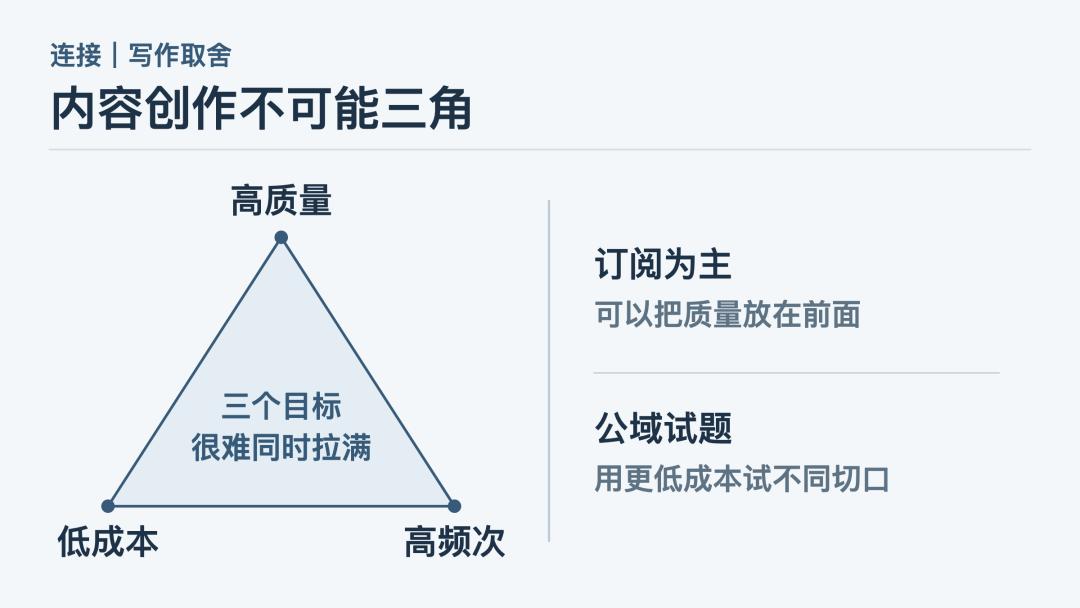
AI has accelerated this reshuffle, enabling the new pattern to take shape quickly.
With the combination of workflow, Agent and skill, text content can be produced at low cost.
But the problem is that the homogeneity is very serious, and most of the content only scores 60-70 points. Although complete, these contents are not sincere, not vivid, and cannot touch people's hearts.
The topics are not unique, and the views are not sharp enough, which is the problem caused by over-reliance on AI.
Regarding the changes of the official account platform, we care about the following questions:
1. How to obtain public domain traffic
2. How to use AI to avoid content homogeneity
Let's leave these questions here for now, and we will answer them all together later.
Part 2: Demand - People Can No Longer Control Their Attention
The free disposable time per person per day is limited, and now it is far from enough to cover all entertainment needs.
Previously, official accounts lost most of users' time to short videos, and now short dramas are coming. According to third-party statistics, the average usage time of short dramas per capita has reached 129 minutes, exceeding that of all major short video platforms.
In essence, people can no longer control their own attention.
You can regard attention as a muscle. If you keep exercising it and control your attention with subjective consciousness, this muscle will become more and more developed. On the contrary, it will become weaker and weaker.
Now the subjective consciousness of most people cannot resist the temptation of short videos and short dramas.
Therefore, on the whole, the attention that official accounts can obtain will definitely be less.
But this does not mean there are no opportunities. Since we cannot change the overall situation, we can look for opportunities at the structural level.
There are two types of users who are still typical audiences of official accounts:
1. Business owners from traditional industries, who have inherent reading habits.
Most of these business owners were born from the 1960s to the early 1980s. They read web portals when they were young, and they still maintain this habit up to now.
This is also why platforms like Toutiao, NetEase/Tencent/Sina/Sohu News still have a large number of readers.
Let me tell you a true short story:
When I was doing B2B business before, I gave offline lectures to business owners from traditional industries. Once in a class, a business owner turned to me and asked: Teacher Han Xu, is Video Account an app?
A moment later, he held up his Huawei flip phone and asked: Which one is Douyin?
This is not made up, I do not have such an imagination, it really happened.
You may ask, how could someone who does not even know what Douyin is come to a class about short videos? I had this doubt at that time too.
Later I found the answer: these business owners are still browsing Toutiao, and their experience of short videos comes from the short video content in Toutiao.
2. High-cognition users, who have the ability to control their own attention.
When I give offline classes, I often meet students who do not have Douyin installed on their mobile phones.
These people intentionally deleted it to ensure that their time will not be wasted. This group of people are basically white-collar workers from large factories, overseas returnees and so on.
And this group also has the habit of reading.
The reason why I specifically mention these two groups is to express that: Official accounts can still find opportunities in segmented crowds.
This is just my insight, you can find the suitable crowd among your own audiences.
The way to think is: 1) Who is used to reading text content; 2) Who has the ability to read text content.
The general environment of content media has led to changes in users' reading preferences:
First, fast pace. Users want to get information quickly, no background introduction, no nonsense, no unnecessary foreshadowing.
Second, high information density. One information point after another pulls users to keep reading. Once the content is disconnected, users will give up.
Third, strong readability. You should treat the article as a product, and consider the human-computer interaction experience, which I will elaborate on later.
Fourth, emotional value. Content that only contains dry knowledge is just an instruction manual. Users need empathy, identity recognition, and a sense of harvest.
These are all user demands, and none of them are easy to achieve.
I would like to share my thinking method with you, condense all these problems into one, and keep asking yourself:
Why do users want to read my content?
For example, people often ask: Can I use AI to generate content directly?
AI can definitely generate content, but if you are the user, will you read it? Or under what circumstances will you not mind even if you know the content is directly generated by AI?
When you answer this question for yourself, you will figure it out.
My answer to this question is as follows: In such a highly competitive environment, manually written content will definitely be more popular in the future, which is the difference between 70 points and 90 points.
But in some scenarios, if you have very scarce information, users will ignore the AI-generated flavor.
For example, if you experience the internal test of Doubao's personal agent at the first time and publish the content on your official account, it does not matter whether the content is generated by AI or not.
Or, if your audience cannot distinguish between manually written content and AI-generated content, such as the elderly in the sinking market, it does not matter either.
Regarding the changes in user demands, we care about the following questions:
1. The boundary between human creators and AI in content creation
2. How to create articles that suit the preferences of current users
Let's leave these questions here for now, and we will answer them all together later.
Part 3: Supply - How to Write Articles With Distinctive Features
In this part, I will focus on the specific operation methods, and solve all the remaining problems mentioned above.
How to write a popular article?
This is a big question, we need to discuss it in several modules: Topic Selection × Opening × Content Structure
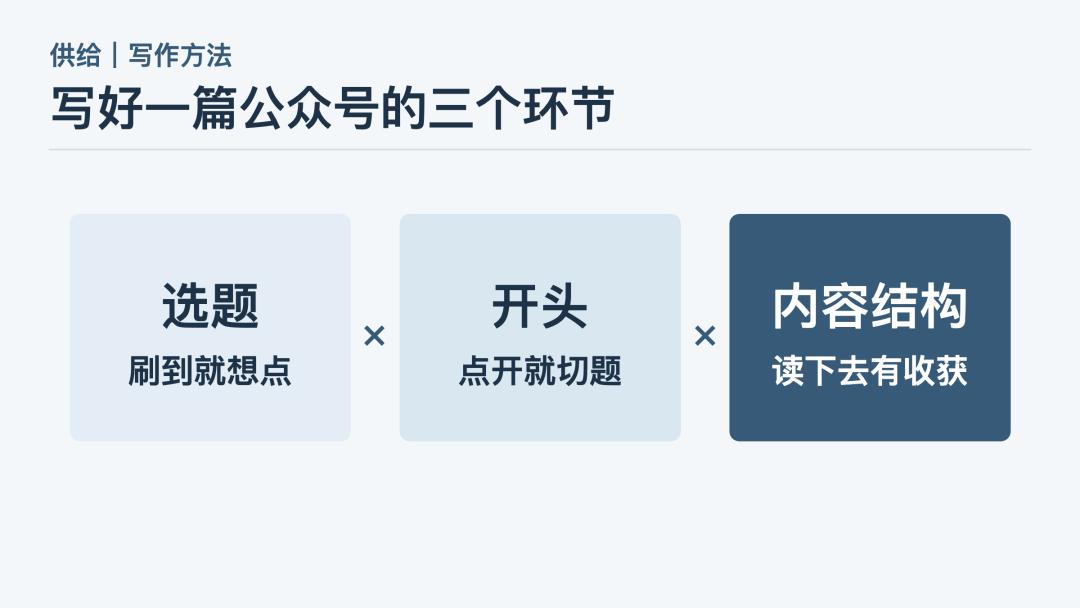
1. Topic Selection
We need to split it into two questions: first, to make more people see it, and second, to make people like it.
After all, the traffic of official accounts has been oriented to the public domain. Expanding exposure and attracting more incremental users is the unavoidable first step, no matter you are running an old account or a new account.
First, to make more people see your content, you need to optimize the traffic conversion funnel
Optimizing the conversion of public domain traffic is similar to the algorithm logic of Douyin. I will simplify it into one paragraph to explain:
The traffic logic of all content platforms is the same: jump from a small pool to a larger pool. If your content data performs well, it can keep jumping to larger pools until the data performance drops.
The data mentioned here can be roughly divided into three in-depth stages: entry, stay, and interaction:
Entry: Click-through rate, which refers to clicking the title on official accounts, clicking the cover on Xiaohongshu;
Stay: User stay duration, completion reading rate / completion playing rate
Interaction: Likes, comments, collections, etc., the weight coefficients of different platforms are different
Entry is the first step, which only shows that users are interested in the topic, especially the title. But if you use clickbait, or the content is obviously inconsistent with the title, it will reduce the stay-related indicators, and still affect the exposure.
Stay means that users are really consuming the content and checking its quality. They vote with their attention, read more if they like it, and swipe away if they do not.
Interaction is deeper user feedback, which only a small number of users will give. Different operations correspond to different psychological activities of users.
For example, you often see such data structures:
Many likes: Often appear in content with emotional resonance, users express their recognition and click likes strongly
Many comments: The content is controversial, or makes users have a strong desire to express their opinions
Many collections: The content is very useful, often seen in highly practical or inventory-type content. Sometimes it also means that users will read it later
Many shares: The content has strong social attributes, and sometimes it is saved to read later instead of being shared
No matter what content platform it is, the mentality of users doing these operations is almost the same. You can compare them with your own content later to find the rules.
Let me tell you a small trick: Some content has been boosted by paid traffic or brushed data, and usually the combination of these indicators will be very strange.
For example, there are a lot of likes, but no comments at all.
Specifically for official accounts, we mainly focus on these indicators:
Subscription conversion: Whether existing fans are interested in the content
Source distribution: Whether you get public domain traffic, which refers to clicks from the feed page
Completion reading rate / reading duration: The quality of the content
Comments / shares / thumbs-up / heart-shaped likes / collections: What emotional feelings users have
Among these indicators, the first thing you need to do is to get public domain traffic.
You only need to do one thing well: topic selection.
To do a good job in topic selection for official accounts, you need to meet the following conditions:
First, the topic should be broad
If you want to enter the public domain, it means that users do not know you, and do not care who the author is, they are attracted by the topic.
If you want to get as much traffic entry as possible, the topic must be broad, and the audience should