Wang Junlin's Whiskey "Gamble"
In Wang Junlin's "gamble", there are two enemies: one is time, the other is capital.
Investing heavily in whisky layout in advance can push Langjiu directly from the top 10 ranks to the top 3. However, it cannot be ignored that the Chinese whisky market requires 5-10 years or even longer for cultivation. During this period, Eshan has to wait slowly for the output to rise and the market to heat up.
In addition, Langjiu, which already owns two wineries, has to face the capital problem of the construction of Eshang Winery again. Over the past decade of construction, Langjiu has been in a state of borrowing and repaying loans, and Wang Junlin may have to go through this period again.
1. The Whisky Wager
Wang Junlin owns three wineries: Langjiu Manor, Longma Winery, and the Eshang Winery which is under construction. The first two were started construction in 2008 (actually the construction of the first one started in 2012) and 2023 respectively, and have been put into production.
The key lies in this third Eshang Winery, which is a step for Wang Junlin to bet on the whisky category.
In November this year, the first Sichuan (Emeishan) Whisky Industry Development Conference opened, and Eshang Whisky announced its official commissioning. Public information shows that Eshang Winery is currently the single malt whisky winery with the largest designed production capacity in China, with an annual capacity of 10,000 kiloliters.
Eshang Winery is the third 10-billion-yuan winery under Wang Junlin's name. Reports show that the initially planned production capacity of Eshang Whisky was only 2,000 kiloliters, covering an area of less than 1,000 mu. Later, the capacity was increased all the way to 10,000 kiloliters, the area expanded to 12,000 mu, and the investment rose from the initial 1 billion yuan to 100 billion yuan. Wang Junlin mentioned on site that the total investment in Eshang Whisky including the winery will reach 120 billion yuan.
Eshang Whisky uses Scottish malt as raw material, Spanish sherry casks, stills from Scottish McMillan, and has invited Iain McAlister, the legendary distiller who once worked on the "Glen Scotia" brand, to serve as chief distiller.
In China's alcohol consumption market dominated by Baijiu, whisky is only a small category.
A set of comparative data shows that in 2025, the revenue of Baijiu enterprises above designated size in China reached 572.4 billion yuan, while the whisky market is about 15 billion yuan, with a gap of 35 times between the two.
However, Baijiu is on the decline, while whisky is on the rise.
In 2025, the cumulative output of Baijiu enterprises above designated size nationwide reached 3.549 million kiloliters, down 12.1% year on year. This marks the ninth consecutive year of output decline in the industry, with a cumulative drop of nearly 74% from the historical peak of 13.584 million kiloliters in 2016.
The consumption scale of whisky reached about 5.5 billion yuan in 2023, which tripled in two years. Another key data point is that the domestic whisky output reached 50,000 kiloliters in 2023, exceeding the total import volume for the first time.
This is the current situation where Wang Junlin bets on whisky: a market that is still small but growing at a high speed.
It is worth noting that new whisky needs to be aged in casks for at least 2 years, and single malt whisky needs at least 3 years of cask aging. That means, finished products will not be available on the market until 2029 at the earliest.
A report from Morgan Stanley shows that by 2030, China's whisky consumer market will reach 150 billion US dollars, and whisky will truly become a hundred-billion-yuan market.
This is the first enemy of Wang Junlin in the whisky "gamble": time.
Even if the whisky market is still small, it may become the second largest category after Baijiu as time goes by. At the same time, during the nearly 5 years from the commissioning of Eshang Winery to the launch of finished products, Langjiu may miss the explosive period of rapid growth of the whisky market.
2. The Radical Player
The strategic transformation of Langjiu actually includes the transition from high-end positioning to mass market, and then to youth-oriented positioning. Langjiu Manor, Longma Winery and Eshang Winery are actually the products of these three eras.
Langjiu once benchmarked against Moutai and took the high-end route. In 2017, Langjiu released a new advertisement for Blue and White Lang: "On the Chishui River bank where the Yunnan-Guizhou Plateau and Sichuan Basin meet, two great Chinese sauce-flavor Baijiu were born, one of which is Blue and White Lang", forming an implicit bundling with Moutai.
In 2022, the ex-factory price of Blue and White Lang was even raised to 1009 yuan per bottle, exceeding the ex-factory price of 969 yuan per bottle of Feitian Moutai and 889 yuan per bottle of Wuliangye Pu Wu.
It was also in this year that Langjiu's revenue exceeded 20 billion yuan.
However, affected by the weakening of high-end positioning in the overall Baijiu market, Langjiu quickly launched the mass market route.
With the completion and commissioning of Longma Winery, on February 8, 2023, Langjiu released the "Langjiu Dual-flavor Strategy", clarifying the strategic goals of achieving annual sales of 10 billion yuan in 2 to 3 years, forming a pattern of "two excellent flavors" with high-end sauce-flavor and mass dual-flavor, becoming the No.1 player in the strong and sauce mixed flavor Baijiu market, and becoming products loved by the public.
So far, dual-flavor has become the second growth pole of Langjiu in the post-20-billion-yuan era.
But it has to be said that the overall growth of Langjiu is not optimistic. In addition to the 30-billion-yuan revenue target for 2025 that Wang Junlin previously mentioned but failed to achieve, the revenue data is also not ideal.
Industry insiders estimate that Langjiu's sales in 2023-2024 are about 22 billion yuan and 24 billion yuan respectively. According to the "Top 100 Private Enterprises in Sichuan List" released by the Sichuan Provincial Federation of Industry and Commerce, Langjiu's operating revenue in 2023 was 15.566 billion yuan. By 2025, the list data shows that Langjiu's revenue is about 13.999 billion yuan.
Theoretically, as the same list, the statistical caliber should be the same, but Langjiu's data has declined.
From high-end to mass market, and then to whisky, Langjiu is embarking on the third strategic transformation.
At present, Chinese Baijiu enterprises are indeed increasing investment in youth-oriented alcohol products, but they are still in the initial stage in terms of scale and volume.
We also learned from an alcohol industry practitioner that
Large Baijiu manufacturers are currently in a trial state for new alcohol varieties, digesting them through their own offline channels without large-scale promotion, and still focusing on traditional Baijiu at present.
Langjiu obviously belongs to the radical camp.
3. Capital Pressure
If time is one major problem for Wang Junlin, then the other is capital.
At present, the total investment of the three wineries under Langjiu has exceeded 47 billion yuan. In 2008, Wang Junlin traveled to Europe to visit Château Lafite and Domaine de la Romanée-Conti, and got the idea of building wineries after returning. Langjiu Manor started construction in 2012 and opened in 2020, with an investment of over 20 billion yuan.
Longma Winery, which started construction in 2023, was partially completed and put into use in 2026, with a total investment of 15 billion yuan according to public reports.
Coupled with the total investment of 12 billion yuan in Eshang Winery, the total 47 billion yuan investment in the three wineries is a huge amount of capital.
Since the very beginning of Langjiu Manor, capital has been a big problem.
At the Trout Strategic Positioning Dark Horse Lab course held at Langjiu Manor in 2020, Qian Jinbo, Chairman of Red Dragonfly Footwear, asked,
The huge investment in Langjiu Manor is supported by internal financing and profits of Langjiu Co., Ltd., or supported by side businesses?
Wang Junlin responded,
"We must use our own funds to support development", and said, "The more we earn, the faster we invest; the less we earn, the slower we invest."
But in fact, Langjiu's several previous attempts to go public for IPO all ended in failure, and the prospectus disclosed Langjiu's profitability.
Data shows that Langjiu's revenue from 2017 to 2020 was 5.116 billion yuan, 7.479 billion yuan, 8.348 billion yuan and 9.337 billion yuan respectively, and the attributable net profit was 304 million yuan, 712 million yuan, 2.425 billion yuan and 2.502 billion yuan respectively. The sum of profits in these four years is less than the capital required for the construction of Langjiu Manor.
The main source of funds is loans, which leads to Langjiu needing to borrow money for construction and keep repaying debts.
Prospectus data shows that the cash received from borrowings from 2018 to 2020 was 4.968 billion yuan, 4.623 billion yuan and 6.666 billion yuan respectively, and the cash paid for debt repayment was 4.287 billion yuan, 3.799 billion yuan and 5.367 billion yuan respectively. The total borrowings in three years reached 16.26 billion yuan, and 13.45 billion yuan was repaid.
In addition, inventory and fixed assets increased by 2.927 billion yuan and 3.831 billion yuan respectively in the three years, totaling 6.758 billion yuan.
Data shows that from 2018 to 2020, Langjiu's asset-liability ratio on a consolidated basis was 67.02%, 66.06% and 63.6% respectively, higher than the industry average.
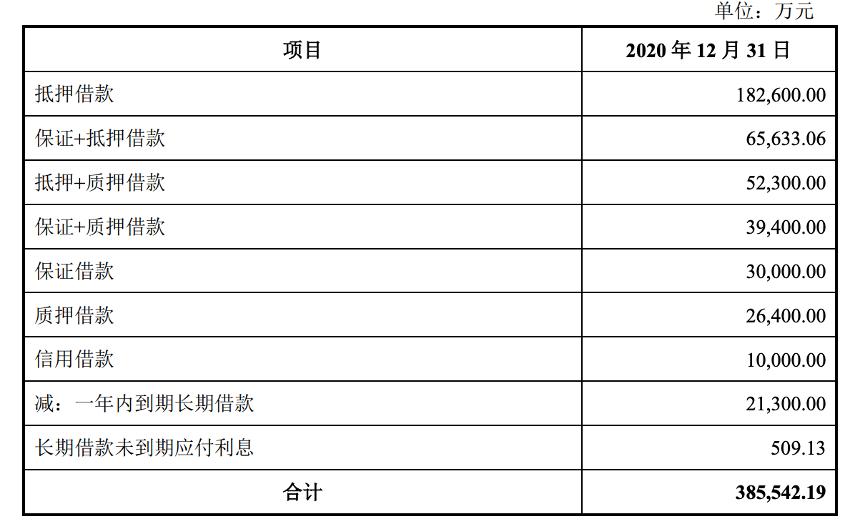
In addition, Langjiu's long-term loans reached 3.85 billion yuan in 2020, compared with 2.13 billion yuan in 2019 and 769 million yuan in 2018, with a sharp increase for two consecutive years.
Most of the long-term loans are mortgage and pledge loans.
All of these mean that after Langjiu managed to build Langjiu Manor and Longma Winery through the process of borrowing and repaying, it once again invested tens of billions of yuan to build Eshan Winery.
The investment in the whisky category is like a "gamble" for Langjiu and Wang Junlin, a bet Wang Junlin placed on the future alcohol consumption of the Chinese market.
However, this can not help but remind people of what Wang Junlin once said,
Others think I dare to take risks, but I also emphasize "dare to gamble and dare to win".
We must have a bottom line. When making this change, I have to be able to afford the loss. If I invest 1 billion yuan, even if I lose this 1 billion yuan, nothing will be affected, I can do other things, we can do anything.
But the stage must exist, if the stage collapses, everything is over.
This article is from WeChat Official Account "Big V Business", author: Liu Ying, published with authorization from 36Kr.