Adidas maintains sustained growth, Anta takes the top spot in market share, and Nike China has unveiled its "five-year prescription"
In November 2026, under the bleak autumn wind, a consumption scene of "two extremes coexisting" is unfolding in the West Zone of Taikoo Li Sanlitun, Beijing.
On one side, the UNIQLO flagship store is packed with customers, who push hangers to shuttle between shelves, long queues form in front of fitting rooms, and the checkout counters are also crowded with people. On the other side, the two-story Nike RISE flagship store has come to an end. Some products are hung with clearance signs of "20% off for two items", the "NIKE" logo on the outer wall has been removed, replaced by construction enclosures for store renovation.
As of November 24, this store has completely withdrawn from this core business district location.
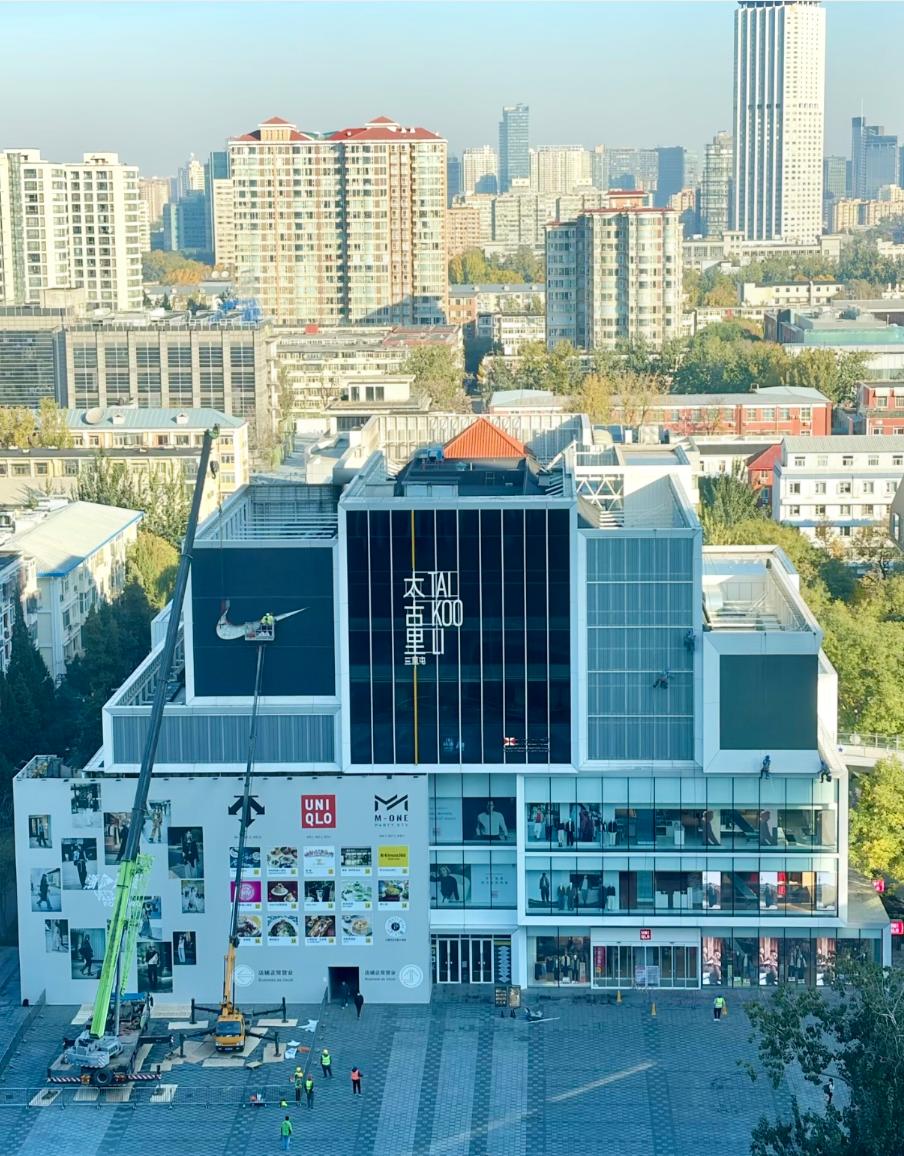
Nike Sanlitun Taikoo Li Store / Source: Xiaohongshu
Covering an area of about 2,800 square meters, this store opened in January 2022, and it was the first project where Nike implemented the RISE retail concept with its strategic partner. For more than four years, it has long undertaken key functions such as new product debut and member operation. In response to this withdrawal, the operator Topsports responded that it is a regular optimization and adjustment of the offline store network.
In fact, Nike's channel contraction in China had foreshadowed long ago. In July 2026, agents such as Topsports and Pou Sheng International successively announced on the Hong Kong Stock Exchange that they had received official notice from Nike that the online platform sales of Nike products in Chinese mainland will be completely terminated from January 1, 2027.
With the online access taken back for self-operation and the offline model store removed from the market at the same time, Nike is reshaping the channel boundary of its business in the Chinese market with an almost "one-size-fits-all" measure.
Nike China's "High-Stakes Bet" on Direct Operation
Nike's move to take back online sales rights for direct operation first puts pressure on its two major distributors in Chinese mainland.
As one of Nike's major distributors in China, Topsports was the first to feel this "chill". On the day the July announcement was released, Topsports' Hong Kong stock fell by 24.08% in a single day. The board of directors also clearly stated in the announcement that the termination of cooperation with Nike will "have a significant negative impact on the group's business in the short term".
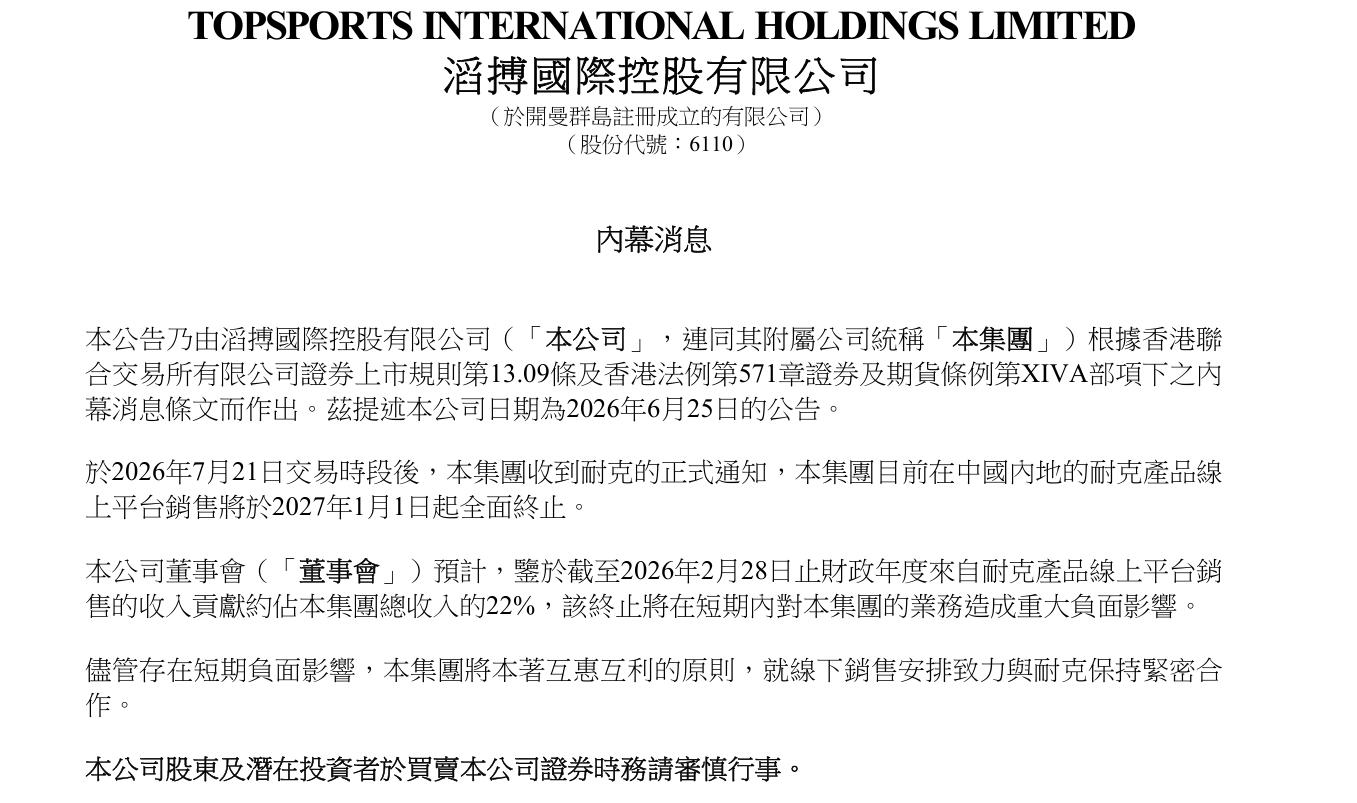
Announcement of Nike's termination of online platform sales cooperation with Topsports / Source: Topsports International Holdings Limited
In terms of performance, Nike's sports products are one of the important sources of Topsports' revenue. Over the past few years, Nike and Adidas, as the two major brands disclosed in Topsports' financial reports, have accounted for more than 80% of the total revenue all year round. In the 2025/2026 fiscal year, the two major brands achieved a total revenue of 22.33 billion yuan, accounting for about 86.7% of the total revenue; among them, the revenue contribution rate of Nike's online platform alone has reached 22%; calculated based on the group's revenue of 25.74 billion yuan in this fiscal year, the corresponding scale is about 5.6 billion yuan.
Pou Sheng International is relatively less affected. On the day the announcement was released, Pou Sheng's Hong Kong stock closed at HK$0.315, down 8.70% in a single day. The company wrote in its voluntary announcement that for the fiscal year ended December 31, 2025, the online platform sales of Nike products contributed about 15% of the group's total revenue, but its contribution to profit was "not significant". Calculated based on the revenue of 17.132 billion yuan in this fiscal year, this part of the business corresponds to about 2.57 billion yuan.
Facing the reconstruction of online channels, Topsports stated in its interim performance announcement for the six months ended August 31, 2026, released in October, that the offline sales arrangement will be committed to maintaining close cooperation with Nike. Prior to this, Topsports has opened new independent stores for Nike ACG outdoor line in Nanjing and Changsha respectively; confirmed by Nike officials, the newly opened ACG store in Nanjing has achieved encouraging initial performance.
Pou Sheng Group also stated in the announcement that it will continue to cooperate closely with Nike, jointly promote the continuous optimization of the market channel ecosystem, and jointly create higher quality experiences for consumers.
Nike also stated synchronously that in the future, it will take the official flagship stores on Tmall, JD.com and Douyin, as well as the official Nike website and App as the core to rebuild its digital market ecosystem in China. This means that after this power takeover, the work previously shared by distributors such as Topsports and Pou Sheng, including online operation, inventory turnover, return processing and member maintenance, as well as the pricing power of online sales, will all be transferred to the brand itself.
"This will have a two-way impact on Topsports and Nike." In response to the Sanlitun store closure and Nike's move to take back direct operation power, Bai Wenxi, vice chairman of China Enterprise Capital Alliance, analyzed to New Consumption Finance Research Institute, "For Topsports, more than 5 billion yuan of revenue will evaporate directly in the short term. In the medium and long term, the establishment of a brand matrix that 'reduces dependence on Nike' is more urgent. For Nike, while taking back the pricing power, the company has also cut off its largest distribution capillary, which will further put pressure on the revenue of the Greater China region."
In fact, this is not the first time Nike has "taken back power" from channels. The same set of strategies has been implemented in North America for one round.
In 2017, Mark Parker, then CEO of Nike, launched the Consumer Direct Offense strategy. He put the official website, App and direct-operated stores at the forefront of the channel sequence, and simultaneously "slimmed down" the list of global wholesale partners, which led to shocks in the channel system.
In November 2019, Nike terminated its two-year direct sales pilot with Amazon, and released an announcement stating that in the future, it will "mainly sell through its own direct-operated retail networks and platforms, as well as other exclusive partners".
In 2020, after the new CEO John Donahoe took office, this logic was accelerated, and in October 2021, the company terminated cooperation with 7 offline retailers including DSW and Macy's in one go.
On paper, this round of channel reform has indeed achieved initial results. At its peak, Nike's direct operation revenue in North America once accounted for 44%, surpassing other offline brands. But at the same time, after cutting distributor channels, the company's competitors such as Anta, Hoka and On Running quickly seized the retail space vacated by distributors.
Since 2023, Nike has tried to repair its relationship with wholesale partners. First, Foot Locker restored core displays, and DSW and Macy's re-obtained authorization for Nike products. In the autumn of 2024, after Elliott Hill returned, he launched the "Win Now" strategy, which tilted the supply of classic styles back to distributors. In May 2025, Nike finally returned to the Amazon US platform for the first time in six years.
From 2017 to 2025, Nike spent eight years completing the whole process from taking back power, encountering setbacks, to making adjustments. Now, the same strategy is being replicated to the Greater China region.
When the same logic is repeated in different markets and at different channel levels, what kind of results will Nike get this time?
Nine Consecutive Quarters of Decline in Greater China, Cathy Sparks Wants to Unify the "Measurement Standard"
The enclosure in Sanlitun is the latest piece of the puzzle in Nike China's channel adjustment.
For a long time in the past, Nike's growth was mainly based on classic models such as Air Force 1, Dunk and Air Jordan 1, maintaining popularity by changing color matching, launching co-branded products and reissuing classic styles; in fiscal year 2025, the Dunk series alone contributed about 4 billion US dollars in revenue.
Elliott Hill (He Yanfeng), CEO of Nike, said in an interview with The Wall Street Journal that although this strategy brought short-term benefits, excessive supply seriously diluted the scarcity and "coolness" of the brand, leading to inventory backlog.
Data shows that in fiscal year 2025, Nike achieved a revenue of 46.3 billion US dollars; among them, the Nike brand recorded 44.7 billion US dollars, down 9% on both reported and currency-neutral bases. Affected by the 20% decline in Nike's digital business, the decline in Nike's direct sales revenue was more obvious, falling by 12% and 13% on the reported basis and currency-neutral basis respectively, with revenue of only 18.8 billion US dollars, 2.7 billion US dollars less than last year; while the inventory level was as high as 7.5 billion US dollars.
In fiscal year 2026, Nike temporarily stopped the decline in performance. As of May 31, 2026, the group achieved a revenue of 46.4 billion US dollars, which was flat with the previous fiscal year on a reported basis. Direct sales revenue further dropped to 17.7 billion US dollars, down 6% and 8% on the reported basis and currency-neutral basis respectively. Digital brands and self-operated stores declined simultaneously, decreasing by 12% and 4% respectively; the inventory level also remained at a high level of 7.5 billion US dollars.
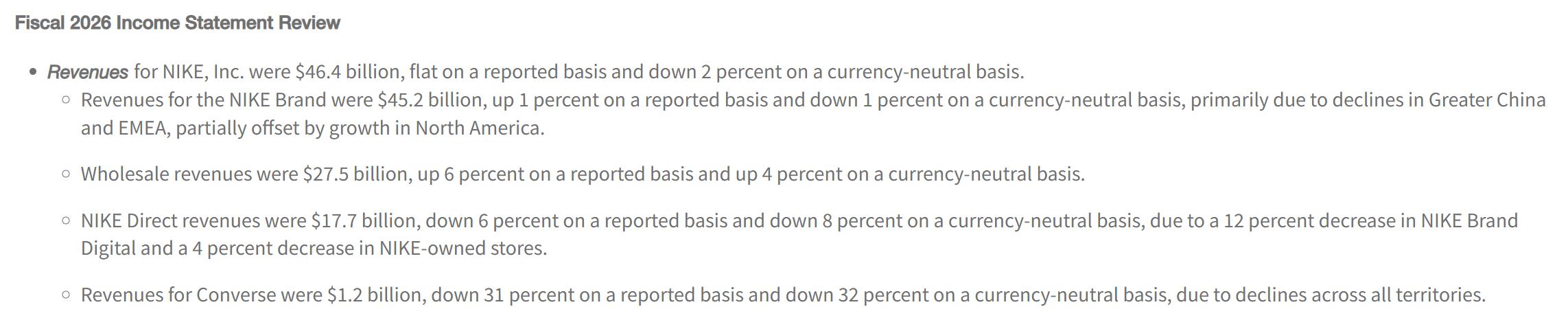
Nike's performance in fiscal year 2026 / Source: Nike official website
By region, the differentiation of Nike's performance is even more significant. The North American market achieved annual revenue of 20.511 billion US dollars, a year-on-year increase of 5%, which is the main support of the group; Europe, the Middle East and Africa recorded 12.572 billion US dollars, a year-on-year increase of 3%; Asia Pacific and Latin America recorded 6.243 billion US dollars, basically the same as the previous year. Only the Greater China region went against the trend and declined, with an annual revenue of 5.847 billion US dollars, down 11% year-on-year on a reported basis and 13% on a currency-neutral basis.
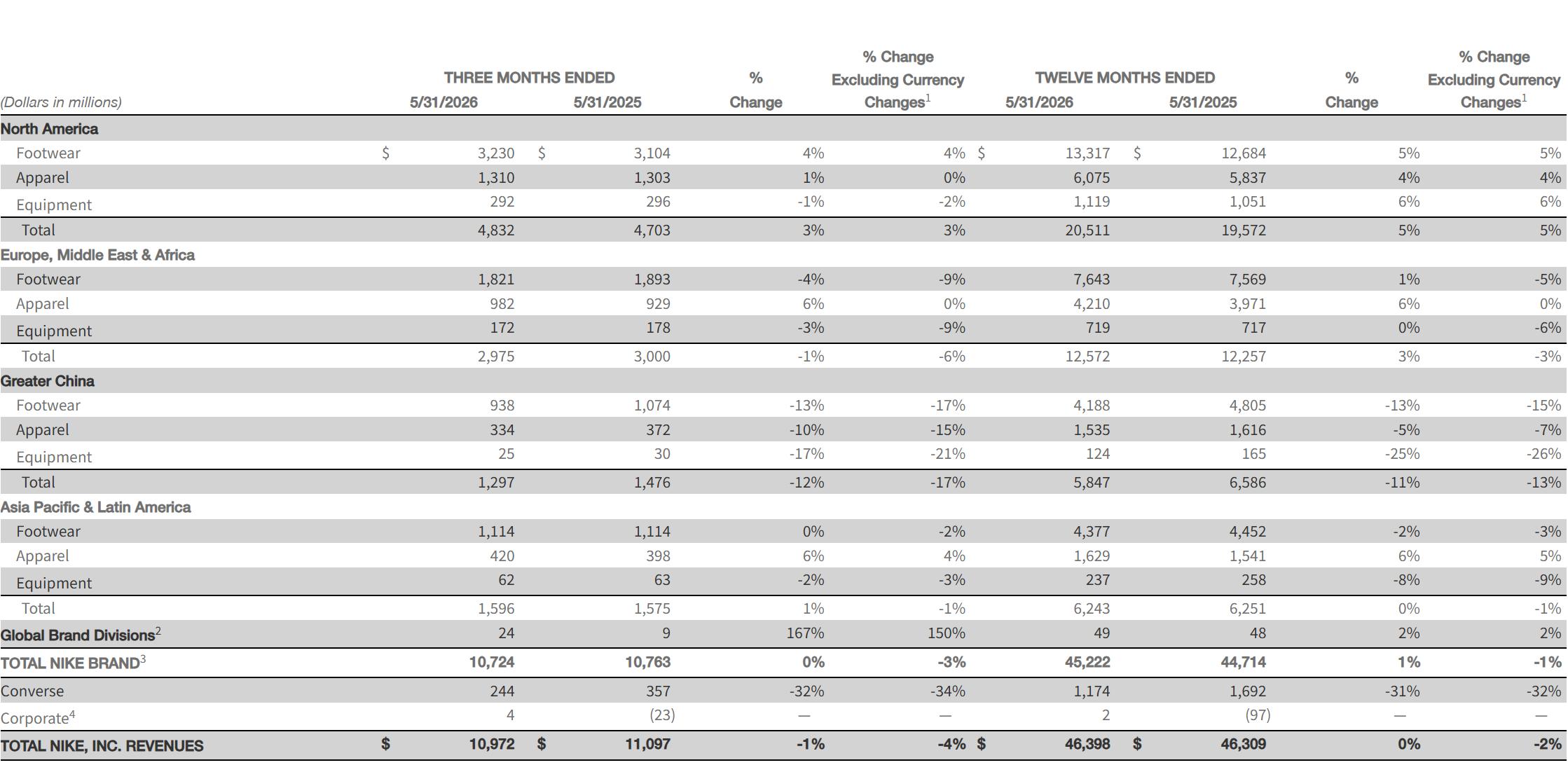
Nike's revenue by region in fiscal year 2026 / Source: Nike official website Investor Relations
Entering the first quarter of fiscal year 2027, the Greater China region still failed to stop the decline. In the three months ended August 31, 2026, the revenue was 1.18 billion US dollars, down 22% year-on-year on a reported basis and 26% on a fixed exchange rate basis, with the decline further expanding; the EBIT was 248 million US dollars, down 34% year-on-year, which has been negative growth for nine consecutive quarters.
In response, Cathy Sparks, General Manager of Nike Group Greater China, said that in China, Nike's connection with consumers is still strong, but the market layout has not yet reached the state it should be. She said that in the future, a more unified, high-quality and deeply interconnected market voice will be built to reduce market fragmentation and strengthen trust with consumers.
This kind of fragmentation has long been traceable in China's online channels. Cathy Sparks publicly mentioned that there are more than a thousand online stores selling Nike products in China's digital market, most of which are operated by 16 offline retail partners.
Among them, first-level distributors obtain lower purchase costs with larger procurement volume, while second-level distributors add an extra layer of gross profit on the upstream price. Once inventory is backlogged, the pace of cash withdrawal at all levels is not consistent, and the discount intensity will also diverge accordingly.
According to statistics from industry media, taking the women's Air Force 1 casual sneakers (IR8637-100) launched by Nike in 2026 as an example, the prices of Nike, Topsports and Shengdao official flagship stores are different, which are 849 yuan, 722 yuan and 621 yuan respectively, and the price of Nike official flagship store is the highest.
The same new product appears on the same platform with different price tags, Nike's price system has been in chaos, and its profits have been thinned. It seems reasonable that Nike wants to unify the "measurement standard" in the Greater China region.
Nike China's Market Share Has Declined for Five Years, The Company Calls Out to Adidas: Take Back the Share That Belongs to Us
When the group's performance growth is weak and the Greater China region continues to decline for two consecutive years, Nike's headquarters can no longer sit still.
On November 17, 2026, Nike held its first Investor Day in nine years at its headquarters in Beaverton, Oregon, USA, and launched a medium and long-term strategy named "Full Stride Ahead": based on fiscal year 2027, it plans to achieve about 5 billion US dollars in new revenue by fiscal year 2031, and increase the operating profit margin from about 6% to 12% to 14%.
The revenue growth is mainly composed of two parts. On the one hand, the professional sports business composed of five major categories of running, training, football, basketball and outdoor plans to contribute about 4 billion US dollars; on the other hand, the sports lifestyle business composed of Nike Sportswear, Jordan and Converse plans to contribute about 1 billion US dollars.
But the capital market did not give applause. On the day of Investor Day, Nike's stock price closed down 6.3% at 35.85 US dollars. In September this year, Nike has been removed from the S&P 100 Index.
The next day, Nike's management held an all-hands meeting at the Beaverton headquarters. CEO Elliott Hill (Chinese name He Yanfeng) tried to redefine Investor Day as a "starting line" rather than an end point — he admitted that Nike's recovery "takes longer than expected", but also emphasized that the company "has all the conditions needed for success".
Dave Denton, Chief Financial Officer, made a more direct statement. He named Adidas and said that Nike must take back the sneaker share snatched by competitors: "Adidas should not have that part of revenue, it belongs to us, let's take it back."
But from the perspective of the global base, Denton's bold words of "taking back the share snatched by Adidas" will face a years-long track of share loss.
According to data from Euromonitor International, Nike's share in the global sneaker market dropped to 22.9% in 2025, down 3 percentage points from the previous year, and has declined for three consecutive years. In the same period, Adidas' share rose from 11.7% to 12.2%,