Don't miss out on the incremental gap of 200 million people.
Even on the shelves of county-level supermarkets, a national brand is usually never absent.
Over the past decade and more, distribution channels have extended shampoos, milk and mobile phones all the way to towns and townships, making them easily accessible to consumers. Whether a consumer will reach out for a product when standing in front of the shelf is another story.
Marketing scholar Byron Sharp regards "physical availability" and "mental availability" as two core conditions for brand growth. The former refers to the convenience of making a purchase, while the latter refers to the possibility of a brand being noticed, recognized or recalled in a specific purchase scenario. A brand can be widely known to all households, but still be absent from a specific single purchase.
"Product seeding" is a more lightweight term coined by the Chinese internet for the latter task. As product seeding becomes increasingly mature, the assessment of budgets and campaign effects is also tightening. Brands need to focus on current transaction volumes, and also reach out to consumers who have not yet expressed their demands or included the brand in their consideration set.
Kuaishou put forward the concept of "Quality content drives effective product seeding" at its 2027 Pinju Marketing Promotion Conference. By re-emphasizing content this year, the platform aims to first expand the scope of users whose interest is sparked by content, and then improve conversion rate through refined operations.
A platform that has been summarized by the term "old iron (close buddy)" for many years may be worth a brand new review.
Why We Need to Re-examine Kuaishou
There are efficiency reasons for brands to center their budget on platforms that have been proven effective. The campaign effects are predictable, the teams are familiar with the operation strategies, and there are references for post-campaign reviews. However, the familiar media mix may also lead brands to repeatedly target the same group of consumers.
Kuaishou corresponds to a quantifiable untapped gap. According to the statistical caliber disclosed by Kuaishou, the platform has more than 200 million active users that do not overlap with Douyin. For brands that focus most of their budgets on Douyin, this group of users cannot be covered by increasing investment in existing channels. As a result, the position of Kuaishou in the brand's budget should be determined by the distribution of target consumers.
A considerable part of this group of users lives in counties, towns and townships. As the new-tier market that has been mentioned repeatedly in recent years, the weight of county and township areas is also worthy of re-evaluation. Data from the National Bureau of Statistics shows that in the first three quarters of 2026, the county and township market, which includes town districts and rural areas, accounted for 39.1% of the total retail sales of consumer goods, 0.3 percentage points higher than the same period of the previous year; the retail sales of consumer goods in rural areas increased by 2.3%, and the growth rate was 1.4 percentage points higher than that of urban areas.
With a market share close to 40% and a faster growth rate than urban areas, it backs a more stable consumption status. Consumers in high-tier cities are more sensitive to economic fluctuations and cut their spending earlier, while county and township residents have relatively stable income and living costs, and their daily consumption is less impacted. For national brands seeking incremental growth, this market can hardly be omitted from their growth plans.
After confirming the size of the crowd, brands also need to update their understanding of this group of people. Labels like "old iron" and "down-to-earth vibe" only explain part of Kuaishou's community temperament, and the term "inclusive market" describes the geographical distribution of users, but none of these labels can sum up their purchase needs.
The user profile presented by platform data is far more detailed. In the past one or two years, the number of young people and female users on Kuaishou has grown rapidly, and interests such as e-sports and ACGN have become more prominent. The conference showed that there are already 632 interest circles on the platform, which are further subdivided into more than 4,100 interest points.
This makes the growth space go beyond geographical division. Consumers living in the same county with similar ages may focus on completely different product values due to different interests and lifestyles. Using a general "inclusive market" label will easily exclude existing demands from the brand's field of vision.
Content consumption is also shifting towards deeper engagement. The conference disclosed that the consumption duration of professional and practical content increased by 19% year on year, and the consumption duration of high-quality videos longer than 3 minutes increased by 14%. Users are willing to spend more time learning about the functions and applicable conditions of a product, which is particularly beneficial for categories that require explanation of technical parameters or usage methods.
Back to the rows of supermarket shelves. Even if consumers know the brand, segmented products still need to be re-explained.
For brands that have completed national distribution, this group of people is no stranger. Many of them have seen these brands on the shelves of county and township supermarkets, and some have already made purchases, but they may not understand the differences between different products.

It is largely two different things for a user to simply see a commodity, and to truly understand the information that the brand and the product want to convey. The latter needs to be built through content. The more new products and segmented product lines there are, the more important this work becomes.
To re-evaluate Kuaishou, all these changes need to be considered together. The non-overlapping user group means there is still reach space for existing campaigns; the segmented circles and professional content indicate that these users need to be communicated with in a targeted way. The next question brands need to answer is how to build awareness on Kuaishou.
The demographic differences of Kuaishou provide opportunities to reach new customers, while segmented content allows brands to deepen existing awareness. The next problem to be solved is how to turn these opportunities into communications that users are willing to listen to and can easily understand.
How Does Product Seeding Happen on Kuaishou
The way to build awareness depends on the status of users on the platform. Most of the time users spend on Kuaishou is watching short videos and live streams, and they usually do not have a clear purchase plan when opening the app. Product information appears in a plot clip, a game live stream or a creator's daily record, and the purchase intention is gradually formed after that.
The typical path on Xiaohongshu starts with demand: users have a question first, and then judge whether a product is suitable for them through search and comparison of multiple notes.
The marketing tasks corresponding to the two paths are different. Content in the search scenario targets already formed demands, and competition occurs between similar products; content in daily viewing targets people who have not yet formed demands, and its function is to let them know the value of a product, and include it in their consideration set when the need arises.
For brand budgets, the latter is a more fundamental task. The launch of new products first requires building awareness, and transactions rely on subsequent operation links. The situation where a single piece of content directly brings orders exists, but it cannot be taken as a normal requirement.
There is a prerequisite for this kind of engagement to take effect: users do not actively look for information, and whether they accept a piece of content largely depends on whether they trust the person who is speaking.
AI has made this prerequisite harder to meet. It is undeniable that AI has indeed made content production easier. Kuaishou compared the costs of two types of content at the conference: for a 60-second product video, the average quotation of influencers with more than one million followers on the Juxing platform is 13,000 yuan, while the average price of AI-generated content is about 7.5 yuan, a difference of nearly 2000 times.
However, the content supply has increased significantly, but the marketing effect of brands has not improved simultaneously. The reason is that users' pre-purchase judgment has not changed: they still need to confirm whether the product is relevant to them and whether the information is true. AI has lowered the production threshold, but also increased the difficulty of distinguishing true from false, so users turn to rely on real human creators they have followed for a long time.
The easier it is to produce content, the more users need a reason to trust you.
This exactly falls on Kuaishou's deepest accumulated moat.
Platforms that are good at interest-based distribution and hit content can make a piece of content get concentrated exposure in a short time, but the audience may not have a continuous following relationship with the influencers in the content, so brand information is easily swiped away with the next scroll. Kuaishou's traffic distribution is more decentralized, and more traffic falls on the long-term following relationship between users and creators. According to the conference data, the average number of private domain interactions per user per year exceeds 1300 times.
Musician Li Minglin is an example. He has recorded his life on Kuaishou for more than ten years. His fans started following him when he was singing, and watched him get married and become the father of three children. Fans follow his life just like following a TV drama series.
Years of continuous viewing have made the audience form a stable judgment on the creator. When a creator recommends a product, this judgment will extend to the product. The possibility of the recommendation being accepted is therefore different, which is also the basis for Kuaishou to emphasize the "success rate" of product seeding.
Trust relationship provides the basis for communication, but products still need to establish specific connections with users' lives. Taking cleaning appliances as an example, ordinary families focus on time-saving and labor-saving performance, while pet-raising families pay more attention to whether hair gets tangled, whether corners can be cleaned, and whether the machine is easy to maintain. For the same product facing different circles, the selling points that need to be emphasized are not the same.
Therefore, the influencer section of the conference advocates selecting influencers by circles and content: first clarify what kind of expression is needed, and then find creators who have corresponding content capabilities and can reach target users. Guide reviews are suitable for explaining functions, plot clips and life records can present usage scenarios, and live streams allow more direct Q&A. Selecting a circle is equivalent to confirming the influencer, the users behind the influencer, and the communication habits of both parties at the same time.
Kuaishou's StarPlan AI can assist in candidate screening and content analysis, helping brands find cross-segment influencers and mid-to-micro influencers that are not originally on the list. As for how these people usually speak and whether the product can naturally fit into their content, it still needs to be judged by the brand itself.
The cooperation of 999 Aonuo is a result of this method. The brand wanted to build trust in children's nutrition among rural families, and selected village doctor Zhong Liping as its partner. She explained the nutrition knowledge required for children's growth in her content, responding to the real concerns of parents in daily life. Data shows that the views of cooperation-related content reached 700 million, accumulating 57 million user assets for the brand, and Aonuo's brand image of "Guardian of Healthy Growth" has expanded beyond its original circle.
The selection of circles can also go beyond the industry where the brand is located. Liang Mama cooperated with Kuaishou's e-sports team, and the total video views exceeded 20 million. After watching the videos, users' repeated searches for the brand increased by 1.5 times, and their interest continued beyond the content.
Shared life moments such as the Spring Festival can expand this kind of communication to a larger scope. During Kuaishou's Spring Festival activities last year, the total brand exposure reached 40 billion times, with precise reach of 1.3 billion times through coupons. L'Oreal Paris cooperated with Kuaishou on the program *The Most Beautiful Journey Home*, combining users' Spring Festival travel story collection, brand custom short films and exclusive high-speed rail trains, connecting the sentiment of returning home for the Spring Festival with gifting needs with the slogan "Bring L'Oreal home for the New Year". Consumers' expectation of returning home provides a specific purchase scenario for the brand.
Brands integrate into content that users are willing to watch, and leave the opportunity to be recalled in specific needs. As for whether this interest can be converted into business, it depends on whether the subsequent operation can support it.
How to Convert Generated Interest into Business
The most common loss between interest and transaction occurs in the connection of user groups. The early content makes a group of users interested in the brand, but the subsequent performance ads and live stream operations may reach another group of people. Brands pay the cost of building awareness for the first group of users, but this part of investment is not utilized by subsequent operations.
Kuaishou's "seeding-operation linkage" is targeted at this exact link. Users' viewing, interaction and search on the content side are recorded as interest signals, which are input into the recommendation model on the operation side, so that e-commerce traffic and ads will redistribute products and live streams to users who have already been influenced by the content. Last year, the platform focused on connecting the signals between product seeding and operations; this year, this link has been extended to content production, boosting, measurement and operation conversion.
Baiyunshan's project adopted this method. The brand first accumulated high-intent users through content and brand resources, and then linked with the operation side for ad delivery. The user group accumulated in the early seeding stage was re-identified on the operation side. During the project, the average daily GMV of the store increased by 83%, and the GMV brought by R3 users increased by 109%.
The identified users also need a place to continue learning about the products. The short video and live stream linkage has always been the cooperation mode recommended by Kuaishou to brands, which is based on Kuaishou's influencer structure. Most other platforms extend from short video influencers to live stream sales, while Kuaishou has accumulated a large number of sales anchors, which can extend from live streams to short video product seeding, and brands can also purchase live stream slots, short dramas and material authorization as a package.
OnePlus adopted this method in its cooperation with game influencers. It operated official account content from February, and went deep into the e-sports circle from April to May, with 79 anchors participating in related cooperations, followed by the new product launch by top influencers, vertical live streams and the 618 shopping festival. Game anchors talked about mobile phones while playing games in the live stream, and then guided fans to the brand's official live stream. Against the background of overall pressure in the mobile phone industry, this path opened up incremental growth from the game user group for OnePlus.
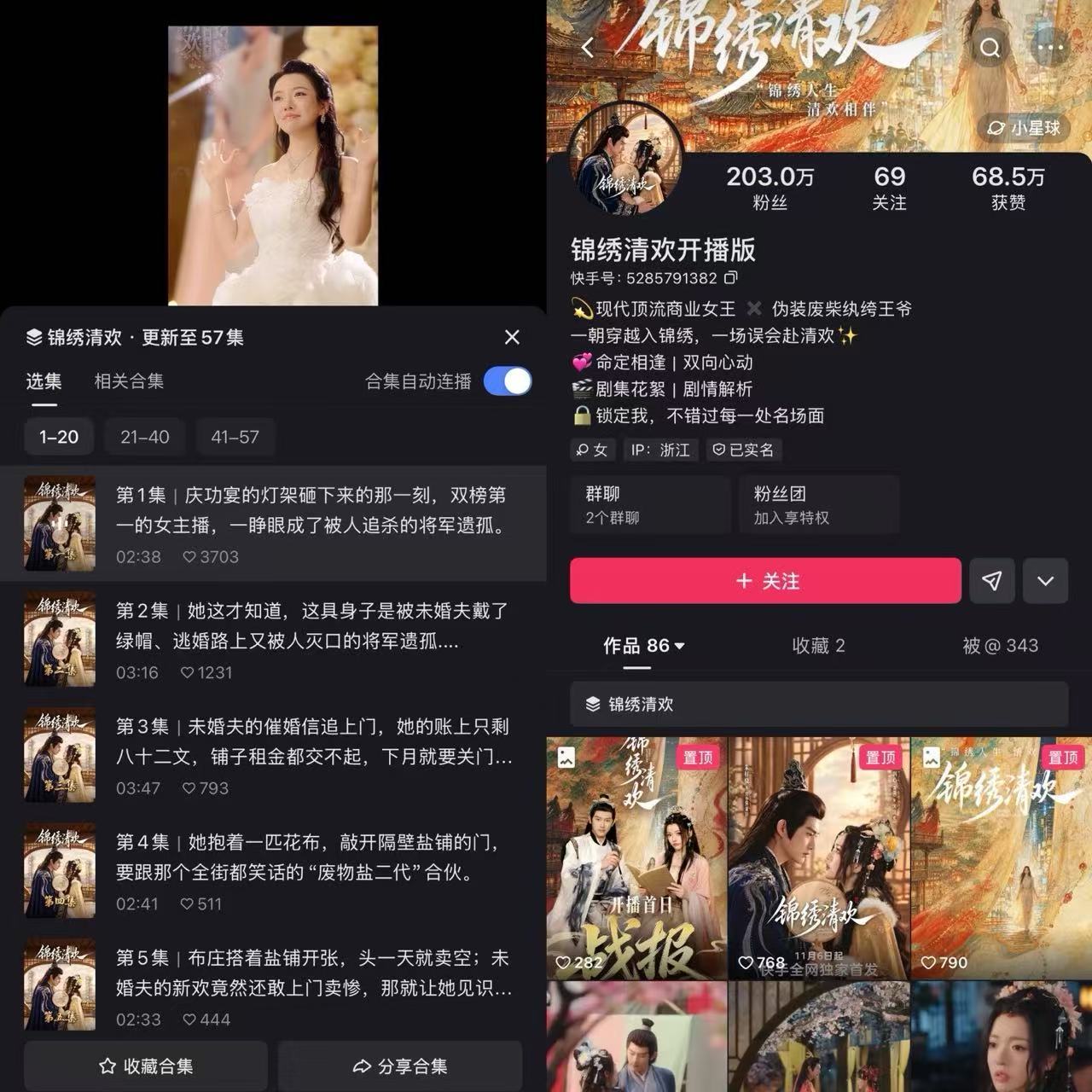
Short dramas add another entry point to this link. The short drama *Splendid and Joyful Life* starred by top sales anchor Dandan achieved 150 million in-platform topic views on its premiere day. The short drama brought new followers to the anchor, and subsequent product explanations were completed in the live stream. The cooperation threshold is also decreasing. With the combination of AI comic dramas and sales influencers, a 10-episode short drama can be cooperated with a budget of 100,000 yuan level.
Product seeding has already been a mature business, and brands' understanding of the market is still being updated. The accumulated relationship between users and content on Kuaishou provides brands with an opportunity to re-understand consumers; a more complete operation link allows this understanding to be continuously tested by sales results.
Back to the rows of shelves in the county supermarket. Where products have already arrived, the brand's explanation may not have reached yet. New growth may start by filling this gap.