A dark horse in the video model sector has risen to the global No.1 position, which can generate a 30-second long take in one go, with its price slashed to 1/10 of that of Seedance.
Let's start with a clip: A blue vintage car cruises through the streets of Vice City, motorcycles zoom past brushing its body, pedestrians weave along the sidewalks, and the camera follows the car through turns and weaving paths all the way.
This hyper-realistic footage is not a game recording, but comes from MAGI-2, a video generation model officially released today by Sand.ai, with only one static screenshot and one prompt as input.
According to the evaluation results of the Artificial Analysis video generation leaderboard, MAGI-2 has reached No.1 in the world in the image-to-video (I2V) dimension, surpassing Seendance 2.5 and becoming the SOTA model in the I2V field. MAGI-2 also has a parameter count of up to 480B, far exceeding most publicly available video models with disclosed parameter sizes, and it is planned to be open-sourced in the future.
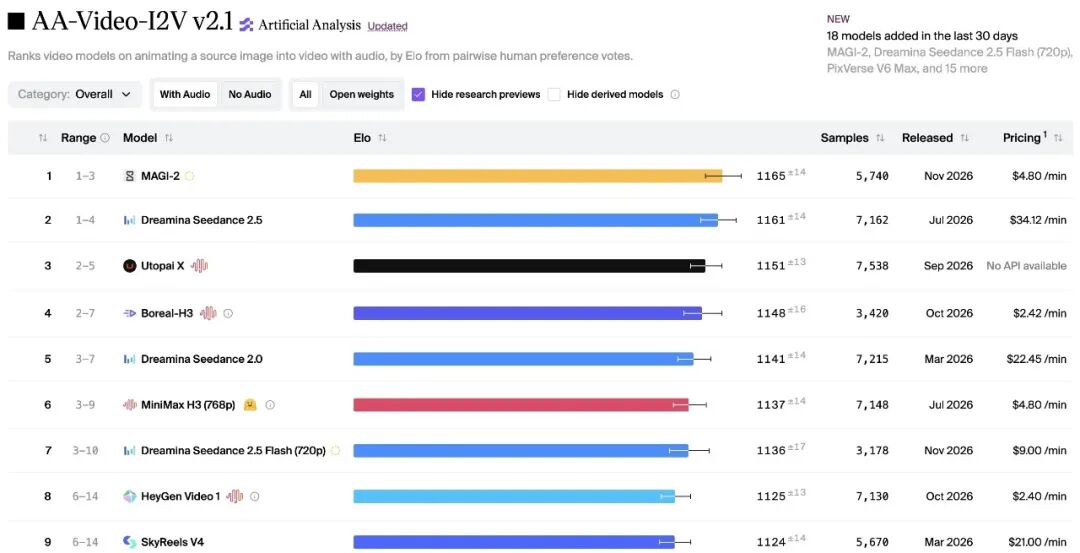
Apart from the leaderboard ranking, MAGI-2 has also brought multiple capability upgrades this time: the maximum native single-generation duration can reach 30 seconds with a resolution of 1080P; reference input is expanded from a single image to a mixed combination of images, videos and audios, supporting up to 20 assets at a time, while further improving the control of camera scheduling and frame details.
The pricing of MAGI-2 is also highly competitive. The official list price of 1080P MAGI-2 is 0.5 yuan per second, which is about 1/10 of the price of Seedance 2.5 for the same specification, and generating a 30-second video only costs 15 yuan.
Before the model release, Zhidx conducted in-depth practical testing on MAGI-2 in advance. Our experience shows that with longer generation duration, richer reference inputs and lower generation cost, this upgrade of MAGI-2 is no longer only targeting video picture quality and leaderboard rankings, but the practical usability of video generation in actual production scenarios.
01. Long video, multi-asset, fine-grained editing: MAGI-2 capabilities reach new levels
Nowadays, mainstream video generation models can already produce quite stunning frames, but when they are actually integrated into content production workflows, the difficulties go far beyond generating one or two beautiful shots. A complete video usually requires consistent characters, scenes and props across different shots, coherent movements, and shot transitions that conform to narrative logic.
From the direction of this upgrade, what MAGI-2 tries to solve is exactly the continuity and controllability issues in long content generation. We conducted practical tests around three links: single long video generation, multi-asset reference and video editing.
First, single-pass generation of 30-second video.
In the practical test, we took "an astronaut making a video call with his daughter on Earth at the space station" as the theme, and required MAGI-2 to complete a series of actions including the astronaut floating in the zero-gravity cabin, traversing the cabin, looking at his daughter on the video call, and reaching out to touch the screen in one video, and advance the story in the specified order.
From the final generation effect, the astronaut's character image remains stable within the 30-second duration, and details such as the blue in-cabin spacesuit and armband are consistent throughout; the zero-gravity floating movement is coherent, and the displacement process is natural, without obvious limb breakage or teleportation; the three scene transitions are all completed through push-in shots, and the entire video has a complete sense of narrative. Details such as the baby photo fixed by a wooden clip next to the screen and the red sticker on the girl's forehead are still retained after multiple changes of shot size.
Second, multi-asset reference and fine-grained control. For professional creation scenarios, generating a good-looking frame is only the first step. There are often clear requirements for character images and scene styles, and the model needs to complete the content according to the established creative ideas.
MAGI-2 supports up to 20 mixed reference assets of images, videos and audios, including up to 10 reference images, up to 5 reference videos and up to 5 reference audios. It also supports controlling video content through an ultra-long prompt of 20,000 characters, time points and action nodes.
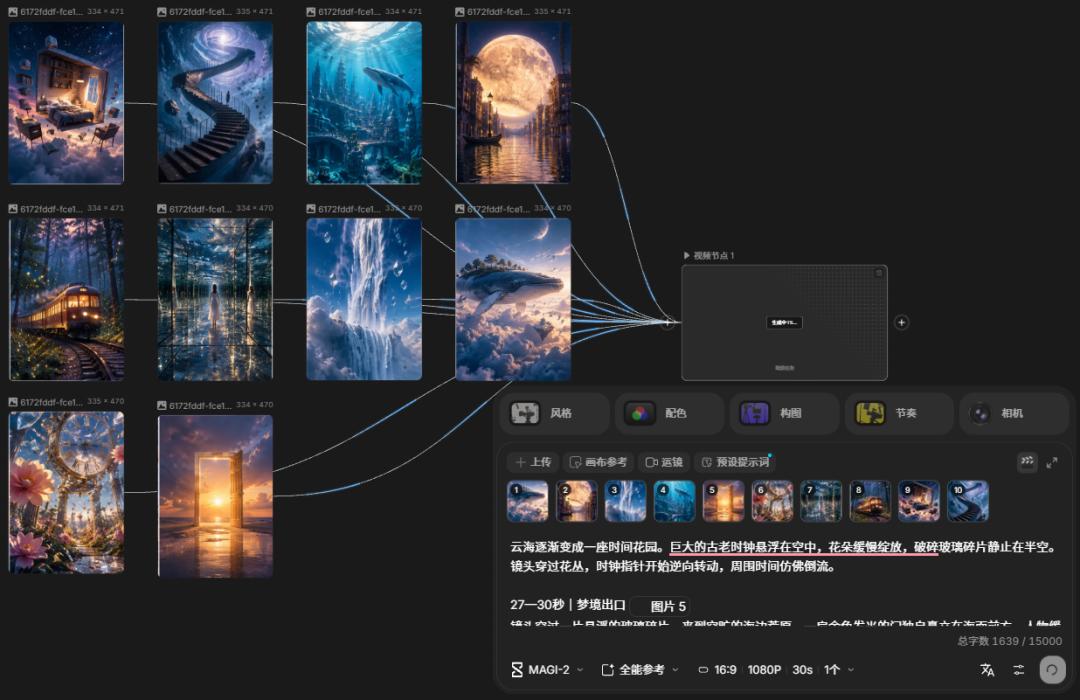
We tried to use 10 images as reference inputs, and then specified the specific requirements for characters, scenes, actions and shot transitions through prompts, requiring MAGI-2 to create a dream space with 10 scenes.
From the final video, MAGI-2 basically followed the reference assets strictly as required: all 10 dream spaces are presented without any omission or error, and there is no situation where the reference images only play an atmospheric role.
In another test, we wrote all the requirements into a plain text prompt, and specified the action trends of "running to jump, leaping in the air, rolling to buffer force, and stopping in front of the skyline" for the time periods of 0-5s, 5-11s, 11-17s, and 17s to 25s respectively.
From the generation results, MAGI-2 executes the time points quite accurately: the four shots are strictly divided according to the time periods specified in the prompt, the total duration is fully utilized, there is no shot delay, early transition or sequence disorder, and the action connection is natural. In such scenarios involving large-scale movements, the frames generated by the model do not have obvious continuity errors.
The value of such capabilities is that creators can convert the partial requirements that originally required repeated regeneration and post-splicing into clear instructions at the generation stage, greatly reducing the workload.
After video generation enters the actual workflow, there is another easily overlooked problem: how to modify the generated content. Sometimes users only want to modify a local part of the frame, but the model may change the character appearance, background, lighting and even other originally satisfactory frames along with it. Changing one part leads to changes in other parts, making it difficult for creators to precisely control the modification range.
To this end, we selected a shot from the previous practical test, and required MAGI-2 to only modify the image of the little girl in the video call in the clip, while keeping the scene, shots and other frame elements unchanged.
The practical test results show that MAGI-2 accurately executed the editing task: it only modified the little girl in the video clip, without changing the photo in the lower left corner, and the little girl's movements and expressions are highly consistent with the original video.
From 30-second continuous generation, to multi-asset mixed reference, and then to targeted post-generation editing, this upgrade of MAGI-2 presents a clear technical route: enabling creators to not only generate videos, but also specifically decide how the video is generated and how to modify it after generation.
02. From "following instructions" to "understanding": MAGI-2's technical foundation and intelligent emergence
The improvement of MAGI-2's generation capabilities is inseparable from the expansion of model scale and the design of the underlying architecture.
In MAGI-2 Preview, Sand.ai has verified the feasibility of the single-stream unified Transformer and Multi-Head Latent MoE architecture, allowing text, video and audio tokens to interact in the same sequence, which provides a basis for the collaborative generation of frame movements, character lip shapes and sound changes.
The official version of MAGI-2 further expands the model scale: the total parameter count of the base model is increased from 114B in the Preview version to 480B, and the activated parameter count increases from 6B to about 28B.
While expanding the model scale, how to control the training and inference cost becomes the key. Sand.ai chooses to continue to adopt the Multi-Head Latent MoE ultra-fine granularity mixed expert architecture, instead of simply expanding the traditional MoE.
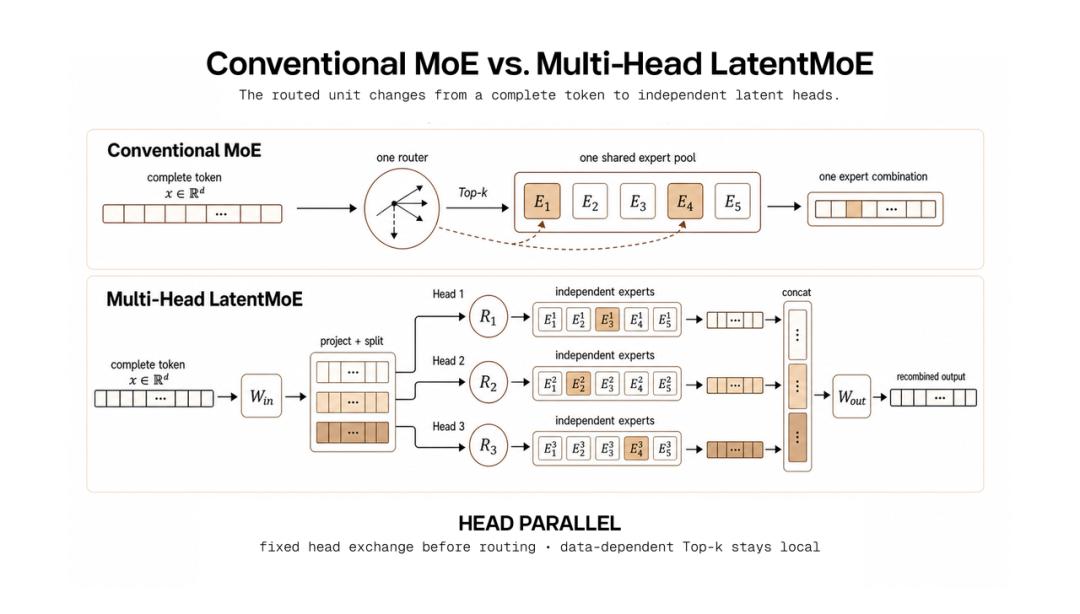
Structure comparison between conventional MoE and Multi-Head Latent MoE
Its core idea is to split each token into multiple independent heads, and each head has its own router and expert pool. Compared with the traditional MoE that needs to perform dynamic routing first and then distribute the complete token to different GPUs, this design can statically distribute different heads to the target devices first, and then complete expert selection and calculation locally, so as to reduce the uncertainty of cross-device communication.
Around this architecture, Sand.ai further developed distributed training schemes such as Head Parallel and MagiFSDP, and optimized expert calculation, parameter management and training process through dedicated operators and the MagiMuon optimizer. According to the technical report, under the 480B pre-training setting with the same total calculation amount, the Multi-Head Latent MoE achieves about 22% training acceleration compared with LatentMoE.
In addition to the expansion of model scale, the training data is also expanded synchronously. The pre-training data of MAGI-2 is further expanded by about 3 times compared with the Preview period, reaching 4T tokens. Sand.ai stated that the team completed the annotation of about 1 billion samples in only three weeks, with an average of about 4000 tokens per sample.
The data filtering strategy has also changed. The Sand.ai team did not blindly pursue clean frames and unified aesthetics, but retained more complex real materials, including multi-person interactions, frequent shot transitions, on-screen text and complex sound fields. These data allow the model to be exposed to richer action relationships, scene changes and audio-video correspondence relationships.
Sand.ai stated that with the synchronous expansion of model capacity and data scale, some problems that previously required repeated repairs in the post-training stage, such as extra fingers and movement distortion, have been significantly improved in the pre-training stage.
On this basis, MAGI-2 further improves the performance of frames and sounds through reinforcement learning, shifting the optimization focus from basic structure repair to details such as light and shadow, texture, hair and materials.
At the same time, the model also introduces a dedicated latent space spatio-temporal super-resolution scheme to upgrade the basic generation results to 1080p, 25fps, and re-injects the original reference image in the super-resolution stage to improve the consistency of character faces and text clarity in long videos.
Larger models and richer data also enable MAGI-2 to begin to emerge capabilities beyond conventional instruction execution.
The first category is rule understanding and autonomous problem solving. Cases shared by Sand.ai show that MAGI-2 can independently generate the complete problem-solving process of a 9×9 Sudoku puzzle and give answers that conform to Sudoku rules, without reference to the final answer and problem-solving steps.
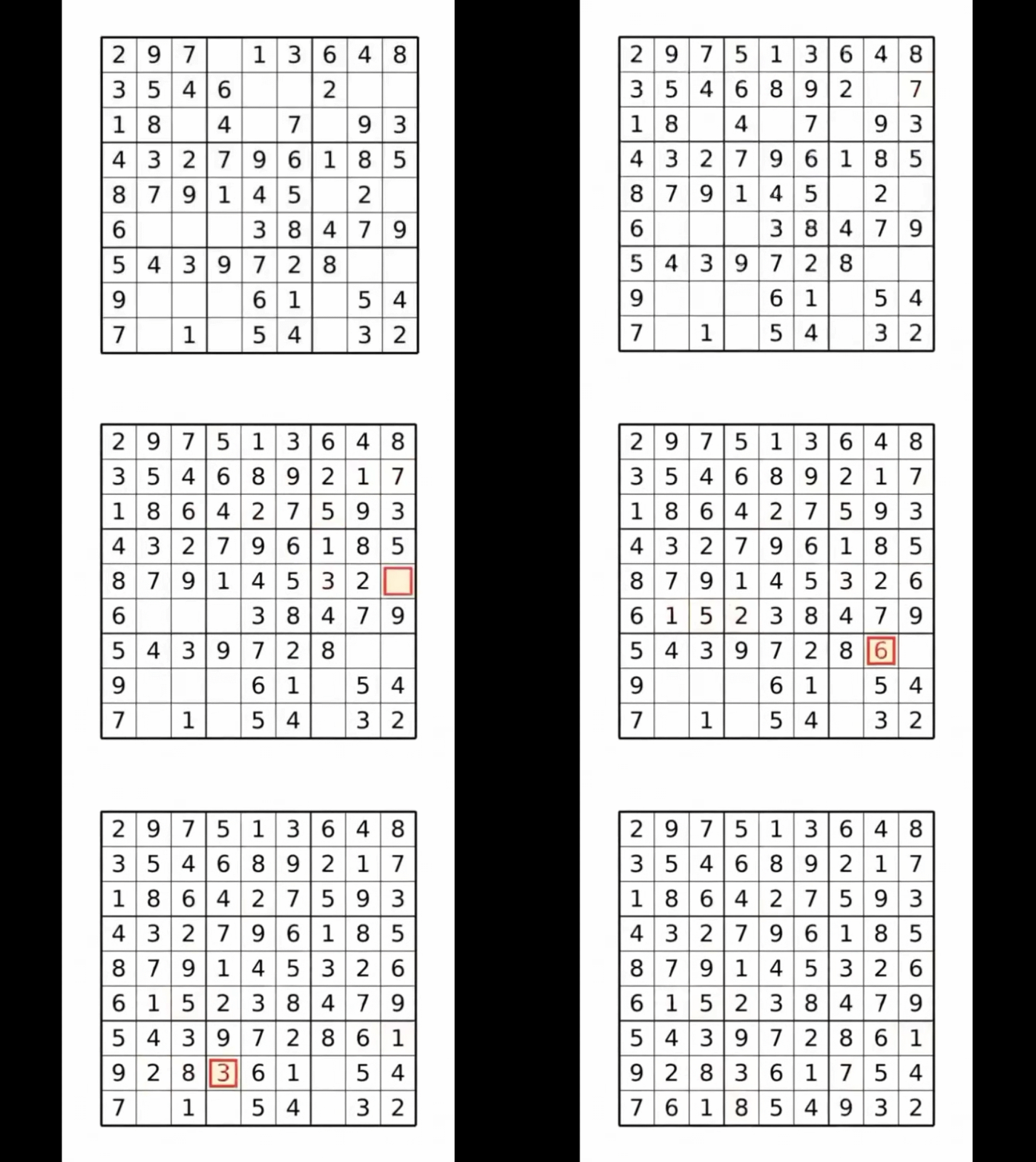
In the past, making this type of video usually required first using other tools to calculate the answer, then breaking down each operation step into prompts to guide the video model to generate segment by segment. MAGI-2 can integrate rule understanding, step organization and video generation into the same task.
The second category is narrative planning. For example, in our practical test, we asked MAGI-2 to generate a sci-fi film trailer with the theme of future city, and the prompt only mentioned keywords such as short-haired woman and red full moon.
MAGI-2 completed the whole story by itself: first use a long shot to show the city and the red moon, then follow the character's movement with a medium shot, then arrange an explosion that does not exist in the prompt as a plot turning point, and finally end with the character turning around and running.
Sand.ai said that these capabilities are observed after the model parameter scale is further expanded. To adapt to different creative needs, the team also added a switch to the Prompt Enhancement (PE) function: users can choose to let the model directly understand the creative intent, or get more detailed generation control with the help of PE.
03. 0.5 yuan to generate 1 second of video: MAGI-2 targets mass commercial production
In the first two parts of the practical test, MAGI-2 demonstrated capabilities such as continuous long video generation, precise multi-asset invocation and targeted local editing. But for commercial creation, whether it can stably output content that meets the requirements and whether the generation cost is low enough also determine whether the model can truly enter the production workflow.
We also tried to use MAGI-2 to complete different types of video tasks such as e-commerce advertising, brand promotion and overseas localization, to observe its actual effects in e-commerce, stylized video creation and video localization.
In the e-commerce marketing scenario, we chose a pair of professional white and blue running shoes as the test object. First, we input three perspective images of the running shoes (side, top and rear) into MAGI-2 as reference materials, and then required the model to generate a product advertisement of about 20 seconds.
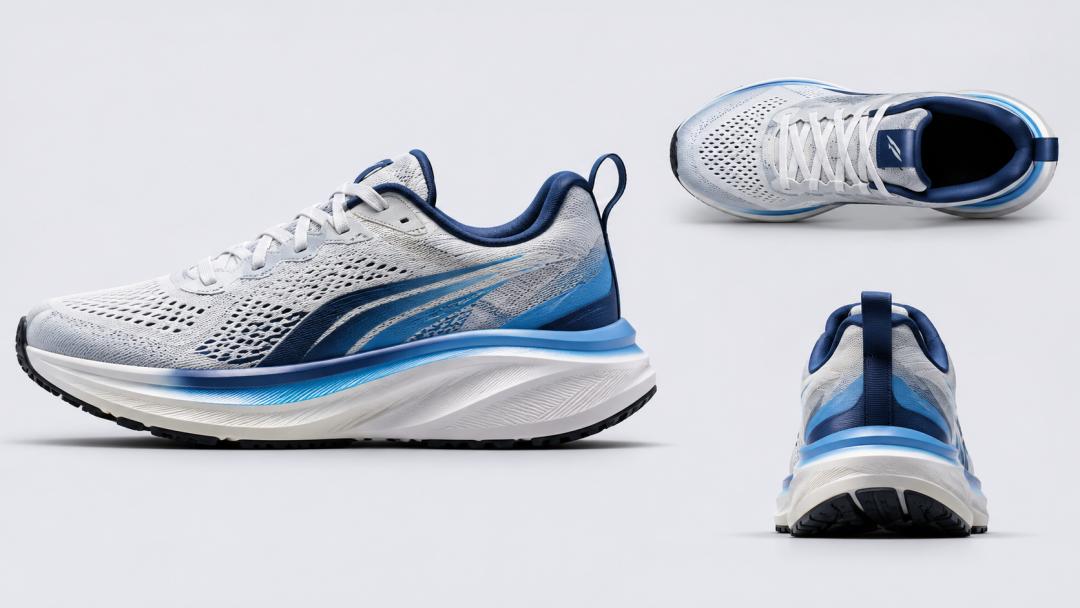
From the generation effect, MAGI-2 basically completed the shot transition from static product display to dynamic wearing effect. The white upper, blue side decoration and thick sole of the running shoe maintain high consistency in different shot sizes, and the overall design of the shoe does not change significantly due to shot transitions.
MAGI-2 has good understanding of various style prompts. We tried different styles such as miniature models and clay animation, and the model can well restore the corresponding visual features.
In addition, MAGI-2 can also play a role in video localization tasks. We took a Chinese tea brand advertisement as the original material, and required MAGI-2 to replace the appearing character with another overseas woman, rewrite the Chinese voiceover into English, and retain the drink appearance, cup logo, background store and camera movement in the original video as much as possible.

From the editing result, MAGI-2 completed the character replacement and language conversion, and the modified frames still retain the main scenes and shot structure of the original video.
Combined with the price of 0.5 yuan per second for MAGI-2, the commercial value of the above capabilities lies not only in reducing the production cost of a single video, but also in making the large-scale and customized production of video content more feasible.
For example, for e-commerce merchants who need to continuously update materials, they can generate advertising versions of the same product in different scenes, shots and styles for placement testing on different platforms and for different audiences; targeted editing capabilities such as character replacement and language conversion are expected to reduce the cost of reshooting and remaking when brand advertisements go overseas.
Sand.ai also revealed that MAGI-2