The film box office dropped by 11.9 billion yuan, while the performance revenue only increased by 2.6 billion yuan.
In the first half of the year, the national film box office decreased by 11.879 billion yuan, while the performance box office increased by 2.6 billion yuan, and the gap between the lost amount and the gained amount was more than three times. The over 9 billion yuan in between went neither to cinemas nor to performance venues.
01
Let's first take a look at what a cinema is selling at noon.
The Lumiere Cinema in Xiaozhai, Xi'an, cleared its screening halls from 12:00 to 14:30 on workdays, turned off the lights, turned on the air conditioning, distributed disinfected blankets, set up separate zones for men and women, and even reserved a hall with fully reclining lounge beds. According to a November report from The Paper, this business sells monthly noon nap packages for 39.9 yuan, which works out to less than 2 yuan per day if calculated based on 20 working days a month.
Staff of the cinema said in an interview in November that the attendance rate during the noon break period has exceeded 50%.
When the same screening halls are used for film screenings, the national average attendance rate is only 5.76%. This was the level of cinemas across the country in the first four months of 2026, while the figure was 10.87% back in 2019. According to statistics from Top Data, a hall with 100 seats only has an average of 5 to 6 people seated on a regular basis.
I did the math, and this nap business is far more profitable than screening films. For a film screening, you need to split the revenue with multiple parties, pay special funds, and negotiate screening schedules with film distributors, while selling nap services only incurs electricity costs.
The cinema operator in the survey by Qianlong.com put it more bluntly: every day as soon as the cinema opens, rent and labor costs flow out like running water regardless of whether there are audiences or not.
Some people calculated a figure for this situation: 93% of the time in a year, a single seat is left empty.
02
The empty time slots were originally supposed to be filled with films, but this year the vacancy has become even more severe.
According to the Briefing on the Development of China's National Performance Market in the First Half of 2026 released by the China Performance Industry Association on July 24, there were 324,300 commercial performances (excluding performances in entertainment venues) across the country in the first half of the year, with a total box office of 30.408 billion yuan. The number of performances and box office increased by 1.96% and 9.41% respectively, and the audience reached 98.8118 million person-times, up 5.28%.
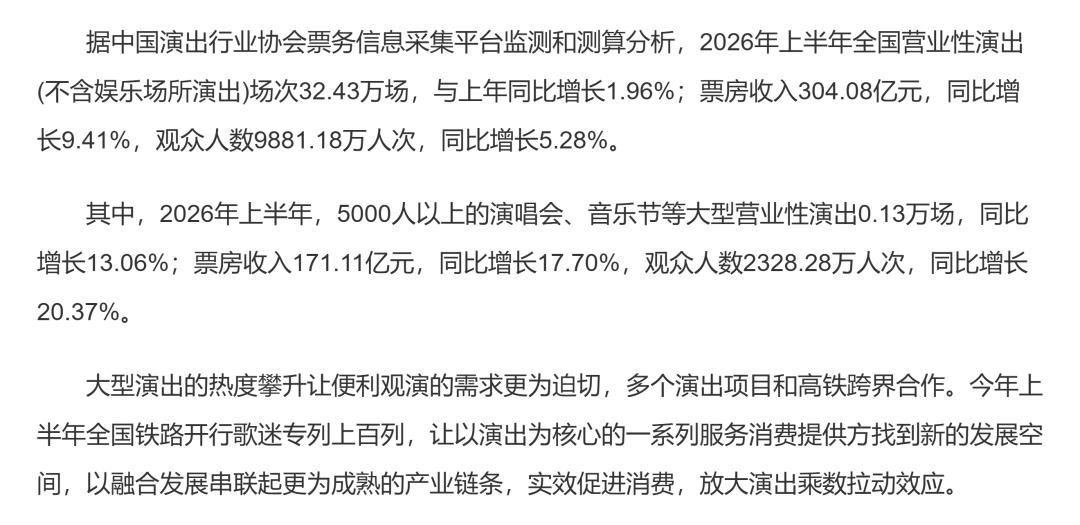
Image source | Briefing on the Development of China's National Performance Market in the First Half of 2026, China Performance Industry Association
According to data released by the China Film Administration, the film box office in the same period was 17.354 billion yuan, 11.879 billion yuan less than the 29.233 billion yuan in the first half of 2025, representing a year-on-year decline of 40.6%. The number of moviegoers dropped from 641 million to 422 million.
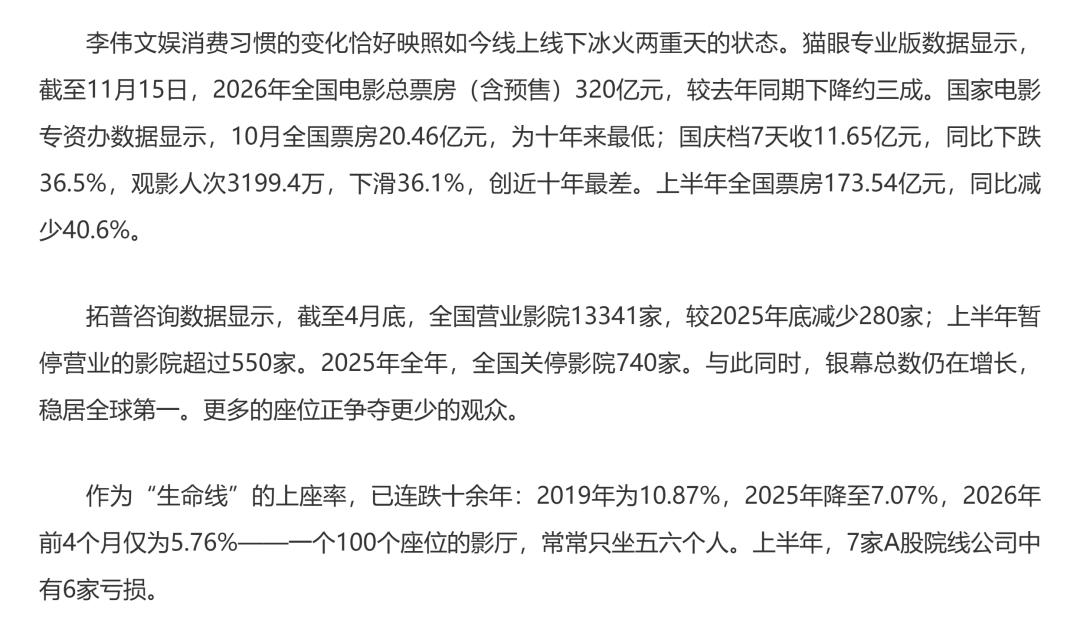
Image source | First-half data from China Film Administration, cinema operation indicators from Top Data
If you divide the two figures, you will see that the performance box office is already 1.75 times that of the film box office.
Calculated backwards based on the 9.41% growth rate, the performance box office in the first half of last year was approximately 27.79 billion yuan, with a little over 2.6 billion yuan added this year. The film industry lost 11.9 billion yuan while the performance industry only absorbed 2.6 billion yuan, leaving over 9 billion yuan scattered elsewhere.
This gap is the real problem. If concerts were simply taking business away from films, the gains and losses on both sides should be roughly equal. Now that one side has lost 11.9 billion yuan while the other has only gained 2.6 billion yuan, it shows that most people have no intention of spending the money elsewhere, and they simply choose not to spend it at all.
03
The revenue growth in the performance sector is not evenly distributed, all concentrated in the top end of the market.
The most noteworthy part of the briefing is the industry structure, while the total figure of 30.4 billion yuan is less important. According to the same briefing, there were only 1,300 concerts and music festivals with more than 5,000 attendees in the first half of the year, up 13.06% year on year, but they took in 17.111 billion yuan in box office and 23.2828 million person-times of audience, up 17.70% and 20.37% respectively.
Only 1,300 performances took away 56% of the entire industry's box office, and their growth rate is twice that of the overall market.
The number of performances increased by 13% while the audience size increased by 20%, which means the capacity of each show is getting larger. According to the briefing from the China Performance Industry Association, the average number of available tickets per concert increased by 11% year on year, and the proportion of projects held in stadiums also rose by 2 percentage points.
The total number of people has not increased, but the number of people that each show can accommodate has increased, and these extra audiences traveled from other cities.
Pan Yan, Vice President and Secretary-General of the China Performance Industry Association, released a figure: the national average cross-city attendance rate for large-scale concerts and music festivals is over 60%. The association's own estimated driving coefficient is 1:6.85, which means every 1 yuan of box office revenue can drive nearly 7 yuan of spending on catering, accommodation, transportation, travel, shopping and entertainment.
This coefficient is not just a theoretical calculation. In the first half of the year, hundreds of special fan trains were operated across the national railway network, and the China Performance Industry Association included this event in the main text of the briefing.
If you search for "cross-city concert trip" on Xiaohongshu, most of the results are related to business: accounts that run special concert shuttle bus routes, from Shengda 763 to Superstar Bus and Yaya Bus and group travel services, are publishing their route information, and chartered buses are available for Nicholas Tse's Hangzhou stop and Silence Wang's Hangzhou stop.

Image source | Screenshot of search results for "ask for leave for cross-city concert" on Xiaohongshu
When an entire industry can develop dedicated supporting transportation services, it means cross-city performance attendance is no longer an individual behavior.
The related searches on the same page also include these phrases: "how to ask for leave to go to a concert in another province", "do I need to ask for leave for a cross-province concert on weekends", "how to ask for leave if there is an exam on the concert day". When people on an entire page are researching how to ask their employers or schools for leave, the nature of this matter has changed.
04
The film industry has not only lost box office, but also the efficiency of each screening.
In the first half of the year, around 73.31 million screenings were held across the country, hitting a record high. The number of screenings is rising, but the audience is decreasing. According to data from Top Data, the average number of viewers per screening is only 5.8, down 36.2% year on year, and the average ticket price has also dropped by 4.4 yuan to 41.2 yuan.
According to Top Data, the average annual output per screen dropped from about 920,000 yuan in 2019 to around 470,000 yuan, nearly halved, while the number of screens has risen to 93,000, still the largest in the world. There are over 20,000 more screens than in 2019, but the annual movie attendance has dropped from 1.728 billion to around 1.2 billion.
According to statistics from Top Data, as of the end of April this year, there were 13,341 operating cinemas across the country, 280 fewer than at the end of 2025, and more than 550 cinemas suspended operations in the first half of the year. 740 cinemas closed down in 2025, and 806 in 2024, both hitting historical highs.
According to a November report from Jiangsu Economic News, 6 out of the 7 A-share listed cinema chain companies posted losses in their semi-annual reports, covering all players from leading enterprises to regional operators.
According to statistics from Top Data, ticket prices have been declining all the way: the average ticket price during the 2026 Spring Festival film schedule was 47.8 yuan, the lowest in six years, and the average price for the summer film schedule was 36.74 yuan, the lowest since 2022. The price cuts did bring back some audiences, and the summer box office reached 12.498 billion yuan, up 4.4% year on year, but the output per screen has not recovered.
05
Both films and performances sell the experience of "going out and sitting for two hours", but the nature of these two hours is completely different.
Film content can be watched later, but performances cannot be delayed.
Once a film leaves the cinema, its subsequent distribution path is fixed: it will be launched on streaming platforms one month later, have commentary clips available three months later, and be broadcast on TV half a year later. Audiences know they will not miss it, so "wait for the word-of-mouth to come out first" has become the default action. 200 new films were released in the first half of the year, only 5 had a box office exceeding 1 billion yuan, and only 6 mid-tier films with box office between 200 million and 1 billion yuan were left, half less than the same period last year.
Without the mid-tier films, the group of casual audiences who "just pick a random film to watch" disappeared accordingly.
Performances are a different story. That specific concert only happens on that exact day, in that exact city, with that exact group of performers. If you miss it, there will be no replay, no pirated version, and you cannot wait for the reviews to come out. This irreplaceability is the full reason why they dare to sell tickets at high prices.
There is another layer: films sell "what you watch", while performances sell "who you are with". The former is determined by content supply, while the latter is determined by social demand. The film content supply is indeed weak this year, but social demand has not weakened at all.
To put it simply, people are willing to pay for "this once-in-a-lifetime experience", but they are not willing to pay for "content that you can watch anytime".
06
But it is also inaccurate to regard the performance industry as a universal panacea for consumption recovery.
There is a sentence in the briefing that is easily overlooked: the market supply of large-scale music festivals has decreased slightly year on year. The music festival sector, which grew the fastest in the past few years, has started to shrink, and operators have shifted their focus from "competing for traffic" to "competing for experience".
Ticket prices are also going down. The box office growth rate of large-scale performances is 17.70%, while the audience growth rate is 20.37%. The fact that the number of audiences grows faster than the revenue shows that the average ticket price is decreasing. The number of available tickets per show increased by 11% while ticket prices are going down, which is a typical strategy of trading lower unit price for higher sales volume.
More importantly, 30.4 billion yuan of box office is not equal to 30.4 billion yuan of profit. This amount of money needs to be split among organizers, artists, venue owners and ticketing platforms, and no one publicly announces how much is left after the split. There is no comparable financial reporting system in the performance industry, so we can only see the revenue side of this figure.
So the accurate statement is that the performance industry has absorbed only a small part of the revenue leaked from the film industry, and it is not easy for them to hold on to this part either.
07
Cinemas are also looking for new paths, and they have got half of it right.
On July 3 this year, the China Film Administration and the State Administration for Market Regulation jointly issued the Notice on Promoting Diversified Operation of Cinemas and Prospering the Cultural Development of Cinemas, which includes ten measures that explicitly encourage cinemas to introduce catering, coffee shops, book bars, cultural and creative retail, esports games and immersive experiences.
SFC Metro-City Cinema in Xuhui, Shanghai, is the first anime-themed cinema in China, and its non-ticket revenue has exceeded 30% in the first half of the year. Shen Ziye, Senior Manager of Marketing and Brand Promotion at Shanghai Film Yingyuanshe, said that after watching the film, audiences will stay to experience XR interaction, buy IP derivatives, and eat themed meals, extending their stay time from 2 hours to more than 4 hours.
Shanghai Film Center SHO has gone even further, operating the space outside the screen as content. It held more than 200 film parties, concerts, premieres and brand launches in 2025, and its box office exceeded 8 million yuan in a single month in June this year, according to the November report from Jiangsu Economic News.
In the early morning of November 15, the League of Legends S16 Finals kicked off in New York, and cinemas across China were brightly lit, but what was playing on the screens was not a film at all.
All these attempts point to the same thing: the problem with screening halls is that they only support one type of content. 93% of the time in a day is left idle, but nap services can be sold out and esports screenings can fill the whole hall, which shows that the value of this space never lies in the screen.
Where did that over 9 billion yuan go? The answer probably lies in these places.
There is a specific person mentioned in the November report: 33-year-old Li Wei works as a dispatcher at a logistics company in Beijing. Last winter, after his night shift, he came across an AI post-apocalyptic drama, and since then he has spent more than ten yuan a month to unlock the episodes. He joked that it is not expensive, even cheaper than a breakfast. The last time he went to the cinema was to watch Pegasus 3 during this year's Spring Festival, and he has not been there since then.
The money may have gone to short dramas and games, or it may not have been spent at all. Statistically, this is called precautionary savings, which in plain terms means people hold on to their money when they feel uncertain about the future.
This is