Why can't Hongguo take over Bilibili?
In the era when Red Giant devours all long-form video platforms, only Bilibili stands out with its unique scenery.
On November 24, Bilibili released its financial report for the third quarter of 2026. In this quarter, Bilibili's daily active users reached 124 million, monthly active users hit 394 million, and the average daily usage time per user reached 121 minutes, all three indicators hitting record highs. This is also the first time that Bilibili's average daily user usage time has exceeded two hours.
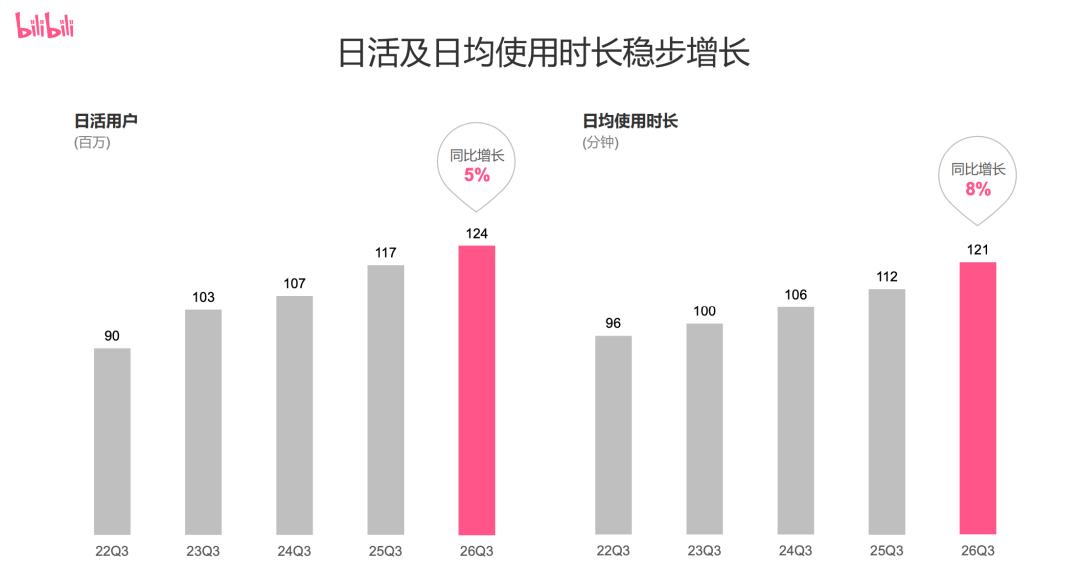
Bilibili Financial Report
Right at the start of the earnings call last night, even Goldman Sachs analysts could not help but ask: when more and more internet companies are impacted by short dramas and short videos, how can Bilibili still maintain continuous growth?
Chen Rui, Chairman and CEO of Bilibili, said that many people asked him this year whether Bilibili has been affected by short dramas, and "My answer is definitely no."
Chen Rui compared short-form content to potato chips, and Bilibili's content to rice, noting that the two meet different needs of different user groups — Chen Rui showed obvious pride in the platform's high-quality content, saying one is junk food while the other is high-quality staple food.
At least judging from the financial report, Chen Rui does have the confidence to say so. Over the past three years, despite the rapid rise of short dramas, the total user usage time of Bilibili has maintained double-digit annual growth. In the first half of this year, this figure increased by 17% year-on-year, and the growth in the third quarter also reached 14%.
However, over the past half year, Bilibili's investors are obviously not as optimistic as Chen Rui. Since the beginning of this year, the stock prices of Bilibili on both the US stock market and Hong Kong stock market have fallen by nearly 70% from their highs for the year.
In the past few months, a number of investment banks have successively lowered Bilibili's profit forecast and target price. One of the reasons is the concern that even if Bilibili can retain users who do not watch short dramas, it may not be able to retain advertisers who have shifted their budgets to short dramas.
The latest financial report has dispelled investors' concerns to a certain extent. In the third quarter, Bilibili's revenue reached 8.32 billion yuan, a year-on-year increase of 8%; adjusted net profit was 828 million yuan, a year-on-year increase of 5%, both figures slightly better than market expectations. In the second half of the year when advertisers generally tightened their budgets, Bilibili's advertising revenue still maintained a year-on-year growth rate of 20%.
After the US stock market closed this morning, Bilibili's stock price rose by 1.93%. After the Hong Kong stock market opened, Bilibili's stock price once surged by more than 14% during intraday trading.
The Red Giant Survivor
Compared with long-form video platforms, Bilibili has hardly been greatly affected by the impact of the Red Giant.
iQiyi, which released its Q3 financial report last week, saw its membership revenue in the current quarter drop to the lowest level in nearly six years. Struggling for survival, iQiyi has had to cut self-produced content, outsource more content to third-party producers, and share revenue based on playback performance.
Bilibili's content supply is accelerating instead. In the third quarter, the number of daily active UP creators on Bilibili increased by 10% year-on-year, the average daily number of video submissions increased by 36% year-on-year, and the number of UP creators with more than 1,000 fans increased by more than 25% year-on-year. In the same period, the average income of Bilibili's UP creators increased by 25% year-on-year.
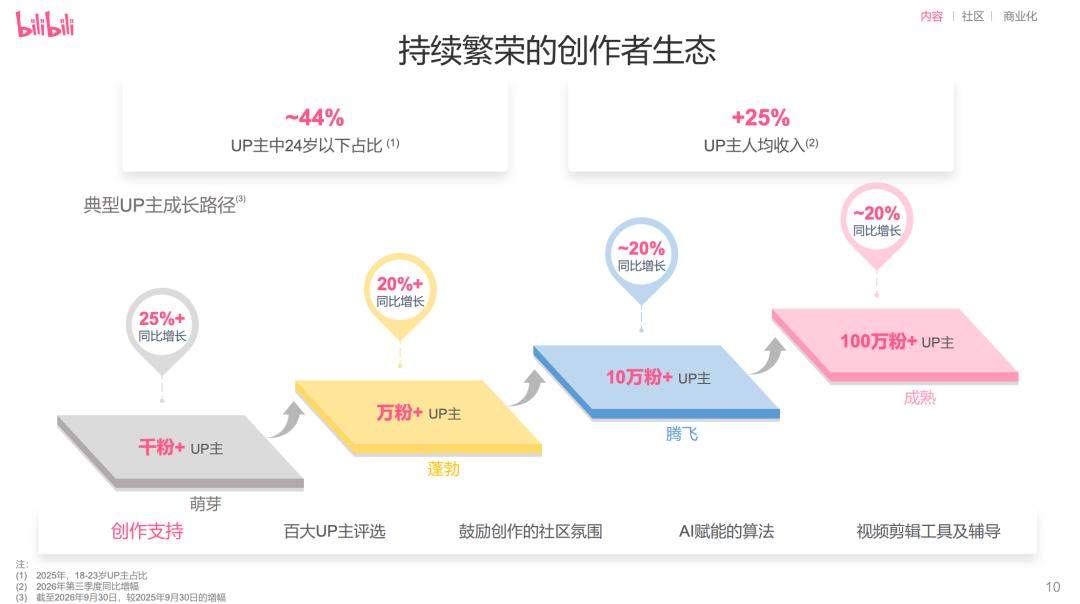
Bilibili Financial Report
This is caused by the underlying differences of the platforms. Different from PGC platforms like iQiyi that mainly rely on dramas and movies to drive membership growth, Bilibili has long been engaged in the PUGC business, and a large number of users are content producers themselves. The difference between the two is as big as that between Netflix and YouTube (this is overpraise for both iQiyi and Bilibili).
Bilibili once took a detour, learning from long-form video platforms to make self-produced content. Later they obviously came to their senses: instead of spending great efforts to produce self-made dramas, it is more cost-effective to allow UP creators to upload pirated content. For example, you can now find popular variety show *Later Will Meet Again* on Bilibili, or Lee Chang-dong's Oscar-nominated feature film *Possible Love*, even in 4K HDR version.
Chen Rui believes that short-form content and Bilibili target completely different user groups. Short-form content pursues continuous attention attraction, so it can only continuously strengthen stimulation. While Bilibili has always focused on high-quality content, the most important thing for high-quality content is to occupy users' minds and make users gain a sense of acquisition.
Chen Rui said that many users of Bilibili do not watch short dramas at all. In his words, "Bilibili's users are the youngest, most active group of users in China with the best education background and the best aesthetic taste."
Chen Rui is good at telling stories. At the earnings call, he even raised the difference between the two to the height of "the beautiful spiritual needs of human beings", saying "If everyone is full of hope for the future of mankind, our business will definitely grow bigger and bigger." — Looking at the increasingly rampant content of Milk Dragon and Big Fat Fish on Bilibili, people may not need to have too high expectations for the spiritual needs of human beings.
But in any case, Bilibili has indeed withstood the impact of this round of short dramas. In addition to the continuous growth of user scale and usage time, even advertising revenue has not been greatly affected.
In the first three quarters of this year, Bilibili's total advertising revenue reached 8.81 billion yuan, an increase of about 25% over the same period last year, close to the full-year figure of last year. In the same period, iQiyi's advertising revenue decreased by about 2% year-on-year, only more than 40% of Bilibili's figure. In the second quarter of this year, Bilibili's advertising revenue surpassed the value-added service revenue including live streaming and premium membership for the first time, becoming the largest source of revenue for the company.
Compared with long-form video platforms, part of Bilibili's advertising has stronger irreplaceability. For example, the AI industry that has risen rapidly in the past two years. For AI products, inviting several UP creators to demonstrate the functions for half an hour may be more effective than inserting dozens of seconds of advertisements between short drama episodes. In the third quarter, Bilibili's advertising revenue from the AI industry increased by nearly 95% year-on-year.
But Bilibili's advertising business is not as easy to operate as it was in the first half of the year. In the first three quarters of this year, the year-on-year growth rates of Bilibili's advertising revenue were 30%, 28% and 20% respectively. After advertising became the company's largest source of revenue in the second quarter, Bilibili's advertising revenue in the third quarter fell back below the value-added service revenue.
Li Ni, Vice Chairwoman and COO of Bilibili, said at the earnings call that advertisers' budgets are generally tightened in the second half of the year, and Bilibili's advertising growth comes more from the structural migration of the overall industry budget.
Facing analysts' concerns about the future growth of Bilibili's advertising revenue, Li Ni almost repeated their previous remarks: the demographic dividend of Bilibili's users as they grow older, multi-screen advertising strategy, and the improvement of advertising efficiency brought by AI. Li Ni said they believe that the company will continue to outperform the industry growth rate in the fourth quarter and next year to achieve advertising growth.
Investment banks are not so optimistic. Citi affirmed the resilience of Bilibili's advertising business in its latest research report after the release of the Q3 report, but still predicted that the advertising revenue growth rate in the fourth quarter will further slow down to 15%, and lowered Bilibili's profit forecasts for the next three quarters by 2% to 5%.
Macquarie is more pessimistic. The bank previously believed that the rise of emerging content platforms such as Red Giant will lead to the redistribution of advertising budgets, and therefore lowered Bilibili's advertising revenue forecast from 2026 to 2028 by up to 20%, and cut the target prices of Bilibili's Hong Kong stock and US stock by 43%.
Chen Rui Still Needs to Strive for the Three Kingdoms Game
If the advertising business is excluded, Bilibili's revenue has hardly grown this year.
In the first three quarters of this year, Bilibili's value-added service revenue increased by 4.2% year-on-year, game revenue decreased by 10.9% year-on-year, and IP derivatives and other revenue increased by 5.3% year-on-year. The total revenue of the three businesses is 14.92 billion yuan, which is even nearly 90 million yuan less than the same period last year.
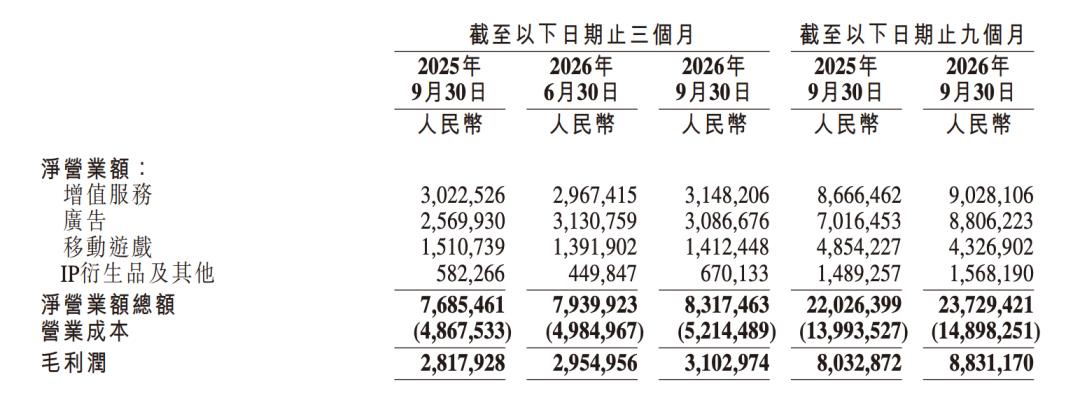
Bilibili Financial Report
Value-added services are still Bilibili's largest business at present, including live streaming rewards, premium membership, and the "Charger" business that pays for UP creators. But in the past two years, the growth of value-added services has continued to slow down. In 2024, Bilibili's value-added service revenue increased by 11% year-on-year, dropped to 8% in 2025, and only grew by about 4% in the first three quarters of this year.
The number of premium members has even started to decline. As of the end of the third quarter of this year, the number of Bilibili's premium members was 24.68 million, a decrease of about 1 million compared with the end of the second quarter, and about 700,000 less than the same period last year. While the user scale hits a record high, the number of users willing to purchase Bilibili's premium membership has decreased. Fortunately, the average revenue contributed by each premium member has increased, so Bilibili's premium membership revenue in the third quarter still maintained year-on-year growth.
The only part of value-added services that still maintains rapid growth is the "Charger" business. In the third quarter, Bilibili's "Charger" business revenue increased by more than 40% year-on-year. In the past two years, more and more UP creators have begun to set some videos to be only open to paying "Charger" users, helping Bilibili obtain part of the payment share.
The bigger problem still lies in the game business.
*Three Kingdoms: Scheming for the World*, launched in the summer of 2024, is the biggest surprise of Bilibili's game business. In the first full quarter after the game was launched, Bilibili's game revenue increased by 84% year-on-year to 1.82 billion yuan, helping Bilibili achieve adjusted profit in a single quarter for the first time.
But more than two years have passed, Bilibili has not launched the next hit game comparable to *Three Kingdoms: Scheming for the World*. In the third quarter of this year, Bilibili's game revenue was 1.41 billion yuan, a year-on-year decrease of 7%, which has declined year-on-year for five consecutive quarters. Compared with two years ago, Bilibili's single-quarter game revenue has decreased by more than 400 million yuan.
Bilibili's self-developed game *Escape from Duckov* last year achieved good results, ranking first in the annual domestic standalone game sales list with sales of about 3.8 million copies. However, limited by the buy-to-play business model, this game may be difficult to continuously contribute revenue like *Three Kingdoms: Scheming for the World*.
In September this year, Bilibili launched its first self-developed online game *Shine! Lumi*, which once rushed to the second place on the iOS download chart in mainland China. Chen Rui said that the performance of this game meets the company's expectations for a casual game, and currently overseas markets contribute about 45% of the total revenue. He expects this game to make a profit next year.
Bilibili's most anticipated upcoming product is still the Three Kingdoms themed game. On December 24 this year, Bilibili will launch another Three Kingdoms themed strategy game *Three Kingdoms: Wangdao Under Heaven*.
According to Chen Rui, *Three Kingdoms: Scheming for the World* mainly targets younger strategy game players who prefer casual gameplay, while *Three Kingdoms: Wangdao Under Heaven* targets older players who have higher requirements for strategy gameplay and have more disposable income. In other words, it can attract more middle-aged groups who have money and leisure, and bring better revenue performance.
Next year is Bilibili's big year for game business. In addition to *Three Kingdoms: Wangdao Under Heaven* launched at the end of this year, Bilibili also plans to launch *Ragnarok Online 3*, a card game adapted from the *Guild Wars* IP, and self-developed game *Three Kingdoms: Phoenix in the Chaotic Era*. The first closed beta test of *Ragnarok Online 3* in mainland China has ended, and it is Bilibili's key product for next year. "The game revenue next year will definitely be better," Chen Rui said.

Bilibili Game Business
Another fast-growing business is selling peripheral products and holding exhibitions. In the third quarter, Bilibili's IP derivatives and other business revenue increased by 15% year-on-year, mainly from IP derivatives sales and offline activities. But this business only accounts for 8% of Bilibili's total revenue, and the revenue in the first three quarters of this year is less than 80 million yuan more than that of last year.
The weak growth of businesses other than advertising means that if Bilibili wants to maintain the profit growth rate of the past two years, it has to continue to find ways to control costs and expenses.
But this room for optimization is also shrinking. In 2023, Bilibili's annual gross profit margin was only 24.2%, increased to 32.7% in 2024, and further increased to 36.6% in 2025. In the three quarters of this year, Bilibili's gross profit margin was 37.1%, 37.2% and 37.3% respectively. Fan Xin, CFO of Bilibili, predicted that the gross profit margin of the company in the fourth quarter will be basically the same as that of the third quarter.
At the same time, Bilibili, which has just achieved full-year profitability, has begun to spend more money. In the third quarter of this year, Bilibili's R&D expenses increased by 11% year-on-year, mainly due to the increase in server depreciation expenses. In September this year, Bilibili issued convertible bonds with a scale of 700 million US dollars, and one of the uses of the raised funds