Pop Mart's Q3 revenue nearly halved year-on-year, has the blind box economy lost its steam?
In the third quarter of 2026, Pop Mart released a performance report that surprised the market: The group's overall revenue decreased by 45%-50% year on year. Among them, offline channels in the Chinese market decreased by 5%-10%, and online channels decreased by 45%-50%.
Just in the same quarter a year ago, Pop Mart's overall revenue still grew by 245%-250% year on year, and its Chinese online channel even increased by 300%-305%.
In just four quarters, from the LABUBU-driven craze of "one figure is hard to get" to the nearly year-on-year halving of single-quarter revenue, the growth curve of the industry leader has taken a sharp downturn.
What is more noteworthy is the online channel.
The self-developed online blind box vending machine has always been an important growth engine for Pop Mart's online business. In the first half of 2026, the revenue of the blind box vending machine reached 2.063 billion yuan, a year-on-year increase of 83.3%, accounting for 43.2% of the revenue of China's online channels, making it the largest single online channel.
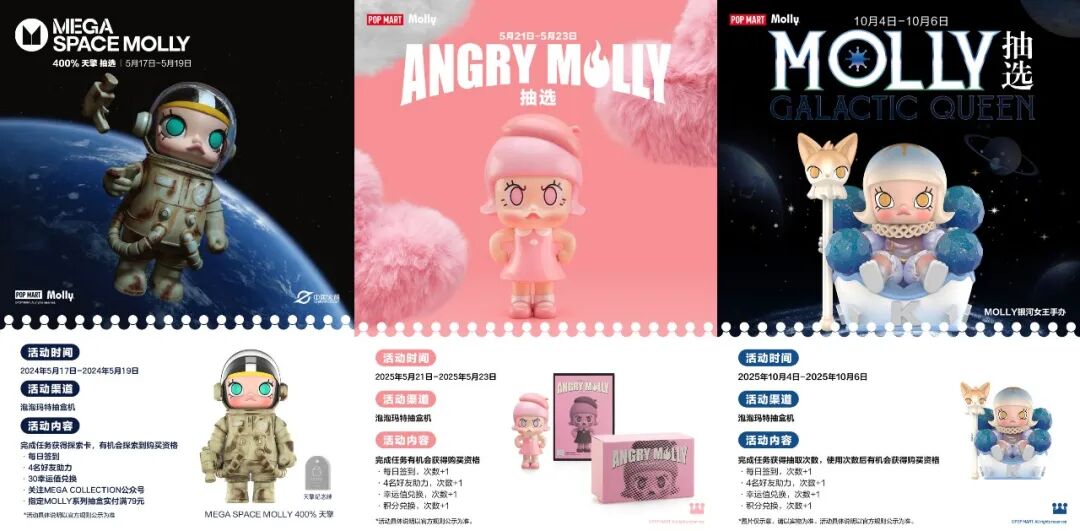
However, in the third quarter, the management confirmed at the performance meeting that the traffic of the blind box vending machine had declined; at the same time, it emphasized that traffic quality and customer conversion rate were still improving, and attributed the decline to the high base effect brought by LABUBU's explosive popularity last year — the casual non-targeted traffic left, and the remaining core users had stronger willingness to pay.
The question is, can the improvement of conversion efficiency offset the shrinkage of traffic scale? When the number of visits to the blind box vending machine no longer grows continuously, can the mechanism that once continuously stimulated repeat purchases by random selection still maintain the past growth momentum?
01 Blind boxes are still growing, but it is not so easy for brands to make money from them
In fact, the growing pains of leading enterprises do not mean that the entire blind box market is cooling down.
From the perspective of online transactions, the blind box market still maintains growth. The industry report released by Guojin Securities in June 2026 shows that the GMV of China's online blind boxes in 2024 was 3.28 billion yuan, a year-on-year increase of 83%; it reached 5.323 billion yuan in 2025, a year-on-year increase of 62%. From January to April 2026, the online GMV reached 1.718 billion yuan, a year-on-year increase of 21%. The market is still expanding, but the growth rate has slowed down significantly.
However, what deserves more attention than how much the market has grown is the source of growth behind the sales figures.
The "2026 White Paper on the Development of China's Toys and Juvenile Products Industry" released by the China Toys and Juvenile Products Association shows that in 2025, the sales volume of blind boxes on Tmall increased by 29% year on year, but the sales volume increased by 69.7%, and the average sales price rose by 31.6%. In other words, the expansion of the blind box transaction scale cannot be simply understood as consumers buying more, and prices and product structure also play a role in it.
But for brands, there is a more realistic problem: the market has incremental growth, which does not mean that every IP can seize the opportunity.
The "2026 China IP Retail and Toy Industry Tracking Report" released by Goldman Sachs Research tracked the multi-IP series Dear Birds launched by Pop Mart in May of that year. The report shows that as of June 8, the sales volume of this series on Douyin and Tmall exceeded 32,000 pieces and 10,000 pieces respectively, but there were still products on sale. In contrast, another multi-IP series Have a Good Run launched earlier was sold out soon after its launch, and its Douyin sales exceeded 200,000 pieces in the first month.
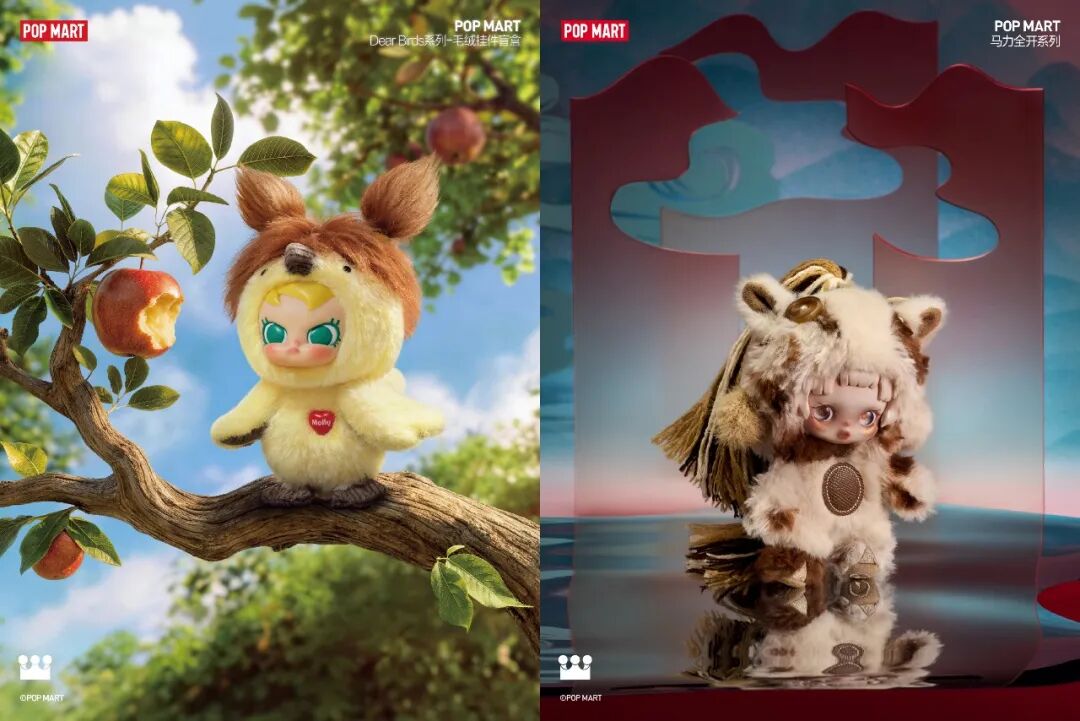
Left: Dear Birds series; Right: Have a Good Run series
It can be seen that even within the same brand, there are differences in market acceptance of different IPs and different products.
For trendy toy brands that rely on IP and serialized distribution, this means that new product development itself has greater uncertainty. The popularity of one IP can drive multiple series and product forms; but when a brand launches a new series, it does not mean that consumers will definitely continue to pay for it. New launches only increase the supply, and what really determines the sales result is whether the product can attract consumers.
In the past, when the blind box market was in a stage of rapid expansion, brands could use the breakout of IPs, new series launches and channel layout to meet new demand. When the industry enters a stage of more sufficient competition, market growth will no longer automatically translate into sales growth for every brand. What brands need to compete for is not only the attention of consumers, but also their limited purchase budget.
02 What challenges is the blind box mechanism that once made consumers addicted facing?
The commercial magic of blind boxes is essentially a clever mechanism design that turns "buying a toy" into "buying a chance of winning a prize". Superimposed by unknown surprises, the temptation of scarcity, and the obsession of collecting a full set, it pushes consumers to place orders repeatedly.
But this mechanism has its own boundaries. When the market moves from the expansion period to the intensive cultivation period, this once infallible growth formula is encountering challenges in three dimensions at the same time.
Randomness: How long can the sense of surprise last?
Randomness is the most basic growth engine of blind boxes. You pay but don't know what you will get. This sense of uncertainty will amplify the emotional fluctuation at the moment of opening the box, and also provide the most direct reason for "drawing one more time".
However, the marginal decline of emotional stimulation is a natural law. When consumers have drawn dozens or hundreds of blind boxes, their threshold for "surprise of opening the box" will get higher and higher; the negative experience brought by repeated models and unpopular models may also gradually offset the joy of drawing the favorite model.
At present, the online blind box traffic of the entire industry is saying goodbye to barbaric growth. Users will not always pay for the action of "opening a blind box" itself. In the end, every click to draw a box needs a more solid value support. And when the freshness fades, consumers will start to calculate: with the same amount of money, should they bet on an uncertain style, or directly buy one that they definitely like?
Hidden models: How much premium can scarcity support?
If randomness provides a reason for repurchase, the hidden model is the value anchor in this set of reasons. It creates scarcity with an extremely low probability, and creates the expectation of "making money as soon as you buy it" with high premium in the second-hand market, making consumers willing to invest repeatedly for a small probability result.
But the foundation of this narrative is also loosening. The most typical example is the hidden model "Id" of LABUBU's "High Energy Ahead" series: the official release price is 99 yuan, and the highest transaction price in the second-hand market once soared to 4522.5 yuan. However, with the large-scale release of official production capacity, the subsequent price fell back to about 400-600 yuan, down 87.4% from the high point.
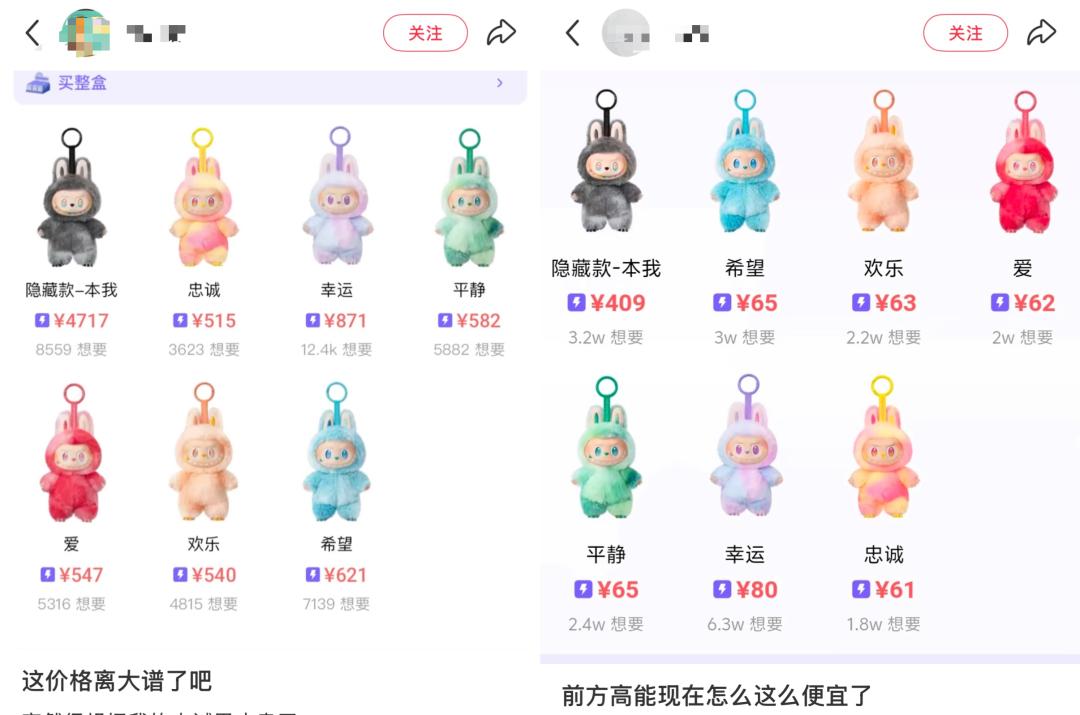
Another example is the "One Cat Transforms into a Cat" series launched in 2026. The highest transaction price of the hidden model "Maine Coon Cat" once rushed to 899 yuan, while the average price in the past three days is less than 300 yuan. The gap between the highest transaction price and the phased average price itself illustrates the problem: high-priced transactions do not represent the general market price, and it may only be a partial emotional pricing.
The bursting of the bubble is not an isolated case for top IPs. The former second-tier top stream Farmer BOB had a premium of several times in the second-hand market for its regular models in the early years, but now it has flowed into offline discount channels. The price of 30 yuan has slipped from "collection premium" to "clearance bargain". From the perspective of the whole industry, on the current mainstream second-hand platforms, the transaction price of the vast majority of regular blind boxes is close to the original price, the premium of ordinary hidden models has generally narrowed to less than double, more and more new products "break their price as soon as they are launched", and the space for hoarding for arbitrage has basically disappeared.

The reason why scarcity is fragile is that its control is never in the hands of consumers. Brands can change supply through increased production, restocking, and reprinting, and the hype of scalpers will quickly disappear as the popularity fades. When consumers realize that "scarcity" can be artificially regulated, the hidden model changes from a "value-preserving collectible" back to an "ordinary model with lower probability". It can still create topics, but it can no longer support continuous growth expectations.
Repeat purchase: Will consumers continue to place orders after the random stimulation weakens?
From the channel data side, in Q3 2026, Pop Mart's Chinese market online channel fell by nearly 50% year on year, while offline only fell by 5%-10%; TOP TOY's overall revenue in Q3 fell by 12.5% year on year, but the performance of clear-box figures and IP peripherals in offline stores was far better than that of blind box drawing products. iBrandi observes that the people who left are mainly the group of people sitting in front of the screen staring at the hidden model probability and second-hand quotations; the people who walk into the store, pick up the box, and pay for their favorite style have not disappeared by the same extent.
The purchase motivation of blind boxes can be broken down into at least three layers:
The first layer is the freshness of opening the box, which decays the fastest;
The second layer is the expectation of speculative arbitrage, which fluctuates sharply with second-hand prices;
The third layer is the emotional recognition of the IP itself, which is the most stable and lasting.
The three layers of motivation can exist at the same time, but their meanings to brands are completely different. The rapid growth of the industry in the past was largely driven by the superposition of the first two layers of motivation; now, the baton of growth is being passed to the third layer.
In essence, this is a migration of value anchors: In the past, the value of blind boxes lay in the "process of opening", in the unknown expectation; when random stimulation and scarcity premium gradually weaken, brands need to let consumers re-see the value of the "thing they get" itself, and return to the attractiveness of IP and the actual experience of products.
The number of blind box draws can be pushed up in the short term by probability design, but what can really retain users is still whether consumers are willing to continue to like this IP, buy its other products, and keep it in their lives after opening it.
03 Blind boxes can be an entry point, but not the whole of brand growth
When the growth of blind boxes begins to face challenges, brands need to consider not only how to continue to stimulate drawing, but also how to form more sustainable operating capabilities between IP, products and consumer demand.
First of all, the IP echelon needs to be able to relay.
The sudden popularity of a single IP can quickly push up sales, but once the popularity of the hit fades, the brand's performance may fluctuate accordingly.
Pop Mart's revenue structure in the first half of 2026 provides a sample. THE MONSTERS is still the IP with the highest revenue, but its revenue fell by 7.5% year on year, and its proportion in the group's total revenue also dropped from 34.7% in the same period of last year to 26%. At the same time, the revenue of the Starman IP skyrocketed by 580.6% year on year, making it the second largest IP. When the popularity of one top IP falls back, another IP makes up for it with a several-fold growth rate, and the overall revenue still grows by 23.8%.
TOP TOY's IP layout is another idea. iBrandi learned that as of March 22, 2026, TOP TOY has 24 self-owned IPs, 42 authorized IPs and more than 660 third-party IPs, forming a three-layer structure of "self-owned incubation + authorized cooperation + third-party introduction". It does not rely on the life cycle of a certain character, but uses the width of IP resources to disperse the pressure of single IP popularity fluctuation.
For brands, the significance of the IP matrix is to disperse the operating pressure caused by the change of a single character's life cycle. When an IP enters the second half of its life cycle, whether other IPs can fill the revenue gap depends on the brand's ability to continuously incubate and cultivate IPs, rather than waiting for the next unexpected hit.
Secondly, the product structure needs to meet the demand of "not wanting to draw".
The blind box mechanism keeps part of the clear purchase intention out of the door. Some people enjoy drawing, some people want to collect a full set, and some people just like a certain character and hope to buy it directly. If the product supply only has the form of blind boxes for a long time, those consumers who "don't want to bet, just want to buy" will not be served.
The category data of Pop Mart in the first half of 2026 is noteworthy: the revenue of plush products is 9.825 billion yuan, a year-on-year increase of 60%, and its proportion in total revenue rises to 57.2%; the revenue of figures is 5