Tesla FSD V15 has completely shattered the so-called "intelligent driving is good enough" narrative.
"It is no different from the real-scene interface of GTA."
On November 21, after Tesla pushed FSD V15.0.1 (software version 2026.38.6.11) to early users, this was the first reaction of many people.
Even the clouds in the sky and the brake lights of the preceding vehicle on the screen can be generated in real time, and this small detail instantly set off a global buzz across social networks.
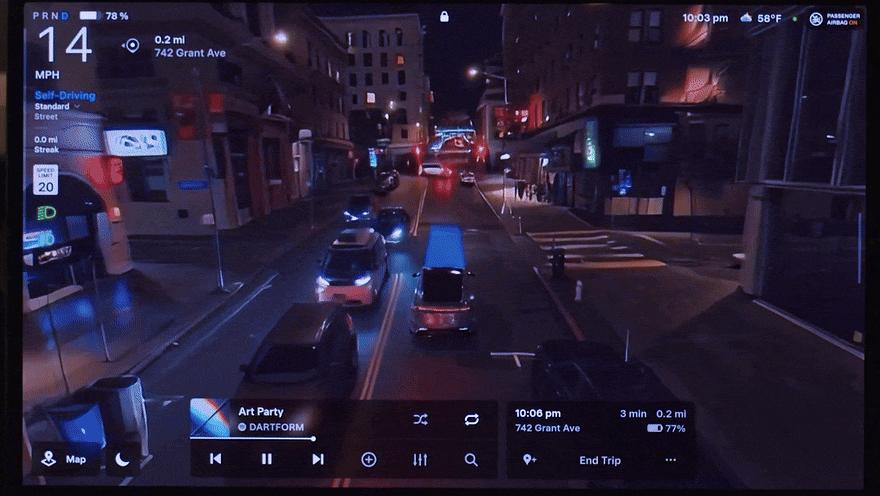
The comparison of the "Tesla Reality View" to the video game GTA was also recognized by Elon Musk.
He replied to investor Sawyer Merritt on X: "It's like GTA."
However, the Reality View is only the most eye-catching feature.
This time, FSD V15 also upgraded the driving model; its visual encoder is shared with Robotaxi and Optimus humanoid robot; the model and software gap between human-supervised mass-produced vehicles and unmanned operation fleets is also narrowing.
Over the past year, the main theme of China's intelligent driving industry has been "popularization of high-level intelligent driving on 100,000-yuan-class vehicles" and "removing LiDAR to reduce costs". "Free intelligent driving" and "the technology is already sufficient" have gradually become the default premises.
Tesla's FSD V15 was launched right at this moment.
Su Qing, head of Horizon Robotics' intelligent driving division, wrote on WeChat Moments after reviewing it: The arrival of V15 is very timely. It forces the market to shift to respecting technology and computing power, competing for higher standards instead of only focusing on cost and racing to the bottom. The short-term future of autonomous driving still has huge room for improvement, and there is absolutely no such thing as the technology being already sufficient.
01 No game engine, the GTA-level visuals are "generated"
When the FSD V15 update note was first released, Tesla's official AI account called it Tesla Augmented Reality, deleted the post 25 minutes later and reposted it, renaming it Tesla Reality View.
Augmented reality superimposes a layer of virtual information on the camera feed, while the visuals on this screen are not the original camera footage, but generated by the model.
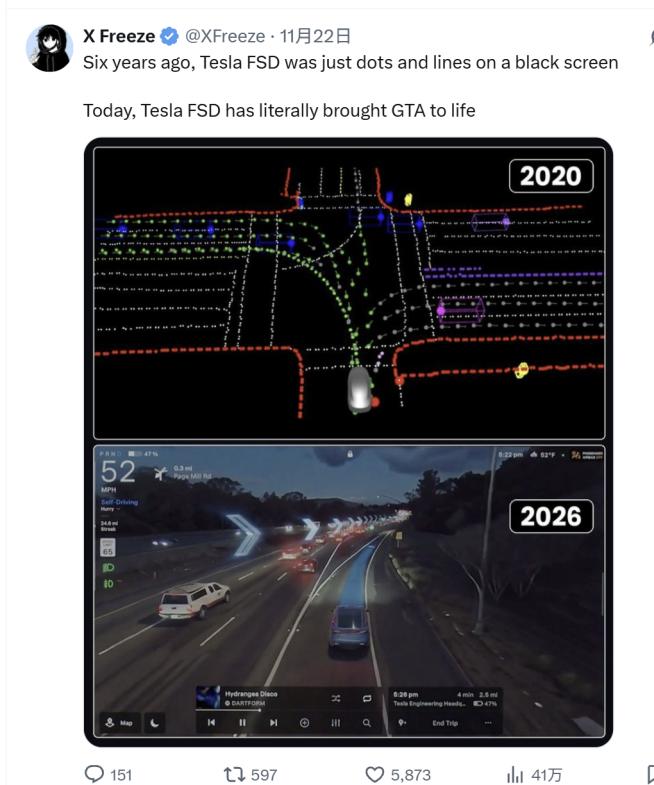
Reality View replaces the FSD visualization interface on the central screen, saying goodbye to the traditional "model guesses and draws for you" or "camera footage stitching" solution, and generates visuals in real time based on the visual features used by the driving network.
The previous SR (Surround Representation) interface output a simplified 3D digital model, which uses blocks to represent vehicles or stick figures to represent pedestrians.
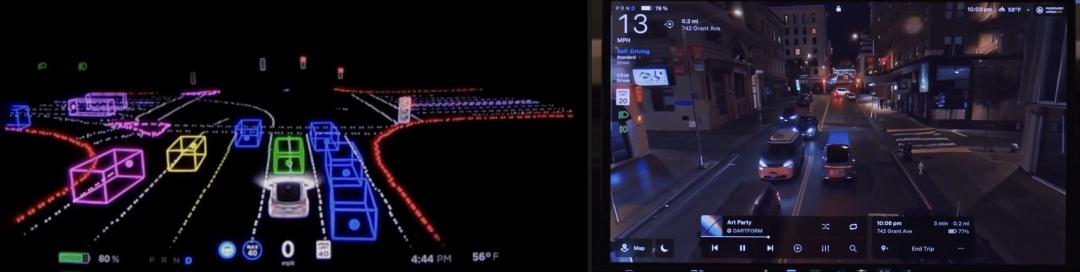
Reality View can continuously generate near-realistic visuals from any virtual perspective above the vehicle.
Users can directly see "the real world in the eyes of AI" (potholes, water puddles, small animals, speed detection cameras, floating turn arrows in the air), which greatly alleviates supervision anxiety.
Drivers can "choose between the full-screen visualization interface, map or split-screen view, and can also select the silent mode to enjoy a more comfortable driving and riding experience".
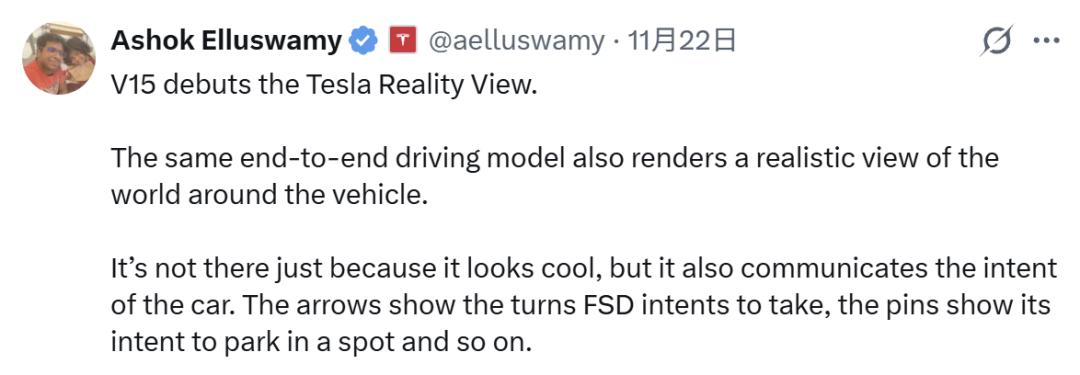
New prominent icons also appear in the visuals: arrows indicate the turning direction planned by FSD, and thumbtacks indicate the parking position of the vehicle.
According to Ashok Elluswamy, Vice President of AI Software at Tesla, this interface "is not just cool-looking", it also conveys the vehicle's intentions.
However, the image clarity provided by Reality View at the current stage is limited, and there is a certain degree of latency.
Musk stated that the visuals are currently rendered at 36 frames per second, and he believes the latency between the camera and the screen can be further compressed by about 35%, but this is a follow-up optimization direction that has not been pushed to users yet.
What is really like a game is not only the visuals, but also the interaction.
Users can use the overhead view to directly touch the screen to control the driving direction of the vehicle.
The vehicle will drive to wherever your finger points. During driving, you can switch lanes; when parking, the screen will display nearby parking spaces, and you only need to select manually.
Musk said that clicking a certain position on the screen will make the car drive there, and this feature is most suitable for specifying an exact drop-off point or parking space.
This is equivalent to assigning part of the driving functions to a "game display screen".
While posting the comparison chart, Elluswamy wrote in the caption: "What's even crazier is that the right side uses less computing power than the left side used to."
Tesla's AI4 hardware platform consists of two main chips, with a total of 6 TRIP accelerators, and Reality View only uses half of one TRIP accelerator in AI4.
Tesla explained in the description that the reason for achieving this extreme computing efficiency is that Reality View replaces all explicit model signals with the visualization of an end-to-end neural network, thus reducing the total calculation amount.
Under the old architecture, the model had to output explicit signals such as lane lines, obstacle frames, and traffic light status one by one, and then hand them over to another set of graphics programs to draw.
V15 removes this intermediate conversion step.
On November 23, Musk gave more details on X:
The camera footage first enters Tesla's Universal Vision Encoder (UVE).
The encoded features are sent in two paths: one path goes to the model with about 3 billion parameters that directly outputs driving actions; the other path is assigned to an independent generative model with about 1 billion parameters (which he calls a conditional mean-flow model, a type of diffusion model).
This independent generative model adds noise to the previously generated frame, then denoises it according to the latest visual features, and outputs a small segment of video at a time.
The driving model and the rendering model are two separate models that share the same set of visual features. The "half TRIP accelerator" refers to the overhead of the generative model path.
To stably output continuous visuals from the virtual perspective above the rear of the roof, the visual features must first contain a sufficiently complete 3D scene: where the surrounding objects are, what their materials are, where the light comes from, and where each object will move in the next second.
This is the technical principle of "real-time AI video generation (not a game engine)" as Musk described.
Beyond the screen, another major change in V15 is navigation.
V15 is the first FSD version that uses Tesla's self-learning navigation technology. From the start to the end of the trip, the navigation system uses an end-to-end learning model based on Tesla's fleet route preference data.
For example, when parking, V15 will display several parking space options near the destination on the map, which are referenced from the vehicle's parking history. This can be regarded as an enhanced version of "memory parking".
The rest of the changes are more focused on experience polishing.
In terms of obstacle avoidance, V15 can better detect and avoid potholes, debris and animals, and has "more natural speed control in school zones and bad weather", and the vehicle can also avoid deep water areas.
V15 also adds two new features:
FSD will now automatically slow down when it detects a speed camera; the bike rack mode allows users to enable FSD when a bike rack or similar trailer hitch accessory is installed.
In addition, combined with gear prediction, the automatic gear shifting function has also been improved.
Users can directly feel these changes, but the upper limit of V15 is determined by the model behind the screen.
02 From V12 to V15: Larger models, cars and robots share a pair of "eyes"
In recent years, the focus of Tesla's intelligent driving iteration has shifted from stacking perception hardware to making models larger and more efficient on limited chips.
At the beginning of 2024, V12, the first initial version of Tesla's single end-to-end neural network, was officially pushed to users.
This version changed the modular architecture of "perception-prediction-planning-control".
Driving logic that used to be written out by a large number of manual rules is now more handed over to the neural network to learn from data.
In November 2024, V13 was launched, which further simplified the control stack: the photon information captured by the camera is directly input into the model without any pre-processing.
As the scale of model parameters continues to expand, the value of the simple technical route begins to show.
At present, Tesla has not fully disclosed the parameter composition of the entire network. The number given by Musk is that the driving action model has about 3 billion parameters, and the Reality View generative model has about 1 billion parameters.
The expansion of neural network parameters improves the model's ability to understand time, scenarios and the consequences of actions.
Musk mentioned at this year's April earnings call that V15 is a version with "overall reconstruction of the software architecture".
The first item listed in the FSD update note is that V15 has upgraded the Vision Encoder.
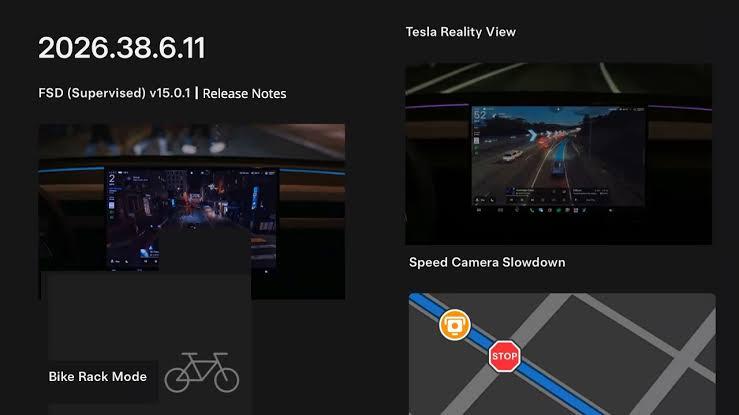
FSD v15.0.1 update note and preview of core new features
This visual encoder is unsupervisedly trained with millions of internet videos, and is shared with the Robotaxi and Optimus humanoid robot systems.
This "three-terminal homology" did not appear suddenly, but went through a continuous "alignment" process.
Previously, the hardware layer of Tesla's automotive products has long been unified.
Kerry Liu Xiangke, former Senior Manager of AI Hardware Development at Tesla, pointed out in a conversation with the "Silicon Valley 101" podcast: In terms of hardware, all Tesla Robotaxis, whether it is the Model Y or the steering-wheel-free Cybercab, are no different from mass-produced vehicles.
The more critical change lies in the software and model layer.
The software version running on Robotaxi is "the latest and most powerful inside Tesla", and after long-term testing and stability verification, it will eventually flow back to mass-produced vehicles in a rhythmic manner.
In October 2025, Tesla skipped FSD V14.0 and launched V14.1. Musk called it the second largest update after V12. This is also regarded as the first large-scale backflow of Robotaxi technology to mass-produced vehicles.
Elluswamy disclosed at the Q2 2026 earnings call that Tesla's Robotaxi fleet has accumulated more than 380,000 miles of unsupervised driving in six cities across two states, with no major accidents during the period.
Earlier in January this year, Tesla officially removed safety drivers from its Robotaxis in Austin.
This data reflects the operational progress of Robotaxi, not the independent test mileage of V15. He also said at the same call that the fleet has been running early versions of V15.
In August, Tesla told JPMorgan that V15 has seven major improvement directions planned internally, and about 40% of them have been used on the Austin Robotaxi fleet.
After visiting the Fremont factory, JPMorgan called V15 the "main gate" for the large-scale rollout of unsupervised autonomous driving.
In October, Elluswamy said Tesla hopes to add "some first batch of customer vehicles" to the Robotaxi fleet "around the second quarter of next year". The premise is that the vehicle is within Tesla's geofence and included in fleet management.
When V15 was pushed out this time, he also specifically emphasized that the first batch is only for "the first wave of customers".
Mass-produced vehicles and Robotaxi fleets, L2 and L4, are not only gradually achieving identity at the product hardware and software level, but also converging at the business model level.
The visual encoder of V15 is already shared with the Optimus humanoid robot.
Tesla is trying to turn the understanding of the physical world by cars and robots from two unrelated systems into a system that can share part of the visual representation and training capabilities.
Larger models, more data and more computing power bring better generalization.
Tesla has never changed this path.
Musk once said, "Making cheap cars cannot change the world". He also said that Tesla's investment in AI training and inference in 2024 was about 10 billion US dollars.
V15 is not only a consumer-side software update, but also a key step for Tesla to migrate its autonomous driving capabilities from "human-supervised" to "unsupervised operation".
Family cars are no longer isolated means of transportation, but data terminals and actuators that share physical world cognition with robots.
03 Another voice: 25x improvement factor, and the abandoned HW3
Tesla claims that the upgraded visual encoder has improved the key intervention rate of V15 by 25 times.
Musk emphasized on X: Not 25%, but 25 times! Welcome to the singularity.
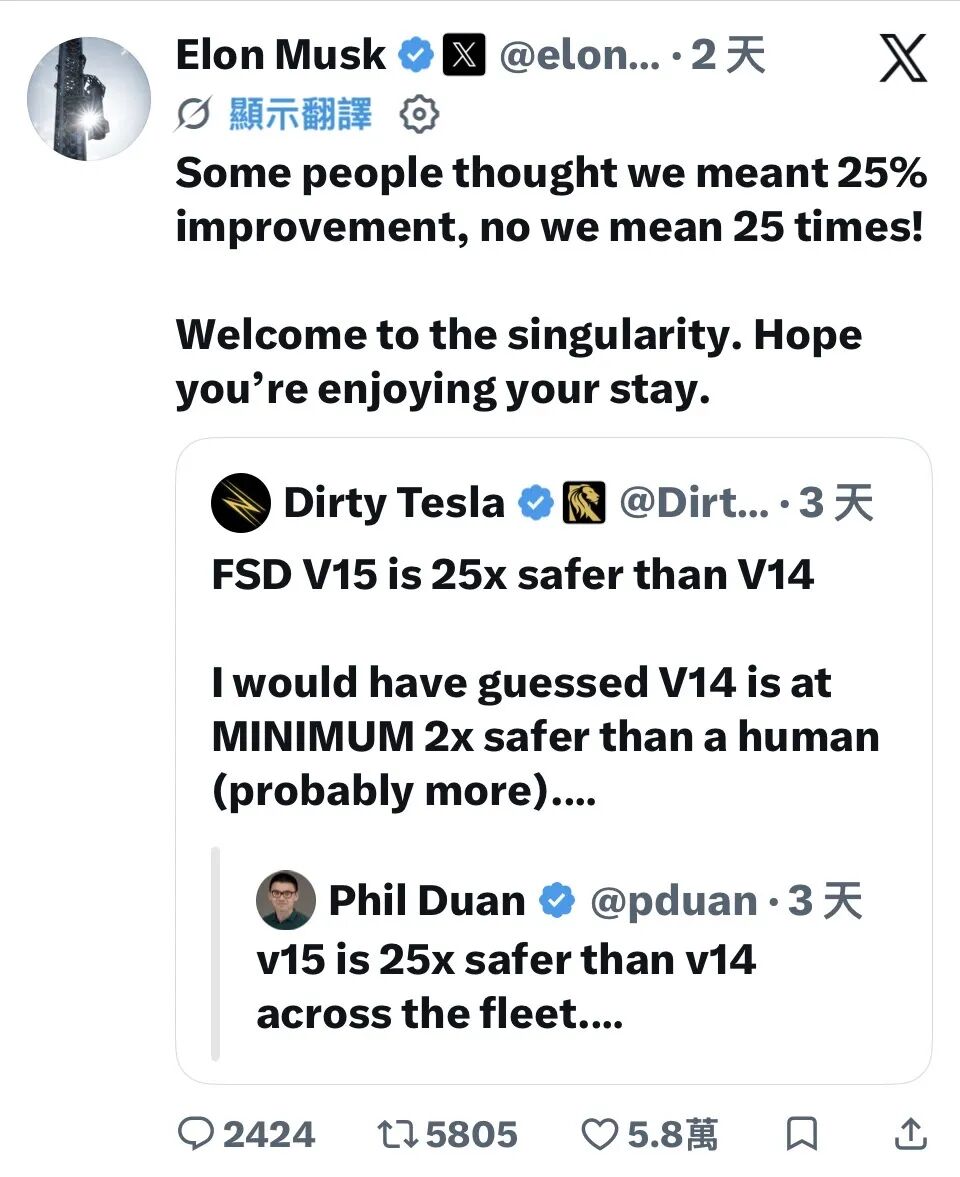
The key intervention rate is a commonly used indicator for measuring autonomous driving systems.
Phil Duan, head of Tesla FSD and Robotaxi, also mentioned this 25x figure on X.
He said, This difference is hard to notice in a single drive, and it only becomes apparent after millions of miles of driving.
According to earlier data this year, FSD V14 can travel thousands of miles between two key interventions.
Multiplying the level of about 2,000 miles by 25, the driving mileage between two key interventions will reach about 50,000 miles.
Foreign