Nvidia, whose market value has skyrocketed by 6 trillion, has saved Jensen Huang's dignity
The "Dragon King Returns to the Palace" plot in Hongguo short dramas is far too conservative.
In just 11 days, Jensen Huang went through a breathtaking underdog comeback arc.
From being mired in a sex scandal and resigning dejectedly, to receiving full backing from the President and the richest man in the world, 200,000 people signing a joint petition, then returning to NVIDIA and seeing his net worth skyrocket overnight, even authors of over-the-top wish-fulfillment stories would call this completely absurd.
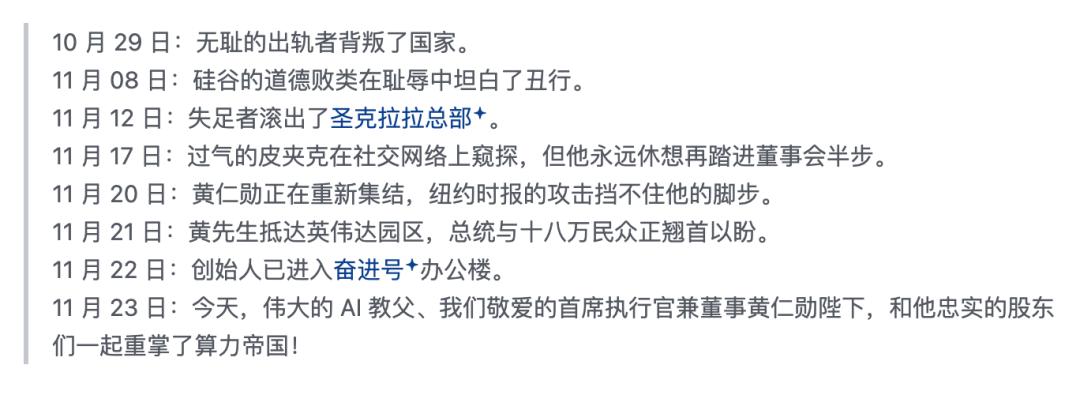
On November 12, Jensen Huang just announced his resignation as NVIDIA CEO, and the company's stock price plummeted immediately, dragging down the entire Nasdaq tech stock sector.
When someone is down, everyone kicks them. At his lowest point, he became the target of widespread public condemnation, perfectly illustrating the saying that "even breathing feels like a mistake".
On social media, all kinds of unverifiable "leaks from NVIDIA employees" kept popping up, with some people claiming that Jensen Huang breathed too loudly and scared the senior executives.
Others claimed he was "too overbearing", and even forced employees to taste the beef brisket served in the staff canteen.
The New York Times even published a special article criticizing Jensen Huang "bringing shame to leather jacket enthusiasts".

However, as global tech stocks kept falling, the plot gradually took a surreal turn. A massive "Save Jensen Huang" movement swept across Silicon Valley.
A few days after Jensen Huang resigned, the petition calling for his reinstatement had already garnered support from more than 200,000 people.
Not only did Elon Musk publicly voice his support for Jensen Huang, but Donald Trump even personally lobbied the NVIDIA board of directors.
Under pressure, the NVIDIA board, which had taken a hardline stance just a few days earlier, did a complete 180-degree turn and officially welcomed Jensen Huang back to the company.
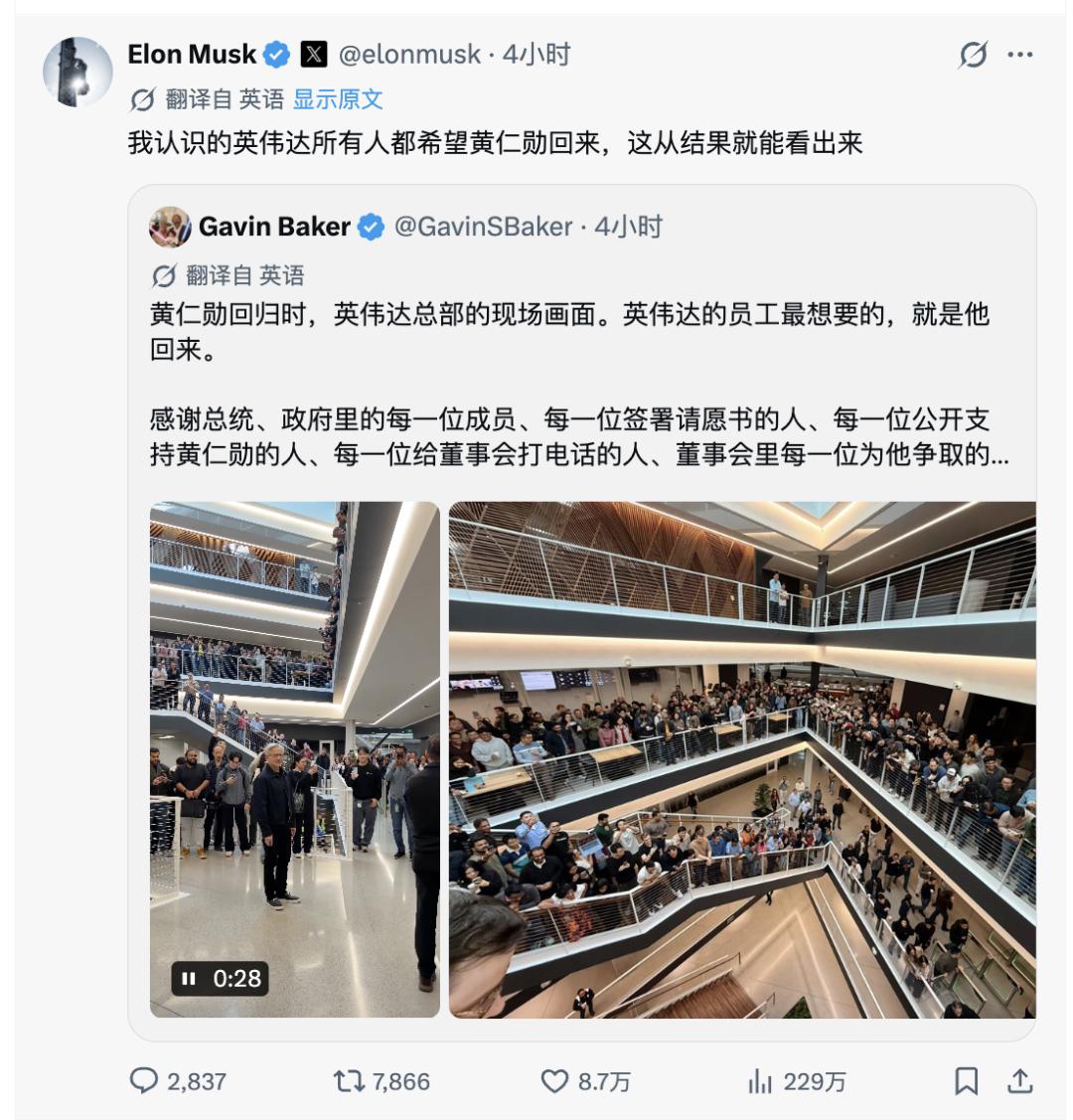
Right after this Silicon Valley version of "Consort Xi Returns to the Palace" concluded, the company's stock price surged 31.48% the same day, with its market value jumping by 952 billion US dollars overnight, equivalent to roughly 6.39 trillion yuan, setting a new single-day market value growth record for a listed company worldwide.
The Nasdaq index also rallied 6.5%, and tech stocks that had been battered in previous sessions staged a strong rebound.
Some people joked that if you turned Jensen Huang's experience into a short drama synopsis, it would probably read like this:
The company fired me, global assets plummeted, and a financial crisis hit! The President of the United States and the world's richest man jointly begged me to return. The President said I am a national treasure of the US, and the richest man spoke up for me. The second I came back, global assets soared, and human technology achieved breakthroughs!
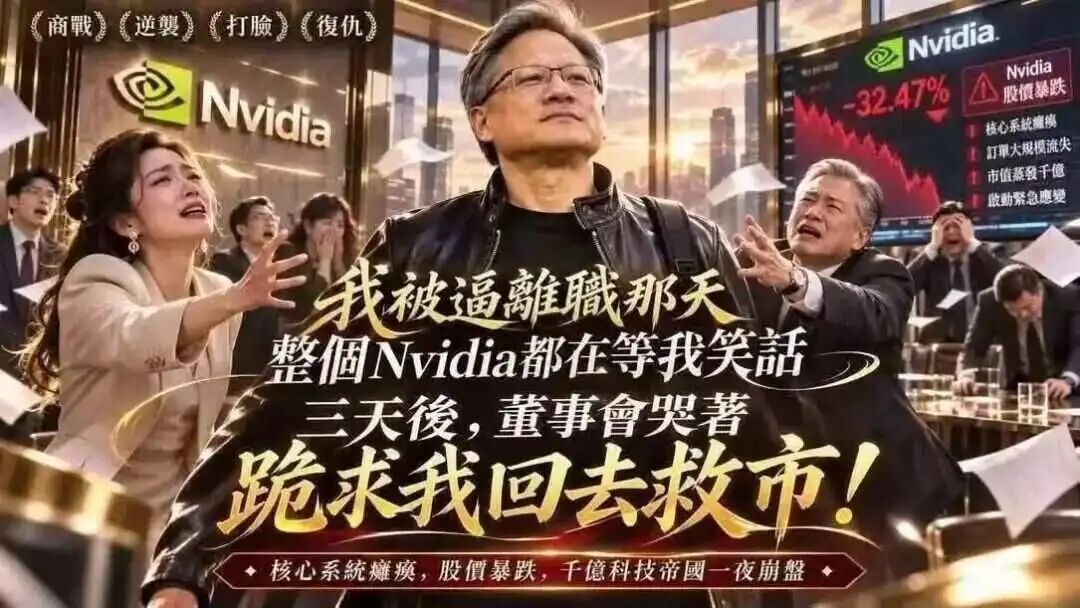
But during the days Jensen Huang was out of work, it was not just tech giants that were on tenterhooks.
On the other side of the Pacific, A-share retail investors, office workers who bought funds, and even young people who invested in gold hoarding all got a taste of the "prosper together, fall together" dynamic.
Jensen Huang, Unemployed for 11 Days, Dragged Down Global Assets
"My own job can be unstable, but Jensen Huang's job has to stay secure".
For global investors, these 11 days of Jensen Huang being unemployed were far more unbearable than losing their own jobs.
After all, Jensen Huang's status in the industry is entirely built on his proven ability to generate massive wealth.
Over his 33 years at the helm of NVIDIA, he turned this little-known small chip maker into a tech giant with a market value approaching 6 trillion US dollars.
The surge in its stock price is nothing short of an investment miracle: it has nearly multiplied 10,000 times since its IPO.
What does that mean? If you had invested 10,000 yuan in NVIDIA stock back in 1999 and held it until now, your net worth would be close to 100 million yuan.
In the eyes of many people, Jensen Huang is no ordinary CEO, but a walking God of Wealth.
That's exactly why after he publicly announced his resignation, the global capital market immediately went through a bloodbath.
NVIDIA's shareholders were the first to suffer, as its stock price plummeted 14% the same day, wiping out over 1 trillion US dollars in market value.
Some US investors even posted tearful stories on Reddit, saying they spent 250,000 US dollars buying NVIDIA stock, only to see its value drop to just over 80,000 US dollars.
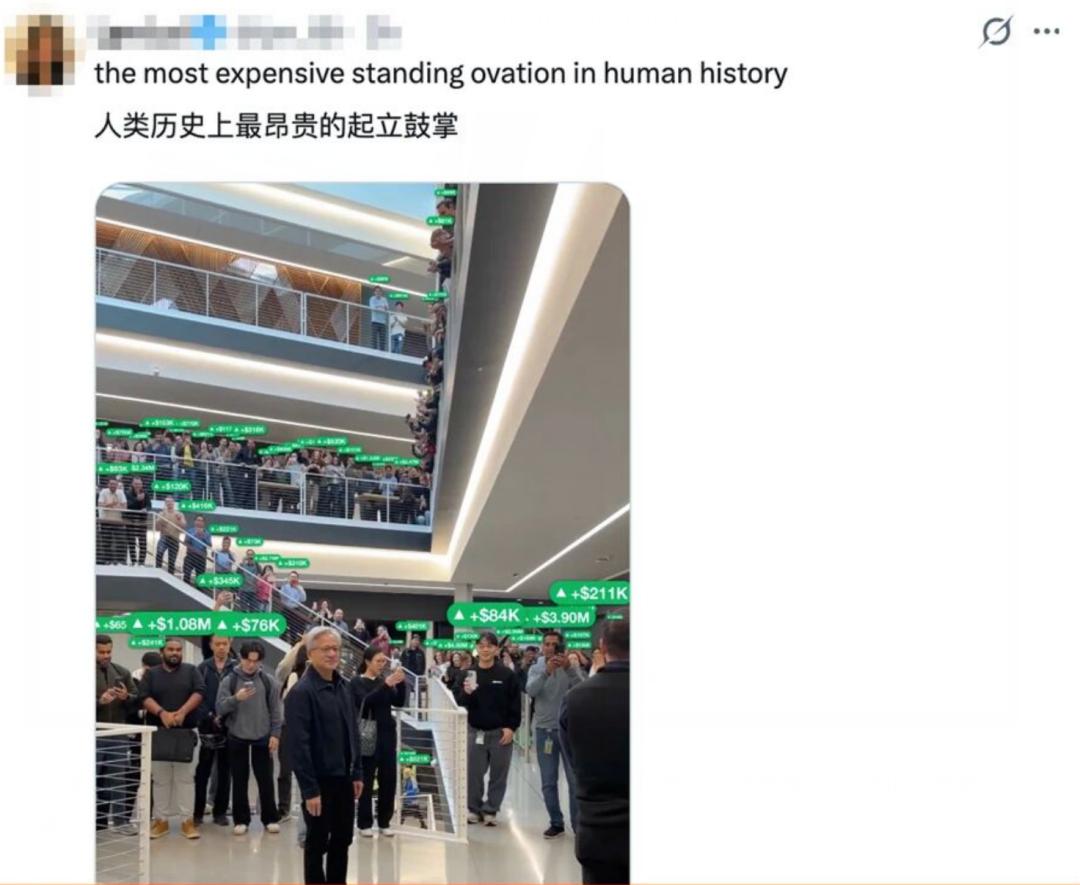
Even bigger ripple effects followed.
In the past few years, more or less all US tech giants have benefited from NVIDIA's growth, so now they are sharing both the gains and the losses.
According to The Wall Street Journal, the Nasdaq index plummeted 10% in a week, marking its largest weekly drop since 2020, with 4 trillion US dollars of market value evaporating in a single day.
The A-share market could not escape the turmoil either: more than 5200 stocks fell on the 20th, the ChiNext Index dropped 3.54%, and previously high-flying tech sectors such as optical modules and semiconductors suffered steep losses across the board.
To put it in the words of A-share retail investors, "Jensen Huang is the one who messed up, why am I the one who gets burned?"
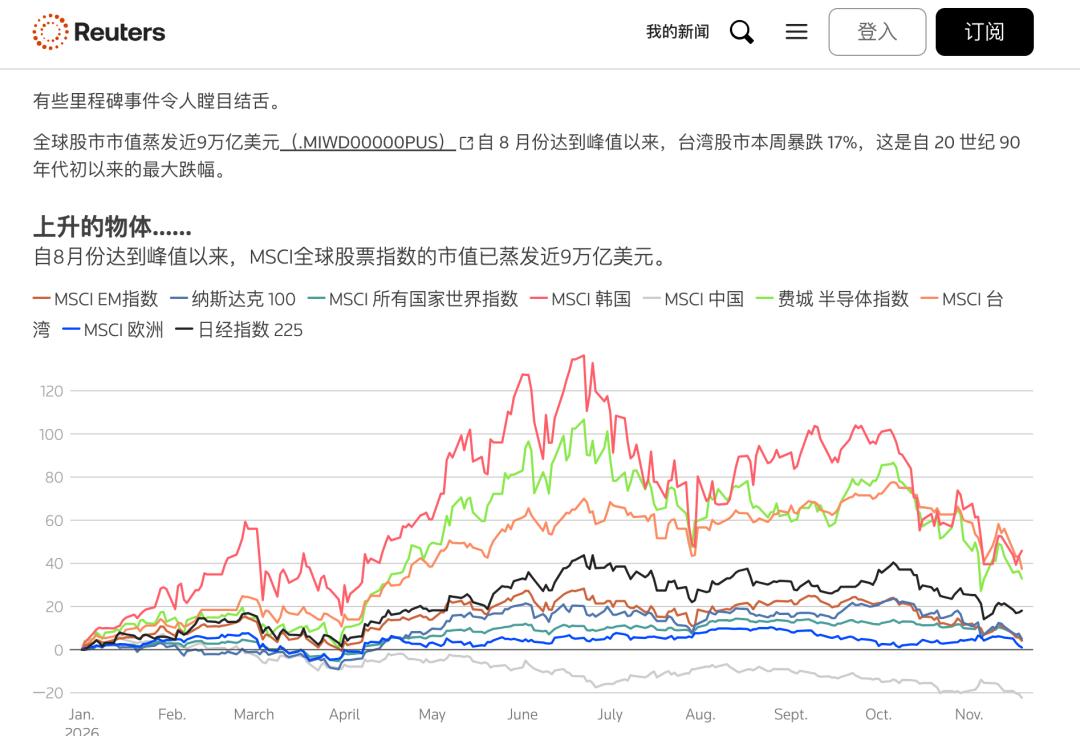
If it is reasonable for stock investors to take losses, it is somewhat confusing that people hoarding gold were also caught in the crossfire.
In 8 trading days, the international gold price fell below five consecutive integer thresholds, and domestic spot gold prices dropped back to the 700-yuan level per gram.
Brand gold jewelry that rose to over 1700 yuan per gram at the start of the year has now fallen below 1100 yuan, with a 50-gram gold bracelet losing more than 30,000 yuan in value out of thin air.

Why did even gold prices take a hit? Behind this is essentially a scramble for cash across the financial market.
Many Wall Street institutions use leverage for their stock investments, and when stocks plunge across the board, they may be required to add margin. To raise funds, institutions have to sell off other assets in their portfolios.
Gold, though a capital-preserving safe-haven asset, is also one of the most easily liquidated assets.
According to a report released by the World Gold Council, concerns over the valuation of AI and tech stocks triggered widespread deleveraging across the financial market. North American gold ETFs saw a net outflow of nearly 12 tons of gold, pushing the international spot gold price down by 8.9% in a week.

That a personnel incident could cause such huge ripples across the globe is also closely related to NVIDIA's identity transformation over the years.
In the past few years, NVIDIA has not only been the biggest winner of the AI era, but also the organizer of this wealth feast.
From financing for large model startups, to computing power procurement by tech giants, and even Wall Street investments that run into hundreds of billions of dollars, this company has a hand in all these activities.
Today, it is far more than a shovel seller, and has effectively become the "AI central bank" of Silicon Valley.
NVIDIA, the Shovel Seller, Has Become Silicon Valley's "Central Bank"
Gold prospectors may not strike gold, but people who sell shovels always make huge profits.
For decades, this saying was NVIDIA's secret to wealth creation.
But now, NVIDIA, with a trillion-dollar market value, has hit a thorny problem: the shovels are getting more and more expensive, but there are not enough prospectors who can afford to buy them.
Looking back at NVIDIA's growth history, Jensen Huang's business strategy has roughly gone through three major upgrades.
In the early days, NVIDIA was just a supplier of gaming graphics cards. It was not until it launched the CUDA computing platform in 2006 that it monopolized the software ecosystem and climbed to the peak of the global chip industry chain.
In 2022, when ChatGPT made its debut, NVIDIA, which had been making low-key layouts for more than a decade, finally ushered in its golden age. While others fought tooth and nail to compete for AI dominance, Jensen Huang just quietly raked in profits.
But AI, which is as money-hungry as a gold-devouring beast, costs so much that even tech giants cannot keep up.
According to the Financial Times, OpenAI expects that the company will consume a total of 278 billion US dollars in capital from 2026 to 2030. And there are barely any AI companies that have achieved positive profitability.
The latest Financial Stability Review released by the European Central Bank also points out that the free cash flow of most large US cloud computing enterprises has turned negative.
The money giants earn painstakingly from selling ads, software and cloud services is not even enough to cover the cost of AI infrastructure construction.
As customers run out of money, NVIDIA is the one that gets most anxious. If even the wealthy landlord has no surplus food, how can it keep making profits?
To solve this problem, it simply steps in to create demand for its own business, and its identity has ushered in the third upgrade.
Last year, Microsoft, NVIDIA and Anthropic reached a tripartite cooperation agreement.
NVIDIA promised to invest up to 10 billion US dollars in Anthropic, Microsoft promised to invest up to 5 billion US dollars, and Anthropic committed to purchase 300 billion US dollars worth of Azure computing power from Microsoft, which will be supported by NVIDIA's hardware.
This is the widely popular "circular financing" model in the AI industry today. By investing in its customers, NVIDIA can not only share the growth dividends of downstream enterprises, but also lock in future computing power demand in advance, turning the unfulfilled AI commercial prospects into real, tangible cash.
By August this year, NVIDIA even joined hands with six financial giants including BlackRock, Blackstone and Goldman Sachs, planning to raise more than 5000 billion US dollars in third-party funds for AI infrastructure.
Just a week later, it announced a 1.5 billion US dollar investment in data center developer SB Energy, and provided up to 1050 billion US dollars in conditional guarantees for the Ohio data center project leased by Open