1 Billion Tokens, 10,000 Fake Birds Open-Sourced: AI-generated Pseudo-popular Science Content Is Polluting the Next Generation's Common Sense
If you are a birdwatching enthusiast, you may have noticed that a new application named *Bird Trace: Birdwatching Logbook* has been launched on the App Store in recent days.
But after a short trial, you will find that everything about it feels off.

An ordinary record-keeping app has an installation package as large as 1GB — while a typical popular science field guide app usually takes up around 100MB of storage.
This birdwatching app neither has a built-in Unreal Engine 5, nor runs a local large language model. The huge package size is purely because the developer, in order to save server resources, adopted the development idea of making 3A masterpieces and crammed massive bird stickers directly into the local package.
Take a closer look at its interface copy and update notes, and you will find the distinct, pervasive Claude-generated style between the lines.
But this is only perfunctory on the surface. If you trace further down, you will find its real absurdity lies in the core data source — the bird field guide.
All the built-in materials of this app, which is promoted under the banner of popular science, come from an open source project that has been making the rounds in developer circles recently — "Global Bird Sticker Library".
Launched at the same time as this app is a supporting bird website "Bird Album" that supports retrieval in 15 languages.
Just reading the author's own project review article, you can feel the full-on excitement of "computing power creates miracles" between the lines.
You don't need to brave the wind and rain in the wild, nor do you need to know anything about bird anatomy. With one computer and 8 windows running AI scripts, in less than a week, you can draw all existing bird species in the world "without missing a single one", and whether the result is realistic or not does not matter at all.
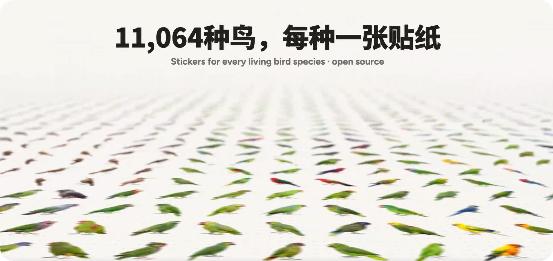
This self-proclaimed independent developer who says he cannot write code at all burned more than 1 billion Tokens through Vibe Coding, used up the weekly quota of multiple $200 top-tier memberships, and in less than a week, turned 11,064 existing bird species worldwide (later adjusted to 11,011 species and 91 subspecies following the update of the checklist) into white-bordered stickers, before announcing to the whole network that the project is "officially open source".
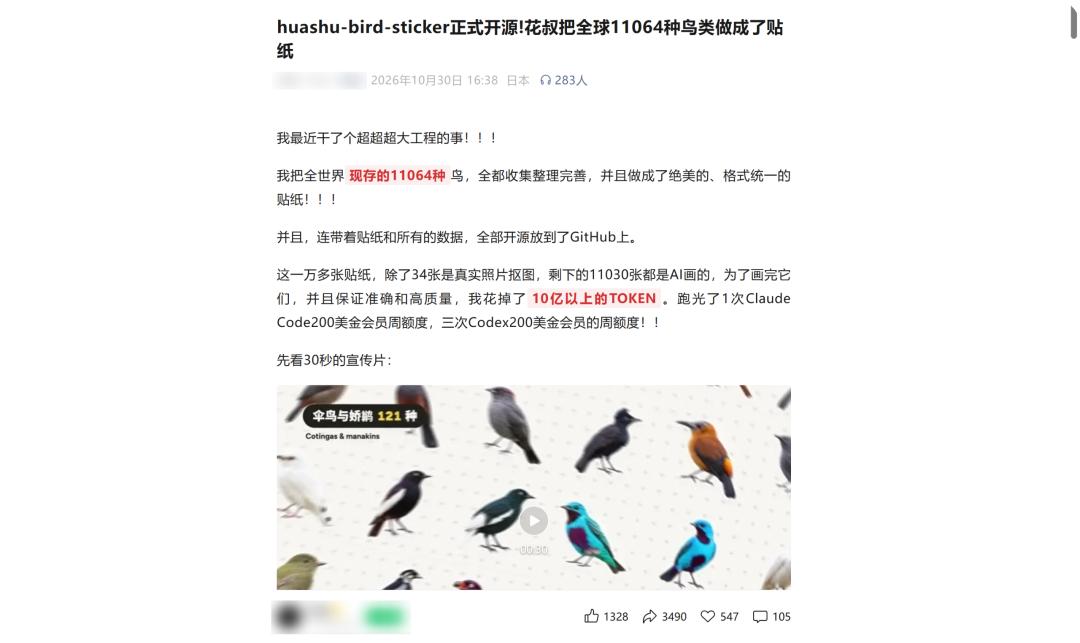
As this sticker library openly seeps into apps and search websites, secondary knowledge hazards have already begun to emerge.
Some self-media outlets and ordinary users who do not have professional identification capabilities are using these AI-generated stickers with serious errors in basic biological features such as feather color and beak shape, to painstakingly piece together "expert-level" popular science texts, images and short videos about animals and plants, which spread freely on social platforms, and the author is quite proud of this.

Even though ornithologists have expressed deep indignation and other independent developers have kept criticizing the project, the author has classified all of them as "remnants of the old era, workers who rejected the textile loom".
In this illusion built up by computing power, the absurd farce of "garbage in, garbage out" is advancing triumphantly in the name of AI amid praise from bots.
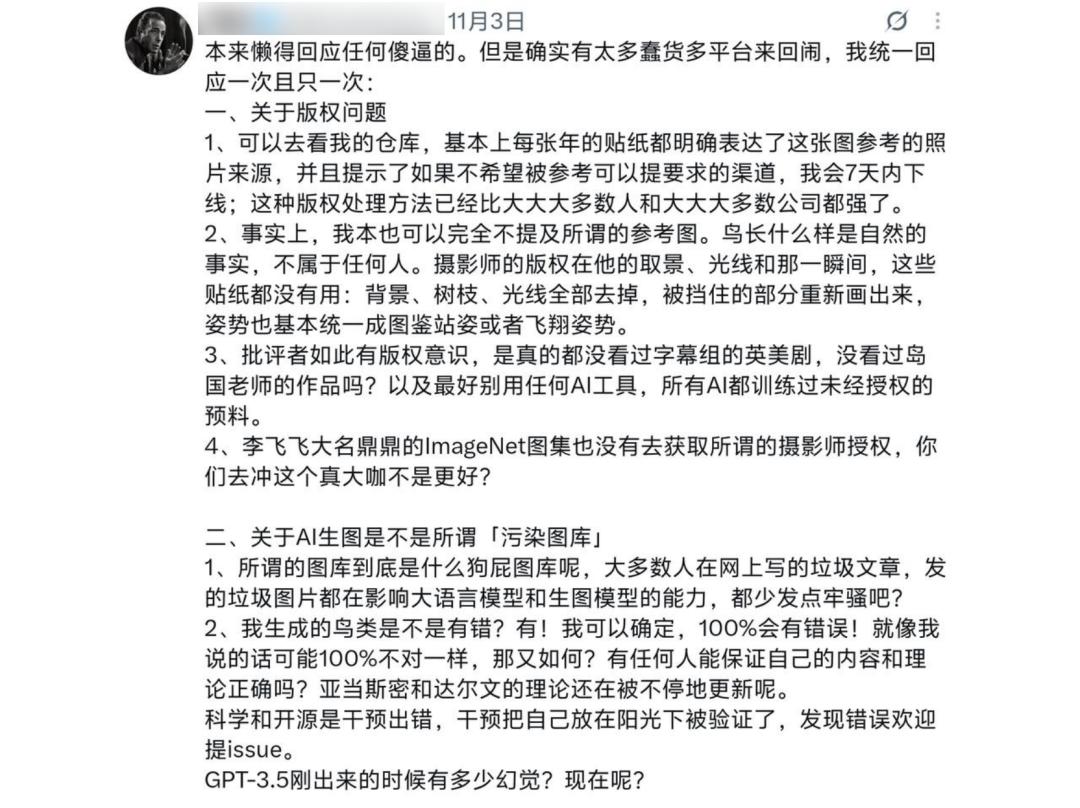
Scraping images and random drawing: a "bird mass production assembly line"
If you dig deep into the black box of the production process of this 10,000-bird sticker library, the process is so outrageous that science communicators and wildlife photographers will be left gasping in disbelief.
First comes the scraping logic that is almost blatant theft. It is very easy for AI to make up random, false details when drawing birds out of thin air, and the author himself does not have a professional database, so how did he solve this problem?
By writing scripts.
He went to iNaturalist and Wikimedia Commons, bulk-scraped the real photos taken by photographers from all over the world after long hours of waiting in the wild, stitched them into 3×3 "nine-square grids", and directly fed them to the generative image model for redrawing.
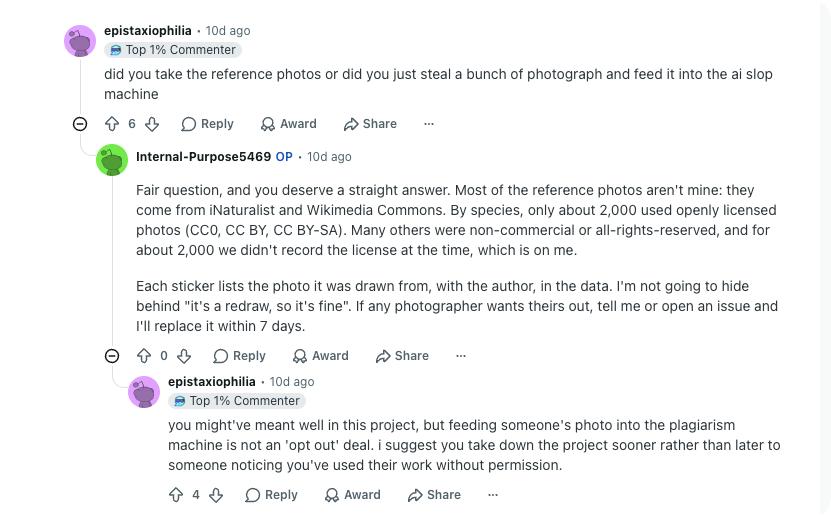
According to the author's own disclosure, among the reference photos of these 11,064 bird species, only 1,986 are actually licensed under open licenses (CC0, CC BY, etc.). The vast majority of the rest are either clearly marked "non-commercial use", "no derivative works", "all rights reserved", or even 2017 of them do not have any recorded license agreement at all, and were all crammed into the AI melting pot without any prior permission.
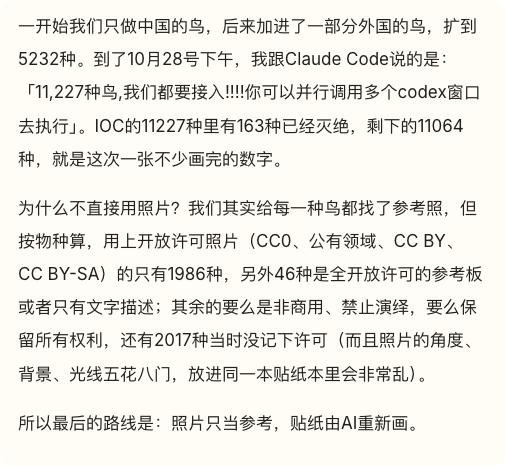
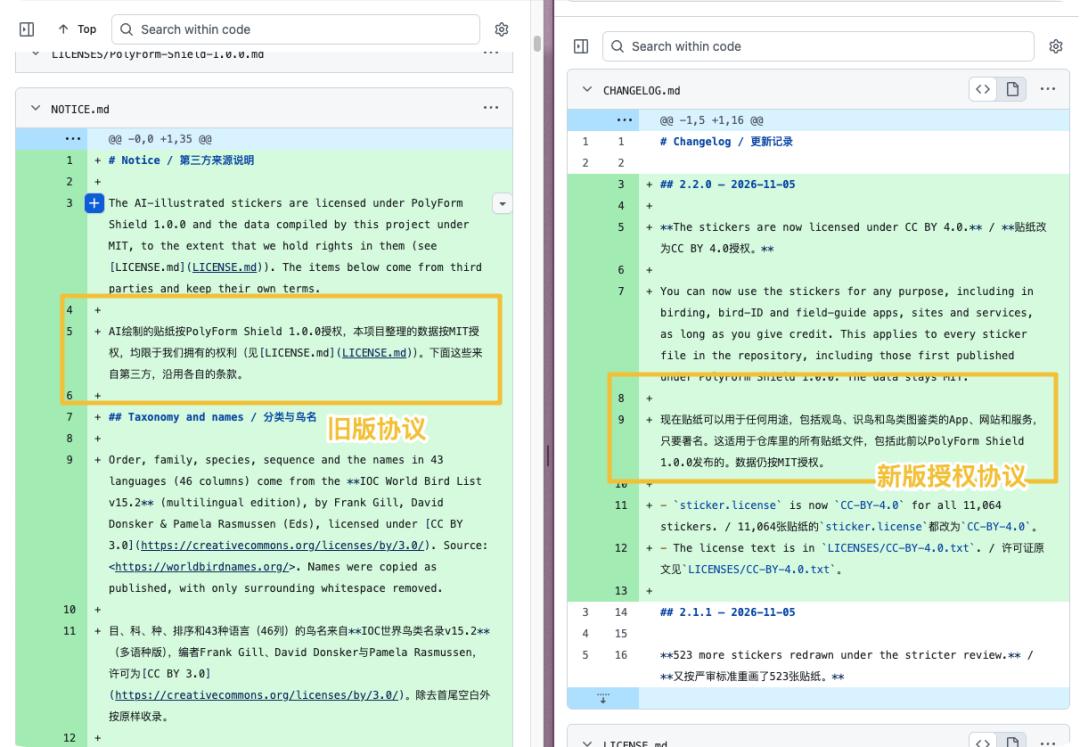
After the "content laundering" process turns them into AI stickers, the author immediately puts his own license label on them (he even used the PolyForm Shield 1.0 license that restricts the use of competing products at first, later changed it to CC BY 4.0), and nonchalantly writes a note: if a sticker references your photo and you do not want it to be used, please send an email to raise an Issue, and we will remove it within 7 days.
This robber logic of "feeding works to AI first, and deleting them only after the wronged party comes to claim compensation" directly caused public outrage on the r/birds section of the overseas birdwatching community Reddit: "Feeding other people's hard work into a plagiarism machine can never be whitewashed by an 'opt-out' mechanism implemented after the fact."
In order to forcefully gather more than 10,000 bird species in just a few days, there is another reckless approach: for rare bird species that cannot find good reference photos, they patch together several incomplete photos; after the model finishes drawing, the result is sent to another AI reviewer for scoring. During testing, the author himself found that the generative image model frequently creates ridiculous, bizarre monsters —
Irises that are originally red or teal are drawn as lifeless solid black eyeballs; toes are fused into a lump of flesh; even hummingbirds, which have extremely short legs, are forcibly given a pair of long sparrow-like legs.
What if the drawing still turns out wrong after two redraws? The principle set by the author is: neither fall back on using real photos, nor leave the entry blank, but "pick the relatively best one from the bad lot", and forcibly keep the image with a relatively high score.
Using pure engineering brute force thinking to fend off serious popular science problems results in that in the first version of the open source repository, there are as many as 3,388 defective works that do not even meet the AI passing line (80 points) set by the project itself (109 of them are even below 70 points), but they are still blatantly packaged and added to the public image library.
Although later in November, the author re-ran all these more than 10,000 images with another set of AI standards and announced that all of them "passed the line", from start to finish, this image library promoted under the banner of popular science has never undergone systematic review by even one ornithology expert.
Where exactly is "popular science pollution" toxic?
"Once, Mr. Fujino called me to his lab, pulled out a diagram of the blood vessels in the lower arm from my lecture notes, pointed at it, and said to me gently: 'Look, you have moved the position of this blood vessel a little. — Of course, after this move, it does look better, but anatomical diagrams are not fine art. The real object is like that, and we cannot change it. I have corrected it for you now, from now on you have to draw it exactly as it is on the blackboard.'"
This is a well-known excerpt from Lu Xun's *Mr. Fujino*. But to people's astonishment, even today, the idea that "aesthetic effect is more important than facts" still has such a huge market in the AI circle.
Even when the image library has a large number of obvious factual errors, the author still enthusiastically recommends that everyone use these stickers to "make courseware for nature education, and make bird cards for children", and even provides CDN interfaces bound to the IDs of authoritative scientific research databases such as eBird and GBIF; but then he added a thick layer of disclaimer in the documentation:
"These are illustrations, not field guide plates... If you find a drawing error, you are welcome to raise an Issue. Error correction from bird lovers is the most needed contribution to this project."
This is also the biggest controversy of the entire open source project: whether one has the ability to verify more than 10,000 images is a matter of capability; but whether professional review was conducted before the product was launched and pushed to the public for popular science purposes is a matter of attitude.
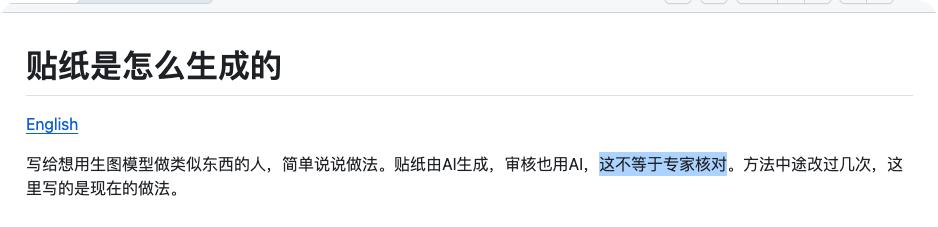
What the author adheres to is the most typical "agile development" thinking in the code world — launch and get it working first (Ship it), then rely on the community to raise Issues for iterative error correction.
As a developer, it seems that as long as the script runs, images are generated, and the code is open sourced, the work is considered done, and the accuracy of the knowledge is completely shifted to users and the professional community. Translating this logic of "pollute first, govern later" to the field of natural science is undoubtedly a disaster.
Take the Peregrine Falcon, known as the "raptor of the sky", as an example. If you only look at the sticker image, laypeople cannot spot any problem at all, especially since the entire drawing style is realistic, not cartoon or stick-figure style.
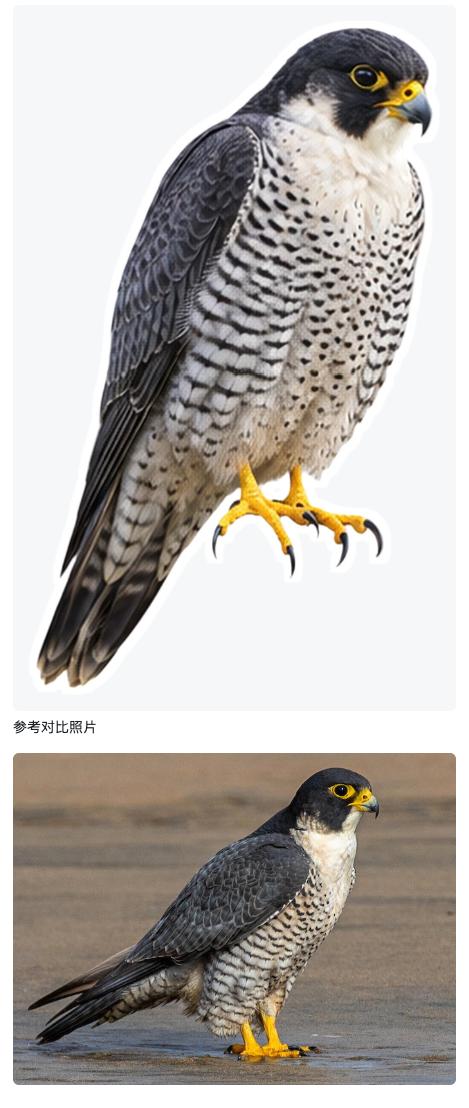
It was not until bird lovers posted the comparison image that people found that the Peregrine Falcon, which originally has thick tarsi and strong, powerful claws, grew a pair of weak, thin claws under the AI's pen. After checking back, the author admitted that the reference photo scraped by the script was taken from a low angle under the tree, and the Peregrine Falcon's feet were blocked by belly feathers and tree branches.
When the program automatically removed the tree branches, the AI directly "filled in" a pair of thin claws out of imagination, and the AI reviewer responsible for quality control did not notice this at all.
Take the Sulphur-crested Cockatoo as another example. It is not only the author's favorite bird species, but also the original inspiration that prompted him to start this project.
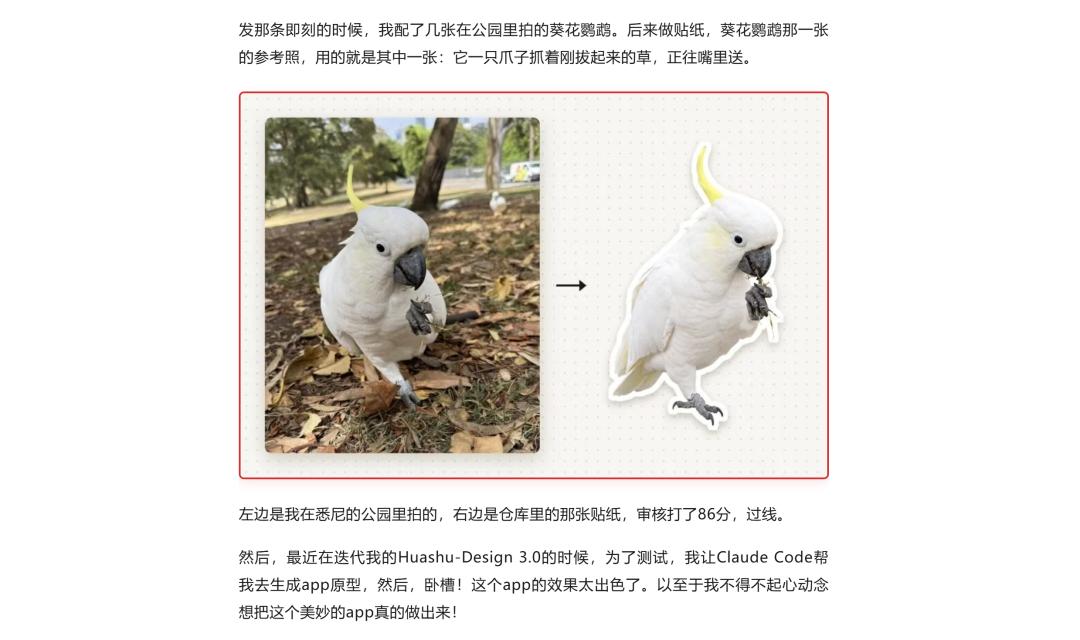
But after the AI finished drawing, the most basic folded wing feather area (the hierarchical and structural relationship between coverts and flight feathers) of the bird was still completely wrong.
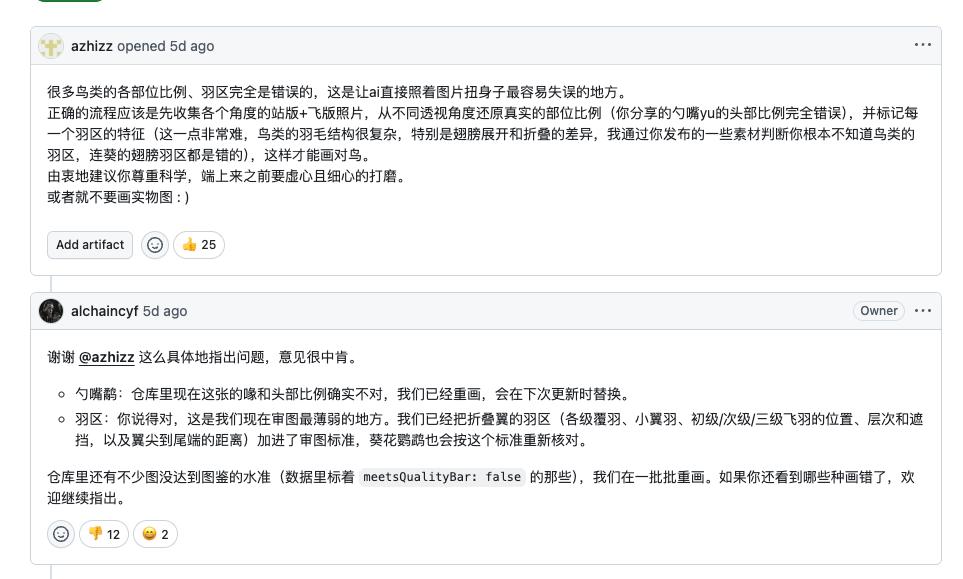
The statement that "these are illustrations, not field guide plates" cannot exempt the author from responsibility, not because "bird field guides cannot use drawings", as traditional hand-drawn field