GPT-6 can now design proteins.
On November 24 local time, OpenAI released a preprint paper with a simple and straightforward title — "GPT-6 as a Universal Foundation Model for Protein Biology: Outperforming Specialized Models".
According to its introduction, the GPT-6 series of models already have the native capability to design new proteins, can independently design new protein structures and amino acid sequences, the entire process relies solely on the model's own reasoning capability and general-purpose programming tools, without the need to call vertical models specifically built for biological tasks.
"Our research demonstrates the huge potential of combining natural language with the inherent protein design capability." This technology enables multi-scale precise regulation ranging from a single chemical bond between two atoms to the macroscopic morphology of the entire protein. OpenAI points out that the ultimate goal is to allow scientists to issue instructions to the model only using natural language to design proteins and molecules.
Prior to this, the field of protein design was mainly dominated by dedicated vertical model systems. For example, RFdiffusion is mainly used to generate protein backbone structures, while ProteinMPNN is used to assign amino acid sequences to proteins. This time, OpenAI stated directly that a single large AI model does not need retraining, and can handle different types of design requirements and be competent for most of the above design work only by receiving new instructions.
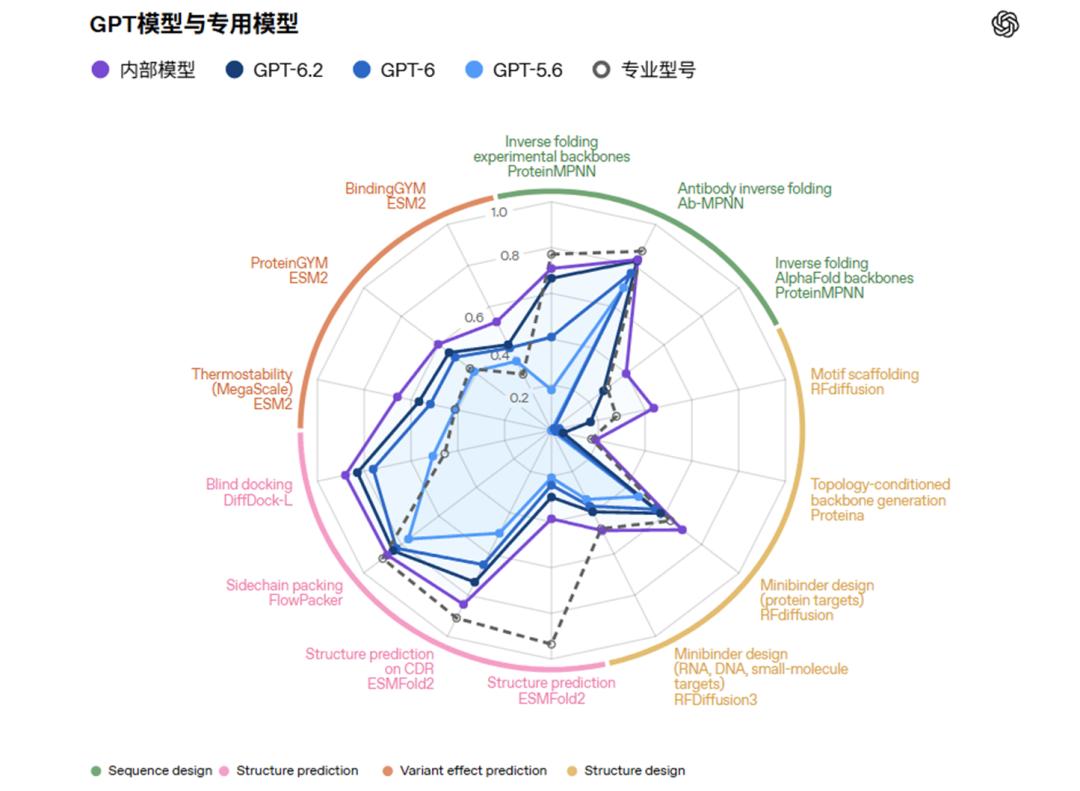
(Note: Points farther from the center indicate better performance. OpenAI says that the new-generation model has improved performance on many of the 14 protein tasks tested.)
OpenAI cooperated with its research partner Onava, converted part of the model design schemes into actual proteins and carried out experimental verification. Researchers used the pre-release version of GPT-6.2 to design protein structures and constructed corresponding proteins accordingly. In experiments conducted on five targets, these proteins showed signs of binding.
It is worth mentioning that the model also demonstrates generalization capability.
Researchers provided the large model with a previously undisclosed PD-L1 mini binding protein structure, based on which the model generated two amino acid sequences. The two sequences differ from the original sequence at 52 and 58 positions out of 90 respectively, and there are also 44 positions of difference between the two new sequences. The experimental results show that both designs show signs of binding. OpenAI stated that this result strongly proves that the capabilities possessed by the model do not merely come from memorization of existing data.
However, OpenAI explicitly acknowledges that predicting the complete protein structure remains a weak capability of the model. On this task, even its best internal model lags far behind specialized structure prediction models; and the entire end-to-end protein design process still relies on external tools.
Prior to this, Anthropic released two heavyweight flagship models, Claude Mythos5.2 and Claude Fable5.2, on November 9, which also demonstrated relatively outstanding capabilities in protein design:
Mythos5.2 independently wrote the calculation process, called the model, and completed the structural prediction of adeno-associated virus (AAV) capsid proteins, with 28 out of 34 capsid proteins meeting the preset standards; the average score of Mythos5.2 in RNA sequence prediction and design surpassed that of human participants; Mythos5.2 scored higher than Opus5.5 in tasks such as de novo protein sequence design, target-specific binding protein design, protein domain identification, and mutant protein function prediction.
Orient Securities points out that in recent years, models represented by AlphaFold and Claude have taken the lead in making technological breakthroughs in the field of protein design, providing important tools for early-stage drug structure design and screening, and bringing a large number of wet experiment demands such as protein synthesis and affinity testing. Considering that the existing biological data is far from meeting the requirements of AI4S for data scale and quality, with the paradigm shift from using AI to analyze existing biological data to organized and large-scale production of high-quality datasets, AI will participate in and accelerate the production of biological knowledge. Therefore, automated wet laboratories that can produce high-quality data with high throughput and low cost will be scarce resources and core barriers in the AI4S era. As AI applications extend to the entire chain of new drug R&D, it will drive a leap in the magnitude of related demands.
This article is from the WeChat Official Account "Sci-Tech Innovation Board Daily", written by Zheng Yuanfang, and published by 36Kr with authorization.