Long Quan, a professor at the Hong Kong University of Science and Technology, has launched a new AI startup dedicated to space physics, and he previously sold his former company to Apple.
Nov. 25 report from Zhidx: Today, Long Quan, founder of the first computer vision lab of the Hong Kong University of Science and Technology and former chief scientist for spatial intelligence at Apple, officially announced his second venture, establishing Envision AI, a spatial and physical AI company, committed to building the next-generation general native spatial and physical foundational model.
Enterprise credit query platform Qichacha shows that Envision AI was founded in June 2026, with its headquarters in Shenzhen, and completed equity financing in November this year. Based on large language models, the company explores the unified representation and reasoning of text, image, spatial information and physical information.
The founding team of Envision AI includes Long Quan, professor at the Hong Kong University of Science and Technology (one of the important pioneers and founding figures in the field of Chinese 3D vision), Philip Torr, professor at the University of Oxford, as well as serial entrepreneurs Zhang Feihu, Yao Yao (core author of Ant Group Lingbo papers), and Xu Jingxi, former senior executive of Tencent Meeting.
Among them, Zhang Feihu serves as Co-Founder and CEO, Philip Torr serves as Co-Founder and Chief Scientist, Xu Jingxi serves as Co-Founder and Head of Engineering, and Yao Yao is also a Co-Founder.
It is reported that Envision AI has gathered dozens of post-2000s PhD talents from top universities at home and abroad, and has reached business cooperation with many leading technology enterprises at home and abroad to achieve revenue.
In the future, based on its self-developed spatial and physical foundational model, the company plans to focus on fully expanding to high-value industrial scenarios such as synthetic data and model distillation, high-precision editable 3D content and UE game construction, physical simulation, next-generation controllable video generation, real-time interaction and end-side intelligence, to sprint for the "ChatGPT moment" of physical AI.
01. Led by HKUST professor, the chief scientist is academician of two British national academies
Long Quan is the most notable member in the founding team of Envision AI, responsible for the company's technical strategy, architecture direction and talent cultivation.
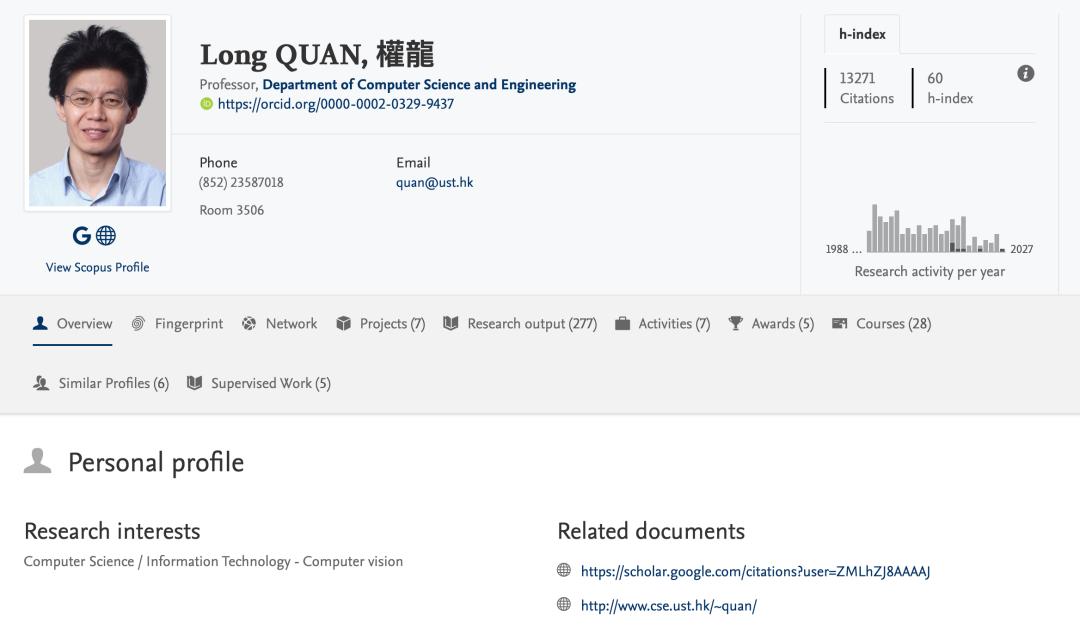
Long Quan is a professor in the Department of Computer Science and Engineering of the Hong Kong University of Science and Technology, IEEE-CS Fellow. He has long been engaged in computer vision and graphics research, with more than 23,000 citations on Google Scholar.
Long Quan went to France from China for further study in 1985, and got acquainted with Songde Ma (former director of Institute of Automation, Chinese Academy of Sciences) and Zhengyou Zhang (current chief scientist of Tencent) who had studied in France earlier. The three are collectively known as the "Three Musketeers of Chinese Vision in France".
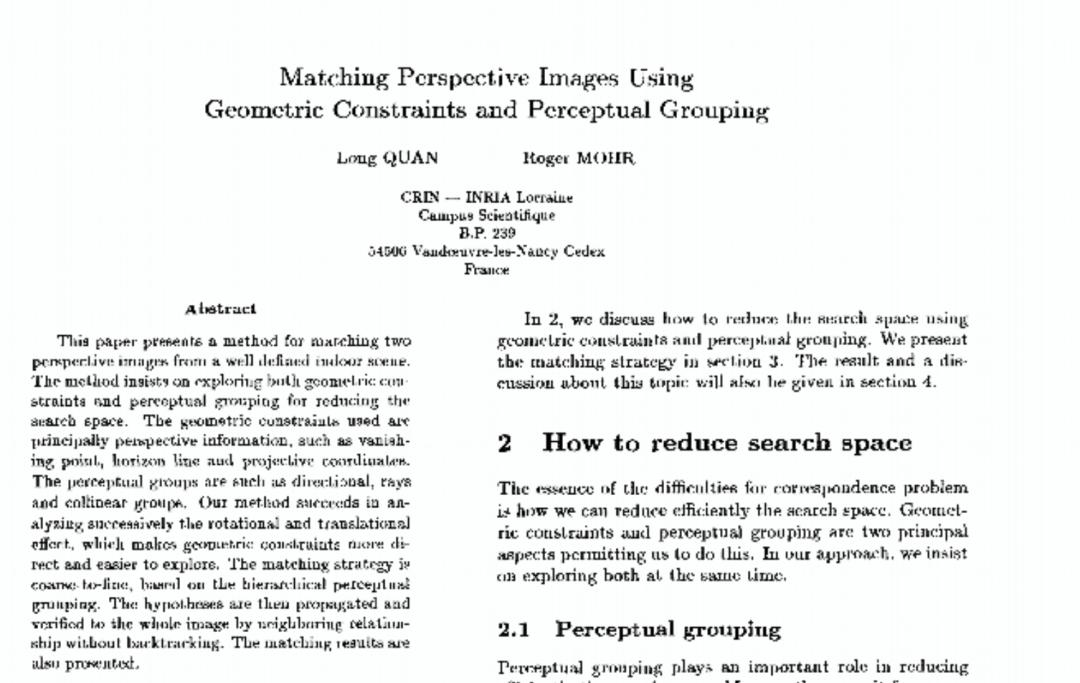
In 1995, Long Quan proposed the 6-Point Algorithm to study the problem of three-view reconstruction under the condition of uncalibrated cameras, and published the first ICCV Chinese computer vision paper "Matching Perspective Images Using Geometric Constraints and Perceptual Grouping" in 1988.
After joining the Hong Kong University of Science and Technology in 2001, he founded VisGraph, the first computer vision research group of HKUST, and his research direction gradually expanded from 3D reconstruction to image-based 3D modeling, visual SLAM and other fields.
Long Quan also served as General Chair of ICCV 2011 and CVPR 2022. In 2015, he co-founded 3D reconstruction company Altizure with his students Tian Fang and Yao Yao, to convert photos taken by drones and mobile phones into 3D real scene models. Altizure was acquired by Apple in 2020.
After the acquisition, Long Quan joined Apple and continued to engage in end-side 3D reconstruction and spatial intelligence research.
The core team of Envision AI is not a temporary combination, and several members have long-term teacher-student, fellow apprentice and scientific research cooperation relationships with each other.
Long Quan said that he once led Zhang Feihu to study 3D vision, and he could be regarded as Zhang's "half supervisor", and later recommended Zhang to the University of Oxford to pursue his doctorate under the supervision of Philip Torr.
Among other team members, Zhang Feihu is the CEO of Envision AI, mainly responsible for team management, product promotion, operation and commercialization, and also participates in AI R&D at the same time.
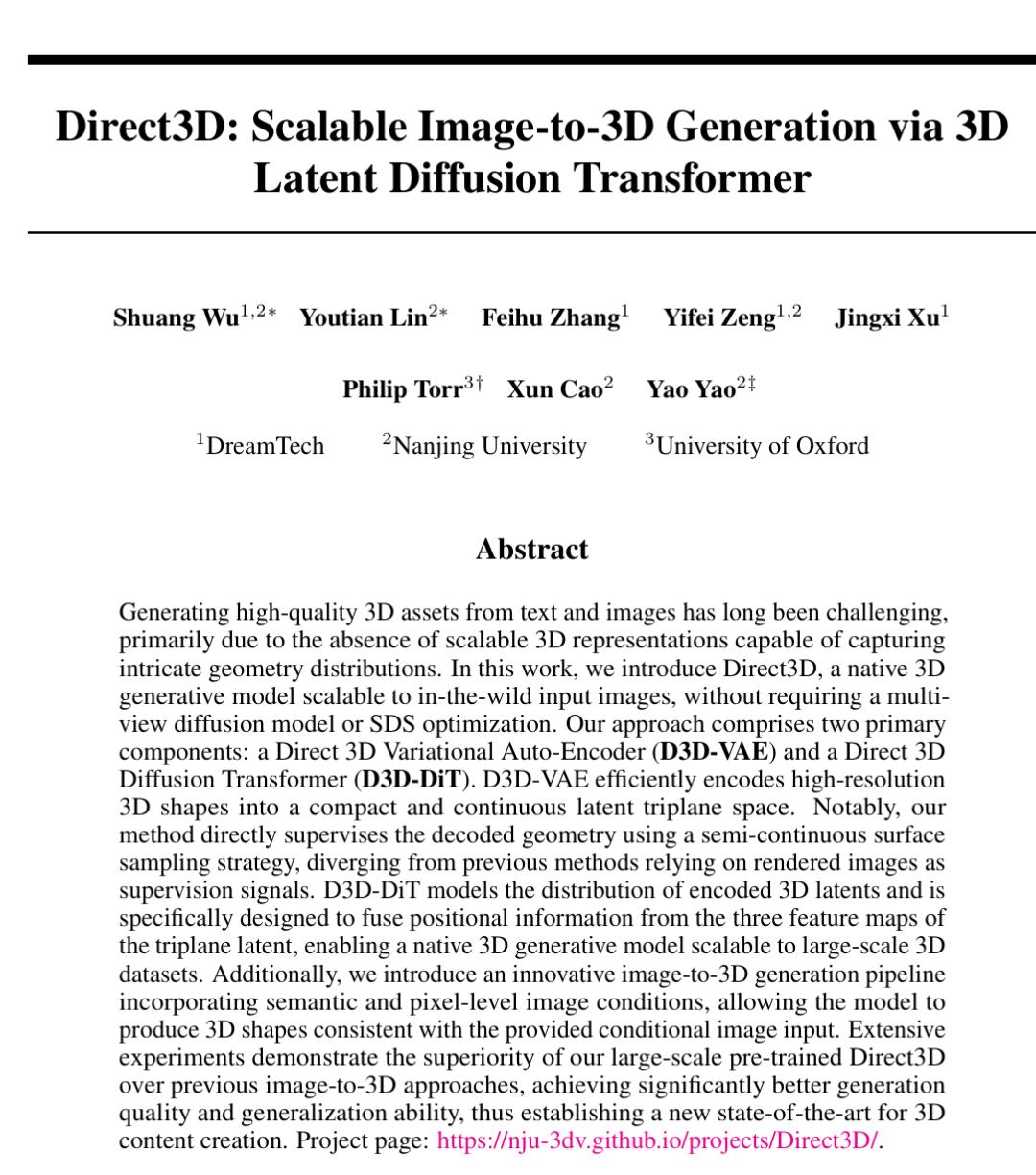
Dr. Zhang Feihu graduated from the University of Oxford, supervised by Philip Torr. He was once shortlisted for the CVPR Best Paper Award, and also participated in the founding of 6d.ai and DreamTech. According to public information, DreamTech once released the native 3D generation model Direct3D, which adopts the 3D Diffusion Transformer architecture.
Yao Yao is Long Quan's PhD student and a founding team member of Altizure. After the company was acquired, he followed Long Quan to join Apple as a senior researcher, and the two left Apple at the same time later.
In this venture, Yao Yao is mainly responsible for cutting-edge exploration and R&D work.
Dr. Yao Yao graduated from the Hong Kong University of Science and Technology with a major in Computer Science. He is a tenure-track associate professor at the School of Intelligent Science and Technology of Nanjing University, and once participated in the model training work of Ant Group Lingbo. He has been nominated for the Best Paper Award of ECCV 2026. His representative works include the MVSNet series, NeILF series and Direct3D series.
Philip Torr is the chief scientist and technical advisor of Envision AI, who will participate in the discussion of the company's strategic direction. He is a tenured professor of Engineering Science at the University of Oxford, a Fellow of the Royal Academy of Engineering and a Fellow of the Royal Society of the UK, and once won the Marr Prize, the highest award in the field of computer vision.
Dr. Xu Jingxi graduated from the Chinese University of Hong Kong. He used to be a senior researcher in the Product Department of Tencent Meeting, participating in the design and development of products such as Tencent Meeting and WeCom Meeting, and is responsible for engineering work at Envision AI.
02. 3D reconstruction used to be the main research line of Long Quan, who judges that large models will integrate this capability
As an important member of the founding team, the main research line of Long Quan is to enable computers to restore the 3D world from 2D images.
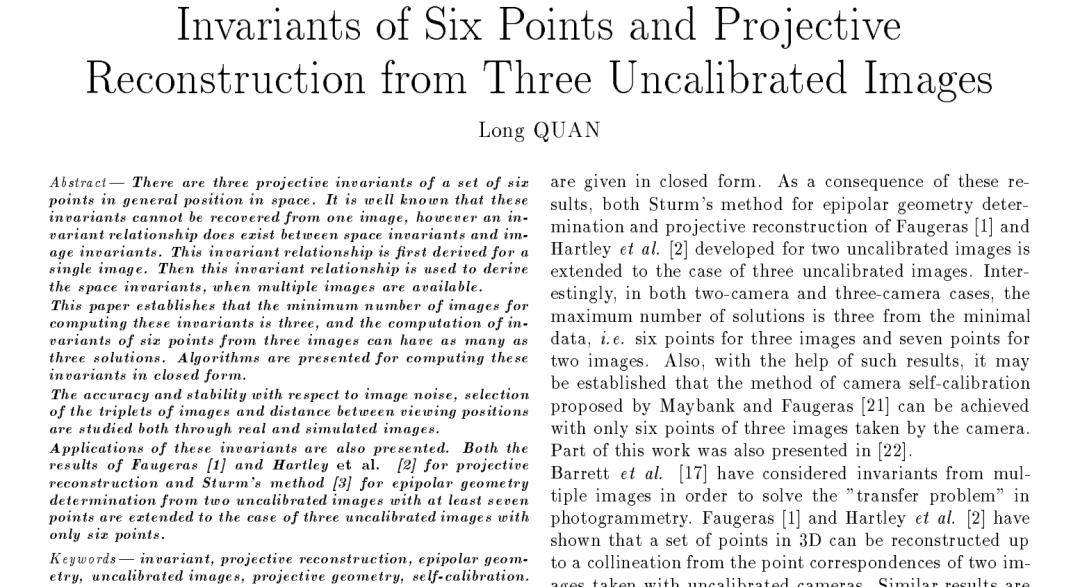
The "6-Point Algorithm" mentioned above is a relevant paper published by Long Quan in 1995 in IEEE Transactions on Pattern Analysis and Machine Intelligence (TPAMI). Long Quan completed this research as the sole author.
Specifically, this research proposes that for three images taken by uncalibrated cameras, six spatial points can be used to calculate projective invariants to further carry out 3D reconstruction.
In the exclusive interview with Long Quan conducted by China Computer Federation (CCF), this paper was introduced, and it is believed that it laid the foundation for the minimum data and reconstruction uniqueness of 3D reconstruction for uncalibrated cameras. The interview author pointed out that almost all 3D reconstruction based on uncalibrated cameras is based on this algorithm.
After joining the Hong Kong University of Science and Technology in 2001, Long Quan continued to promote the research of 3D reconstruction and image-based modeling. From 2005 to 2009, Long Quan's team successively applied relevant methods to the modeling of hair, plants, trees, building facades and urban street scenes, and the research results were published in SIGGRAPH, the top conference in the graphics field.
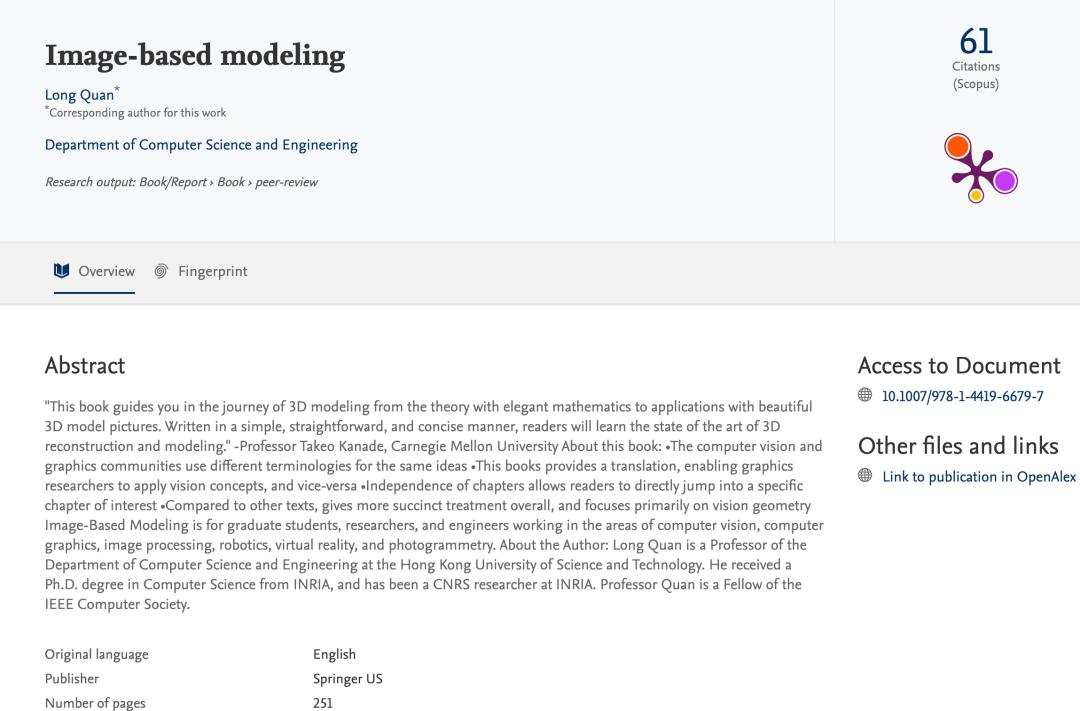
In 2010, Long Quan published the monograph "Image-Based Modeling", which systematically sorted out the methods of 3D modeling.
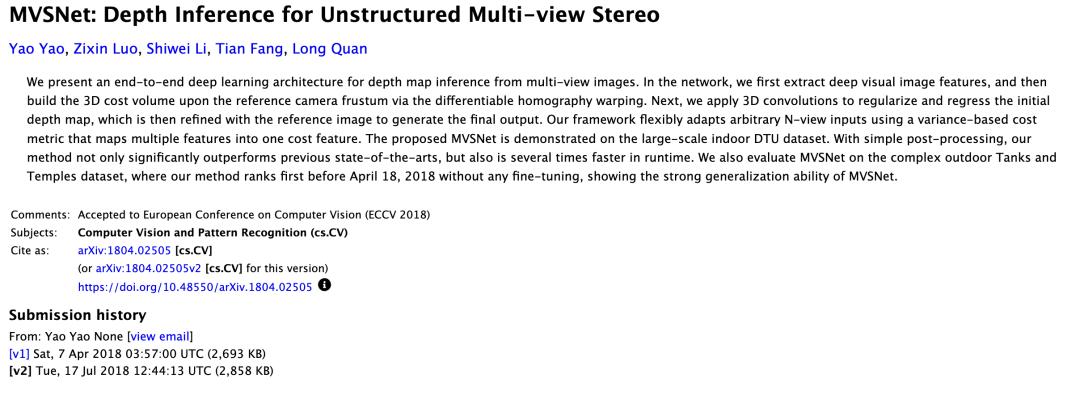
In 2018, Long Quan co-published the MVSNet paper with Yao Yao and other collaborators, proposing an end-to-end deep learning architecture for inferring depth maps from multi-view images.
This paper was accepted by ECCV 2018, and it is also one of the important works in the field of multi-view 3D reconstruction.
Long Quan said in the interview that the explosion of ChatGPT at the end of 2022 made him see new opportunities brought by generative AI. At that time, he and Yao Yao had been working on spatial intelligence at Apple for three years, while Zhang Feihu's team had carried out R&D work on 3D reconstruction and generation through DreamTech since 2023.
By the end of last year, Long Quan judged that the pure 3D modeling generation capability may be gradually integrated by large language models, while large language models still have deficiencies in expressing spatial and physical features. Based on this judgment, he co-founded Envision AI with Zhang Feihu, Yao Yao and others in 2026.
03. Aiming at developing foundational models, hoping to establish a unified representation framework
From the perspective of Envision AI, to enable AI to understand space and changes more reliably, language models alone are not sufficient, and it is also necessary to explicitly process information such as scale, position, time and 3D structure.
Therefore, Envision AI proposes to establish a unified representation framework on the premise of retaining the respective characteristics of text, image, spatial information and physical information, to associate discrete language symbols, continuous perception, multi-scale visual structure and the state of the 3D world.
Long Quan further explained the underlying idea of Envision AI, that is, to make images, 3D space and physical information into coded representations, as the basis for unified multimodal processing.
The company summarizes its research objectives into the following three points:
- Explore the foundational framework and foundational model that can uniformly represent different structural information such as text, image, space and physics;
- Enable language models to collaborate with foundational models that can represent spatial and physical scales, and form a closed loop through the actions and feedback of agents;
- Enable the model to not only describe the world in language, but also form and apply spatial and dynamic representations of the world itself, while maintaining consistency, controllability and interpretability.
At the data level, Envision AI has currently accumulated 30 million high-quality spatial physical data assets, 40 million spatial physical video data, and more than 5 million complex scenarios.
Envision AI has also released the demo of its own model, which has surpassed SOTA models in spatial consistency, and can achieve the same or better generation effect at a lower cost.
From the generated factory scene, the picture is generally realistic, and when the viewing angle is rotated, the shape of the scene objects is stable, maintaining good consistency.
In terms of commercialization, Envision AI has reached business and strategic cooperation with many leading enterprises at home and abroad.
Comparing the two ventures, Long Quan believes that the difference lies in the different problems to be solved, "Simply put, one is responsible for 'reconstruction', and the other is responsible for 'understanding plus operation'. Altizure mainly uses drones and smart phones to obtain images, and then performs 3D reconstruction of the real world; Envision AI hopes to go further on this basis, to enable the model to understand the world and be capable of practical operation."
He mentioned that past research and products usually develop a set of algorithms for a specific problem. After changing the scenario, it is often necessary to re-collect data, adjust parameters or even retrain the model.
Therefore, Envision AI hopes to cover multiple types of tasks with a unified foundational model, instead of returning to the development mode of "one set of algorithms for one scenario".
04. Conclusion: From 3D reconstruction to spatial and physical AI, this company still needs product verification
From image-based modeling to deep learning-driven 3D reconstruction, these specific works constitute the technical accumulation for Long Quan to enter the spatial and physical AI field this time.
But for the founding team of Envision AI, spatial and physical AI has changed not only the research objects, but also the evaluation criteria of technical capabilities.
The team background and technical route of this company are worthy of attention, but its actual technical capabilities still need to be verified by subsequent products and test results.
(Note: The cover image of this article is generated by AI)
This article is from the WeChat official account "Zhidx" (ID: zhidxcpm), written by Zhong Chen, edited by Mo Ying, and published with authorization from 36Kr.