GPT, Claude and Gemini compete on the same stage, and the latest results have been released.
Ever since GPT-6 Astra demonstrated impressive capabilities in robotic manipulation tasks, mainstream large models such as Claude and Gemini have successively joined the exploration in the field of embodied intelligence.
In October this year, GPT-6 Astra achieved a 74.8% task success rate in the RoboLab-120 simulation benchmark; Google Gemini 4 Argon helped robots raise the success rate of pick-and-place tasks from 56% to 75%; Anthropic released Claude Fable 5.2, which recorded a 64.9% success rate in the RoboDojo simulation evaluation.
But without targeted training, if we let these large models directly control robots in a unified real-world environment, what exactly is their zero-shot manipulation capability?
According to a report by Robot Outlook on November 24, the real-machine evaluation platform RoboChallenge recently officially released its brand-new evaluation benchmark RoboChallenge Zero, which conducted 6 robot manipulation tasks on 11 mainstream large models, totaling 330 real-machine tests.
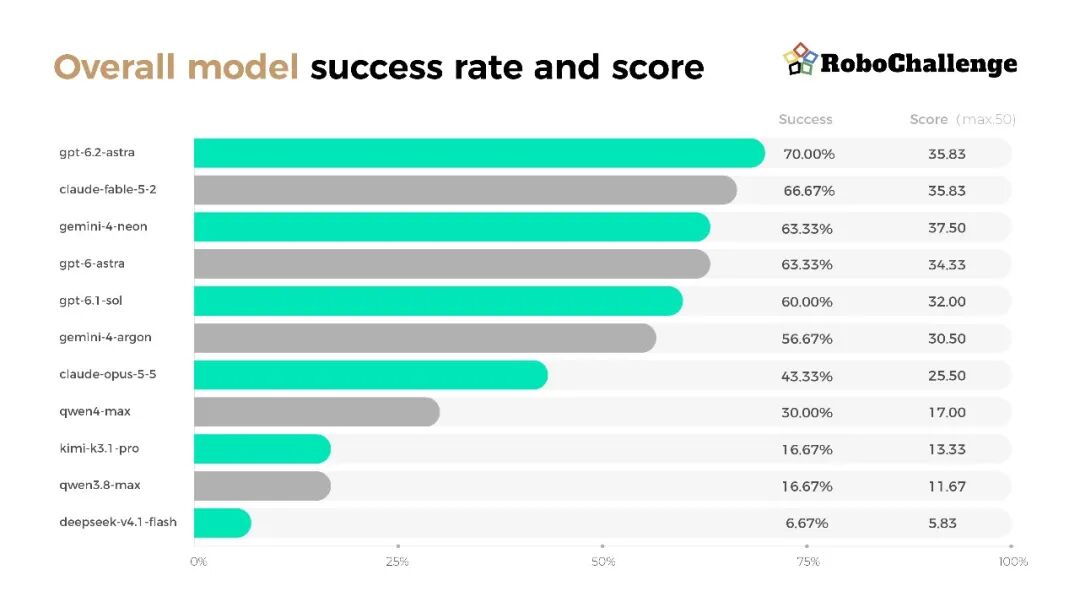
The results show that the overall task success rate of the 11 large models is only 44.85%. Among them, the top-ranked GPT-6.2 Astra achieved a 70% success rate, but none of the 11 large models succeeded in the more complex flexible object manipulation.
This score sheet reveals the capability boundary of general large models in manipulating robots: they can understand tasks, plan actions, and complete part of the operations. However, they still have obvious shortcomings in fine manipulation, execution efficiency and reasoning cost.
Compared with directly undertaking high-frequency, continuous robot manipulation, general large models may be more suitable to act as a "coach" at the current stage, rather than an "athlete" who plays on the field in person.
01. 11 large models submit their real-machine test results, GPT-6.2 Astra takes the first place
This RoboChallenge Zero evaluation brings together 11 mainstream large models, including GPT-6.2 Astra, GPT-6 Astra, GPT-6.1 Sol, Claude Fable 5.2, Claude Opus 5.5, Gemini 4 Neon, Gemini 4 Argon, DeepSeek-V4.1-Flash, Qwen4-Max, Qwen3.8-Max and Kimi-K3.1-Pro.
These models are placed under a unified evaluation framework, focusing on investigating whether they can directly complete real robot manipulation tasks without targeted training.
It is understood that all models use the same prompt template and tool interface, no demonstration data for evaluation tasks is provided, and training and fine-tuning during the test are not allowed.
During the test, the large model observes the surrounding environment of the robot through the camera, obtains the robot status, reasons according to the task requirements, and then calls tools to control the robotic arm to perform actions. After completing one action, the model can continue to observe the environment and adjust the strategy until the task is completed or the maximum number of calls is reached.
This evaluation sets a total of 6 tasks, covering object recognition, pick-and-place, mathematical reasoning, dual-arm collaboration, fine trajectory control and flexible object manipulation. Each model is tested independently 5 times in each task, accumulating 330 real-machine tests, and the success rate is calculated according to whether the task is fully completed.
Finally, the overall task success rate of the 11 models is 44.85%, and the performance difference between different models is obvious.
Among them, GPT-6.2 Astra ranks first with a 70% success rate, followed by Claude Fable 5.2 with a success rate of 66.67%; Gemini 4 Neon and GPT-6 Astra tie for third place, both with a success rate of 63.33%.
In addition, 5 other models have a success rate of less than 50%, and the lowest DeepSeek V4.1 Flash only has a success rate of 6.67%.
02. Simple tasks have a success rate of nearly 90%, while complex flexible operations almost all fail
Seeing this, the success rate of GPT-6.2 Astra seems to prove that general large models have good robot manipulation capabilities. However, by further breaking down the scores of these 6 tasks, we can find that the performance of large models varies greatly on different tasks, especially in fine manipulation and flexible object processing, where the success rate drops almost sharply.
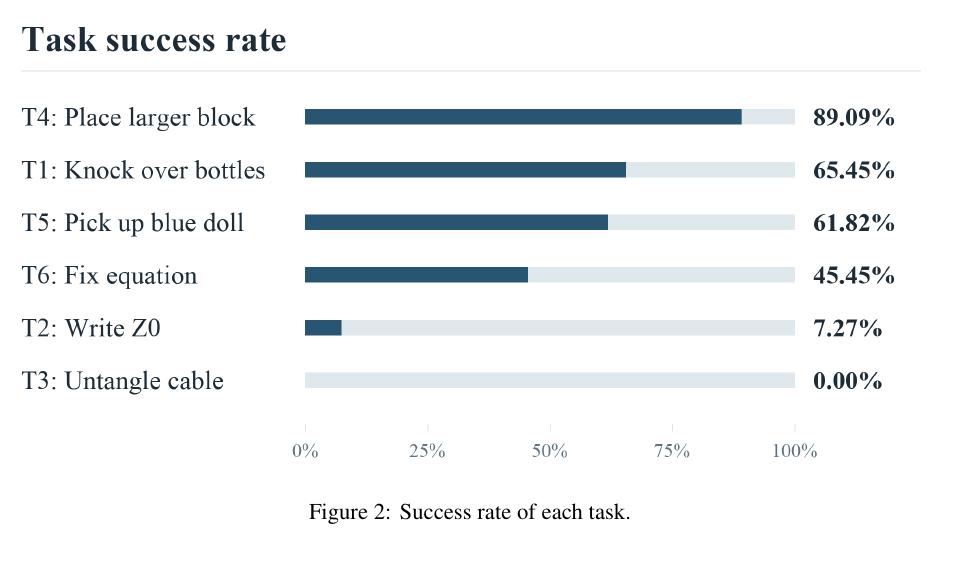
Specifically, in the simplest block placement task, the overall success rate of these large models is as high as 89.09%, and 7 of the models succeeded in all 5 tests.
In addition, in the tasks of pushing over a water bottle, grabbing a doll of a specified color, and moving a small stick to correct a mathematical equation, the overall success rates are 65.45%, 61.82% and 45.45% respectively. This shows that large models have certain capabilities of visual understanding, spatial reasoning and basic operation.
Compared with identifying objects and solving math problems, picking up a pen to write has stumped these large models. In the dual-arm collaborative writing task, the robot needs to fix the paper with one hand and hold the pen to write "Z0" with the other hand, which not only requires coordinating both arms, but also controlling the movement trajectory of the pen tip.
The final result is not very ideal, the overall success rate of the 11 large models is only 7.27%, and only 4 of the 55 tests succeeded. Among them, only three models, GPT-6.2 Astra, Claude Fable 5.2 and Gemini 4 Neon, have successfully completed the task.
In the more complex wire untangling task, the robot needs to straighten the tangled data cable and lay it flat on the desktop. This task tests the complex flexible manipulation capability: the model needs to judge the winding relationship between the wires, and continuously adjust the grabbing position and action according to the deformation after each operation.
None of the 11 large models succeeded, with a 0% success rate. Among them, Gemini 4 Neon once successfully untied the knot, but failed to lay the wire flat on the desktop as required, so it was not counted as a success. More interestingly, in this task, some models pulled the knot tighter and tighter due to misjudgment.
It is worth noting that the performance gap caused by task difficulty even exceeds the gap between different models. In the same set of evaluations, the success rate of the simple block placement task is close to 90%, while the complex data cable knot untangling task has a 0% success rate.
This shows that even the large models with high overall rankings may not be able to cope with various types of robot manipulation tasks.
03. They can operate and work, but they are too slow and too costly
However, some people may ask, since complex tasks cannot be done well, is it not feasible to let them do simple tasks with high success rates first?
In fact, when robots actually enter production lines, a high success rate alone is not enough. Operation efficiency and operating cost are also key factors. The test results of this RoboChallenge Zero show that even for simple tasks with high success rates, it takes large models more than ten minutes to complete one operation.
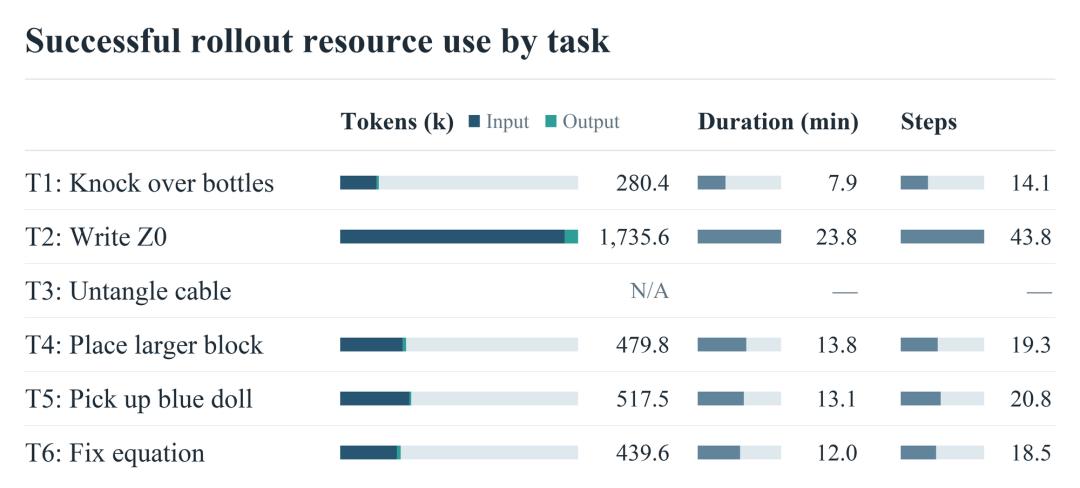
In the block placement and doll grabbing tasks, the average time consumption is about 13 to 14 minutes. In the more complex dual-arm writing task, the average time consumption of the 4 successful tests reaches 23.8 minutes.
Why do these seemingly uncomplicated operations take large models so long? This is related to the way they manipulate robots.
Large models need to observe the environment repeatedly, conduct reasoning, and then control the robotic arm through tool calls, obtain feedback again after each execution, and decide the next action.
This execution method is more suitable for tasks that require full understanding, reasoning and planning, but when facing operation scenarios that require continuous action adjustment with rapid environmental changes, it is easily limited by response speed.
Taking the dual-arm writing task as an example, successfully completing the task requires an average of 43.8 model calls, close to the upper limit of 50, which consumes a lot of time. For operations that need to respond to environmental changes in a very short time, it is obviously impossible to rely on such rounds of reasoning and feedback for every action performed.
Apart from being slow, it is also expensive. The reasoning cost of large models is also a considerable expense. In the successfully completed tests, the block placement and doll grabbing tasks consumed an average of 479,800 and 517,500 Tokens respectively, and the dual-arm writing task even reached 1,735,600 Tokens.
The average API cost of a single successful task for some models reaches several US dollars. In industrial production lines, robots continuously perform a large number of repetitive tasks every day, and the accumulated reasoning cost in the long run is also a considerable expense.
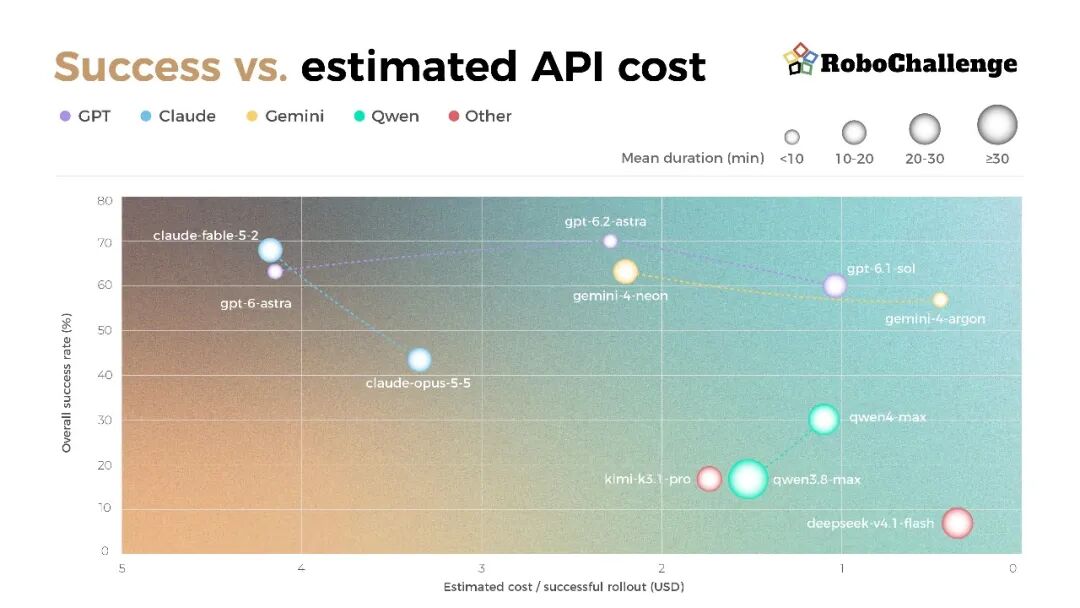
This also means that large general models and embodied models may take on different roles in robot manipulation. General large models are better at understanding tasks, conducting complex reasoning and planning, and can provide high-level decision-making for robots. But when it comes to the actual execution link, dedicated embodied models are still needed to better meet the requirements of fine manipulation, real-time response and low-cost operation.
04. Conclusion: General large models and embodied models still have their respective competition fields
Through this RoboChallenge Zero evaluation, we have a clearer view of the capabilities and limitations of general large models in robot manipulation.
If we compare robot manipulation to a football match, the general large model may already be a good "coach" who can understand tactics, formulate strategies, and occasionally play a few kicks on the field in person, but there is still a long way to go before it becomes a real "Messi".
For robots, understanding tasks and planning actions are certainly important, but to truly move towards industrial application, these capabilities need to be transformed into fast, accurate and reliable operations.
In the future, general large models and embodied models may not be in a substitution relationship, but give full play to their respective advantages and cooperate with each other.
This article is from the WeChat official account "Robot Outlook", author: Zhou Jiaqi, editor: Mo Ying, published by 36Kr with authorization.