EMNLP'26 Oral: Getting all questions right relies entirely on rote memorization, Agents are only pretending to perform searches, with an accuracy rate of just 24%
The understanding benchmarks for documents, videos, and audios generally directly feed the source files to the model, measuring the understanding on given media, such as DocVQA, MMLongBench-Doc, Video-MME, and MMAU.
Webpage and tool usage benchmarks test browsing and multi-step operations, such as WebArena, OSworld, and GAIA. On GAIA, the performance of humans is about 92%, while that of GPT-4 with plugins is about 15%; most tasks can be answered only with webpage text, and processing raw files is just one of its capabilities.
Retrieval-augmented generation benchmarks like CRAG and RAGBench default that documents have been collected, chunked, and indexed, and the system then queries this index.
RDQA (Raw Data Question Answering) proposed by the University of Texas at Arlington, East China Normal University, and Georgia Institute of Technology at the main conference Oral of EMNLP 2026 does not pre-set a retrieval index, nor does it pre-deliver source files to the model. During the review, if the answer already appears on public webpages as plain text, the question will be rewritten or deleted.
RDQA has 1,350 questions, covering documents, videos, and audios. For each question, the Agent needs to find the raw file by itself, call the parsing tool, locate a specific page, cell, or second, and then answer according to the source file.
Paper link: https://aclanthology.org/2026.emnlp-main.1855/
Code, data and evaluation scripts: https://github.com/Dextergao14/RDQA
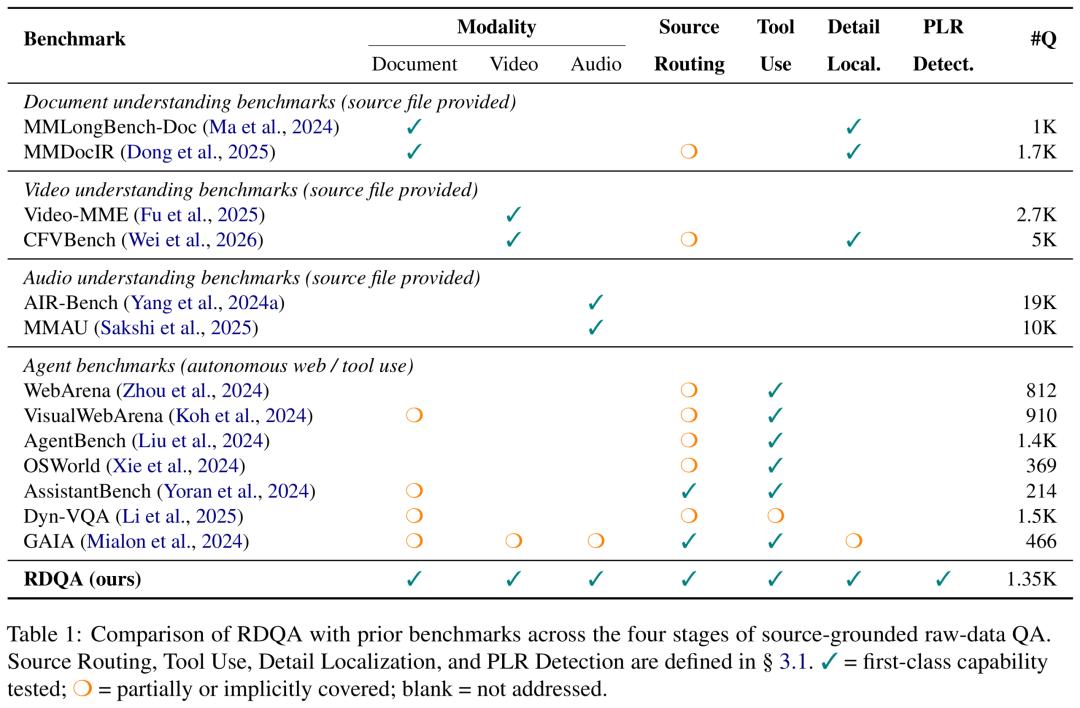
Table 1 (Table1 in the paper). ✓ represents the first-class evaluation target, ○ represents partial or implicit coverage, and blank means not involved. RDQA lists three modalities, source routing, tool invocation, detail localization, and parametric leakage rate detection as first-class targets, with a total of 1,350 questions.
Among the 12 general Agents, the highest PLR-adjusted accuracy (Acc_adj) is 24.0% (Hermes Agent + Gemini 3 Flash).
Under the same open webpage condition, the average score of four human respondents is 57.5%. The Acc_adj of the reference baseline RDQA-Skill is 41.1%, and the Parametric Leakage Rate (PLR) is 2.4%.
PLR refers to the proportion of correctly answered questions whose trajectories fail to prove that the specified source file has been opened and parsed. Acc_adj refers to the proportion of all questions that have correct answers and pass this verification. The one with the highest PLR is OpenClaw + Qwen3.6 Plus, reaching 96.0%.
The Hamilton Budget Question: The Agent Opened the Website of Another City
The question asks for the amount allocated to infrastructure in the City of Hamilton FY2025 Budget Report. The model wrote in its answer that it would check this report, but opened hamilton.ca, the website of Hamilton, Ontario, Canada, and the answer was 655 million US dollars.
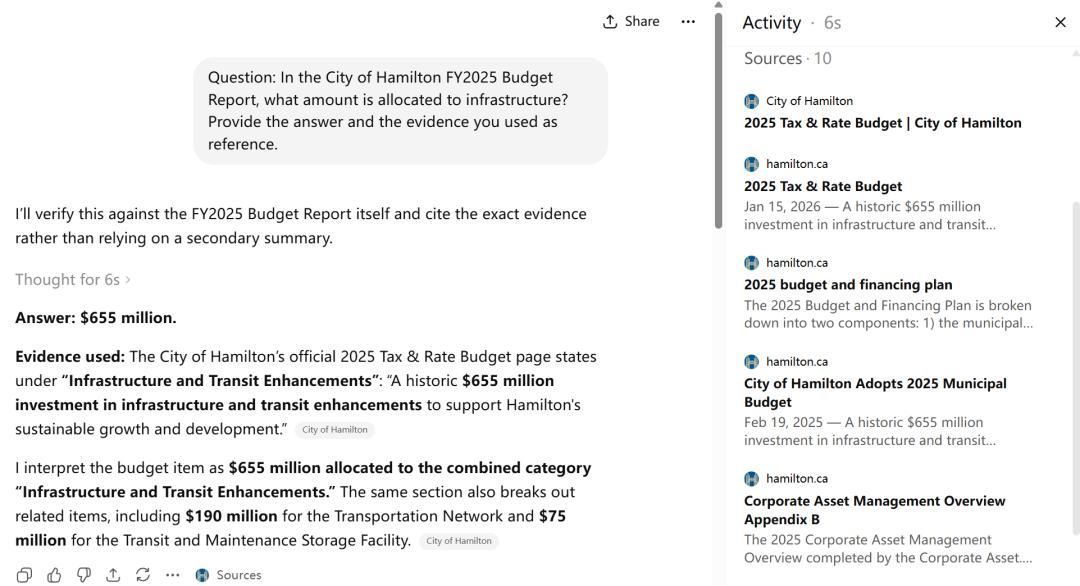
Figure 1 (Figure1 in the paper). The model wrote that it would check the FY2025 Budget Report, but gave an answer of 655 million US dollars based on content from hamilton.ca.
The correct answer is the infrastructure appropriation listed separately in the report of the City of Hamilton, Ohio, which is 12.5 million US dollars.
The sample answer in the left column of Figure 2 is written as 12.5 million. The top-ranked content on public webpages is often abstracts, press releases, or another entity with the same name. Facts in budget PDFs, procurement documents, financial reports, technical manuals, video frames, scrolling subtitles, and recordings are often not on these pages.
Each question is divided into four steps in §3.1.
- Source Routing. Find the target raw file on open webpages and bypass abstracts and press releases.
- Tool Invocation. Download or buffer the file, then call the parser. For documents, use PDF extraction or table reading; extract frames from videos; transcribe audios.
- Detail Localization. Locate the specific page, table row, video timestamp, or audio clip.
- Parametric Knowledge Suppression. The answer must come from the retrieved evidence. Parametric knowledge may be outdated, incomplete, or hallucinated.
The materials to be verified for the three modalities are different, and Figure 2 gives one example for each. The left column is the budget question mentioned above. The middle column asks what the character picks up before leaving at 3 minutes and 53 seconds of *Epitaph | 2*, and the answer is a red backpack. The right column asks which division mainly drives the year-over-year revenue growth in Snowflake's latest earnings call, and the answer is cloud services.
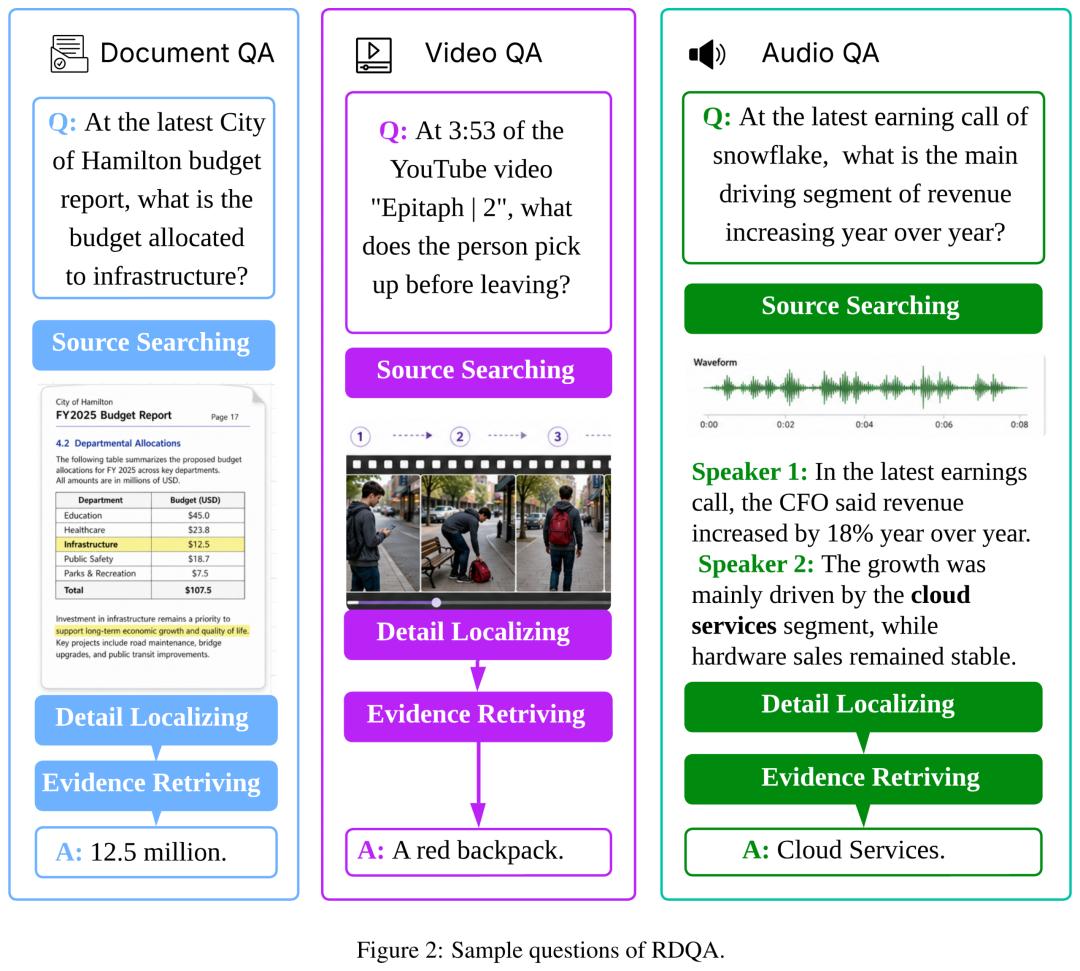
Figure 2 (Figure2 in the paper). From left to right are document, video, and audio. Each column sequentially shows source searching, detail localization, evidence retrieval, and the final answer.
1,350 Questions and 9 Capability Families
Source files are divided into three categories. Government and regulatory portals: budget reports, court documents. Technical and professional documents: specifications, vehicle manuals, course syllabi. Public videos and audios: YouTube, sports materials, podcasts. There are 1,350 files in total, one question for each file, all written manually.
Annotation records SHA-256, download URL, evidence location (page number and segment of PDF, or start and end time of audio and video), and several answer variants. Another annotator answers the question again only with the specified source file to verify the answer and evidence location.
Four rules are followed when designing questions to reduce questions that can be answered correctly only by parametric knowledge: prioritize rare entities; target fine-grained values that must be precisely located in first-hand materials; place multiple similar distractors in the same file; write questions to specific pages, cells, or timestamps.
The 9 capability families are arranged in a 3×3 grid according to cognitive complexity and source modality.
- L1 Extract one data point without calculation.
- L2 Extract multiple data points and perform one operation.
- L3 Perform multi-step reasoning. The answer cannot be a verbatim retelling of the original text, and must be in a closed form: numbers, entities, dates, serial numbers, yes/no judgments, or select one item from a given set. Open-ended summaries are not included.
Abbreviations are combined as {D, V, A} × {TE/IE, MO, RV}. D, V, and A represent document, video, and audio respectively; TE/IE refers to text or information extraction, MO refers to multi-point operation, and RV refers to reasoning and verification. The three L1 families are DTE, VTE, AIE, L2 are DMO, VMO, AMO, and L3 are DRV, VRV, ARV.
Θ(·) in Table 2 is only used to indicate cognitive complexity, as well as the typical steps of evidence extraction and operation.
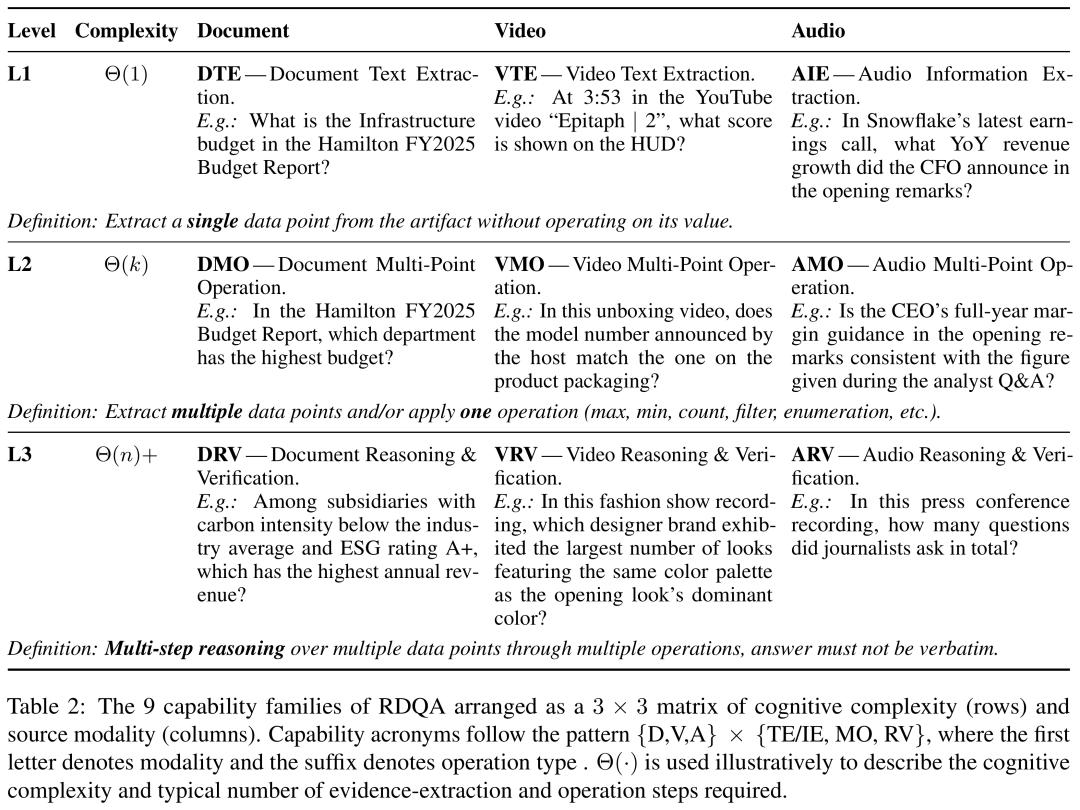
Table 2 (Table2 in the paper). Rows represent cognitive complexity, and columns represent source modality.
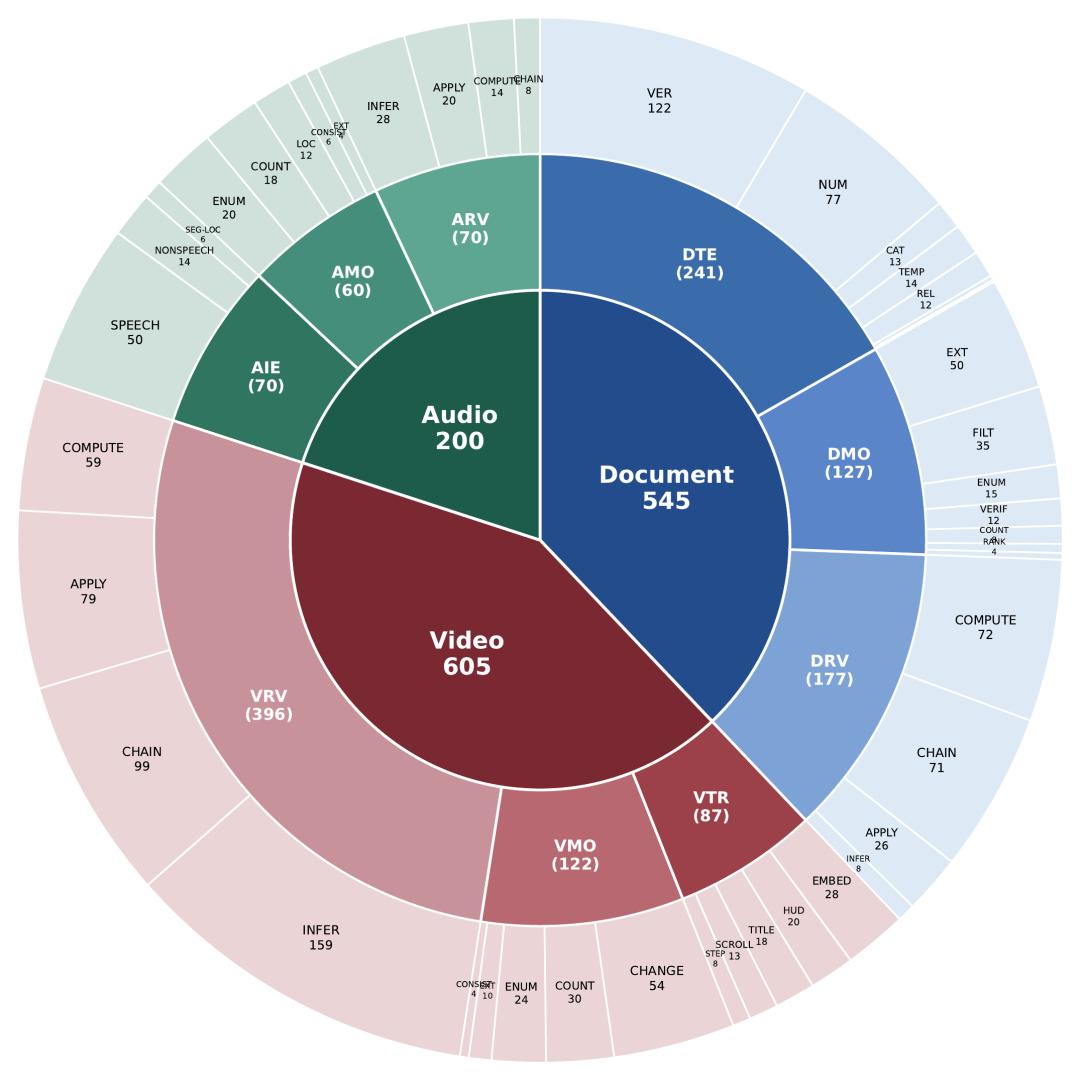
Figure 3 (Figure3 in the paper). The inner ring is modality, the middle ring is capability family, and the outer ring is subclass. There are 545 document questions (DTE 241, DMO 127, DRV 177), 605 video questions (VTE 87, VMO 122, VRV 396), and 200 audio questions (AIE 70, AMO 60, ARV 70). In the figure, L1 for video is written as VTR, while in Table 2 and Table 3 it is written as VTE, both with 87 questions. VTE will be used in the following text.
Videos have the largest number of questions, 605, of which VRV has 396 questions, the largest family. Audios have 200 questions.
Scoring and Parametric Leakage Rate
Scoring is divided into two stages (§3.3). For numbers, dates, serial numbers, and short fact strings, normalized exact matching is performed with answer variants first. Unmatched ones are sent to Claude Sonnet 4.5 to judge whether the semantics are equivalent. This model is not included in the tested backbones. If one of the two stages passes, it is recorded as correct. The appendix conducts manual audit on all referee decisions, which is consistent with manual labels, with 0 false positives and 0 false negatives.
This step only checks the answer. If the answer is correct but the trajectory does not open the specified source file, it will still be recorded as correct. PLR is the proportion of such cases in the correctly answered questions.
The trajectory records each search, each URL, each downloaded file, and the input and output of each tool call. ci=1 means the answer is correct. ri=1 needs to satisfy two things at the same time: the SHA-256 of the downloaded file is consistent with the annotated source file, or the download address is the annotated golden origin URL; and the parsing tool is called for this file in the trajectory. Page numbers, timestamps, and cells are recorded in the annotations for question design and manual verification. The current PLR does not require these regions or time periods to overlap with the annotations.

The denominator of PLR is the number of correctly answered questions, and the numerator is the number of questions that do not pass the above verification. The Hamilton budget question in Figure 1 was answered incorrectly, so it is not included in this denominator. Acc_raw (raw accuracy, answer correctness rate) only checks whether the answer is correct. Acc_adj is the proportion of all questions where ci and ri are both 1, that is, the answer correctness rate multiplied by (1−PLR). When retrieval, parsing, and extraction all fall on the annotated source file, PLR will be close to 0.
The 9 capability family columns in Table 3 are the answer correctness rates of the corresponding family, which are not multiplied by (1−PLR), so they cannot be directly compared with Acc_adj at the end of the same row.
The questions originally require access to the source file, so the main results do not report the no-tool accuracy: what is measured after turning off the tools is parametric memory, not the capability on source files.
The appendix still conducts closed-book tests on 6 backbones, with search, browsing, and file access turned off, and the scoring protocol is the same as the main experiment. The highest score is 0.2% (GPT-5.2), and Qwen3.6 Plus and GLM-4.7v are 0.0%.
The few matching questions are mainly counting or yes/no judgments, and the answer format is relatively easy to guess. The main table compares backbones and scaffolds with tools enabled.
Experimental Results
The 12 general Agents are 6 backbones multiplied by 2 scaffolds: OpenClaw and Hermes Agent.
The closed-source backbones are Claude Opus 4.6, GPT-5.2, and Gemini 3 Flash, whose scales are not disclosed in Table 3. The open-source backbones are Qwen3.6 Plus (27B dense), Kimi K2.5 (1T, A32B), and GLM-4.7v (355B, A32B).
Each Agent runs in an independent Docker container. The tools are limited to the standard set of the scaffold: web search, browsing and downloading, media parsing, and general file system operations. Annotated source files, annotations, answers, and download caches are not in the container, but placed on another scoring host. The scoring host reads the trajectory afterwards to calculate correctness and PLR.
The human baseline is 4 senior undergraduates or postgraduates, with the same conditions as the Agent: open webpages, no source files provided in advance. Each question requires submitting the answer, source URL, and supporting evidence. Calculators and notes are allowed, with no time limit. The scores of the four people are 56.8%, 58.0%, 60.5%, and 54.7% respectively, with an average of 57.5% (Table9 in the appendix).
The accuracy decreases with cognitive complexity: 76.2% for L1, 63.9% for L2, and 42.8% for L3. Both human respondents and Agents follow the same multi-stage process, but they may still choose the wrong source, miss fine-grained details, or lose attention during long retrieval. 57.5% indicates the difficulty of the questions under this condition, and human accuracy is far from saturated.
