Is Luckin Coffee going to sell coffee machines? It never takes hardware manufacturing as its core business, so selling hardware products is completely straying from its proper business focus.
Is Luckin Coffee, the coffee seller, preparing to manufacture coffee machines on its own?
Not long ago, Luckin set up a wholly-owned subsidiary called "Luckin Intelligent Technology Research" in Shanghai, with a registered capital of 10 million yuan. In addition to technology development, its business scope also covers the manufacturing, sales and repair of household electrical appliances, as well as the sales of electric heating food processing equipment.
After the news came out, many people interpreted it as Luckin's plan to enter the household coffee machine market. After all, with nearly 40,000 stores and more than 500 million cumulative transaction customers, Luckin does have the conditions to extend its coffee business to consumers' homes.
However, research by Lei Technology found that Luckin has long been researching coffee equipment, and its layout around this matter may be deeper than the outside world imagines.
In the highly competitive catering industry, Luckin's choice is not an isolated case. Heytea, Nayuki, Bawangchaji, and even some Chinese catering chain brands have already started to research equipment independently or develop it jointly.
The question is, the catering business is already so saturated, why do they still need to cross-border to research hardware?
What exactly does Luckin want to achieve by researching coffee machines?
In fact, Luckin's exploration of hardware R&D can be traced back to at least 2020:
In December of that year, Luckin and Guangzhou Jienuo jointly applied for a patent related to the self-cleaning coffee machine.
In 2022, Luckin applied for another patent for liquid output equipment calibration, trying to improve the precision of quantitative output of raw materials such as syrup.
In 2024, Luckin also applied for four appearance design patents for drip coffee machines in a concentrated manner, and successively obtained the authorizations in 2025.
From automatic cleaning and quantitative feeding to the industrial design of the whole machine, Luckin's exploration of equipment technology has lasted for many years. Its newly released 2027 campus recruitment positions clearly require participation in store equipment demand analysis, product planning, scheme design, supply chain coordination and store pilot testing:
Professionals majored in mechanical design, manufacturing and automation, mechanical engineering and other related majors are given priority.
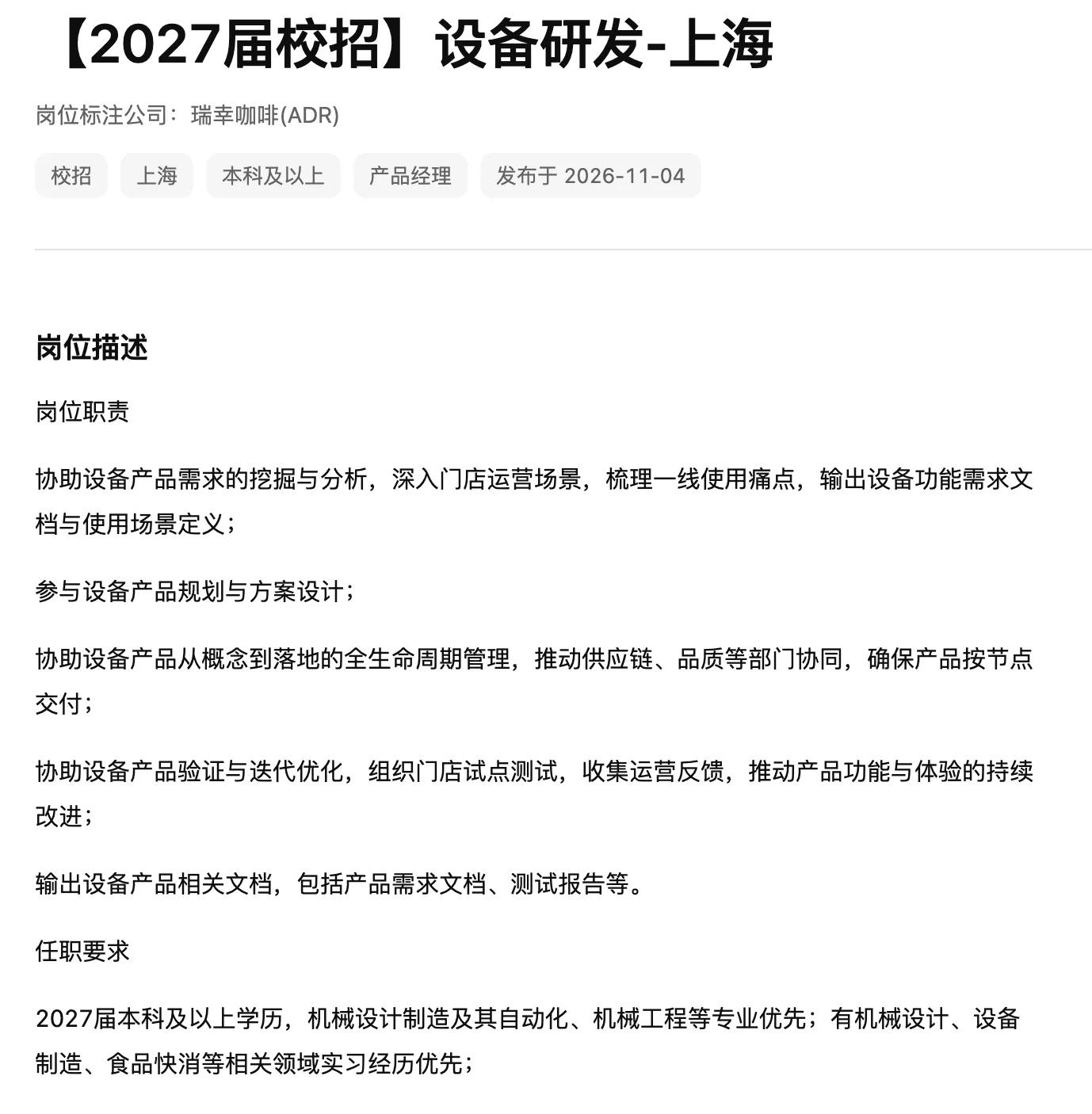
Image source: Jinli Job Hunting
Considering this information, the newly established intelligent research company is very likely to undertake the task of integrating and strengthening the R&D capabilities of relevant equipment. As for why Luckin wants to research equipment on its own, the most direct reason is still its scale.
As of the third quarter of this year, the number of Luckin's global stores reached 38,909, with a net increase of 2,599 in a single quarter.
According to Luckin's 2025 annual report, its coffee machines are mainly purchased from external manufacturers, including the Swiss coffee machine manufacturer Schaerer. In 2025, the average procurement cost of Luckin's coffee machines was about 86,000 yuan, which has dropped significantly compared with 112,000 yuan in 2023.
But purchasing equipment is only the beginning. Coffee machines need to be cleaned and maintained every day, and failures may occur after long-term use. For Luckin, which has nearly 40,000 stores, even if each machine only saves a few minutes of cleaning time every day or reduces part of the maintenance demand, when amplified to the entire store system, it will generate considerable value.
More importantly, self-developed equipment also gives Luckin the opportunity to develop new products more flexibly.
In the past few years, from Coconut Latte and Sauce-Flavored Latte to various flavored coffees, Luckin has been attracting consumers through new products. The more new products there are and the more complex the formulas are, the higher the requirements for raw material quantification, production process and output consistency will be.
If Luckin can master more equipment technologies, it will have the opportunity to design more suitable coffee machines and automatic feeding equipment according to its own product and operation needs, and even further combine the software system with equipment control to reduce its dependence on manual operation and existing solutions of suppliers.
This is especially true in the current competitive environment.
In the third quarter of this year, Luckin's revenue increased by 17% year-on-year, but the same-store sales of self-operated stores decreased by 11.1% year-on-year. Although it was mainly affected by the high base formed by the high subsidies of takeaway platforms last year, while the store scale continues to expand, improving the operating performance of a single store is still a problem that Luckin needs to solve in the long run.
Of course, Luckin does have the possibility to extend its equipment R&D capabilities to the consumer market.
On the one hand, the business scope of the new company clearly includes the manufacturing, sales and repair of household electrical appliances; on the other hand, the four appearance design patents for drip coffee machines previously applied for by Luckin also reflect its exploration of complete machine products.
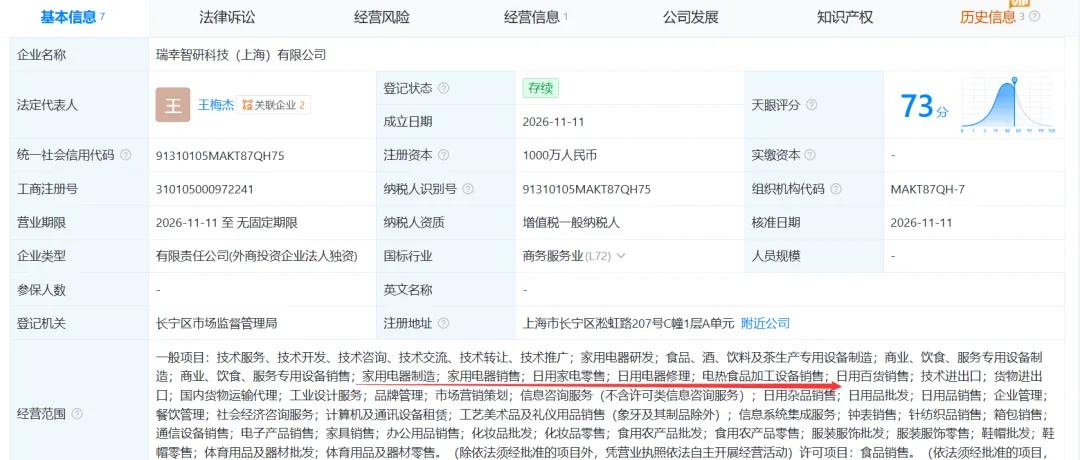
Image source: Qichacha
If Luckin launches home-oriented coffee machines in the future and sells them with products such as coffee beans and coffee powder, it will have the opportunity to extend its relationship with consumers beyond stores and obtain new sources of revenue.
Not only Luckin, more and more catering giants are developing hardware
Luckin's choice is actually a development trend of the ready-to-drink beverage industry and even the entire catering industry.
In 2021, Heytea set up its own intelligent equipment R&D team, and successively developed intelligent tea dispensing machines, automatic peeling machines, pitting machines, lemon crushing machines and other equipment within two years. In 2023, Heytea announced that 7 self-developed pieces of equipment had been put into use in all its stores, and more than 70 related technical patents had been applied for.
Nayuki also began to promote equipment automation R&D in 2021, and put its self-developed automatic milk tea machine into store testing in 2022. Bawangchaji cooperates with suppliers to develop automatic tea-making equipment, integrating its own formulas and production processes into the machines to simplify the operation process of store employees.
Expanding the vision to the catering industry, similar changes are also taking place.
The Hunan-style fast food brand "Bawan Covered Rice" has developed intelligent cooking equipment, trying to reduce its dependence on professional chefs; chain brands such as Laoxiangji and Xiaocaiyuan have improved the efficiency of the back kitchen and the consistency of food output by introducing cooking robots and other automated equipment.
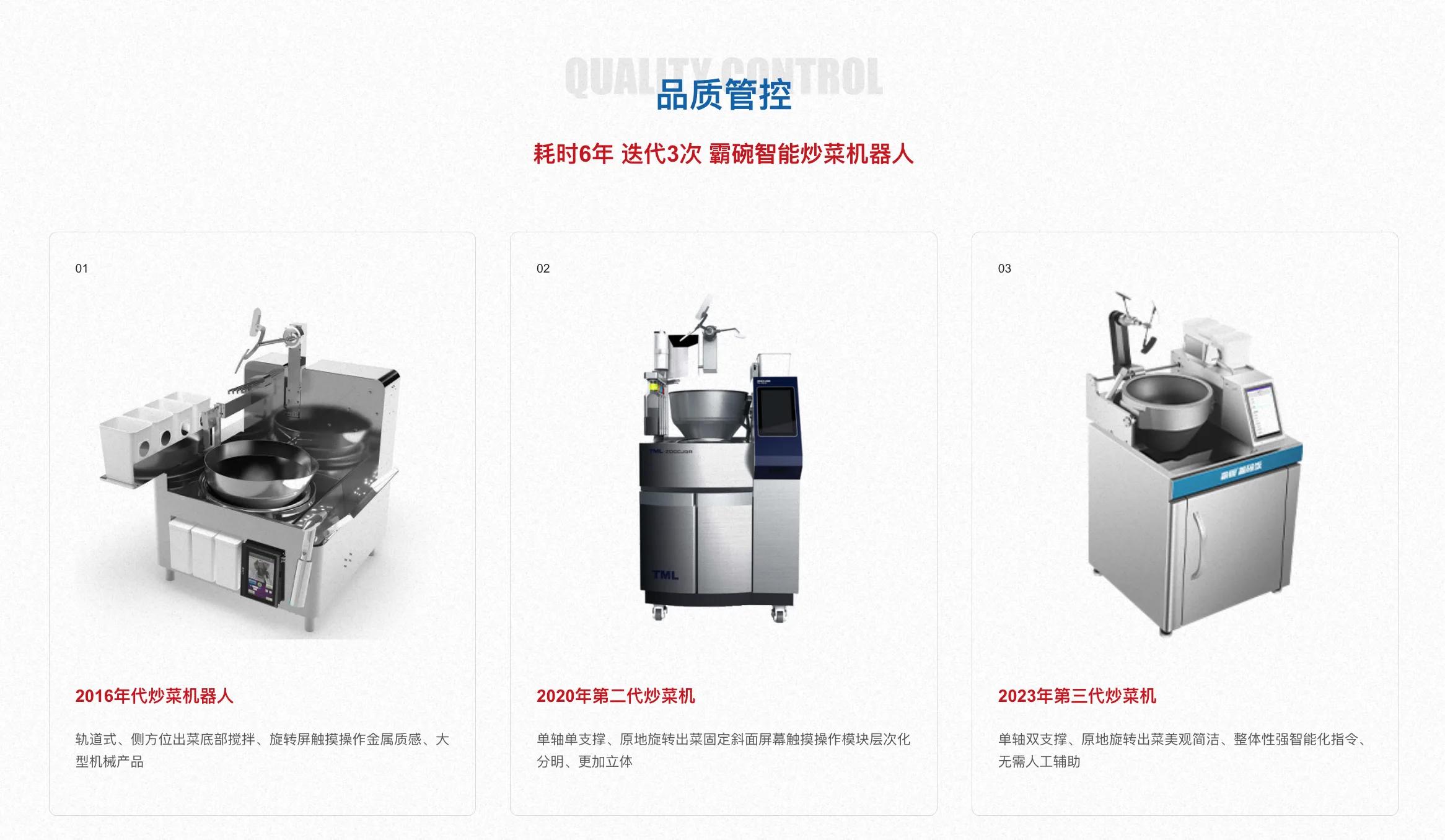
Image source: Bawan
Even, five departments including the Shanghai Municipal Commission of Commerce jointly issued the "Shanghai Action Plan for Promoting the Intelligent Layout of the Catering Industry (2026-2028)" at the end of last year, proposing to promote catering enterprises with high standardization such as fast food, tea drinks and coffee to upgrade to "unmanned and less-personalized" mode, and accelerate the application of equipment such as intelligent beverage machines and automatic frying robots.
According to the plan, by the end of 2028, the full-chain intelligent penetration rate of Shanghai's group meal, fast food, tea drink and coffee enterprises will exceed 70% as the target.
More importantly, while catering brands are paying more and more attention to scale and standardization, some leading enterprises are also beginning to think about how much equipment technology they need to master.
The catering industry in 2026 is not having an easy time. Data from the National Bureau of Statistics shows that in the first 10 months of this year, the national catering revenue increased by 2.2% year-on-year, and the growth rate in October alone was only 0.7%. Fierce competition and slowing growth have made more and more catering enterprises start to look for new means to reduce costs and increase efficiency.
In this context, investing capital and talents to research equipment seems to be a very attractive thing.
Especially for brands with huge store networks such as Luckin and Heytea, the achievements of equipment R&D can be reused in a large number of stores. Once manual operation, raw material waste or equipment maintenance costs can be effectively reduced, the R&D investment will be gradually diluted as the store scale expands.
However, the improvement of production efficiency brought by equipment does not necessarily mean that the operating cost of stores will definitely decrease.
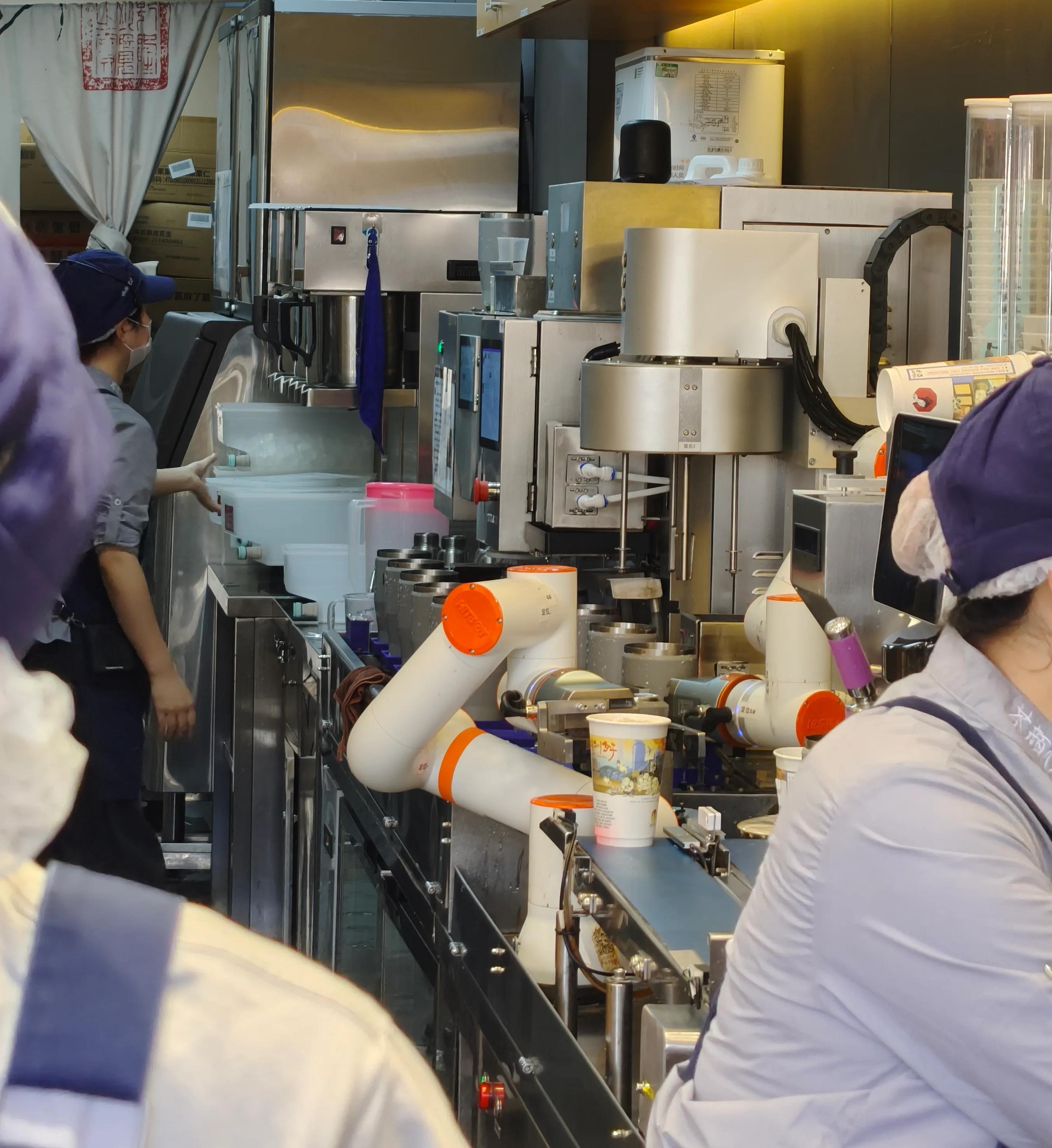
For example, an automatic milk tea machine can shorten a certain drink preparation link from tens of seconds to a few seconds, but employees still need to prepare materials, seal products, clean equipment and process orders. If the store does not reduce the actual working hours as a result, and does not receive more orders during peak hours, the economic benefits brought by the equipment may be quite limited.
A ready-to-drink tea shop, image source: Lei Technology
Moreover, there is an obvious contradiction between catering equipment R&D and ordinary hardware R&D: products are updated too fast.
Brands such as Heytea keep launching drinks using fresh fruits and complex ingredients, and a new product may only be sold for a few months, but it may take longer for a piece of equipment to go from design and testing to mass production.
This is why some equipment R&D projects are more suitable to start with high-frequency and standardized operations. For example, links such as automatic cleaning and quantitative feeding are repeated almost every day, and will not lose their value because a certain new product is removed from the shelves.
At the same time, the demand for equipment R&D of different catering brands may also be very different.
Compared with other tea drink brands with a wide variety of products, Bawangchaji is more focused on fresh milk tea made from original tea leaves, and its main products have relatively similar tea-making processes, so it can achieve a high degree of standardization through automatic tea-making equipment.
However, according to the reply it previously submitted to the US securities regulator SEC, Bawangchaji customized and developed equipment together with suppliers and owns relevant appearance design patents, but it does not exclusively own the core technology intellectual property rights used in the machines.
This means that Bawangchaji did not choose to master all the equipment technology in its own hands, but also realized the automation of the store production process.
Image source: Bawangchaji
For catering brands, what they are most familiar with is always their own products and business needs, while links such as mechanical design, manufacturing and reliability verification are the strengths of professional equipment manufacturers. Cooperation between the two sides is not necessarily inferior to completely independent R&D.
Another point worthy of vigilance is that equipment R&D itself may become a continuously increasing burden. The American chain light food brand Sweetgreen is a typical example.
In 2021, Sweetgreen acquired the catering robot company Spyce, and then launched the automated kitchen Infinite Kitchen, which uses machines to complete part of the production process of meals such as salads. According to the data disclosed by the company, some stores that adopted Infinite Kitchen have achieved significant improvements in labor cost rate and food material cost rate.
However, at the end of 2025, Sweetgreen sold the Spyce business to the catering technology company Wonder for about 186 million US dollars, and continued to use this set of automated kitchen technology through long-term licensing and service agreements.
Even if the benefits brought by the technology have been verified, catering enterprises do not necessarily need to independently undertake the R&D and manufacturing of the whole set of equipment. After all, every link including R&D team, production and manufacturing, quality control and after-sales maintenance means new capital and management costs.
Whether the equipment can bring better business performance also depends on store passenger flow, order structure, labor cost, and the utilization rate of the equipment itself.
Catering giants focus on hardware development for their main business, selling hardware is "off the track"
Judging from Luckin's current scale, existing equipment R&D experience and continuously expanding store network, further investment in equipment R&D is indeed a reasonable choice. Especially in fields highly related to store operation such as automatic cleaning, quantitative feeding and equipment monitoring, Luckin not only has a better understanding of its own actual needs, but also has enough stores to verify the technical effect.
But if it wants to enter the household coffee machine market, things will be much more complicated. Luckin has a huge customer group, high coffee brand awareness and raw material supply chain, but these advantages cannot be directly transformed into competitiveness in the household coffee machine market.
Consumers may choose Luckin because of its price, convenience, or love for a certain signature latte. But when buying a household coffee machine, they will consider performance, price, design, use experience and after-sales service. What's more, there are already a large number of mature manufacturers in the household coffee machine market. If Luckin chooses to enter this market, it will need to face a completely different competitive environment from the ready-to-drink coffee business.
At present, Lei Technology tends to believe that Luckin's main investment direction is still equipment R&D close to its own store needs, and it will improve the independent definition ability of technology and products by cooperating with mature manufacturers.
For Luckin, the newly established intelligent research company may be an important attempt, but what is really worth paying attention to is still whether it can transform its scale, product and operation advantages into more efficient and reliable equipment technology.
After all, catering enterprises ultimately make money by selling cup after cup of drinks and portion after portion of meals. No matter how well the machine is made, whether it can make these businesses better is the key to measure the value of cross-border R&D.