Manus Zhang Tao reviews the full story behind the success: free subsidies are the biggest trap in the AI era
For an AI company with 30 employees, the most critical capability is not deciding what to build, but deciding what not to build.
Recently, Zhang Tao, Co-founder and Chief Product Officer of Manus, delivered a sharing session lasting more than two hours at the "AI Entrepreneurship and Investment" event at Peking University, fully reviewing the trade-offs they made from developing an AI browser to building Manus, key judgments on Agent products, and practical suggestions for young entrepreneurs.
Zhang Tao was born in 1986, graduated from Chongqing University of Posts and Telecommunications with a major in Communication Engineering. He previously worked on product teams at Tencent, ByteDance, Sensors Data, Light Years, and other companies, before co-founding Manus with Xiao Hong and Ji Yichao in 2024.
Before organizing the content, two simple notes to clarify:
1. This article is transcribed and organized by TideSurge AI based on the full recording of Zhang Tao's sharing at Peking University, retaining the first-person perspective with necessary sentence adjustment and simplification;
2. Proper nouns and figures have been corrected according to public materials, and information outside the speech is marked as "Background Note" to strictly distinguish it from the speaker's original remarks.
The following is the sorted full text of Zhang Tao's speech at Peking University ——
We Spent 7 Months Building an AI Browser, and Killed It Ourselves
In March 2024, we formed a new team, Peak (Ji Yichao) and I joined the team during that period. Peak is our co-founder and Chief Scientist.
We started as a company building browser extensions, and it was easy to infer our next step: extensions have a very low upper limit, so it makes more sense to build a full browser on our own.
So from March to October 2024, we spent seven months building a completely AI-native browser.
Let me first talk about why Peak and I joined the team.

Peak (Ji Yichao)
The first reason: Neither of us believes that Chatbot is the ultimate form of AI products.
In early 2024, everyone was still keen on "testing AI" — whenever a new version of a model was released, people would use tricky questions to challenge it, to prove that humans are still more capable. But back in 2023, I already felt strongly that AI has outperformed all of us. Think about it: what ordinary person can maintain such strong response capabilities across all fields?
Why is AI so powerful, yet its impact on society and everyone's daily life is not as significant as its capabilities suggest?
After my research, I attribute it to one point: the Chatbot product form itself limits the expression of the model's capabilities. The upper value limit of a product depends on its users — the product's value can only be unleashed if users know how to ask questions and are willing to ask questions. What if users don't know how to ask good questions?
That's why I always wanted to build a product: 7×24 hours, no human input required, it keeps inferring on its own and outputs tokens continuously. At that time I hadn't even figured out its specific form, but I already knew the intelligence upper limit of the model had surpassed humans, what we needed to do was to use a reasonable product form to actively and automatically stimulate the model to output.
The browser attracted me at that time precisely because it typically "does not require continuous prompt input": your behaviors like writing emails, searching, and browsing web pages are all intents themselves, which can generate a large number of reasoning demands behind the scenes.
The second reason is Red (Xiao Hong), our CEO. Besides being an excellent product manager, he is also very experienced in company operation.
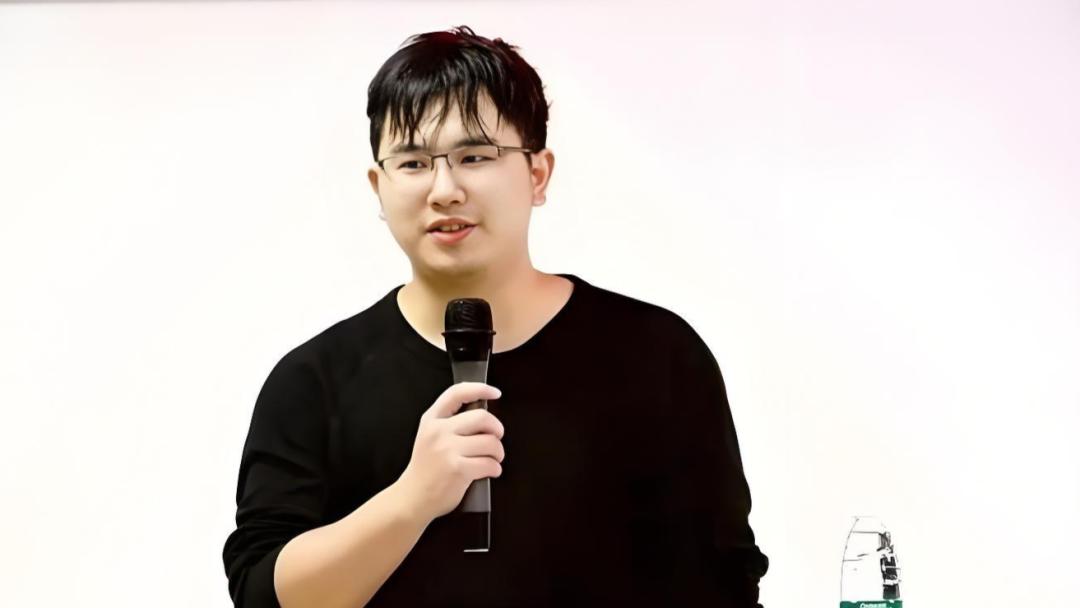
Red (Xiao Hong)
Now let's go back to that browser.
How mature was the product? People who followed AI products in early 2025 should remember two AI browsers — Arc's Dia and Perplexity's Comet. Back in October 2024, our product was far more complete than both of them. But none of you here know that Manus ever built an AI browser, because we never released it. I even finished the launch website and promotional video, but we never made it public in the end.
Why? During internal testing, we could always find one or two exceptionally impressive features. But when we gave the product to our family and friends to try, the problem surfaced: everyone is far too familiar with the browser product form. The first question they asked after getting the product was always — where can I find that feature I use in Chrome or Safari on your browser?
This is the biggest pitfall of grafting new experiences onto old ones: users will always measure you against the baseline of their old experiences. But those are not your highlights, what you want them to notice is the AI part. A small 30-person team trying to align with the baselines of Apple and Google on a product that has been mature for more than 20 years is almost impossible, and it will drag down the development of the AI part completely.
I was still a bit reluctant at that time: if we release it, there will definitely be hardcore users who like it, right? After a few iterations, what if it becomes popular?
But Red was already very hesitant back in September. First, grafting new experiences onto old ones does not make logical sense; second, he was deeply afraid that once we released it, the whole team would be trapped in this project for 3 to 6 months. Once you release it, you can't abandon it even if the first version is not good enough, you will definitely think "maybe one more iteration will fix it", and half a year will pass in the blink of an eye.
Guys, when you are still in school, you may not feel the value of time. But when you start a business, money is the least valuable resource — if you get the direction right, you can always raise more funding. The scariest thing is wasting the most precious resource of founders: time. What you miss is not just time itself, but also the phased industry trends, windows and market opportunities.
When you start a business, money is the least valuable resource, time is the most precious and dangerous one to waste.
Back then our whole company had only 30 people, and we only had the angel round funding from ZhenFund, we had invested seven months into this project and the product was already very mature.
Red finally made the call to sunset the browser. Looking back now, that was our most important decision — without that sunset, there would be no Manus later.
When I told this story last year, there were still voices in the industry saying: if you don't want to build AI browsers yourselves, don't badmouth our track. Today I can say confidently: everyone can see how that track turned out later.
(Background Note: The subsequent development of the AI browser track confirmed this judgment. OpenAI released its AI-native browser ChatGPT Atlas in October 2025, and officially shut it down in August 2026, with the browser proxy function merged into ChatGPT; in China, ByteDance's Doubao and Alibaba's Quark chose to add AI capabilities on top of their existing browsers; Light Years, my former employer, was acquired by Meituan and formed the GN06 team, which launched the AI-native browser Tabbit in June 2026.)
We Saw Something Others Missed From Cursor
After sunsetting the browser, the five of us worked in a small office at a shared coworking park in Beijing, exploring our next product.
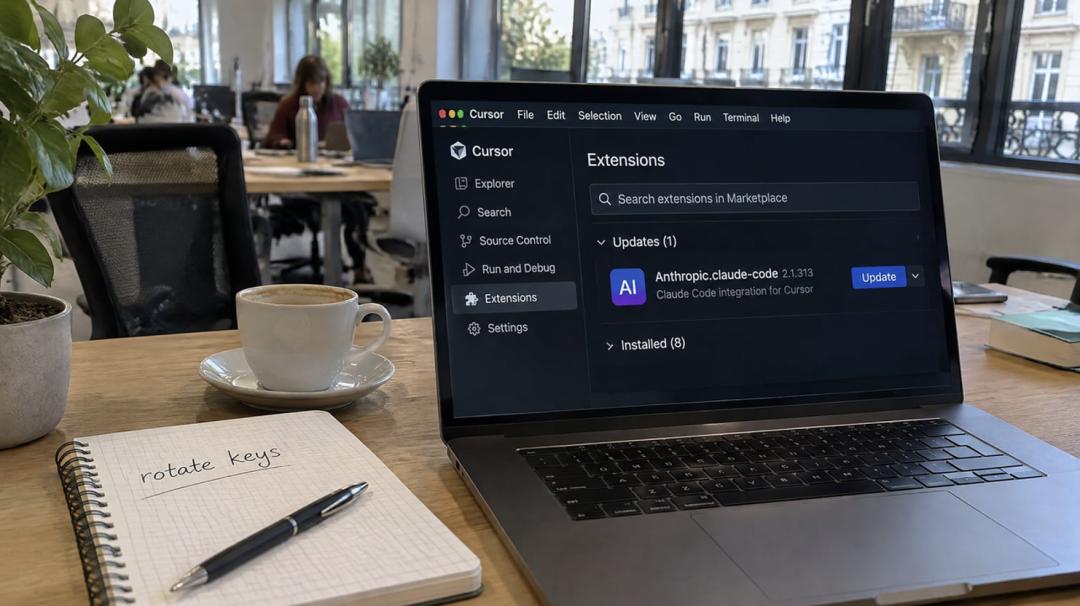
The most phenomenal product of 2024 was Cursor. We used it every day, and gained a different insight from everyone else.
I am not a professional engineer, and I used Cursor to do all kinds of odd jobs: processing expense reports, converting MP4 to MP3 for my wife, and even writing novels.
During this process, we became more and more certain: Anthropic's Sonnet 3.5 behind Cursor, especially the Sonnet 3.5 v2 released in November that year, did not just unlock coding capabilities, but unlocked agentic capabilities.
It has two layers of meaning.
The first layer is long-horizon planning.
This is common sense now, but it was not the case at the end of 2024. Most of OpenAI's models are trained based on turn-by-turn conversations like ChatGPT, and they are used to solving problems within one session. But Sonnet showed signs of this capability starting from version 3.5, and it became even more obvious in v2: it will make long-term plans for tasks, understand that the task should not be finished in one turn, proactively call tools, proactively ask follow-up questions, and complete the task only after getting more information and becoming more confident.
The second layer is tool use, at that time the function call capability of 3.5 v2 was the strongest among all models.
Everyone who saw Cursor wanted to make a copycat, a coding tool. We saw a different opportunity: coding is very powerful, but it should not only be for engineers. The world does not need more engineers, and engineers already have more than enough fancy tools. The real value of this capability is to use coding as an intermediary to solve general scenario problems for ordinary users.
We officially launched the project in December 2024.
We were very nervous the moment we launched the project — I was definitely not the only one who saw this future, so we gathered all our resources to develop as fast as possible, for fear that others would beat us to it.
We developed for more than two months, and when we released on March 5, 2025, we still thought "it's too late, someone must have beaten us to it". But after release, we found out that it seemed like we were the only team in the world working on this direction, everyone else was still building coding tools.
Our Earliest Benchmark Was Made of Tasks Raised by More Than 100 Friends
The early version of Manus looked extremely similar to Cursor.
Dai Yusen, an investor from ZhenFund, came to see our prototype in the middle of development. He didn't say much after seeing it, he just said: this three-column layout, isn't it too professional? It feels like it's keeping me out.
Our target users are non-technical users in the first place. For a product facing non-technical people, the first impression of being "too professional" is a critical problem.
So we changed the interface from three columns to two columns, and made a series of innovations for ordinary users.
When we launched the project, I posted a moment on my WeChat feed: if you had an intern with a bachelor's degree, what tasks would you assign to them? More than 100 friends contributed more than 400 tasks to me.
These more than 400 tasks became Manus's earliest evaluation dataset. We removed tasks that required embodied intelligence like "buy me a cup of milk tea", leaving more than 300 tasks, which became the benchmark we used to test the product every day.
On January 5, 2025, we got the first version of the prototype working.
After that, every day Manus would surprise me, completing tasks in ways that completely exceeded my imagination. I shouted too much in the office every day during that period, and my voice was hoarse when I got home at night, my wife asked me how on earth I could work so hard.
But honestly, the feeling that you see the intelligence jump out of the screen and hit you in the face is impossible to resist — you just know, this is the future.
Transparency, Session Replay, and That $15 Video
The overwhelming impact also brought trouble: when we directly delivered the results to users, they thought it was fake.
In the first week after release, a lot of people really thought we released a fake product.
So we made a judgment: make Transparency a core feature.
There was a very important design in the first version of Manus, which later almost became the standard configuration of all AI products — it fully displays the Agent's working process and thinking process step by step. What it is thinking, which tool it called, which web page it visited, what notes it wrote, it shows all of these to you step by step.
The other feature is Session Replay: you can share the session with others, and they can watch the whole process of how the task was completed just like watching a playback. No invitation code required, no top-up required, when you watch your friend's session, you can also feel that magical moment.
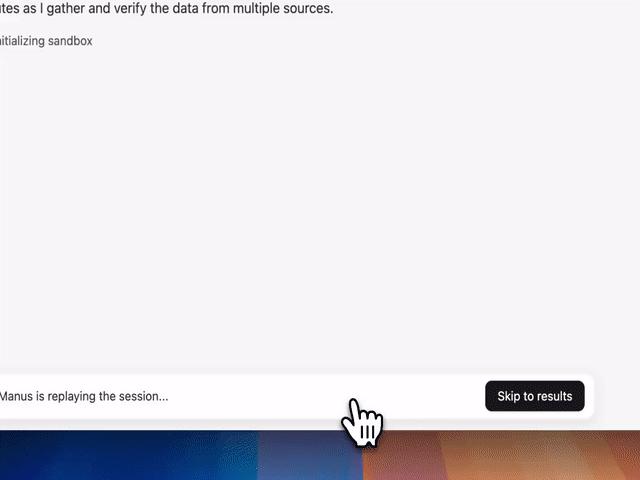
Manus Interface
To be frank, the product's own intelligent performance accounts for 80% of its success. But these two growth-oriented designs were extremely critical for our early viral growth — because you don't trust AI, but you watch it work step by step, and realize that AI is doing things the way a human would, then you will believe it.
The product went viral after release, besides the product itself, there was also that promotional video. I used to say that we spent zero money during our March launch period. Later I found that this statement was not accurate, so I will correct it today.
On February 28, the website was already done, Red looked at it and asked me: Tao, the website looks a bit plain, should we add a video? I called several video production agencies in Beijing, told them we would release on March 5, we only had 6 days left, and asked if they could make a launch video. I asked two or three agencies, all of them said no, their minimum construction period was two weeks. Pushed to the corner, I shot that video myself.
I used my own Sony A7C2, the lens I had was not good enough, so I borrowed the 50mm F1.2 GM lens from Dai Yusen. Peak acted as the talent, we finished shooting on March 1st at two spots with clean backgrounds in our shared coworking park; on the 2nd and 3rd, I edited the video myself with CapCut for two days.
CapCut is free, but exporting 4K videos requires payment — I spent 12 USD or 15 USD to buy a one-month CapCut membership, and canceled the subscription immediately after purchase.
That was the only money we spent during the entire launch period.
Later many companies