Anthropic was sued by a client before it even rang the listing bell, and the client claimed that "The 'Mythos' trademark is mine".
Last Thursday (November 19), Anthropic listed on the NASDAQ under the ticker symbol ANT. Its IPO price was set at $83, and its stock price shot straight to $111.50 at the opening bell. According to Reuters, this is "the world's first publicly listed cutting-edge AI company." As for the exact amount of funds raised, figures vary across sources: depending on whether only the base offering is counted, whether the over-allotment option is included, and whether the concurrent private placement is factored in, the total amount ranges from over 800 billion US dollars to more than 1.1 trillion US dollars. No matter which metric is adopted, it far exceeds the roughly $294 billion record set by Saudi Aramco in 2019, earning it the well-deserved title of the "largest IPO in history".
The listing was undeniably a huge spectacle. But six days before the bell-ringing ceremony, on November 13, an 11-page complaint was filed with the Alexandria Division of the United States District Court for the Eastern District of Virginia (Case No. 1:26-cv-03756).
The plaintiff, Global Printing, Inc., which does business under the name "Mythos" (dba Mythos), is a long-established printing plant founded in 1979 and based in Alexandria, Virginia. Its claim is straightforward: I have been using the name Mythos for 11 years, and Anthropic should stop using it, and disgorge all the profits it has earned from this unauthorized use.
What is even more interesting is that the plaintiff is also a user of Claude, and the complaint refers to Anthropic as its "partner".
I. How a Printing House and an AI Giant Ended Up Clashing Over the Same Name
Let's start with the plaintiff.
According to the complaint, Global Printing started as a commercial printing shop serving the Northern Virginia and Washington D.C. metro area, and gradually transformed its business later, helping clients turn complex operational data into easy-to-understand promotional materials. When it was producing printed materials for a university's development office, it found that donors wanted to see more than just financial statements — they also wanted to know exactly who their money had helped. So it paired handwritten testimonials from scholarship recipients with the university's financial data, which was very well received by donors.
The problem was that manually matching this information via Excel was far too slow. The company therefore built a dedicated system that directly linked beneficiary stories to fields in the university's database, putting donors, funds and related stories into a unified system.
In October 2015, this system was officially launched as a donor relationship software platform under the name Mythos. The complaint explains that Mythos is an Ancient Greek word meaning "a collection of stories that establish shared beliefs", which aligns perfectly with the shared beliefs that underpin public welfare donations. The name was clearly chosen with great care. At present, the platform serves non-profit organizations including universities and foundations across the United States and Canada.
In 2020, it obtained the trademark registration for "MYTHOS" from the U.S. Patent and Trademark Office (USPTO), with the registration number 6,140,016, registered on the Principal Register in Class 42, covering two SaaS services: one is software services for building searchable databases, collecting, managing and sharing user-generated content, and the other is software services for creating customized questionnaires and supporting content marketing. The complaint states that this registration has become an "incontestable" trademark under Section 15 of the Lanham Act, a point that will be referenced later.
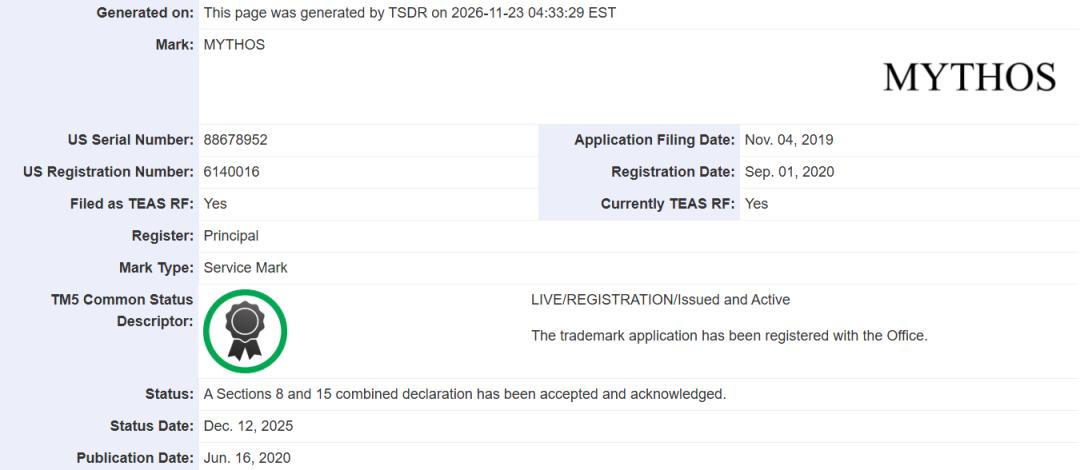
Partial information of the "MYTHOS" trademark applied for by Global Printing (Source: USPTO)
The plaintiff also adopted AI quite early. It built an MCP server and added an agent interface for the Mythos platform; it recently launched a built-in AI assistant named "Mai", short for "Mythos AI", which can draft questionnaires, summarize stories, build dedicated webpages for donors, and draft initial versions of donation proposals. It has also set three ground rules for its AI capabilities: AI only assists humans, not replaces them; models must be based on verified institutional data to reduce hallucinations; all operations must be subject to human supervision.
The underlying model powering these AI capabilities is provided by Anthropic. The complaint notes that the plaintiff selected Anthropic as its partner to provide agent workflows for its clients, and publicly promoted that its platform is powered by Claude, out of recognition for the ethical principles that Anthropic advocates. The complaint even specifically quotes a line from Claude's "Constitution".
Now let's turn to the defendant.
According to the complaint, in March 2026, a draft blog post from Anthropic was accidentally made public, revealing the model name Mythos ahead of schedule; on April 7, 2026, Anthropic officially gave a preview of the Mythos model; after several rounds of iterations, it released Mythos 5.2 on November 9. Anthropic's official website describes it as "our most capable model family for cybersecurity and biological research". According to public reports, Mythos 5.2 and the concurrently released Fable 5.2 share the same underlying model, with the difference that Mythos has fewer protective restrictions in the fields of cybersecurity and biology, and is only accessible to approved institutional users.
This creates a rather awkward situation: one Mythos is a donor relationship software platform that runs on Claude, while the Claude family also has a model named Mythos.
Users are left wondering: Which one is which exactly?
There is another coincidence. The complaint dedicates a special section titled "Cybersecurity and Trust": the plaintiff holds a large volume of sensitive donor data, and universities and medical non-profit organizations need to trust it to properly protect the data; it is applying for the ISO 42001 certification, the international standard for AI management systems, with the final audit scheduled for late November this year. Meanwhile, Anthropic's Mythos is specifically marketed for cybersecurity capabilities, including vulnerability hunting. One party is trying to prove to its clients that "I am very secure", while the other product with the exact same name is best known for its offensive and defensive cybersecurity capabilities. Though the plaintiff does not state this explicitly, the implication of including this part in the complaint is quite obvious.
II. What Cards Does the Plaintiff Hold
The complaint raises two causes of action: the first is registered trademark infringement under Section 32 of the Lanham Act (15 U.S.C. §1114(1)(a)), which is alleged to be "knowing and willful" infringement; the second is unfair competition under Section 43(a) (15 U.S.C. §1125(a)), which refers to false association. The disputed marks include the standalone "MYTHOS" and "CLAUDE MYTHOS".
The plaintiff's claims for relief are comprehensive: compensation for damages and disgorgement of all profits Anthropic obtained from the infringing activities; on the grounds of willful infringement, the plaintiff requests up to treble enhanced damages, as well as punitive damages "as the court deems appropriate"; reimbursement of attorney's fees and litigation costs; pre-judgment and post-judgment interest; and a permanent injunction barring Anthropic, its affiliates and subsidiaries from using MYTHOS or any confusingly similar mark. The complaint does not specify a monetary amount, and the plaintiff requests a jury trial. The plaintiff is represented by the law firm Squire Patton Boggs (US).
It is worth noting a professional detail here: Section 35 of the Lanham Act (§1117(a)) explicitly stipulates that the enhanced damages awarded by the court "shall be compensatory and not punitive in nature", so U.S. courts generally do not award punitive damages under federal trademark infringement claims. The reference to "punitive damages" in the complaint is a catch-all provision, and it remains uncertain whether the plaintiff will eventually obtain such damages.
The plaintiff's most powerful card actually comes from the USPTO.
On June 8, 2026, Anthropic filed two "CLAUDE MYTHOS" trademark applications in the United States, one in Class 9 and the other in Class 42. The Class 42 application falls exactly in the same category as the plaintiff's registered mark. On October 20, 2026, the USPTO examiner issued non-final office actions for both applications, citing the plaintiff's trademark No. 6,140,016 as a conflicting prior mark. The grounds for refusal, as quoted in the complaint, are as follows:
"Registration is refused under Section 2(d) of the Trademark Act, 15 U.S.C. §1052(d), because the marks are confusingly similar, the goods and services are related, and there is a likelihood of confusion as to the source of applicant's goods and services."
It should be noted that Anthropic applied for "CLAUDE MYTHOS", which already added its own well-known brand name "Claude" before the word Mythos, but the examiner still deemed that the mark would conflict with the prior registered mark.
The second card is "You definitely knew about it". The logic of the complaint is as follows: Anthropic is one of the largest AI companies in the world, with well-known law firms as its advisors. Its trademark attorneys would certainly conduct a trademark search before launching the new model, and would easily find the plaintiff's registered mark, whose listed services are very similar to the services Anthropic intends to provide. Therefore, Anthropic infringed the mark willfully and knowingly.
However, this point is stated as "informed and believes" in the complaint, which is an inference rather than concrete evidence. The plaintiff also leaves a fallback in the willful infringement section, stating that Anthropic had "actual or constructive knowledge". U.S. trademark law does stipulate that registration on the Principal Register itself constitutes constructive notice of the registrant's rights (§1072). But whether constructive knowledge is sufficient to establish "willful infringement" remains a subject of varying interpretations in U.S. judicial practice.
The third card is that "confusion has already occurred". The complaint uses very strong wording to make this point:
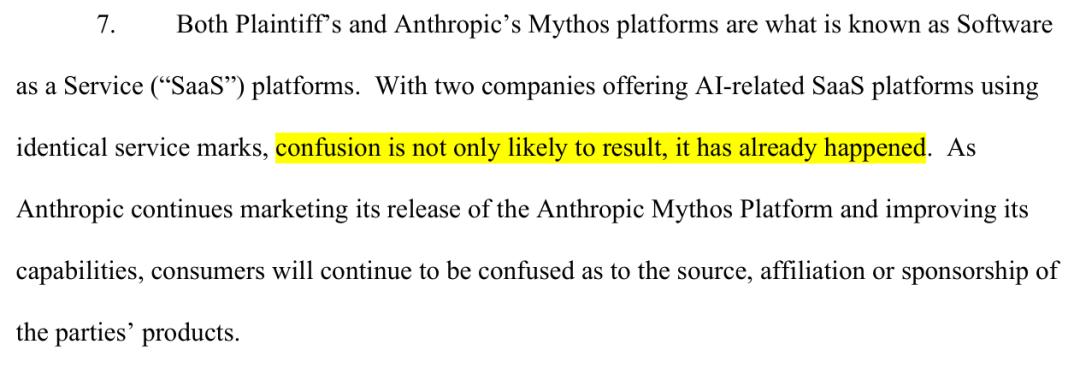
"confusion is not only likely to result, it has already happened."
However, reading through the full complaint, the plaintiff does not cite a single specific example of actual confusion. Whether this card can be played effectively later will depend on what evidence the plaintiff can produce during the discovery phase.
In addition, the plaintiff also claims that based on its long-term use of the mark, it enjoys trademark rights under state law and common law in most or even all regions of the United States, but the two causes of action raised in this lawsuit are both under federal law.
III. How Much Trouble Is This Lawsuit Bringing to Anthropic
It is important to note that a USPTO office action refusing registration is not the same as a court ruling finding trademark infringement.
A non-final office action is only the examiner's preliminary opinion. Anthropic can respond, argue its case, submit evidence, or negotiate a coexistence agreement with the prior rights holder. Even if the trademark application is ultimately refused, that does not legally mean that Anthropic cannot use the name. The right to use the name will be determined by the court.
So how will the court view this case? The core standard for determining trademark infringement in the U.S. is "likelihood of confusion". The Fourth Circuit Court of Appeals, which has jurisdiction over the Eastern District of Virginia, uses a multi-factor test that generally considers the following elements: the similarity of the marks, the proximity of the goods and services, the overlap of the business locations and sales channels, the similarity of advertising methods, whether the defendant acted willfully, the existence of actual confusion, and the level of care exercised by the relevant purchasers.
Factors favorable to the plaintiff: the two marks are identical word for word; both parties provide "AI-related SaaS services"; the plaintiff's registration has become incontestable, so Anthropic cannot challenge the validity of the registration on the grounds that "the term is merely descriptive and lacks distinctiveness"; the USPTO examiner has already determined that there is a likelihood of confusion between the two marks.
Factors favorable to Anthropic: the actual use scenarios of the two parties are very different — one helps universities write thank-you notes for donors and create questionnaires, while the other helps security teams find code vulnerabilities; Anthropic's Mythos almost always appears together with Claude, which is a very strong family brand; the high-end versions of Mythos are only accessible to vetted institutional users, and such purchasers usually exercise a very high level of care before making purchase decisions. Another point: "incontestable status" only blocks part of the challenges to the validity of the registration, it does not mean that the trademark is extremely strong, and the court will still assess the actual distinctiveness of the mark in the market.
There is also a special concept in U.S. trademark law worth mentioning: reverse confusion.
For readers who are not very familiar with trademark law, here is a quick explanation, and veteran readers can skip this paragraph. The common form of trademark infringement is when a small brand free-rides on a well-known brand, and consumers mistake counterfeit products for genuine branded products. Reverse confusion is the opposite: a large company uses a name that a small company has used first, and occupies the name through its huge market exposure, leading consumers to mistakenly believe that the small company is free-riding on the large company. A small company that has used its brand for ten years suddenly becomes overshadowed by a brand belonging to another company.
The complaint itself does not use the term "reverse confusion", and mainly focuses on arguing confusion as to source, association and sponsorship relationship. But judging from the facts of the case, a company with a market capitalization of trillions of dollars and a local printing house clashing over the same name, with the plaintiff being the defendant's user and having publicly promoted that its platform is "powered by Claude", this is a very typical reverse confusion scenario. It is worth paying attention to whether both parties will develop their arguments around this theory in subsequent proceedings.
Finally, there is a slightly ironic detail. On July 1 this year, Anthropic just sued the cybersecurity company Abnormal AI, on the grounds that the company's revised logo was too similar to Anthropic's, which would cause confusion among clients. At that time, Anthropic stated that litigation was the last resort to protect trademarks.
Back then, Anthropic was the prior rights holder, and now it is the one being sued as the defendant.
IV. Why Was the Lawsuit Filed Exactly Six Days Before the Listing
This timing is very suspicious.
The filing date is November 13, and Anthropic's listing date is November 19. The complaint specifically notes that Anthropic recently confirmed that it will conduct its IPO on November 19, with a fully diluted valuation of approximately 1.4 trillion US dollars.
In the "Risk Factors" section of the registration statement (prospectus) Anthropic submitted on November 10, it also mentioned similar risks: if the trademark challenge succeeds, the company may be forced to rename its models, platforms and applications, lose brand recognition, and spend money promoting the new name. Of course, this is a general risk disclosure, it does not name Mythos, nor does it estimate the cost of renaming.
For the plaintiff, filing the lawsuit during the window when the defendant cares most about public opinion and information disclosure naturally gives it much higher bargaining leverage. For Anthropic, Mythos has already been iterated to version 5.2, and has been used in enterprise security scenarios, the cost of renaming would be very high if it has to do so.
As of press time, no official response from Anthropic to this lawsuit has been seen in public reports.
V. Situation in China: "Claude Mythos" Has Passed Preliminary Examination, While the Standalone "Mythos" Has Received a Refusal
While the lawsuit is unfolding intensely in the U.S., Anthropic's trademark layout in China is also worth a look.
According to a search conducted by Zhichanli on the website of the China National Intellectual Property Administration (CNIPA) Trademark Office, Anthropic has also filed trademark applications for "Mythos", "Cla