In-depth Breakdown of a 10,000-Word Case Study: How to Nurture a Super Team That Achieves 3x Growth?

Content Source: "AI-Native Marketing" course from Peking University HSBC Business School, and the special topic course "My 1728 Days of Practicing AI in Enterprise" by Alfix (Quanxiu)
Speaker: Alfix (Quanxiu), former head of the Data Intelligence Department of a hundred-billion-level FMCG group, with 21 years of experience on both the client and vendor sides, author of *User Behavior Analysis* and *Digital Talents and Organization*; Professor Zhou Hongqi, Director of the AI-Native Marketing Program, has served as adjunct professor at NUS Business School and HKUST Business School, participating in content co-creation and polishing.
Note from Notesman:
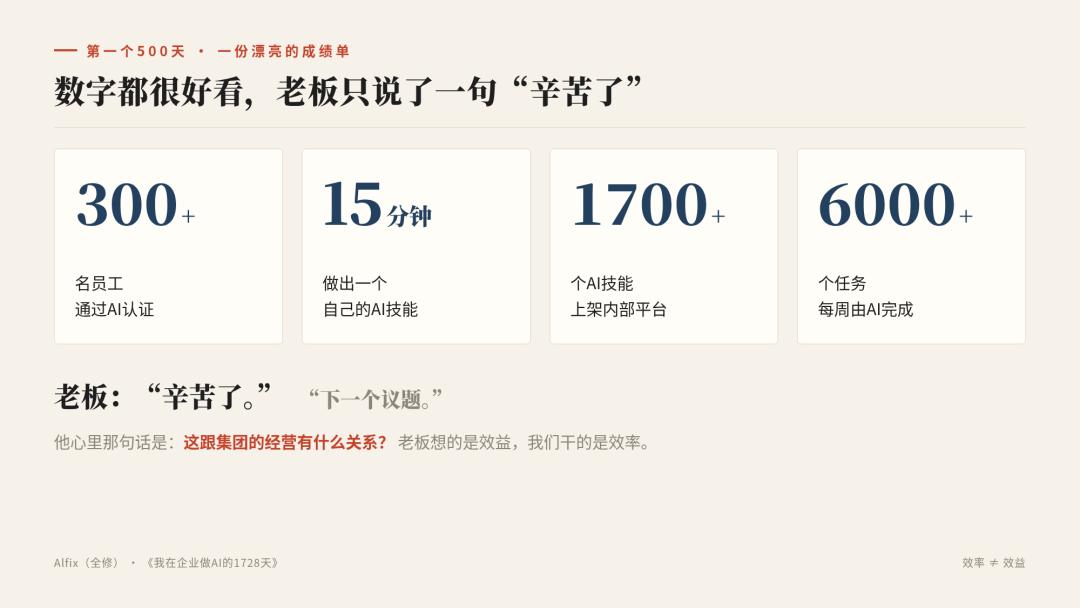
Alfix (Quanxiu) has been working on AI at a hundred-billion-level FMCG enterprise for more than four years, and he submitted an impressive report card to the board of directors: more than 300 employees passed AI certification, over 1700 AI skills were launched on the platform, and these skills help employees complete more than 6000 tasks every week.
After reviewing the report, the boss only said three words: "You've worked hard."
Then he added: "Next agenda item."
Over these more than 1700 days, he encountered more pitfalls than successful cases. The industry model he trained for four months was caught up by general large language models just one month after its launch; the pilot project performed perfectly, but it fell into deep trouble as soon as it was scaled up.
His final conclusion is: For AI transformation, the key word is transformation, not AI.
The following is his sharing, hoping it will be helpful to you.
I. The First 500 Days: What to Build and How Much to Invest
1. Why the Boss Feels No Sense of Recognition
Let's start with that report first.
The figures we presented at that time are still decent in hindsight: more than 300 certified employees can create their own AI skill in 15 minutes, there are more than 1700 skills on the platform, and over 6000 tasks are run weekly.
The boss was very polite, said we had worked hard, and moved on to the next agenda.
I later figured out what he actually thought: What does this have to do with the whole group?
Is 300 people a large or small number? Our company has more than 40,000 employees. You can create a skill in 15 minutes, then what? Which line on the income statement has changed? He couldn't tell, and neither could I.
What the boss cares about is business benefits, while what we are doing is improving efficiency.
Today, when the IT department of many enterprises reports AI progress to their bosses, the chart they present is most likely just like this.
2. Three Paths, the Upper Right Corner Costs the Most
So where should enterprises spend their money on AI?
I drew a matrix. The horizontal axis from left to right ranges from "general skills" to "industry-exclusive skills"; the vertical axis from bottom to top covers cost reduction, efficiency improvement, and business model transformation.
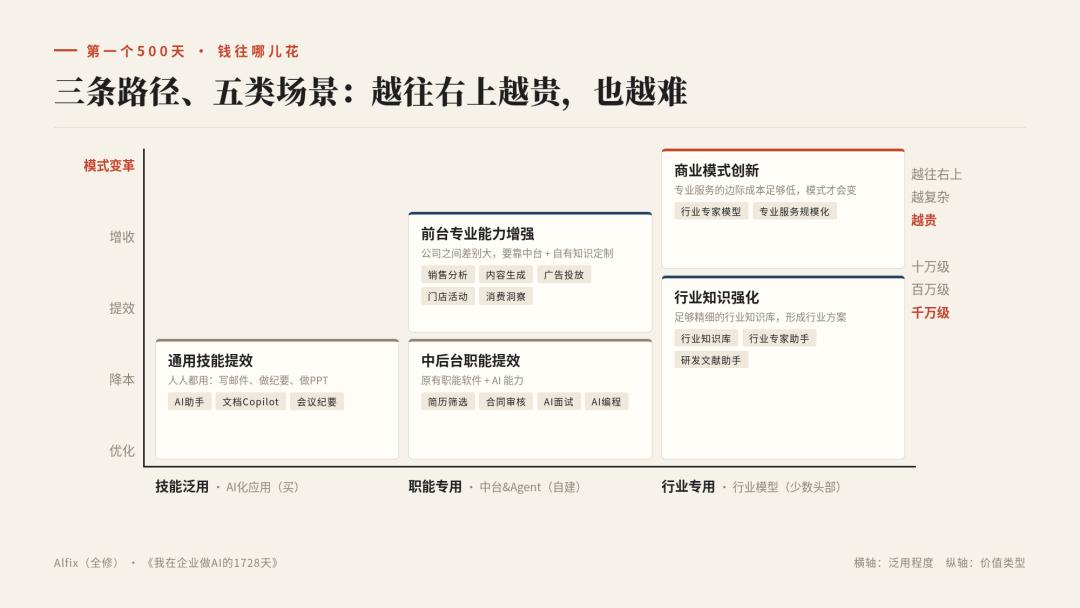
The bottom left area covers scenarios like writing emails, drafting meeting minutes, and making PPTs, which are usable for everyone. You don't need to develop these by yourself, just purchase them. DingTalk, Feishu, and WPS already have built-in AI features now.
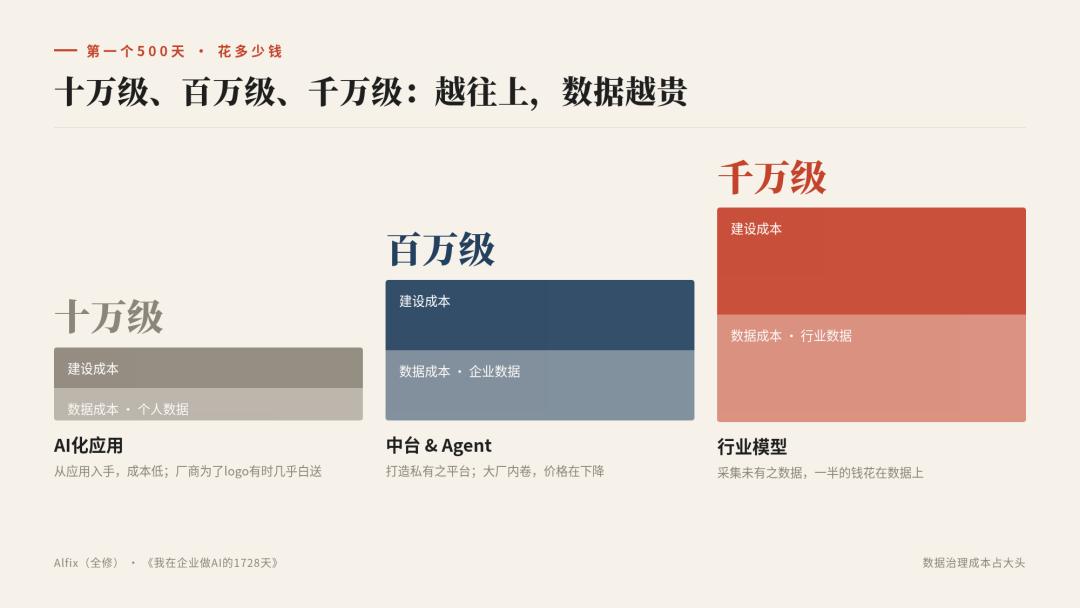
This part does not cost much, at the 100,000-yuan level. One application costs 50,000 or 100,000 yuan, and sometimes vendors almost give it away for free just to get your logo as a reference case.
But it has a problem: the boss cannot feel tangible value.
Worse still, you claim you are improving efficiency, but all employees know what the next step of efficiency improvement is. In addition, these tools are only at the 70-80 point level of a senior employee, so employees always complain that "it is not easy to use". "It can't even solve my daughter's primary school Olympiad math problems." Once such remarks spread, it becomes very difficult to promote the tools.
The middle belt covers exclusive methodologies for your industry and your company, such as the core capabilities of the marketing department and channel department. You cannot buy these on the market. If someone can really help a company increase revenue, the first thing he will do is sell this set of capabilities to your competitors.
So you can only develop this part by yourself, and you need a middle platform that can continuously create Agents. We called it "Enterprise Brain" and "Knowledge Bank" at that time, which is essentially a machine that makes machines. This part costs at the million-yuan level.
The top right corner is the industry-specific model, which is used to transform the business model. This is the shared hope of the whole team, and also the most expensive, starting at the 10-million-yuan level.
3. Peak Performance Right After Launch
Guess which part we worked on?
We worked on all of them, and the first step we took stepped right into the most expensive area.
We wanted to shift from selling products to selling professional services, which was our strategy. There was a huge gap of professional consultants in this field in China, so we wondered if we could train an industry-exclusive AI consultant, so that every family could have a 24/7 online professional consultant.
We imported all the industry professional knowledge we could find, trained for four months, and let the model take 17 relevant professional qualification exams at home and abroad.
It passed all of them, with high scores.
We also got the first filed ToC application in this field in China, released it at the industry conference, and the launch event was very lively.
One month later, GPT-4o was released.
Without any targeted training, it passed all the 17 exams.
Our engineer was completely devastated on the spot. Later he told me that it was the first time he experienced what it felt like to be completely overwhelmed.
Once the base model is upgraded and the water level rises, your four months of efforts are completely submerged.
This kind of thing happens every day now. All companies developing AI applications are worried about being submerged by the next upgrade of large models.
Looking back for review, the so-called "exclusive" industry knowledge we had is actually also accessible to large models. Should enterprises train industry-specific models? My current view is: unless you have data that large model companies cannot get, the cost-benefit ratio is not worthwhile. Industry-specific models are built for transformation, not for simple efficiency improvement.

There is one more thing I want to emphasize.
Later, this AI consultant was connected to more than 100 mini-programs and served millions of families. But up to now, you still don't think this FMCG company has become a professional service company, right?
Having tools does not mean that the business model has been transformed.
4. Those "Uncollected Data" Are the Real Barrier
So what counts as real industry data?
Let me tell you a joke.
We have a high-end product, the regular version sells for 3 yuan, but this one sells for more than 9 yuan. The brand department wrote a complete set of sales scripts: where the raw materials come from, what the content is, and which popular variety show it has appeared in.
Later, we gave shopping guides smart work badges that can record audio, to listen to how they actually sell products.
We were shocked after listening. They did not use a single sentence of the scripts we wrote.
The shopping guide sold it like this: "You think it's expensive? Touch this box, feel the texture." Then she poured a little product on the ground, "Look, it can still gather together after falling, others will scatter as soon as they fall."
I still don't fully understand why our product can gather together after being poured on the ground. Maybe it's because it's relatively thick.
But the product was sold out in this way.
Bosses have no idea that this product is sold in this way.
This is "collecting uncollected data". The sales scripts of top shopping guides and the real methods of handling customer complaints are not recorded in any documents, nor stored in large models, they happen on site.
But this is not cheap. Audio recording requires equipment, analysis requires computing power. I can't train a model just based on a single joke, I need thousands of such scenarios. Moreover, when we first used work badges to monitor the speaking rate of shopping guides, they were very resistant.
This is also why half of the cost of the industry-specific model is spent on data.
5. Four Accounts for Enterprises to Develop AI
Speaking of cost, I suggest enterprises calculate four accounts.
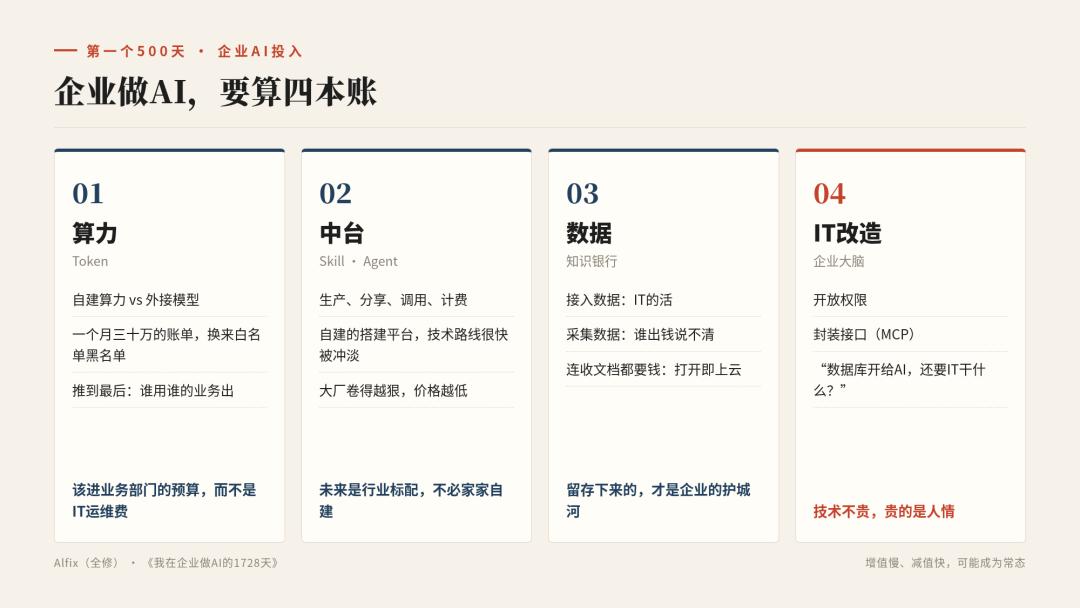
The first account: computing power.
We were among the first batch of enterprises in China to access large models. At the beginning, the IT department used the best model for free access.
Until one day, the bill came out, it was about 300,000 yuan per month.
Guess what happened next? Whitelist, blacklist. Who can use it, who can't, who can use the premium model, who has to downgrade. In the end, only the most core IT personnel can use the best model.
I asked the IT team why, they said that the annual budget is fixed, and OPEX (operating expenditure) has to be reduced every year.
At that time, we consumed tens of billions of tokens per month, which we thought was an astronomical number, so we wanted to negotiate a price with big tech companies. The staff there was very polite: "Brother, your usage is not even in our top ranking."
Even if the amount is not huge, who should pay for this money?
I asked this question in class, some said the IT department should pay, some said users should pay, some said the marketing department should pay because they have sufficient budget.
I deduced it myself: the department that should pay the most is human resources. Because this cost should be compared with the total salary expenditure. For an enterprise with tens of thousands of employees, the annual salary expenditure is billions of yuan, while the annual computing power cost is only several million yuan, which is a drop in the bucket.
But the human resources department does not have this budget either, it can only take money from the "carbon-based employees". If you try to cut a headcount to allocate this budget, you will encounter huge resistance. After much consideration, it seems that the marketing department is the most realistic payer, after all, the marketing department is always trying to spend their budget every year.
In short, my final conclusion is: Computing power cost should not be included in the IT operation and maintenance fee that gets cut every year, it should be included in the budget of business departments.
The second account: middle platform.
We developed our own building platform by referring to foreign products like Dify and n8n, similar to Coze. When we released it, similar domestic products had not been launched yet, and we were very proud.
After a while, everyone found that large models are getting more and more powerful, many things no longer need to be built through drag-and-drop operations, and this technical route was gradually diluted. Coze was shut down a few days ago, and the popular AI middle platforms now are various buddy-type products.
So my current judgment is: the middle platform will become the industry standard in the future, and it is not necessary for every enterprise to build it by itself. The more fiercely big manufacturers compete, the lower the price will be. Those who wait for the market to mature are sometimes right.
The third account: data.
Data access is usually paid by the IT department, which is the responsibility of the IT team.
But data collection is hard to define. If a camera is installed in a store, should the cost be paid by the infrastructure department that opens the store, or the store operation department? Someone has to pay for it.
Even for a trivial matter like "collecting all documents from employees' computers", we spent millions of yuan on cloud office software, which automatically uploads local documents to the cloud every time an employee opens it. Only then did we collect all scattered documents, employees did not feel any disturbance, but there is a huge cost behind this.
The fourth account: IT transformation.
To make AI really work, it needs to be able to access all systems of your company. There are two things to do: open permissions and encapsulate interfaces (MCP).
Technically, it is not expensive, one or two experienced engineers plus AI can finish it quickly.
The expensive part is human relationship cost.
Once a business colleague developed an Agent, and wanted the IT team to directly open the order system database for AI query. The IT team held meetings for a whole week, and the conclusion was: cannot open.