Looking at Next-Generation Payments from SFF: Beyond Technology, Trust Is the Core Variable
Author | Wang Hanyu
Editor | Zhang Fan
When artificial intelligence evolves from an auxiliary tool to a tool that can generate instructions and initiate procurement on its own, the causal chain of commercial transactions is being rewritten.
According to institutional forecasts, by 2030, agents are expected to participate in global consumer and commercial activities worth 3 to 5 trillion US dollars. However, as technology advances, trust shortcomings such as identity verification, authorization boundaries, and dispute responsibility determination have become practical obstacles hindering the large-scale development of the industry.
As the vane of Asia-Pacific fintech, the annual Singapore FinTech Festival (SFF for short) is an important window to observe the cutting-edge of the industry. At this year's SFF, agent commerce is no longer just a topic for conceptual discussion, but has collectively stepped out of the demonstration sandbox and penetrated into real transaction scenarios for consumers and enterprises.
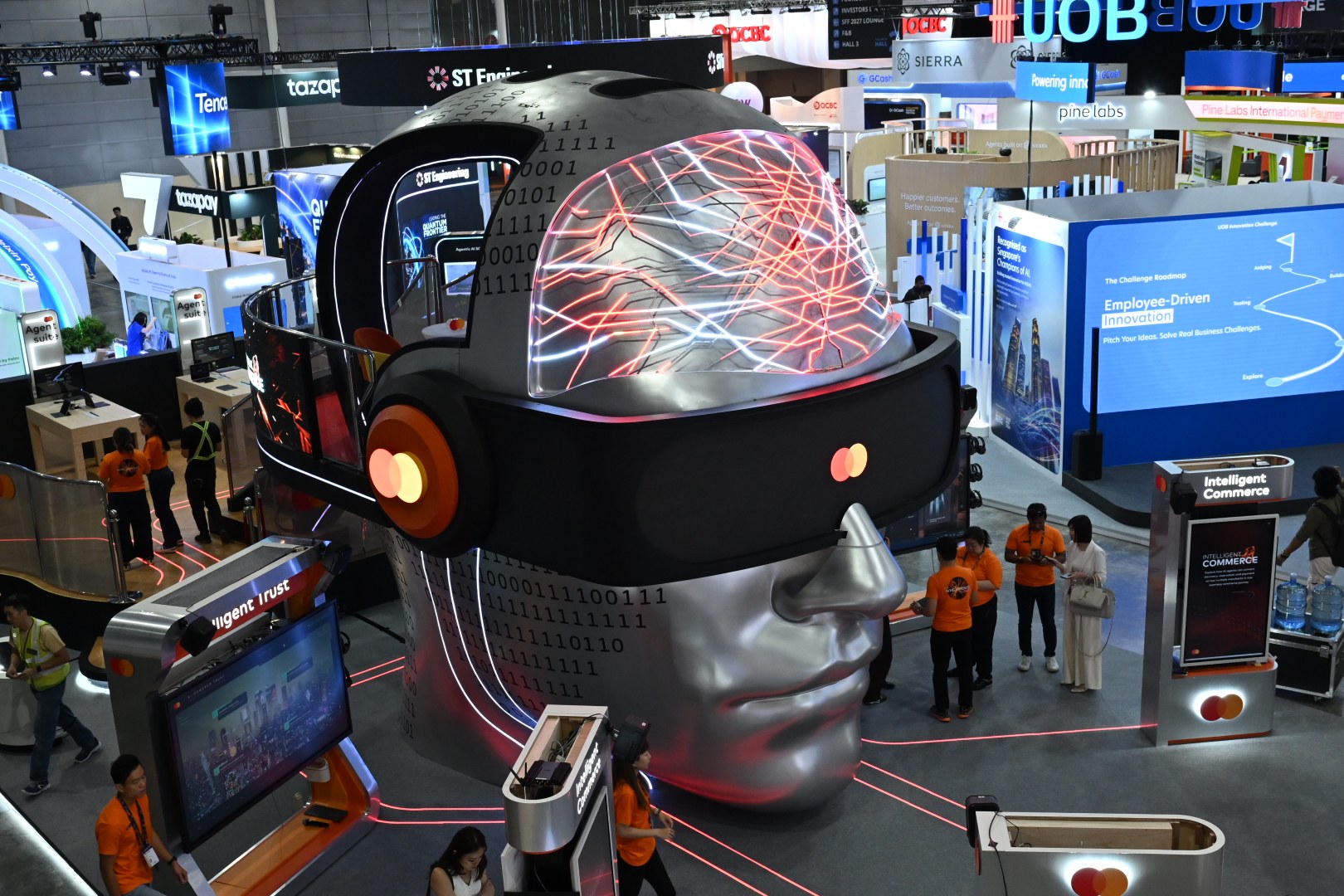
Mastercard booth at this year's SFF
At the same time, inclusive digital payment collection solutions for micro and small business operators and cross-market collaborative technology R&D models have also become the focus of industry discussions. With the accelerated implementation of agent commerce, the entire payment industry is rethinking: what kind of underlying capabilities the industry needs to build to meet the needs of next-generation commerce.
Agent Transactions: The Bottleneck Lies Not in Technology, But in Trust
At this year's SFF conference, agent commerce is the core topic running through the whole event.
The experience scenarios built at multiple booths intuitively demonstrate how AI, data, identity and payment jointly drive the intelligent economy, including interactive contents such as agent payment solutions, AI-driven threat detection, and enterprise-level agent prototypes.
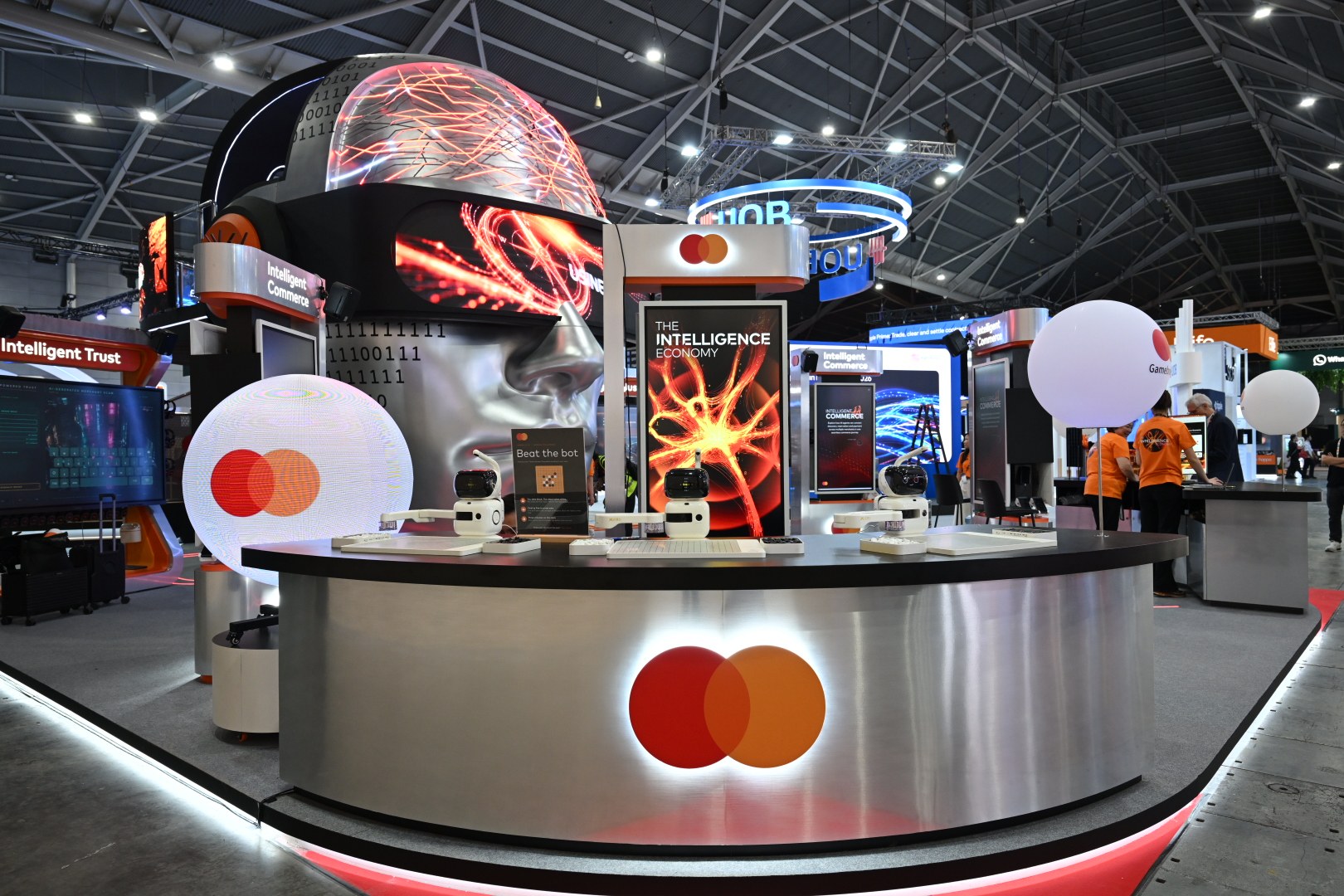
Mastercard booth showcases technological advances in transactions, commerce, trust and other fields
What is more valuable for reference than conceptual demonstrations is the real transaction pilots that have been completed and disclosed on site.
During this year's SFF, for example, Mastercard announced two milestones of its cooperation with Ant International: first, a real consumer-side transaction was completed relying on the Antom platform, verifying that the agent can place orders in accordance with verified user instructions; second, the Mastercard Agent Pay for Machines (AP4M) pilot was completed in Singapore, realizing the control and authorization of enterprises over agent procurement behaviors.
The biggest difference between agent transactions and traditional online shopping is that the user's intention issuance is separated from the actual payment behavior. This will lead to a series of practical problems: How to confirm that the agent has indeed obtained user authorization? How to divide responsibilities after AI hallucinations and unauthorized procurement? How can merchants distinguish legitimate agents from malicious behaviors?
In the consumer-side pilot, the entire transaction relies on Mastercard's "Verifiable Intent" mechanism to generate auditable evidence records of the requirements, budget and constraints given by consumers to the agent. The enterprise-oriented AP4M solution allows enterprises to set identity credentials for agents, define procurement categories and consumption limits, enforce rule checks at the payment link, and trace every procurement initiated by machines.
"Agents already have the ability to complete payments, but the bigger challenge is to build sufficient trust so that consumers, enterprises and merchants dare to embrace this technology," said Bo Qiaochu, Executive Vice President of Core Payments, Asia Pacific at Mastercard. This cooperation implements security guarantees on both the C-end and B-end, with the core of returning control to users and promoting agent commerce to break out of the conceptual stage.
Matthew Driver, Executive Vice President of Services, Asia Pacific at Mastercard, expressed a more pragmatic judgment in exchanges with media including 36Kr: The expansion speed of agent commerce will always be limited by the progress of trust building.
At present, many users are willing to let AI do search and price comparison, but only a few of them really grant permissions to AI to place orders independently. The industry is exploring the "Know Your Agent (KYA)" evaluation mechanism to register agents and continuously monitor their behaviors, so as to distinguish trusted agents from malicious bots. Only when the framework for dispute recourse and rights and responsibility definition is completed can the industry have the foundation for large-scale development.
New Paradigm of Payment Collection for Micro and Small Merchants
If agent commerce represents the future business form, then the payment collection demand of micro and small individual operators is a realistic proposition that urgently needs to be met in the Asia-Pacific market. A large number of street vendors, individual operators, side-business practitioners and others do not have the motivation and cost to purchase traditional POS terminals, but they also need low-cost, easy-to-use digital payment collection tools.
Mastercard Accept, which made its debut at this year's SFF, is precisely targeting this group that has been ignored by traditional payment collection solutions. This solution allows debit card and prepaid card holders to collect payments directly through existing bank or payment apps, using only a mobile phone throughout the process without additional terminal equipment. Consumers can complete payment by tapping a contactless bank card, using a digital wallet, or scanning a QR code to jump to the payment link, and the received funds will enter the bound account almost in real time.
At the SFF site, Mastercard and Philippines' Maya completed the public demonstration of this solution. According to the disclosed implementation plan, after the regulatory approval is completed, the product will be successively launched in markets such as Sri Lanka and Cambodia.
Combined with the development process of a micro and small merchant, this solution can meet the scenario of sporadic orders from side businesses. When the transaction scale continues to grow, the accumulated transaction data can also help financial institutions tap demands and launch more services for merchants and banks.
It is understood that the solution may initially cover key markets in Asia Pacific, Latin America, the Middle East and Africa, and then gradually be promoted globally.
The Other Side of Payment Giants: More Than a Card Organization
The payment industry naturally operates in a cross-regional unified large market, and there is no isolated single market. Although the regulatory rules, user habits and infrastructure in different countries and regions vary greatly, the transaction demand for interconnection between merchants and consumers is common. Relying only on the card clearing network can hardly cover all the demands of the industry in the future. Outputting security capabilities, AI frameworks and risk control solutions adapted to multiple markets is becoming a new competitiveness for payment institutions.
Shortly before the opening of this year's SFF, Mastercard's largest Asia Pacific Excellence Innovation Center in Singapore was put into use. According to on-site information, the center currently has more than 55 resident experts, and plans to add more than 250 professional positions in Singapore by the end of 2029, focusing on R&D related to responsible AI, cybersecurity and trusted digital commerce.

Immersive demonstration area of Mastercard Excellence Innovation Center
Richard Wormald, President of Mastercard Asia Pacific, said: "The Asia Pacific economy is accelerating towards a smarter and more interconnected future. The real opportunity in this process lies in enabling new technologies to be transformed into real value safely and on a large scale."
Taking the Chinese market as an example, in the two years since Mastercard's licensed entity in China, Mastercard NetsUnion, started operations, it has jointly issued and upgraded more than 300 new "China Mastercard" cards with partners, which are applicable both domestically and internationally, and for online and offline scenarios.
Also based on the above business practices, the public's inherent impression of card organizations mostly stays in card issuance and switching and clearing. Now this Excellence Innovation Center shows Mastercard's other identity as a payment giant: linking financial institutions, merchants, governments and technology partners to carry out joint co-creation for the payment ecosystem.
Mastercard Excellence Innovation Center is equipped with four functional modules: AI Center of Excellence, Converged Security Center, Mastercard Experience Center, and Maker Space, covering the whole chain of rapid prototype development, emerging risk research and judgment, and immersive technology demonstration for partners.

Maker Space of Mastercard Excellence Innovation Center
This highlights that the value boundary of modern card organizations has long been broadened. In addition to handling capital flow, they also need to take on the roles of technology testing, risk governance and cross-ecosystem collaboration, to open up the underlying technical base for cross-market transactions.
The End Point of Innovation Is to Solve Trust Problems in the Real World
Sorting out a series of industrial signals released by SFF, we can see two clear and parallel development paths: one side bets on the next-generation business form, builds a complete set of infrastructure around agent commerce, not just acting as a payment channel, but completing a full set of trust tools including identity, authorization, evidence storage and audit; the other side returns to the current inclusive demand, targeting micro and small individuals to solve the transaction pain points in actual operation.
However, judging from the implementation results, the entire industry is still in the early stage of exploration. Matthew Driver mentioned that the vast majority of current applications are still in the stage of "AI assisting humans", rather than fully letting AI complete transactions independently. Consumers are generally cautious about delegating large-value and high-risk decisions entirely to agents.
Therefore, the market will not enter the era of fully autonomous agent transactions overnight. For a long period of time, multiple modes such as "AI search + manual confirmation" and "limited authorization execution" will coexist. In addition, due to the huge differences in regulation, user habits and infrastructure in many regions around the world, there is no one-size-fits-all solution that can be directly copied to all markets. Payment giants must cooperate with local banks, technology platforms and regulators to polish the solutions.
Technical demonstrations always look glamorous, but industrial implementation is full of trivial and practical problems. The competition in the intelligent economy era is no longer about competing for who has a cooler demo, but about who can transform the innovations on the booth into services that small and medium-sized merchants dare to use and are guaranteed in case of problems. This is also a common exam question for all participants in the payment industry.

Follow us for more information