Unveiling the truth behind Anthropic's "exorbitant profits": Cache Tax
In the past two days, the AI developer community has been completely rocked by a seemingly surreal post.
The post was published by Vlad Mihalcea, a legendary figure in the Java ecosystem and Java Champion awardee.
Staring at his Claude bill for the past year, he raised a thought-provoking question: "I have no idea what Anthropic's business model is even supposed to be. I only spent $200 on my Pro plan for the whole year, yet I ended up consuming 16 billion Tokens — if billed at the API pay-as-you-go rate, this sum would add up to a staggering $100,000!"
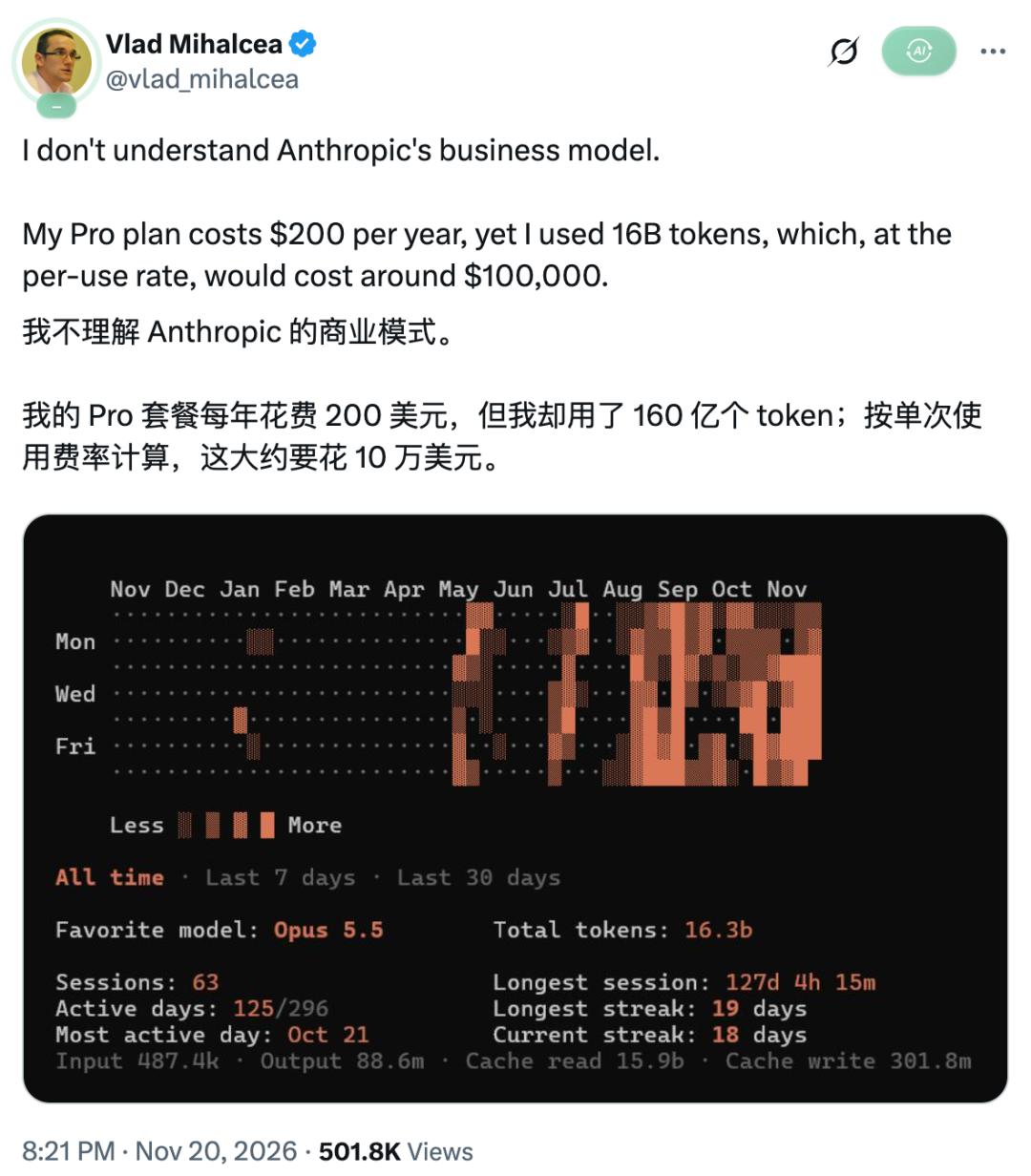
Selling you something worth $100,000 for only $200? This is no ordinary tech company, it is clearly a living saint in Silicon Valley burning investors' money to do charity.
If you think this is just an extreme individual case of a "grind master" programmer, a set of newly released real-world test data will only make you even more confused.
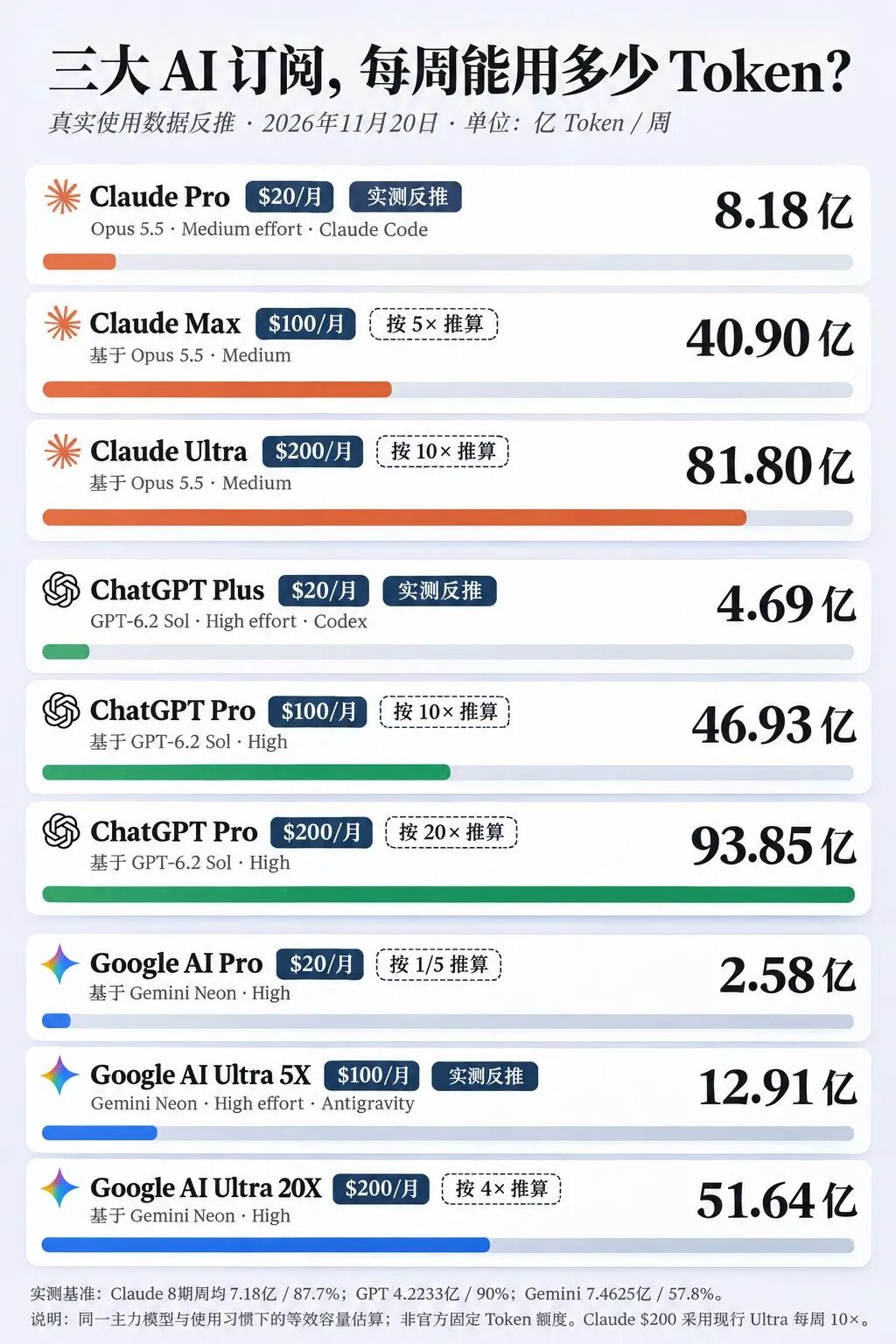
On November 20, 2026, hardcore players used real usage data to back-calculate the equivalent weekly quota of the three major AI subscription services:
The $20 per month Claude Pro plan (running Opus 5.5 + Claude Code) can consume about 818 million Tokens per week; if you upgrade to the $200 per month Claude Ultra or ChatGPT Pro, the weekly Token consumption will directly surge to 8.18 billion and 9.385 billion, and even the relatively restrained Google AI Ultra 20X can reach 5.164 billion.
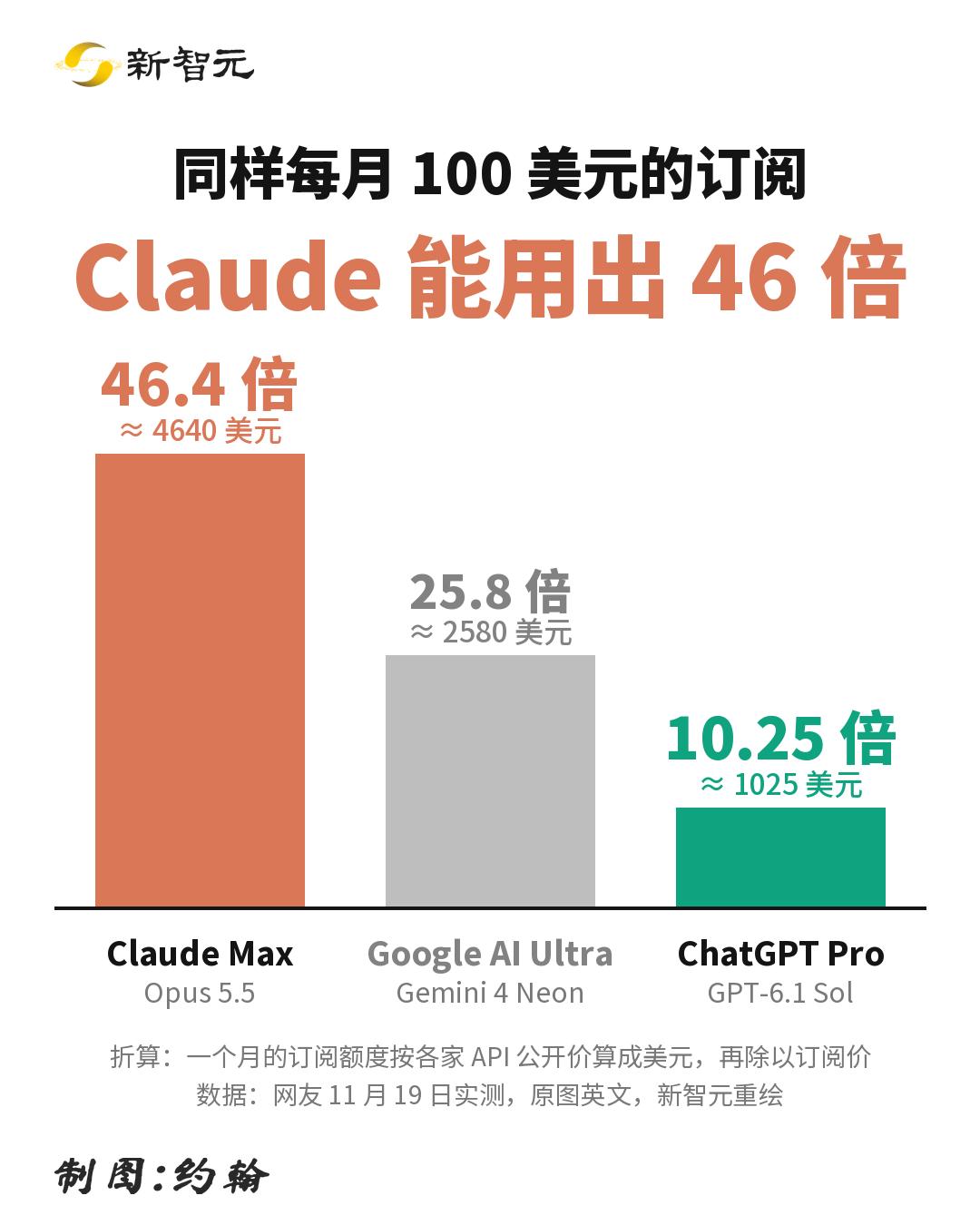
Semiconductor analysis firm SemiAnalysis even calculated the total account: spending $200 per month on the top-tier Claude subscription can get up to $8,000 worth of equivalent API usage per month, while OpenAI's figure is as high as $14,000 per month — on paper, the manufacturers have subsidized a full 40 to 70 times the cost.
Seeing this, many onlookers have already started to sweat for Anthropic: how can this business continue? Are they going to run out of computing power and delist from the market tomorrow?
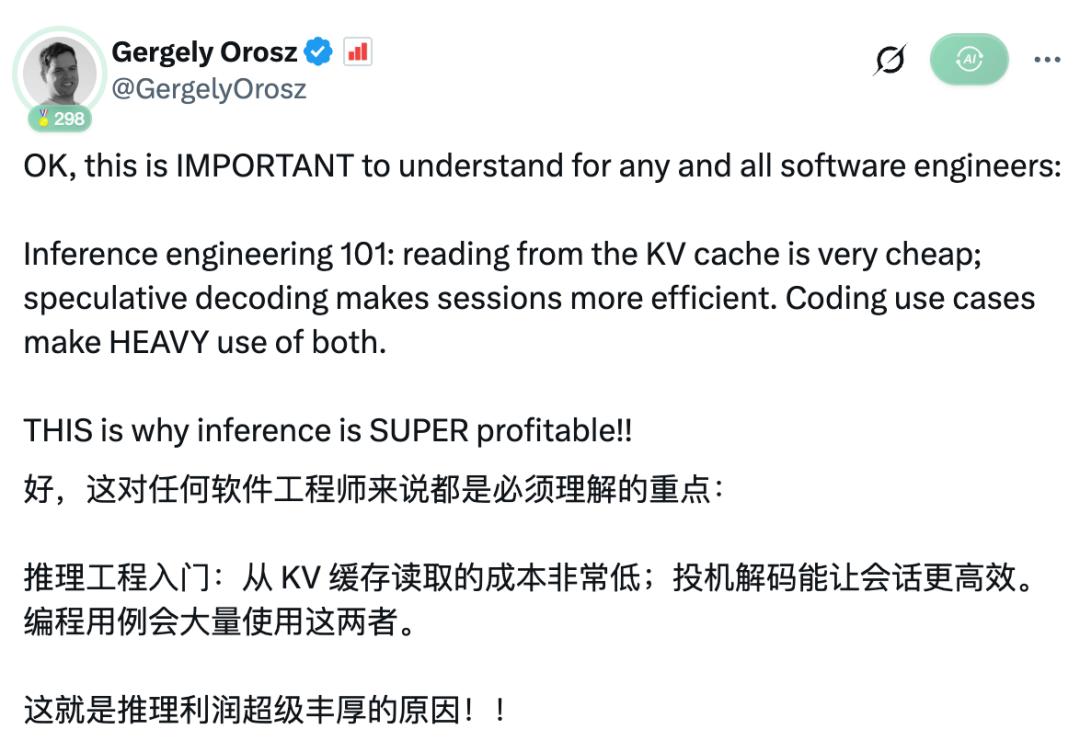
While everyone was discussing, Gergely Orosz, founder of the well-known tech newsletter *The Pragmatic Engineer*, came out to clarify the confusion:
"Every software engineer must understand one thing: the first lesson of inference engineering is that reading KV cache is so cheap it is almost free, and speculative decoding has made the efficiency of long sessions skyrocket. Programming scenarios take full advantage of both technologies to the maximum. This is why AI inference is actually super profitable!"
Wow, it turns out we thought we were frantically "getting a good deal", but in fact the company behind the scenes is making money hand over fist.
How exactly is this account calculated? Today we will fully uncover the profit logic behind Anthropic's business model.
The 16 Billion Token Illusion: Coding Agent Is a "Heavy-duty Repeater"
To solve this case, we must first figure out one question: are the 16 billion Tokens that Vlad burned all "original content" that Claude racked its brains to generate word by word?
Absolutely not.
In the early era of chatbots, you ask a question and the AI gives an answer, and Token consumption grows linearly. But now we are in the era of Coding Agent, and all the rules of the game have completely changed.
The essence of a coding agent working is a "repeater" running in a crazy infinite loop:
It first reads through the entire context of your code base (assuming there are N Tokens), thinks for a second, decides to call a tool to search for files; the tool returns a few lines of results, it appends the new results to the end, then re-reads all the previous context from beginning to end; then calls the next tool to run unit tests, returns an error report, and re-reads everything from scratch again.
If a task calls T tools, the total number of input Tokens the model needs to read will surge to the order of N×T. The longer the session and the more frequently tools are called, the total number of Tokens will explode at a quadratic rate.
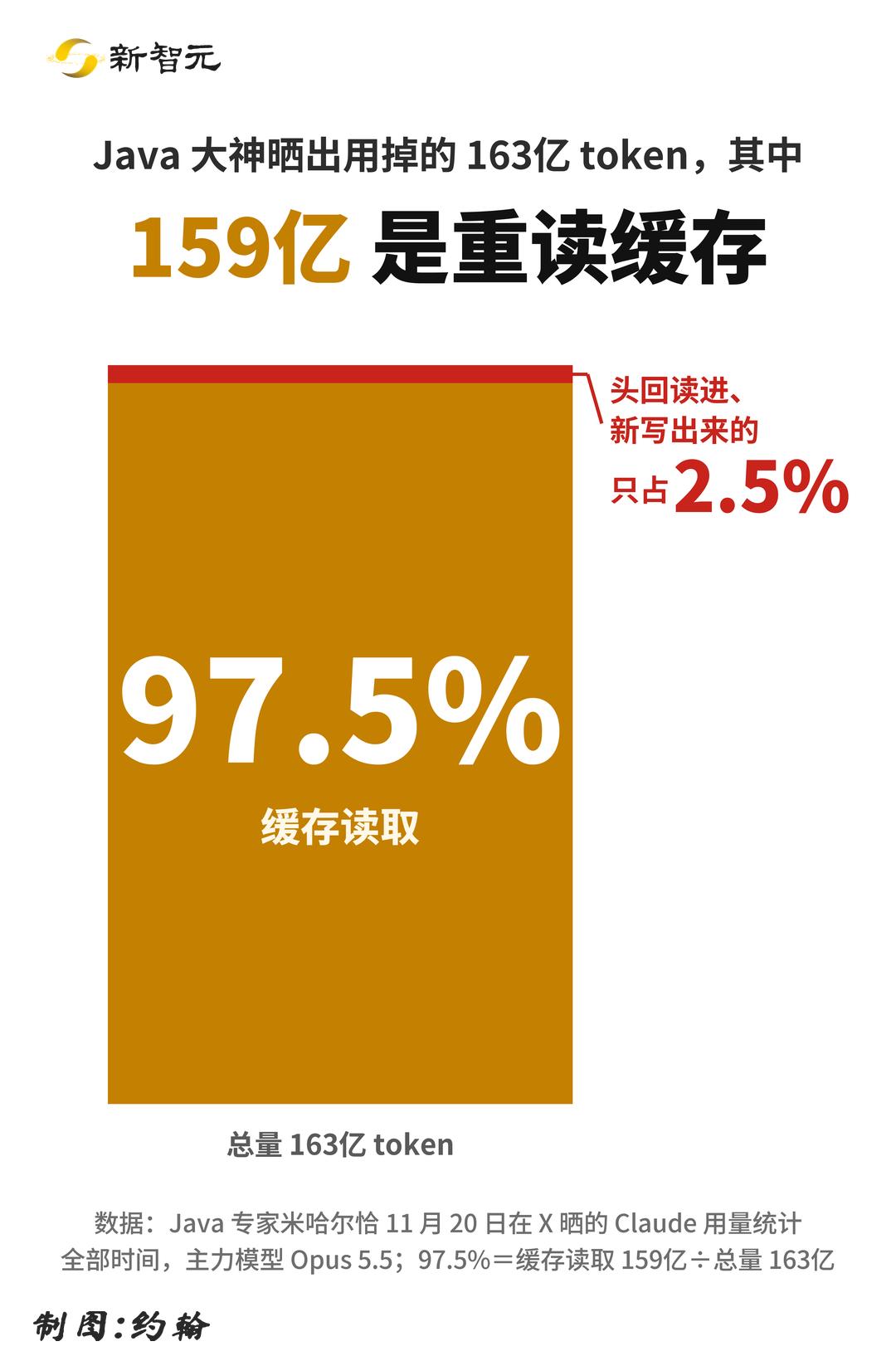
Many developers have always thought that the most expensive part of the bill is the high-priced "Output Tokens".
Diogo Almieda, co-founder and CEO of Typesafe, specifically wrote a simulator to replay the real programming traces of Nvidia Open-SWE-Traces using Fable 5 pricing, and the results show: The output Tokens actually used to generate code and replies only account for 9% to 18% of the total bill!
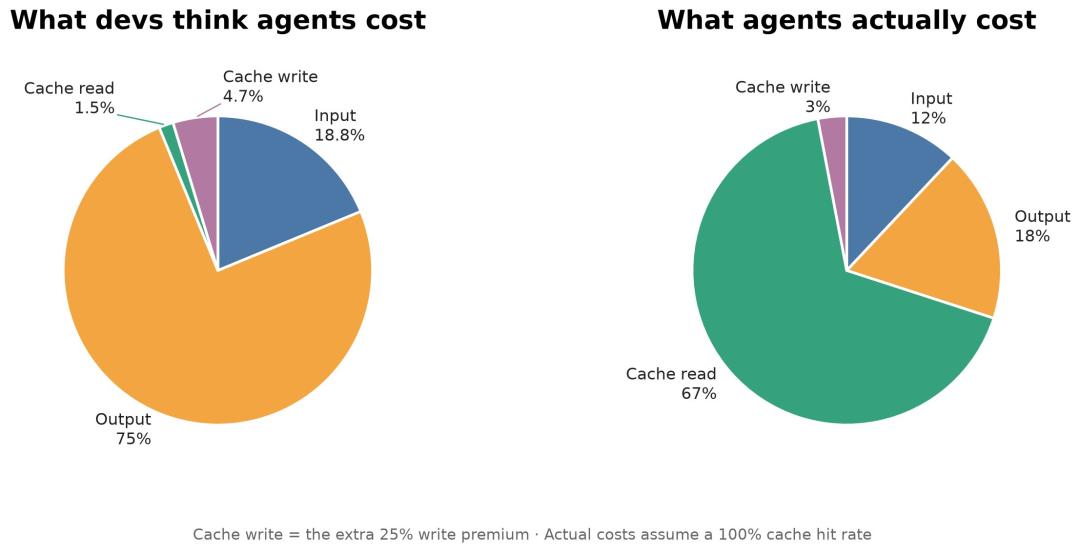
Another developer Martin Alderson simulated an Opus 5 session with 60,000 Token context and 100 rounds of dialogue, and the results show that about 76% of the total bill is spent entirely on "Cache Reads".
In other words, in real coding Agent scenarios, more than 90% of Token consumption is actually the model repeatedly reading the historical records it just viewed a few seconds ago.
At this point you may ask: even if it is "re-reading" repeatedly, that is still 16 billion Tokens read, doesn't the GPU consume power? How can this make Anthropic make huge profits?
This brings us to the first real hidden card.
Hidden Card 1: KV Cache, the "Zero Marginal Cost Money Printer" for AI Manufacturers
Don't be intimidated by terms like "KV Cache". To understand the physical cost of large model inference, you only need to remember three things:
Step 1: Prefill — consumes a lot of computing power. When the model reads your code base for the first time, the GPU must run at full capacity to perform a large number of matrix operations, convert these texts into intermediate states (activation values) that the machine can understand, and then store them in the video memory. The stored "reading notes" are exactly KV Cache. Once the cache is written, when you read the same content next time, there is no need to recalculate at all.
Step 2: Decode — consumes video memory bandwidth. When the model starts to output tokens (generate output Tokens), for every token it outputs, it has to move the entire KV Cache out of the High Bandwidth Memory (HBM) to read. This step has very small calculation amount, but huge data movement amount. This is why the unit price of output Tokens for each API is usually 5 times more expensive than input Tokens — The video memory bandwidth in the decoding stage is the real physical bottleneck of large model inference.
Step 3: Tool call — just presses the "pause button". When the Coding Agent stops to run grep or execute a script, the entire pre-calculated KV Cache is actually lying quietly in the memory. Letting a bunch of bytes stay in the memory for a few seconds consumes neither computing power nor video memory bandwidth.
Now, the most absurd and most profitable scene appears.
When the model generates output continuously, it has to read the entire KV Cache every time it generates a token, and the manufacturer does not charge you extra "cache reading fee", because this cost is already included in the expensive output unit price.
But once the Agent stops to call a tool and continues, the API immediately puts on a stern face, and charges you a "cache reading fee" again based on the number of Tokens, for the exact same KV Cache that has not moved at all in the memory and has almost zero calculation cost.
Diogo Almieda summed this up very sharply: The reason why you have to pay for KV cache after tool calls has no profound technical difficulties, it is purely because — "the manufacturer sets the price this way, take it or leave it."
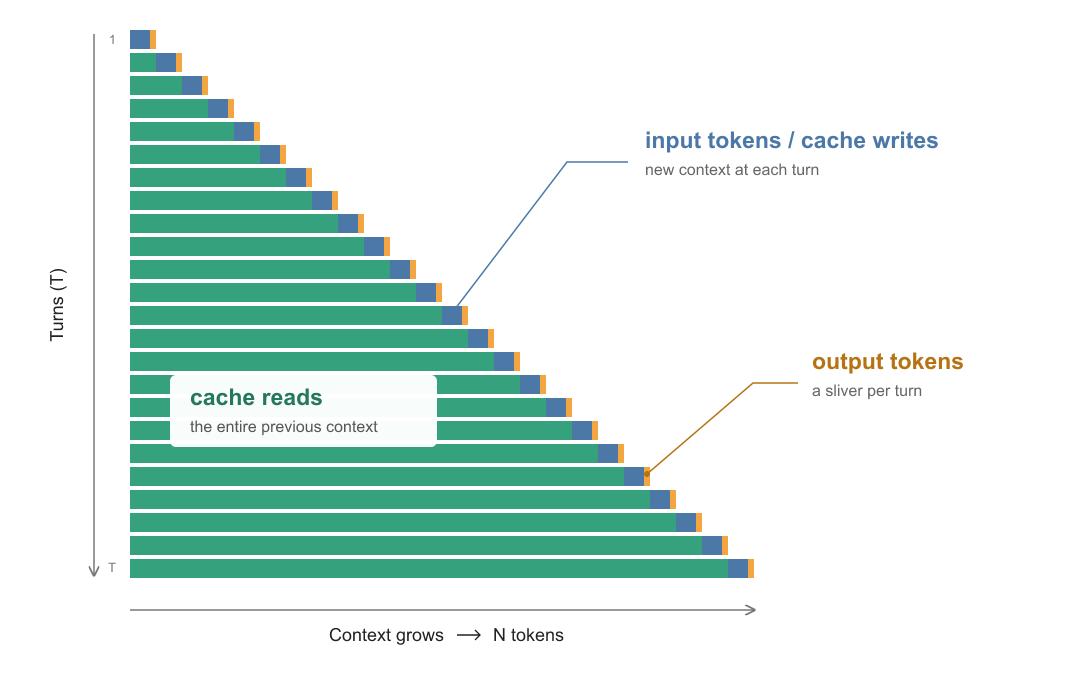
Anthropic itself has accidentally leaked the details long ago.
If you check the Claude API documentation, you will find a very intriguing detail: Cache read Tokens are not counted in the API input rate limits at all!
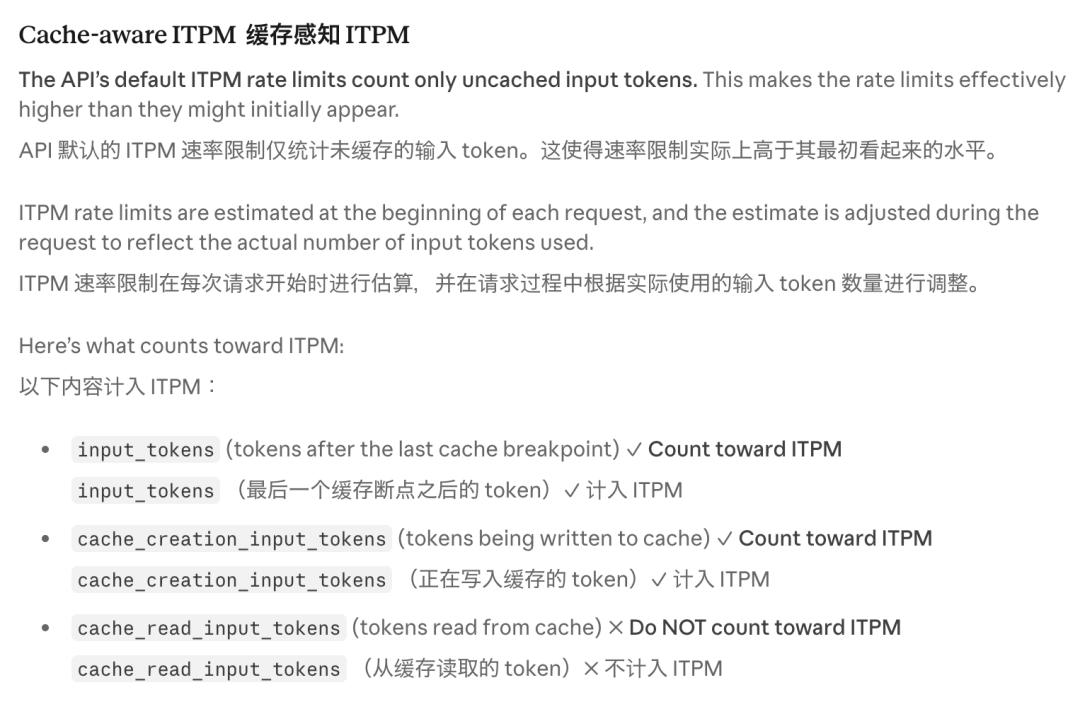
Think about what rate limits are for? They are used to protect servers from being overwhelmed by traffic.
Anthropic dares to exclude cache reads from rate limits, which is equivalent to shouting to the world through a loudspeaker: "This thing barely takes up any of my real computing power, you can read as much as you want!"
As for OpenAI, it ran automatic prefix caching for free for more than a year in the early days, and did not follow Anthropic to add a 1.25x premium to cache writes until GPT-5.6 was released.
Once this layer of window paper is pierced, the $100,000 unsolved case of Vlad becomes clear instantly.
That $100,000 is not Anthropic's real cost at all, it is calculated based on the API price list that marks up the almost free cache reads layer by layer.
For pay-as-you-go enterprise customers, every extra tool call made by the programming Agent allows the manufacturer to collect an extra "cache tax". This money costs almost nothing, so the inference profit margin naturally gets higher and higher.
For subscribers who pay $20 or $200 per month, Anthropic waives this "cache tax", allowing you to burn billions or tens of billions of Tokens freely. On paper it looks like they are subsidizing dozens of times the cost, but in fact the real hardware cost the manufacturer spends is likely to be only a fraction of the marked price.
But even a fraction is still money. SemiAnalysis estimated in October that subscriptions only contribute about 10% of Anthropic's revenue, but consume more than 40% of inference computing power. Heavy users who use their plans to the limit mostly still cost the company money.
Hidden Card 2: Speculative Decoding — Squeeze Every Bit of the GPU's "Idle Time"
If KV Cache has pushed the cost of "reading input" to the floor, then for the real physical bottleneck we mentioned earlier — the decoding stage of "outputting tokens", how does Anthropic save money and improve speed?
This brings us to the second hidden card pointed out by Gergely Orosz: Speculative Decoding.
As mentioned earlier, when the model decodes and outputs tokens, it is mainly limited by video memory bandwidth, resulting in most of the extremely expensive computing cores inside the GPU being in an "idle" state most of the time. It is like a Michelin chef standing in front of the stove, 90% of the time just waiting for the side dish staff to bring the ingredients.
What speculative decoding does is to completely squeeze out the chef's idle time.
Manufacturers will equip a very fast small model (or a dedicated predictor) next to the large model as a "stenographer", let it blindly guess several subsequent Tokens in one go, then send them to the large model in a package, and let the large model use idle computing power to verify all these guesses in one single forward pass. If they are correct, pass all of them directly, if wrong, send them back to rewrite.
Which scenario do you think is most suitable for "blind guessing"? Writing poetry is not, because the next line of a poet can be completely unpredictable; but writing code is a perfect match!
Code is full of highly predictable structures: fixed syntax brackets, repeated variable names, function signatures copied from the context, minor refactoring modifications to existing code... The small model guesses code extremely accurately, with a surprisingly high acceptance rate.
The result is that code that originally required 5 or 6 video memory transfers to output can now be completed with only one transfer.
Now combine the two hidden cards together, a perfect commercial puzzle that makes people amazed appears:
On the input side, rely on KV Cache: Agent re-reads the context frantically? Almost zero computing power cost, the API still charges cache fees, and the subscription system can easily provide ultra-high quotas;
On the output side, rely on speculative decoding: code is highly predictable, use