The domestically produced intraocular lens, which costs 14,000 yuan apiece, has its market opened up through "acquaintance connections".
The global high-end intraocular lens market is growing rapidly.
In the third quarter of 2026, Bausch + Lomb's revenue from high-end intraocular lenses increased by about 70% year-on-year, Alcon's PanOptix series grew by 9% in the same period, and the total global cumulative implantation volume of Johnson & Johnson's TECNIS PureSee and TECNIS Odyssey has exceeded 1 million units.
At the same time, domestic high-end intraocular lenses have been launched to the market one after another, optical design routes such as trifocal and EDOF are constantly enriched, and new breakthroughs have begun to emerge in material innovation, and the work of carrying out the first batch of implantation cases is being intensively carried out at present.
However, imported brands have long occupied the mainstream position in clinical practice. New domestic products neither choose the familiar low-price breakout route, nor have relatively weak early clinical accumulation. How can domestic high-end lenses build clinical trust? It has become an urgent proposition to be solved in the industry.
Global Growth of High-end Lenses, Domestic Players Enter the Market
Since 2026, high-end intraocular lenses have become an important growth source for international ophthalmology giants. In the third quarter of 2026, Bausch + Lomb's revenue from high-end intraocular lenses increased by about 70% year-on-year, and the year-on-year growth rate in the second quarter once reached 175%. In the same period, Alcon's PanOptix series of lenses grew by 9%.
The market space for high-end intraocular lenses is extending to different visual needs and technical routes. Trifocal lenses are still the main battlefield, with Alcon PanOptix and Bausch + Lomb enVista Envy continuously expanding the market. EDOF and enhanced monofocal lenses are also accelerating their implementation. As a representative product of enhanced monofocal lenses, the total global cumulative implantation volume of Johnson & Johnson TECNIS Eyhance has exceeded 10 million units.
In this process, a diversified supply has been formed in the high-end market. Giants continue to iterate optical solutions, astigmatism versions, and preloaded forms, build a complete product matrix, cover different patient groups from improving intermediate vision to getting rid of glasses for full-range far, intermediate and near vision, and multi-line products match differentiated eye use needs and ocular conditions.
Long before this round of high overseas growth emerged, domestic enterprises had already laid out R&D of products such as trifocal and EDOF to fill the long-standing gap of domestic brands in the field of functional lenses.
In the past two years, the above-mentioned domestic products have been launched to the market one after another. Among them, the trifocal intraocular lens, extended depth of focus intraocular lens of Century Kangtai, the extended depth of focus intraocular lens of Aibo Nuode, the trifocal intraocular lens, trifocal toric intraocular lens of Semison and other products, have been successively approved as national innovative medical devices, enriching the selection of domestic products and filling the supply gap in the field of functional intraocular lenses.
In addition, the cross-linked polyisobutylene aspheric intraocular lens launched by Xi'an Yandele opens up a new direction of material innovation. This product adopts a brand-new lens material with stable molecular cross-linked structure, optimized biocompatibility, anti-calcification and anti-aging properties, which specifically solves clinical pain points such as long-term degeneration of traditional lenses and visual quality attenuation.
At present, domestic high-end intraocular lenses have intensively entered the first batch of clinical implantation stage, various enterprises continue to disclose clinical cases to the public, and domestic manufacturers are beginning to compete head-to-head with imported brands in multiple segmented tracks.
Benchmarking Imported Products, Why Do Domestic Products Dare to Set High Prices?
Price is one of the key factors that the market pays attention to.
For a very long time in the past, most domestic medical devices focused on the cost-effective route, relying on price advantages to quickly seize the market, so as to weaken the competitive advantages established by imported brands with their first-mover technology and long-term market accumulation.
However, as China continues to make breakthroughs in various technical fields of medical devices, the pricing logic of many domestic high-end products has changed. In the field of ophthalmology, taking cutting-edge equipment such as ophthalmic OCT and surgical microscopes as examples, the selling prices of some domestic models can already benchmark mainstream imported products of the same grade, and individual models are even priced higher.
Nowadays, this pricing change has extended to the field of intraocular lenses. At present, a number of domestic high-end intraocular lenses that have been approved for marketing and completed network registration are basically at the same price level as mainstream imported products, and some models are even higher than similar imported products.
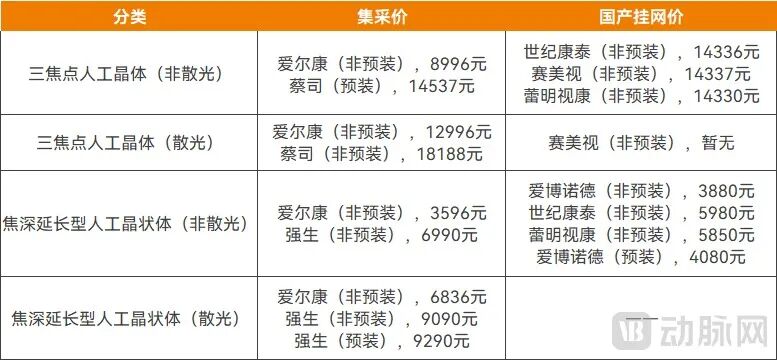
The volume-based procurement price dominated by imported products and the network registration price of domestic high-end lenses, data source: pharmaceutical and medical device bidding and procurement platform, interviews
Taking trifocal (non-astigmatic) lenses as an example, the network registration prices of three domestic enterprises are in the range of 14330-14337 yuan, which is almost at the same level as the 14537 yuan volume-based procurement price of Zeiss preloaded products, with a price difference of only a few hundred yuan.
EDOF intraocular lenses show the characteristics of significant price differentiation. Among them, domestic products and imported products are in several price ranges from more than 3,000 yuan to more than 6,000 yuan respectively, with a gap of about 1,000 yuan at each grade, and no domestic product is at an absolute high price or low price alone.
It can be seen that domestic high-end lenses have not continued the old path of low-price competition, and their pricing is directly linked to the price of imported products.
Facing the strong reputation accumulated by imported brands in the high-end lens market, domestic products must first rely on excellent performance parameters to win the initial recognition of doctors and patients.
For example, the "Liangshi'an" trifocal intraocular lens of Century Kangtai optimizes the optical design, increasing the light energy utilization rate to 90% or even higher, which can reduce glare; it is adjusted for the intermediate and near vision range, adapting to the daily high-frequency usage scenarios of the middle-aged and elderly people such as looking at mobile phones and computers.
The trifocal toric intraocular lens of Semison fills the gap of domestic products in high-end astigmatic lenses. 8 models can correct astigmatism from 75 degrees to 350 degrees, can fit better with the capsular bag after implantation, with improved stability, ensuring the accuracy of astigmatism correction.
On the basis of realizing extended depth of focus and providing continuous visual range, domestic EDOF products achieve contrast sensitivity close to that of monofocal lenses.
Among them, the "Wanshi'an" Ultra-EDoF intraocular lens of Century Kangtai introduces 6 diffraction wave orders to maximize the utilization of light energy, achieve ultra-wide depth of focus, so as to obtain far vision effect comparable to monofocal lenses and smooth continuous visual range.
The "Panorama" extended depth of focus intraocular lens of Aibo Nuode adopts patented aberration regulation technology, which ensures imaging quality while achieving the effect of extended depth of focus, and its overseas brand has been clinically applied in many countries around the world since 2019.
The industry calls this type of product "large monofocal lens", which is mainly for patients who are sensitive to glare and halo and hope to get rid of reading glasses, providing them with a compromise treatment plan. Among functional intraocular lenses, it also has high cost performance and broad application prospects.
A leading intraocular lens enterprise predicts that although the upcoming new round of volume-based procurement will have changes in rules, there will not be a large price difference between similar products, and it will most likely be compressed to between several hundred yuan and one or two thousand yuan. From the perspective of medical insurance payment and patients' out-of-pocket expenses, such a price gap has limited impact.
Since price is no longer a competitive breakthrough, domestic high-end lenses need to demonstrate and accumulate competitiveness in other dimensions to obtain longer-term recognition from doctors and patients.
Open Up the Market with "Acquaintances"
Similar to the domestic substitution process of most medical devices, in the early stage of market development, high-end intraocular lenses must directly face the solid competitive barriers of imported brands. From public hospitals to private ophthalmology institutions, imported high-end lenses have long been the mainstream choice, and it is not easy for new domestic products to enter the market.
At the same time, the clinical evaluation of intraocular lenses has its particularity: the improvement effect of vision and visual quality can be quickly perceived after the operation, and long-term problems such as the comprehensive optical performance of the lens, the incidence of posterior capsular opacification, and glare require long-term follow-up observation. Both short-term effects and long-term stability will affect doctors' judgment and patients' acceptance, and the patient's ocular conditions and effect evaluation dimensions corresponding to high-end lenses are more complex.
In the early stage of clinical application after launch, some domestic brands choose to focus on winning over people who are most familiar with the products, and include them in the early patients of the products.
Taking Aibo Nuode as an example, according to the company's public information, Cheng Zhengfu, the dean of Nanyang Jianfeng Eye Hospital, is a cataract surgeon himself. After suffering from cataract, he chose to implant Aibo Nuode's extended depth of focus intraocular lens in both eyes.
Arterial Network also learned from another leading domestic intraocular lens manufacturer that among the thousands of surgeries performed with its trifocal intraocular lens in more than a year since its launch, more than 200 patients are medical staff and their relatives, many of whom are ophthalmologists.
Such a choice is forced by the realistic environment, and it is an expedient measure to cope with the strong influence of imported brands.
Large companies such as Zeiss, Johnson & Johnson, and Alcon have been deeply engaged in the domestic intraocular lens market for many years, and their high-end series have been deeply embedded in academic promotion and physician training systems. Many doctors have been exposed to and practiced imported lenses since they started their careers. New domestic high-end products not only lack the endorsement of long-term follow-up data accumulated by imported products for decades, but also it is difficult to rely on public hospital channels to achieve large-scale sales before entering the volume-based procurement.
However, from another perspective, the fact that enterprises dare to provide the products, doctors dare to use them, and acquaintances dare to accept them, this "mutual move" is also a direct proof of confidence in the products. Doctors are willing to use new products on their relatives and friends, which is equivalent to endorsing with their personal reputation; the acquaintances involved have a more rational understanding of benefits and risks, and are willing to choose to try under the premise of informed consent.
For a new product, the real usage evidence generated by this batch of special cases is particularly important, which can precipitate more sufficient early clinical trust for the product.
It is worth mentioning that private hospitals have played an important role in the promotion process of new domestic high-end products.
First of all, the decision-making chain of private hospitals is relatively shorter, and they have higher procurement autonomy. The patient groups who have the ability to consume high-end lenses are also relatively concentrated, and they actively introduce new products for patients to enrich the diagnosis and treatment options of refractive cataract surgery.
For example, Aier Eye Hospital mentioned in its 2026 semi-annual report that the company's experts completed the first batch of Wanshi'an Ultra-EDoF intraocular lens implantation surgeries nationwide, pushing refractive cataract surgery into a new stage of "ultra-wide depth of focus, full-range clarity"; successfully implemented the first batch of nationwide implantation of the world's pioneering DiamondSoft cross-linked polyisobutylene intraocular lens.
More critically, reputation is an important business foundation for private institutions. After introducing new products, hospitals have sufficient motivation to complete long-term and continuous case follow-up, and will also share clinical results at different stages at academic conferences. The clinical evidence required by enterprises and the follow-up data accumulated by hospitals are initially connected at this stage.
Monofocal Lenses Are Still the Basic Market
High-end products have high unit prices, and the consumable cost of one operation is equivalent to that of more than a dozen or dozens of monofocal lens surgeries, but the implantation volume is concentrated in large hospitals and large private chains; the price of a single monofocal lens may only be a fraction of that of high-end products, but it has the advantage of large base and wide coverage.
Although the gap of domestic brands in high-end lenses is being filled, the comprehensive competitiveness of domestic products still needs to be established combined with basic products such as monofocal lenses.
Monofocal technology is mature, with wide indications, and can meet the most basic vision restoration needs of cataract patients. Industry statistics show that the annual usage of domestic monofocal intraocular lenses exceeds 3 million units, making it the most mainstream product in the industry.
At the same time, monofocal lenses have more stable visual quality, and even serve as the standard for the visual quality of functional lenses to compare with. The industry has also reached a consensus: if an enterprise cannot make good monofocal lenses, it is difficult to convince people of its ability in functional lenses.
This also means that for domestic enterprises that are vigorously sprinting for high-end products, expanding the grassroots market will still be one of the important tasks.
The volume growth of high-end lenses depends on three conditions being met at the same time: hospitals can perform the surgery, doctors can screen patients, and patients can afford the price difference. At present, these three conditions are mostly concentrated in large urban hospitals and large private chain institutions, while the increment of domestic cataract surgery volume is moving to county-level regions.
According to relevant policy arrangements, county-level hospitals need to have the ability to perform cataract surgery by the end of 2027. The surgical volume and supporting demands at the grassroots level will increase simultaneously, including phacoemulsification equipment, surgical consumables, and intraocular lenses. The demand characteristics of the grassroots market are also very clear: vision restoration is the main goal, monofocal lenses are the main force, and price sensitivity is high.
For enterprises, on the one hand, they can cooperate with equipment manufacturers such as phacoemulsification equipment manufacturers to participate in the practical ability building of young doctors through training; on the other hand, they can package intraocular lenses, injectors, and surgical scalpels into surgical kits to facilitate one-stop procurement for hospitals and public welfare projects, which are all ways to enter the market and reduce usage costs.
Overall, for domestic brands, the parameter sheet can support one pricing, but it also needs to support long-term surgical effects. After that, domestic enterprises need to replace the currently focused optical indicators with continuous follow-up data.
In the monofocal field, what domestic enterprises have accumulated for many years is not only production capacity. The supply chain, cost control, as well as local data and follow-up research precipitated by millions of surgeries every year, are all capabilities that can be transferred to high-end products. At the same time, the clinical cognition accumulated by high-end products can also feed back the iterative optimization of the basic product line.
The mutual empowerment between basic models and high-end products is the key for domestic intraocular lenses to build comprehensive competitiveness.
This article is from the WeChat official account "Arterial Network" (ID: vcbeat), author: Zhang Xiaoxu, published with authorization from 36Kr.