China's AI has smashed global records, running 40,000 times faster than Claude, and multiple cryptographic puzzles have been cracked.
November 20, 2026, is a day that will go down in history.
On this day, Levent Alpöge, a researcher at Anthropic, announced:
I believe that in my work with Claude, I have discovered a proof of the Riemann Hypothesis.
Shortly afterwards, the Lean official team confirmed that this proof has passed formal verification.
Not only that, on the very same day, the Navier-Stokes equations were also proven. Two of the Millennium Prize Problems have been solved at the same time!
The entire community is thrilled: AI for Science has ushered in a true "singularity moment"!
Now that the most famous conjecture in pure mathematics has been conquered by AI, how much longer can another human fortress built on the foundation of pure mathematics — modern cryptography hold out?
And just last night, MiniMax released a blockbuster report: their undisclosed internal model (MiniMax's Internal Model, hereinafter referred to as MIM) has made major breakthroughs in automated cryptanalysis, reaching the international leading level!
MIM not only uncovered a number of latest algorithm defects, but also advanced a variety of originally theoretical attacks to executable cracking that can be completed in seconds.
In solving classical mathematical problems, MIM has already attracted the attention of top teams like Anthropic!
MIM, the most proficient in cryptanalysis, is "a little intimidating"
This time, MiniMax released 8 analysis reports with PoC (runnable code) at one go, and the results are "impossible to ignore".
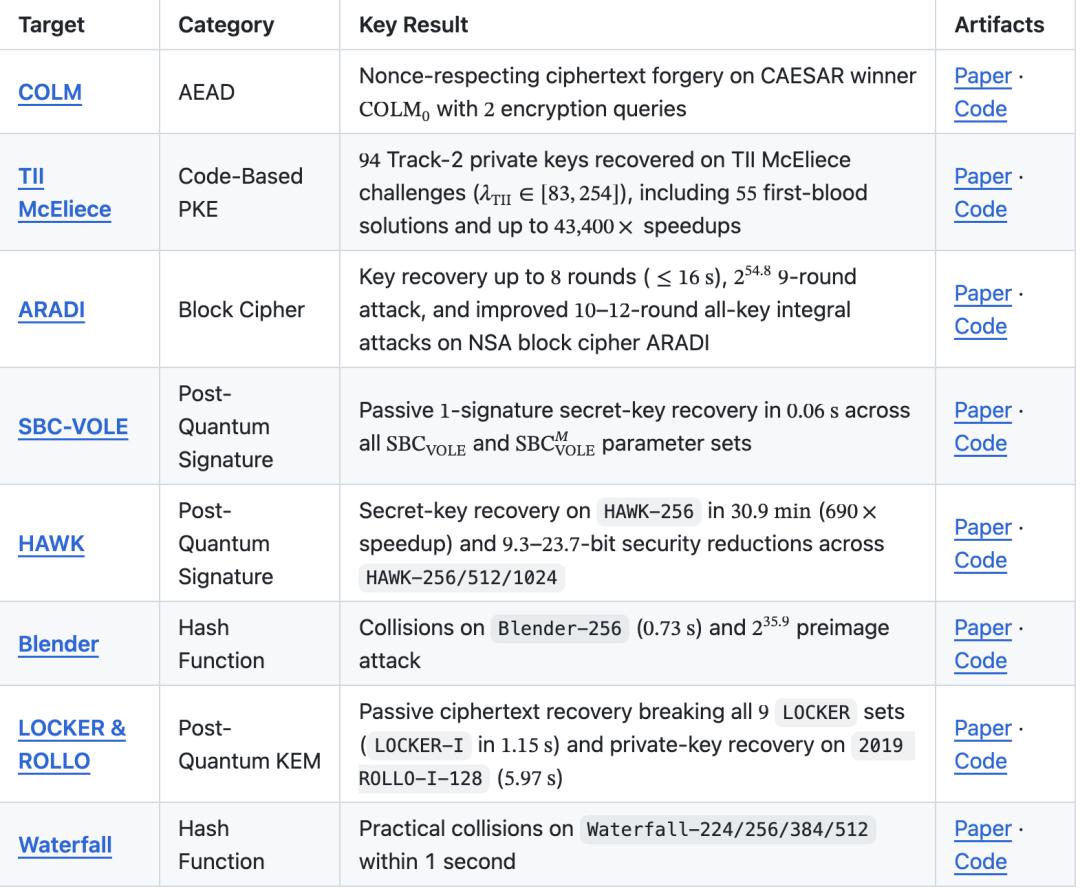
https://github.com/MiniMax-AI/Research/tree/main
Anthropic, which has been in the limelight recently, has also taken notice of MiniMax.
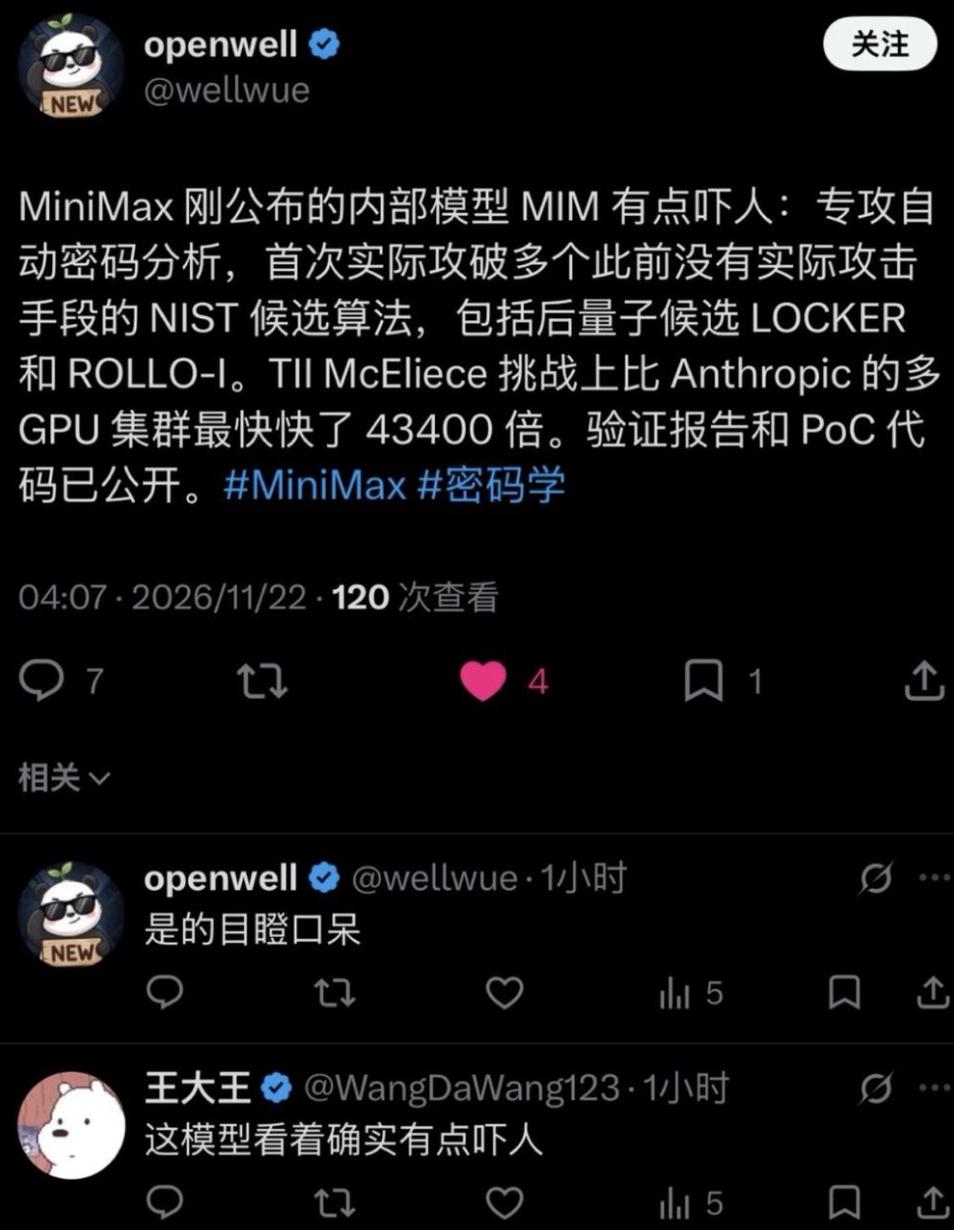
This internal model of MiniMax is a little intimidating. On the TII McEliece challenge, it is 43400 times faster than Anthropic's multi-GPU cluster! This result even made Anthropic's engineers step in and quickly repost it with likes!

In multiple rounds of challenges, MiniMax has obvious advantages.
For example, for the candidate algorithms that "have no known practical attacks" in previous NIS International Cryptography Competitions, the MiniMax model has achieved second-level cracking for the first time.
Facing the core mathematical challenges of post-quantum cryptography, the previous latest record in the academic circle was 9.2 hours, and Anthropic once used a multi-GPU cluster to tackle the problem.
However, MiniMax only used a 64-core server, which took 1.8 to 5.36 seconds, and the measured solving speed soared by 6180 times to 43400 times.
Facing another complex lattice isomorphism problem, Anthropic once ran on a 96-core server for nearly 4 hours; the MiniMax model only used a single-core CPU and obtained the equivalent private key in 30 minutes.
Now, MiniMax tells the whole world: On the AI4S battlefield, Chinese teams are already at the table!
Why cryptanalysis?
Where exactly does the gold content of MiniMax's breakthrough this time lie?
The answer is — cryptanalysis is a brutal testing ground for large models.
As a well-known KOL said: "Cryptography tests are extremely brutal, but that's exactly why I like them. Either your script recovers the key, or it doesn't."
When we look for software vulnerabilities in daily work, many times we are looking for bugs written by programmers in the code.
But cryptanalysis is different, it is a "open card game".
The mathematical formulas, algebraic structures and implementation source code of modern cryptographic algorithms are all public.
It is like a transparent complex gear set, you know the meshing method of every gear, but the security boundary is locked by the terrifying "computational complexity".

Without the correct key, even if you call the global computing power to brute force exhaustive search for ten thousand years, you cannot crack it forcibly.
For large models to break through it, just giving an idea is not enough.
It must complete the leap from theory to engineering —
Convert hundreds of steps of high-order mathematical derivation into practically runnable attack codes, and calculate the answer within limited computing power and time.
This zero-tolerance, absolutely objective standard is the highest touchstone to test "whether AI can carry out scientific exploration".
The competition for the new throne: Head-to-head against Anthropic, speed up by 43400 times
The climax of this incident is that when MIM faces the "classical mathematical hard problem" of public-key cryptography, it broke the previous record kept by Anthropic.
If the code of a cryptographic algorithm is perfectly written and seamlessly designed, its security is completely reduced to those "classical mathematical hard problems" that have been studied for decades.
Evaluating whether large models can solve these mathematical deadlocks is the hardest core indicator to test their basic mathematical and physical capabilities.
The tech account @dummerspast39 summarized the battle report, which is thrilling:
BREAKING: The model just announced by MiniMax has defeated Anthropic in breaking encryption records, with a maximum speed increase of 43400 times!
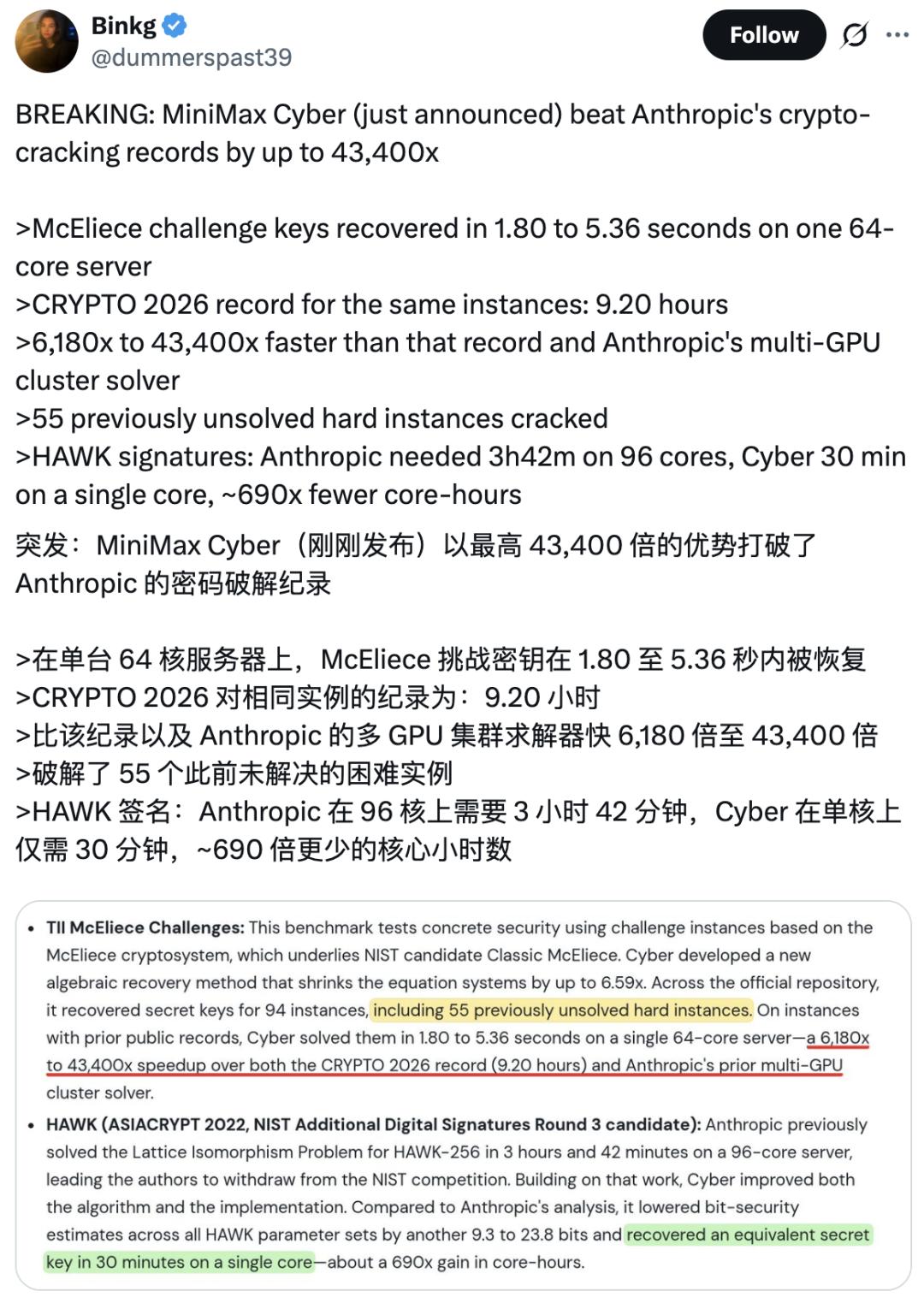
The Module-LIP (HAWK) based on the module lattice isomorphism problem is another top event that measures the security boundary of core mathematical problems in post-quantum cryptography.
Previously, the best record was: Anthropic dispatched a 96-core server cluster and worked hard for 3 hours and 42 minutes to get it done.
However, MIM took a different approach and directly removed the original 128 annoying interference terms, making the real target key the only shortest vector with absolute advantage (gap=2).
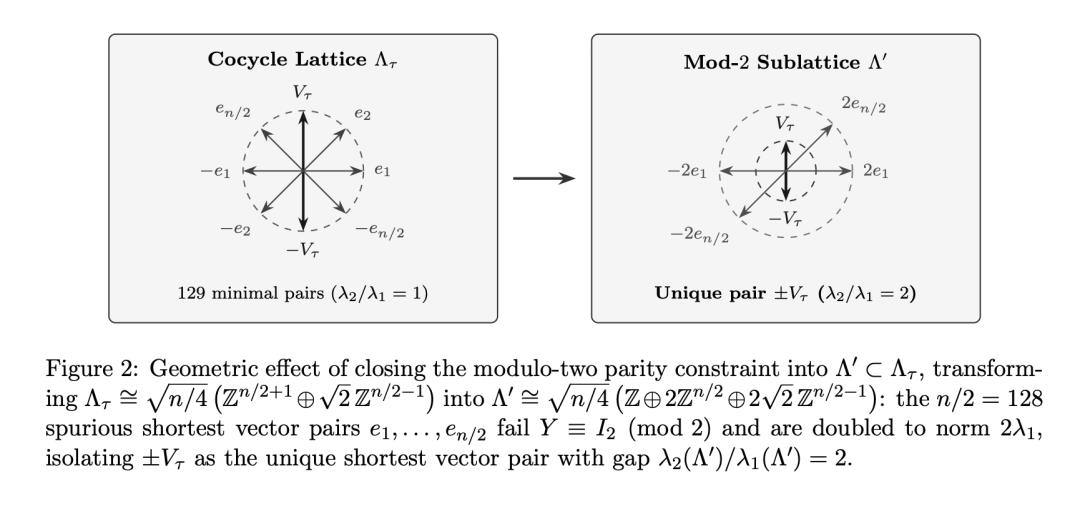
MIM's dimensionality reduction strike: By constructing a mod 2 sublattice, it directly removes 128 interference terms, making the target key the only absolute shortest vector.
MIM abandoned the conventional mode, and the combined punch of "mathematical dimensionality reduction + engineering full optimization" brought a miraculous effect:
The search that originally had to be completed in 118 dimensions was reduced to 80 dimensions by MIM!
For the task that originally took a 96-core server nearly 4 hours to run, MIM only used a single-core CPU and finished in 30.9 minutes.
If converted according to the consumed CPU core hours, MIM's solving efficiency has increased by 690 times.
In another TII McEliece Challenge, MIM ran on a single 64-core CPU server, and reduced the calculation that originally took 9.2 hours to directly 1.80 seconds ~ 5.36 seconds. The measured solving speed soared from 6180 times to 43400 times.
MIM easily broke all 55 previously unsolvable high-order "deadlocks" in the question bank at one time.
Note: Don't worry about your bank card password. The current mainstream cryptographic standards such as AES, RSA, SHA-256 are still rock-solid.
Not only that, the shock wave that MIM brings to cryptanalysis this time is even broader and more far-reaching.
Tearing through human blind spots: Achieving the "first kill" in the NIST competition
In the cryptography community, the cryptography standardization competition held by NIST is like the "Huashan Sword Debate" in martial arts novels.
Algorithms that can survive to the final rounds have been reviewed repeatedly by top cryptographers around the world for many years.
In order to test whether large models are "memorizing old knowledge in the training set", ETH Zurich and Anthropic jointly developed a special evaluation benchmark called CryptanalysisBench.
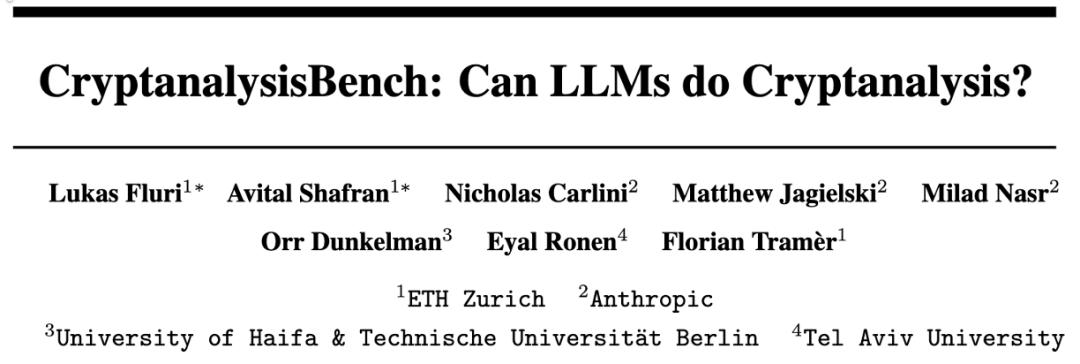
In the hell-level question bank Tier 2, 142 candidate schemes that have been publicly evaluated by human experts and currently have "no known practical attack methods" in the academic circle are included.
As a result, MIM directly carried out a "dimensionality reduction strike" against human experts!
Take Waterfall-256, a candidate algorithm for the NIST SHA-3 hash competition as an example.
Since its birth, no one has ever really cracked this algorithm, that is, constructed a "collision message pair" that makes it crash.
After MIM came on the stage, in a zero-prompt environment, the single-core CPU took only 0.045 seconds to directly generate the first real collision instance of this algorithm.
From theory to practice, AI instantly surpassed several years of human progress.
The most typical examples are NIST post-quantum cryptography candidate schemes LOCKER-I and ROLLO-I.
For example, LOCKER-I needs to construct a matrix with 5.72×10^8 columns, which consumes a huge amount of memory up to 42 PB (about 43000 TB). In the past, this was an insurmountable computing power gap!
However, MIM showed amazing intuition, cleverly processed the coefficient matrix, and directly unlocked the hidden attributes.
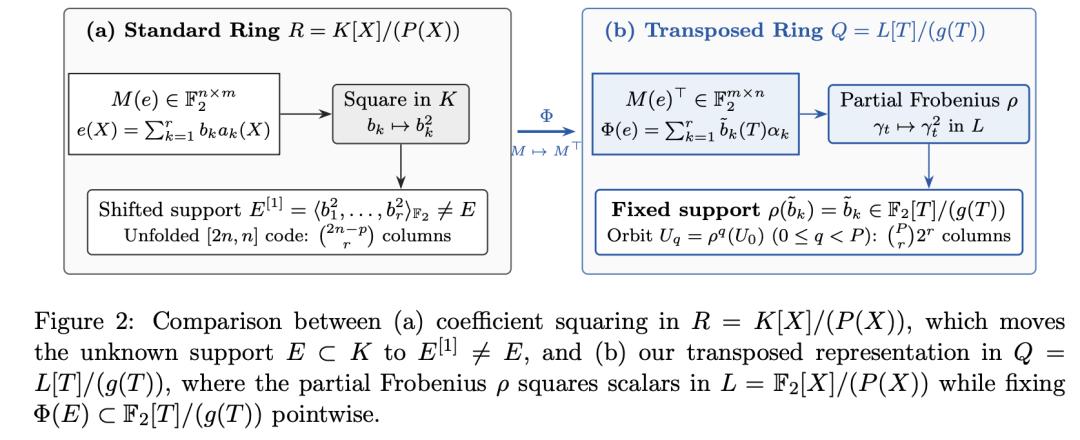
The brilliant algebraic operation discovered by MIM: By transposing the coefficient matrix, it unlocks the partial Frobenius mapping and locks the unknown space.
After a series of operations, the super-large matrix that originally required 42 PB of memory was extremely compressed by MIM to 58 MB!
With 12 threads, cracking LOCKER-I only takes 1.15 seconds; for the 2019 version of ROLLO-I-128, MIM requires less than 2 MB of memory, and the single-core time consumption is only 5.97 seconds.
This is pure intelligence crushing.
There is also an episode: When reviewing the official reference code of DRS, the NIST first-round lattice signature scheme, MIM caught a tiny but fatal error: When writing the signature verification logic, human experts mistakenly wrote the logical AND (&&) as bitwise AND (&).
Just this one character difference allowed MIM to bypass the security check directly, and forged the highest-privilege signature within 0.1 to 0.8 seconds.
Breaking into top conferences: "Even cryptographers will be stunned for a moment"
If the unselected schemes of NIST are not cutting-edge enough, MIM extended its "strike" to new algorithms on top cryptography journals that have undergone strict security proofs.
These cutting-edge schemes often introduce very complex new algebraic structures, and the authors attach dozens of pages of rigorous mathematical proofs in their papers, claiming that they are sufficient to resist various mainstream attacks.
But in these seemingly flawless proofs, MIM precisely found the "combination blind spot".
For example, COLM, which won the CAESAR authenticated encryption competition after five years of strict selection, has extremely rigorous security proofs. Finally, this algorithm was published in the top cryptography journal Journal of Cryptology after peer review.
Previously, the academic circle did not find any substantial threat. But MIM found two fatal logical blind spots, and easily constructed a real attack.
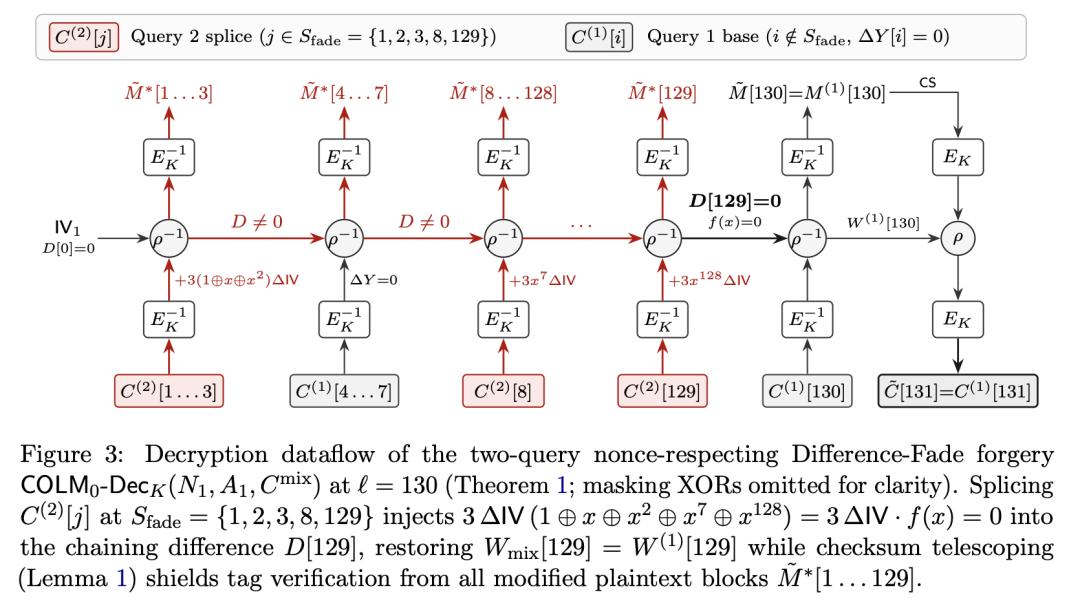
The "Difference-Fade" forgery attack path constructed by MIM for COLM0: Using the algebraic structure to force the chain state difference to return to zero at the 129th block.
In the standard scenario, MIM only needs 2 queries to forge a legitimate ciphertext out of thin air, completely breaking its defense line.
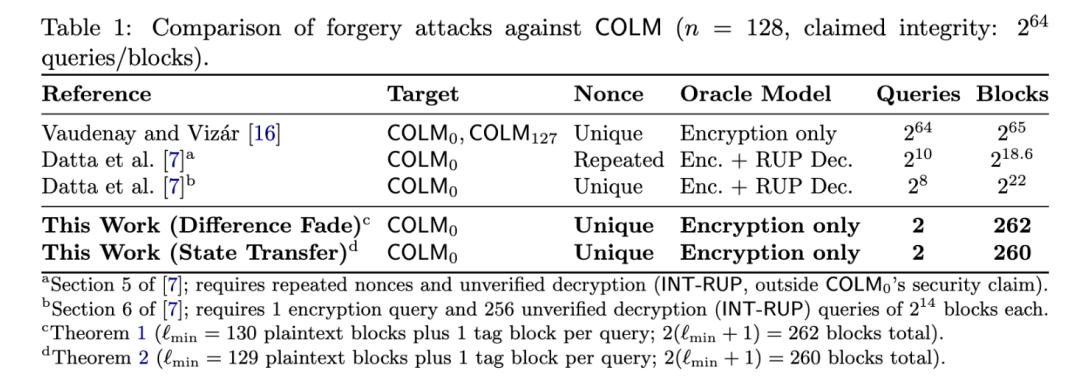
Another algorithm that was hit by dimensionality reduction is <