From Capability to Cash: The First Key Hurdle for Digital Tech Companies
Lao Yang has been working in digitalization for a Party A enterprise for nearly 20 years, during which he has operated and managed two internal digital technology companies. The most frequent question he has been asked in recent years is: Now that we have our own tech company, is digital transformation going to be easier to carry out?
Lao Yang usually replies: Not necessarily, it may even get more troublesome.
Most enterprises establish their digital technology companies just to solve the problem that "the purchased software is not user-friendly". But after the establishment, the original problems will not disappear automatically, and several new problems will emerge.
Recently, Lao Yang delivered a training session on "Operation Practices of Digital Technology Companies" for a state-owned enterprise, giving a detailed explanation from seven aspects including marketization, products and payment collection, as well as organization, culture, finance and positioning.
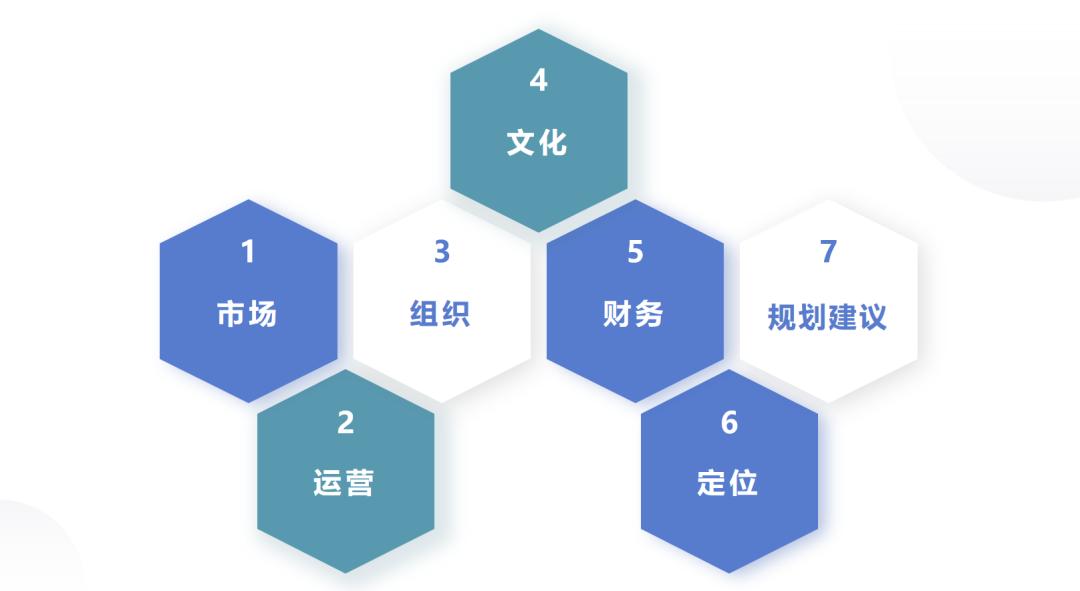
Today, Lao Yang will give a detailed explanation of these seven parts, telling you how to correctly operate an internal digital technology company. First, he will explain the content related to the market sector for everyone.
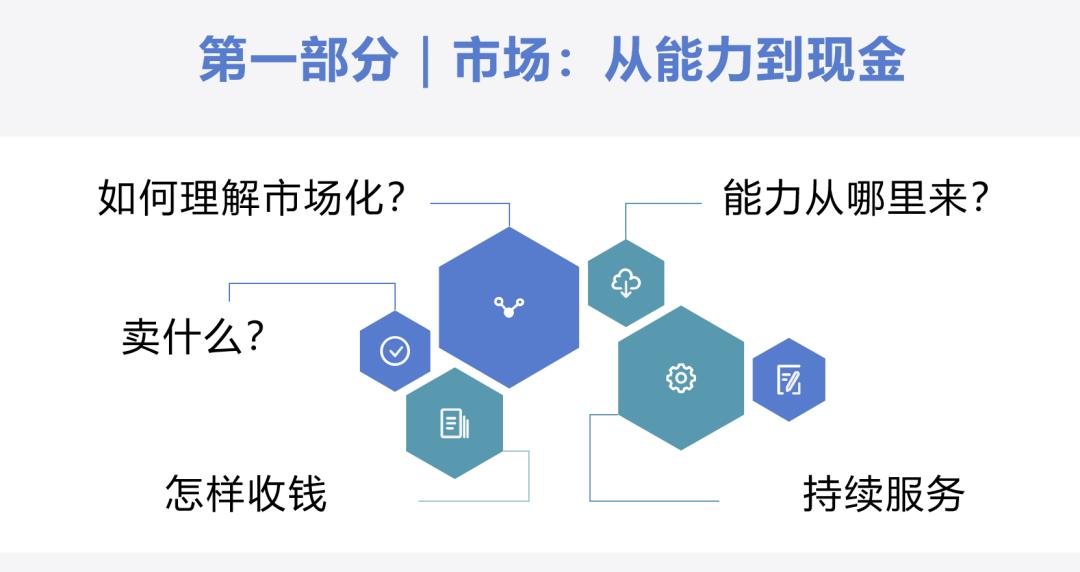
I. How Did Internal Digital Technology Companies Come Into Being
Back then, the enterprise where Lao Yang worked decided to set up a tech company, and more than a dozen meetings were held for this. The reasons boiled down to just a few points, for example:
The functions of the purchased products do not match the actual needs. You have to buy a whole set of software just for one or two required functions, and 80% of the remaining functions are left unused and gathering dust.
The implementation personnel are not reliable. If you change the consultant for the same set of product, the effect will be greatly reduced; if you encounter a bad project, it will be left unfinished there.
Once the contract is signed, the after-sales service becomes unresponsive. There is no local team, and everything has to wait for the headquarters to arrange the schedule.
The cost is like a bottomless pit. The software itself is just the beginning, followed by upgrade fees, interface fees, secondary development fees, and annual maintenance fees. The maintenance fee charged by some manufacturers can reach 20% of the contract amount, and it rises year by year.
The most critical problem is that the source code is in the hands of others. We have recruited several developers ourselves, but we still cannot modify a required function, and can only wait in line and wait for quotations.
All these five points are real problems, so the logic of establishing a digital technology company is correct.
At that time, some people opposed it, saying that there is no need to develop in-house what can be purchased from outside. Looking back now, half of this objection is correct: what can be purchased does not need to be developed in-house. But among the five pain points mentioned above, three of them are not that the products cannot be bought, but that the purchased products are not easy to use. These two things are different: the former is a capability issue, while the latter is a market issue.
The mistake lies in the follow-up part — we regard painkillers as startup remedies.
What painkillers need is no accidents, no extra cost, no schedule delay; what starting a business needs is to find people who are willing to pay, minimize the cost, and sell the same product a second time. The former tests project management capabilities, while the latter tests market operation capabilities.
However, most digital technology companies on the market are established based on the logic of the former, but are assessed according to the standards of the latter. All subsequent troubles stem from this.
II. Marketization Is Not Just Putting Up a Signboard
How to define a digital technology company?
Lao Yang believes that it has six characteristics: independent legal person, sole responsibility for its own profits and losses, internal market-oriented charging, external market-oriented operation, independent decision-making for business operations, and full introduction of competition mechanisms.
It is very interesting that many digital technology companies only meet the first characteristic. They hang up the signboard, revise the articles of association, and engrave the company seal, but then they still have to report to the group for approval for project initiation, pricing, and even recruiting a single employee.
What kind of company is this? It is just a department with a new name.
The criterion to judge whether it is a real digital technology company is very simple: whether you dare to and can make decisions on your own. If you cannot make decisions, the previous statement of "taking sole responsibility for profits and losses" is just a joke — you cannot even make the decision to take a loss, so why should you be held responsible for the company's profits and losses.
Where does the capability of a digital technology company come from? Or how to reflect the capability of a digital technology company?
Lao Yang believes that there are four paths: self-research, procurement, joint R&D, and achievement transformation. And procurement is the path with the most hidden pitfalls.
Lao Yang has seen a very typical model: the digital technology company buys whatever the customer wants from the market, resells and delivers it after adding a price difference. This model works quite well within the group, because the revenue on the books is visible, and it has the exclusive right to undertake projects internally, as the group has issued a document stipulating that all digital transformation projects shall be undertaken by the digital technology company.
Many people call this type of digital technology company a middleman. To put it bluntly, it is just a general contractor. Being a general contractor is not a bad thing, but what you earn is the price difference. There is nothing wrong with it if you deliver the project well and provide good service, after all, it does not matter who the work is assigned to. But the problem is that some digital technology companies simply do not have such project management and service capabilities, and are criticized by the subsidiaries and branches.
After three years, you will find that although the company has more than 100 employees, it does not have a single product that can be sold to external customers.
What is even more fatal is the management cost of the digital technology company: for example, for a technical team of about 40 people, if the comprehensive cost per capita is calculated as 350,000 yuan, the annual cost will reach 14 million yuan. This does not even include the cost of delays, rework, and rehiring due to staff turnover. If this sum of money is allocated to projects, and 8 projects are completed a year, each project has to bear a labor cost of more than 1.7 million yuan.
In such an operating state, it is certain that the digital technology company will suffer financial losses, and it still cannot get rid of the nature of the group's cost center.
III. What Do Digital Technology Companies Sell?
Why do internal clients choose you? Lao Yang listed four points in his courseware: user-friendly and irreplaceable; strong adaptability and easy to implement; fast iteration and timely response; data security and compliance.
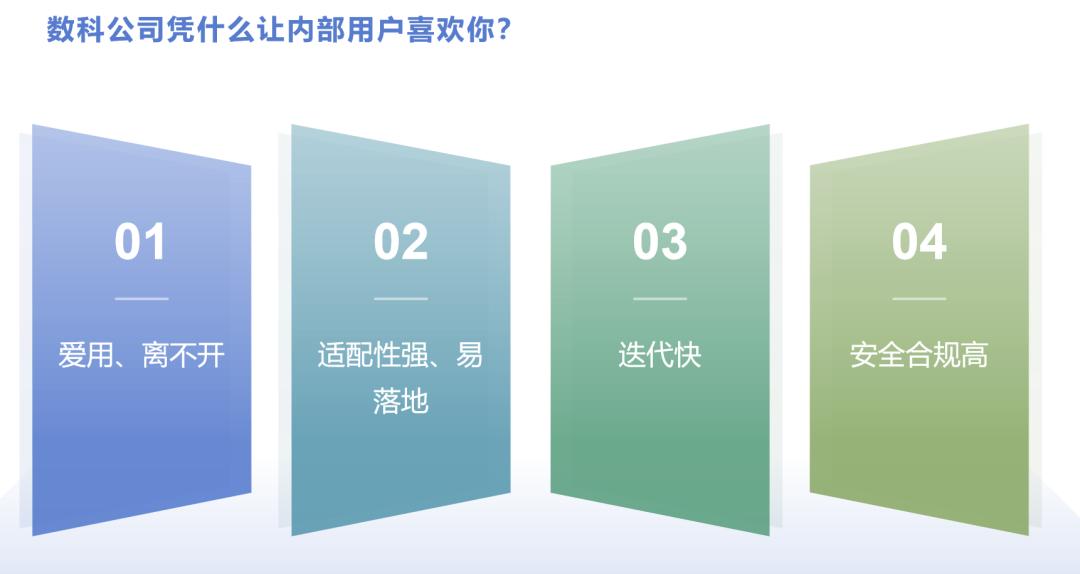
But the reality is that what internal subsidiaries and branches buy is never technology, but the thing that "others cannot solve, or will cost more to solve".
Behind these four points are four kinds of value: stickiness, matching, speed, and peace of mind. Which value you want to focus on will completely determine how you set up the team of the digital technology company. If you rely on stickiness, you have to tightly bind the system to the customer's processes; if you rely on speed, you have to build a team that can respond at any time; if you rely on peace of mind, you have to make compliance and security part of the product, rather than supplementing relevant materials afterwards.
There is another real situation: the requirements are unclear! Internal clients often cannot clearly describe their needs. Phrases like "I don't understand software, you figure it out" and "Aren't you the professionals? Why are you still asking me" are almost standard at the initial stage of the project.
This is both a trouble and an opportunity for internal digital technology companies. The trouble is that requirement collection will take a very long time; the opportunity is that you naturally understand the business that external suppliers need to stay on site for several months to figure out. If you do not turn this advantage into solution capability, you are wasting it.
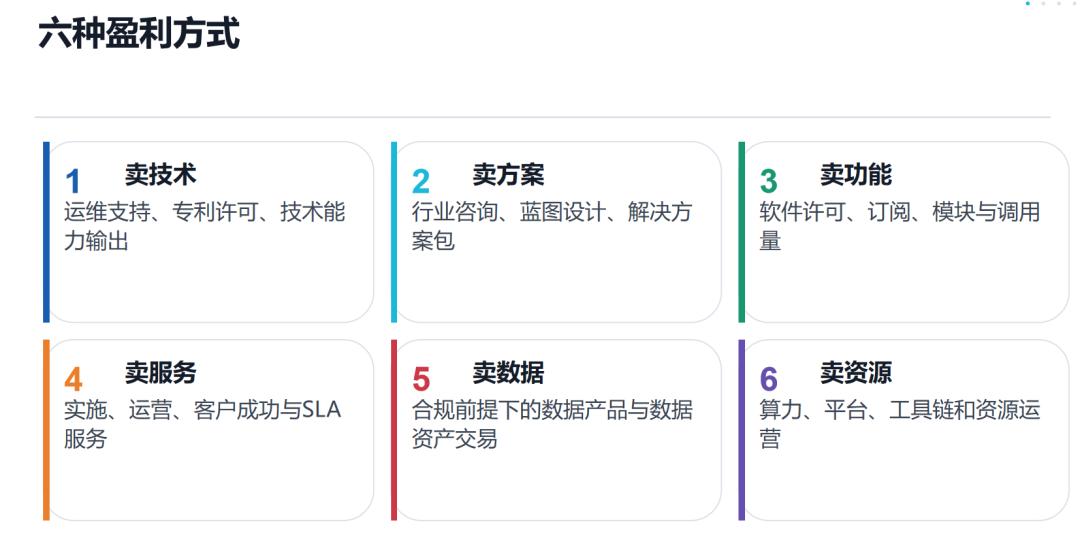
What do digital technology companies sell? Lao Yang summarized six types in his courseware: selling technology, selling solutions, selling functions, selling services, selling data, and selling resources.
It seems that you can choose any of them, but in fact they are six completely different paths.
Selling technology relies on operation and maintenance support, patent licensing, and output of technical capabilities. It relies on irreplaceability, but it will sooner or later degenerate into labor outsourcing — what the customer actually buys is your working hours, and once the employee leaves, the revenue drops to zero.
Selling solutions relies on consulting, blueprints, and solution packages. It has the highest gross profit margin, and it also puts the highest test on pre-sales capabilities. Solution capability is not about writing PPT, but about being able to spot the unspoken problem of the customer at a glance.
Selling functions relies on licensing, subscription, and API call volume. It is the only one among the six types that can generate compound returns, on the premise that you really have a product that can be deployed to a second customer.
Selling services relies on implementation, operation, customer success, and SLA. It has the most stable cash flow, but it is difficult to scale up, because you need more staff for every additional customer.
Selling data relies on data products and data asset transactions. It has the highest threshold, the most attractive stories, but very few players have really made it work.
Selling resources relies on computing power, platforms, and toolchains. It is a competition of capital and scale, and digital technology companies basically have no competitive edge in this field.
Many digital technology companies' favorite thing to do is to sell software, which essentially means selling man-days. It is the most convenient, but also the least cost-effective choice: what the customer buys is your working hours, once the employee leaves, the revenue is gone; you cannot set a fair price, because the man-hour rate is comparable; you cannot scale up, because you need more staff to serve every additional customer.
Only selling functions can generate real compound returns. But most digital technology companies do not have such capabilities and qualified products, so they can only keep selling man-days and expanding their headcount. They look large in scale, but the problem is that they never make profits.
IV. Going Online Is Not the End Point, Getting Paid Is
Some internal digital technology companies think that they are just next door to the subsidiaries and branches, so they do not need to run around every day like external software companies, and they do their work more perfunctorily than external vendors — because their customers cannot run away.
Even if the system goes online, it is still uncertain whether it can be put into practical use. Because most digital technology companies think that whether the system is used well or not has nothing to do with them, that it is a management problem of the subsidiaries and branches, and their task is only to deliver the project and make it go online. That is where the problem arises.
Poor after-sales service will directly lead to difficulty in collecting payments.
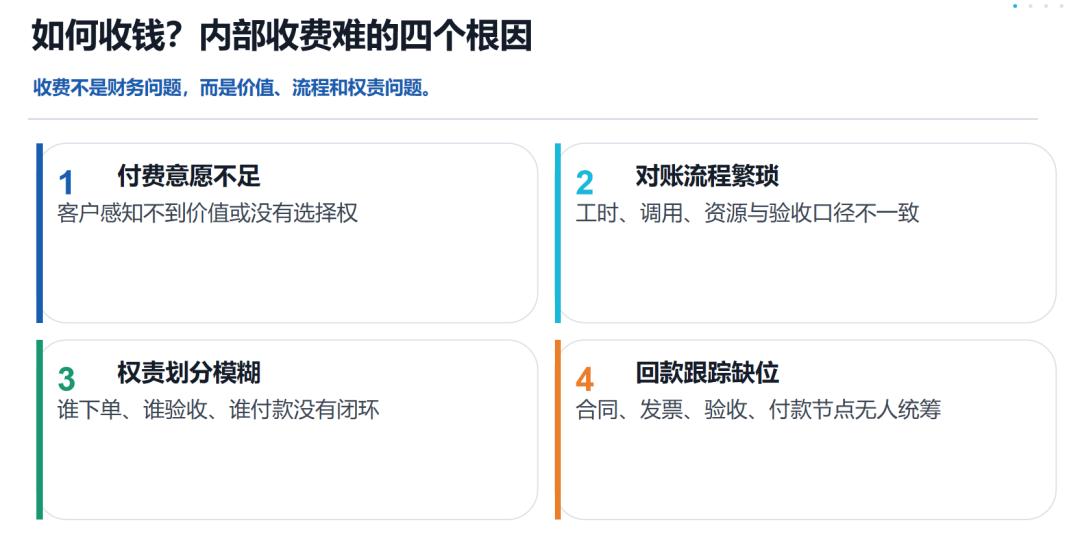
Lao Yang believes that there are four reasons for the difficulty of internal charging for digital technology companies:
1. Customers do not recognize the value; they do not think the service is worth the price.
2. Reconciliation is troublesome; there are different calculation standards between each subsidiary/branch and the digital technology company for calculating man-hours, recording call volumes, allocating resources, and determining the acceptance criteria, and they will fall out whenever they reconcile accounts.
3. Unclear rights and responsibilities; no one in the subsidiaries and branches is responsible for placing orders, acceptance, and payment, and everyone shifts the blame to others.
4. No one follows up on payment collection; the four nodes of contract, invoice, acceptance, and payment are managed by different teams separately.
The most troublesome thing is price comparison. Internal customers will use the low prices in the market to pressure the digital technology company. At this time, the digital technology company has neither cost advantage nor brand advantage, and it is very easy to be labeled as "not cost-effective".
Take a certain digital technology company as an example: the project has been carried out for three months, but the contract is still in the price comparison stage. The procurement staff holds the quotation from outside and asks, why are you 20% more expensive? The project leader cannot explain it clearly, and can only say that they know the business better. In the end, the price was cut by 30%, the service boundary was not clearly defined, the project was delayed for another 8 months, and the payment was nowhere in sight.
Therefore, for pricing, digital technology companies must first figure out what basis they are pricing on.
Pricing based on cost is easy to calculate, but has the highest risk — quoting based on cost is equivalent to exposing your own low efficiency.
Pricing based on market conditions is convenient, but it is often impossible to find a comparable market price for internal business.
Pricing based on value is the hardest to calculate, but also the most worthy of sticking to. If you can calculate how much cost you help the customer save, or how much extra revenue you help the customer earn, the price will be well-founded.
Internal settlement price usually falls into the first pit. Adding a little profit on top of cost seems reasonable, but in essence it is using the group's budget to subsidize your own low efficiency.
Another point that managers of digital technology companies tend to ignore is the credit period. It is not just a financial detail, but part of the business model. If you agree on a 3-month credit period, it is equivalent to providing the subsidiary with a 3-month interest-free loan. If this part of cost is not included in the quotation, the gross profit obtained by the digital technology company is fake.
V. When Should You Expand to the Outside Market
Lao Yang believes that before expanding outside, you must first see clearly the situation in the external market.
The market has changed twice in the past two years.
