The hardest-hit sector has spawned a four-bagger that has surged four times in value.
In 2025, only 30.2% of household TVs were turned on during the statistical period, and more than 70% of TVs have been in hibernation for years.
However, against the backdrop of declining TV sales year by year, Hisense Visual Technology, the leading player in the industry, has bucked the trend and achieved remarkable performance in recent years.
Since 2022, the share price of Hisense Visual Technology has started from a low of around 5.78 yuan, and has now risen to 27.98 yuan, surging by more than 400%, gradually approaching the all-time high recorded in 2015.
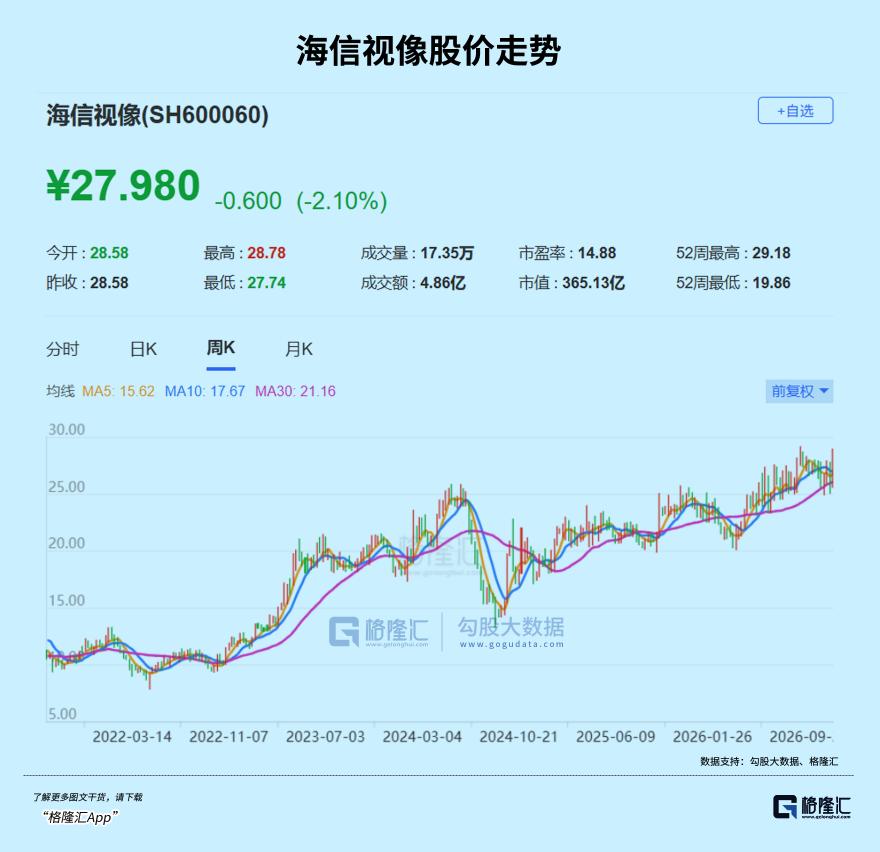
In a track that countless people have judged as a sunset industry, a stock that has quadrupled in four years has unexpectedly emerged.
01
We are now in an era of scarce attention.
Mobile phones and tablets are taking up most of the fragmented time for the majority of people. According to a JD survey, more than 45% of users gave up buying TVs because mobile phones and tablets are more convenient.
At the same time, the TV's own usage experience drawbacks, such as unskippable boot ads, nested membership systems, and unfriendly operation interfaces for the middle-aged and elderly, are gradually pushing audiences away.
With the superposition of multiple factors, it is almost inevitable that TVs are left idle in the corner of the living room gathering dust.
In 2024, stimulated by government subsidies, the color TV industry achieved double-digit growth, with full-year retail sales reaching 127.1 billion yuan, a year-on-year rebound of 15.7%, but retail volume fell slightly by 1.8% instead.
The deviation between sales volume and value speaks for itself. Sure enough, in the second half of 2025, as the subsidy quota was exhausted and the stimulus effect faded, the market changed rapidly, with retail volume plummeting 20.0% year-on-year in the second half of the year.
During the 2025 Double Eleven promotion period, total channel retail sales fell 22.9% year-on-year.
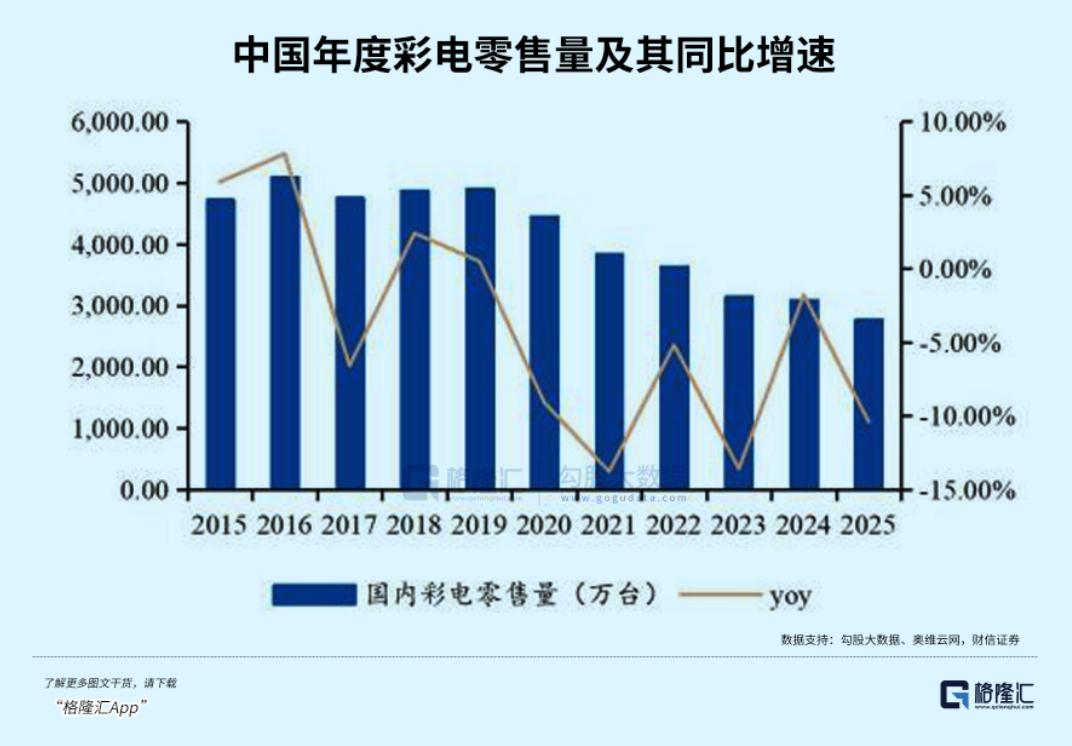
This led to China's color TV retail volume reaching 27.63 million units in 2025, down 10.4% year-on-year, falling below 30 million units for the first time in nearly a decade.
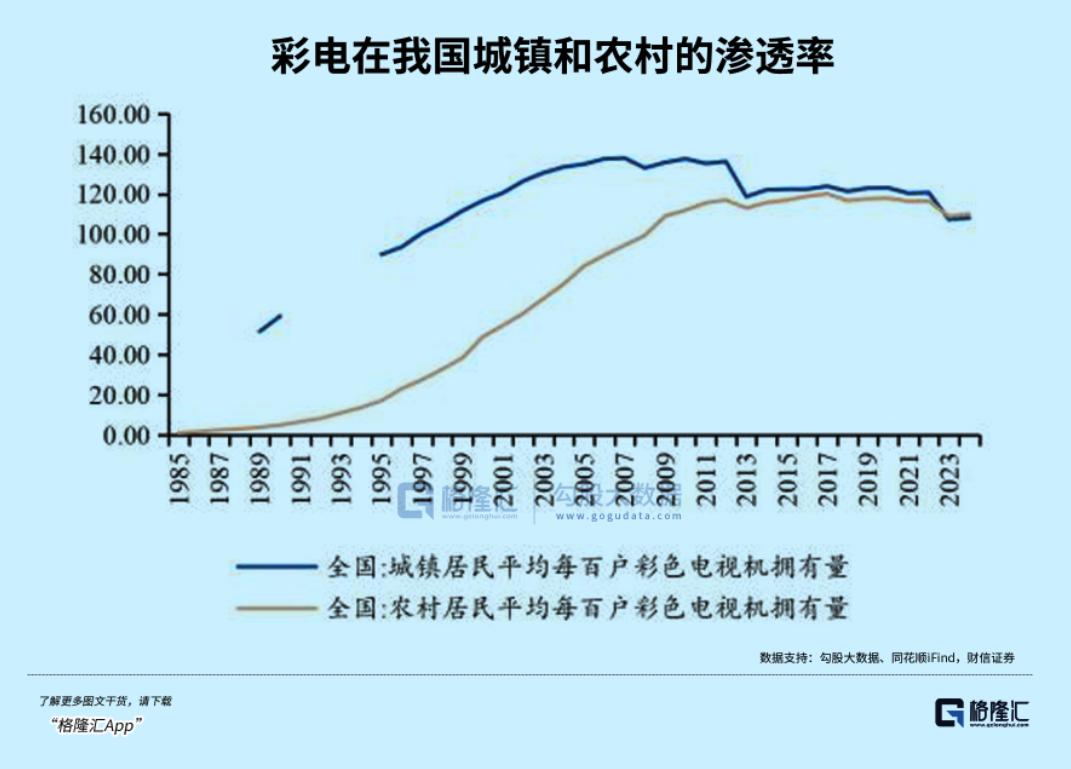
The ownership of color TVs in Chinese households has also been saturated, reaching 108.7 units per 100 households, with Shanghai, Jiangsu and Zhejiang even approaching 150 units, and the ownership of color TVs by both rural and urban residents has approached the peak.
The 7-8 year replacement cycle also means that the annual replacement scale has hit the ceiling.
But on the other side of these data, the color TV market has begun to change.
Data from AVC (All View Cloud) shows that in 2025, the retail volume of color TVs fell by 10.4% year-on-year, while retail sales only fell by 7.3%. The steeper decline in volume than in value means that the average price of each TV sold is on the rise.
Also in 2025, the retail volume share of MiniLED TVs in the Chinese market surged to 31.8%, and its retail sales share was as high as 55.4%.
In other words, for every three TVs sold, one is a MiniLED TV.
Also in this year, the retail volume share of color TVs in the price segment below 4000 yuan decreased by 2.5 percentage points, the share of the 4000-10000 yuan price segment increased by 1.8 percentage points, and the share of the high-end market above 10000 yuan is also expanding.
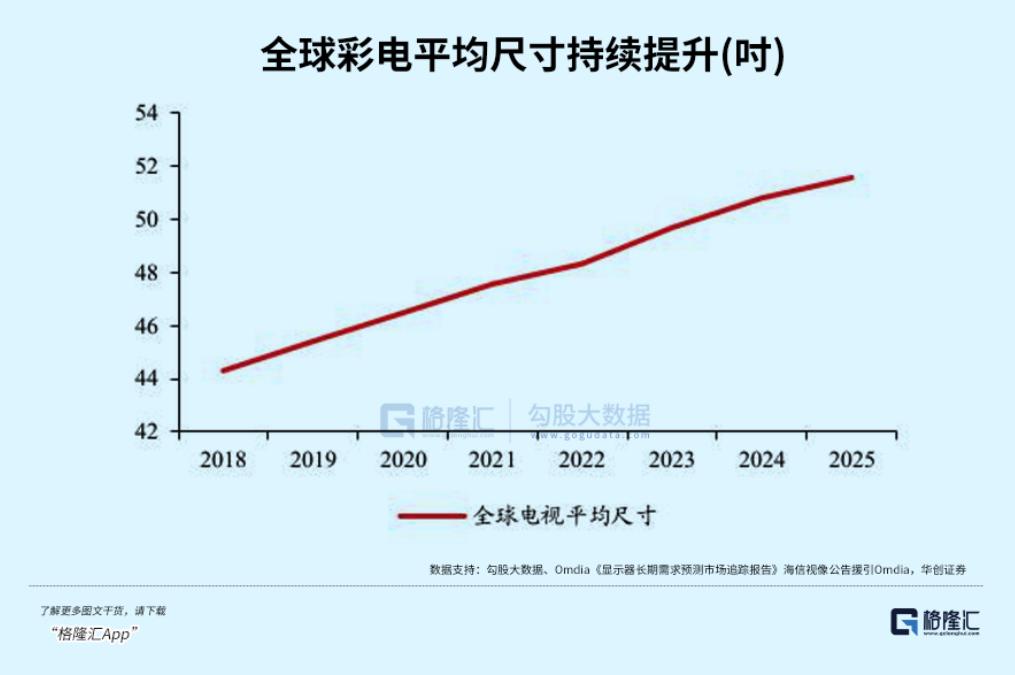
The average size of the industry is approaching 65 inches, and 75-inch and 85-inch TVs are gradually breaking through the market.
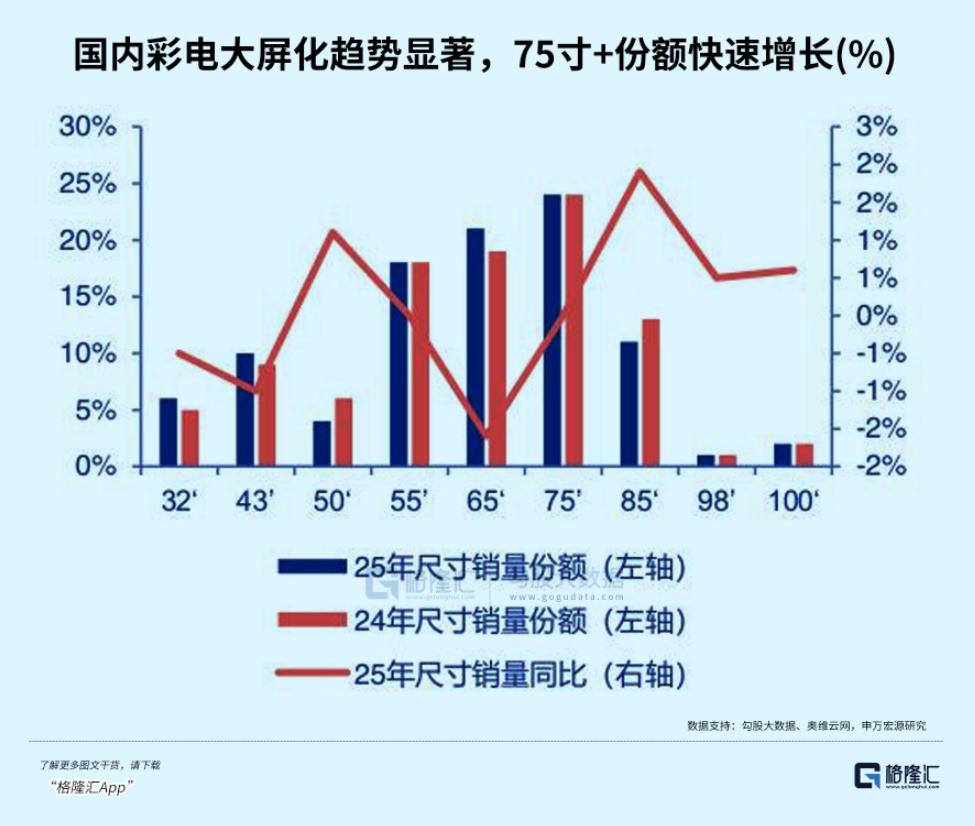
In other words, the number of people buying TVs may be decreasing, but those who are replacing their TVs are more willing to pay more for larger screens and better picture quality.
Against this background, the stock price and performance performance of Hisense Visual Technology in recent years no longer seem abrupt.
02
In the past two years, the most important change in Hisense Visual Technology's performance is the product structure upgrade brought about by the high-end transformation.
In 2025, the company's revenue was 57.68 billion yuan, a slight year-on-year decrease of only 1.5%, but its attributable net profit was 2.45 billion yuan, a year-on-year increase of 9.2%, and its gross profit margin rose from 15.66% to 16.7%.
In the first three quarters of 2026, the growth slope of the profit side became even steeper: the company's revenue only increased by 3.7%, while the growth rate of attributable net profit reached 13.23%.
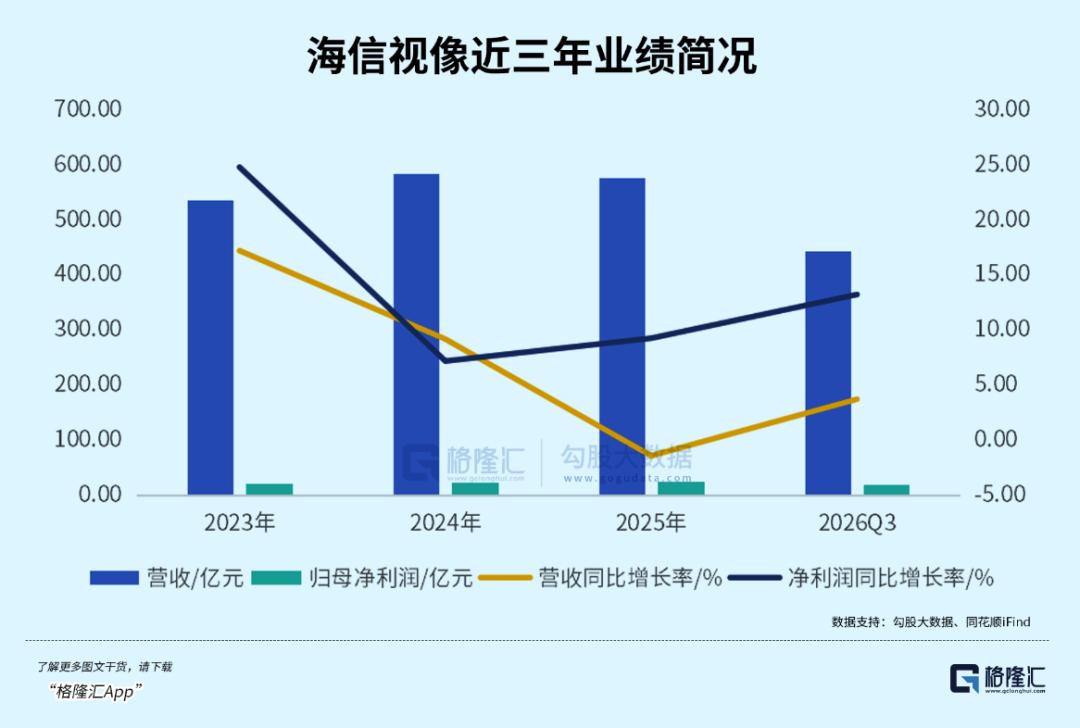
The scissors gap between revenue and profit growth is a concrete manifestation of the change in product structure.
According to AVC data, in the first three quarters of 2026, the sales volume of Hisense RGB-Mini LED TVs increased by more than 10 times compared with the whole year of 2025, and the sales volume of large-screen TVs of 100 inches and above increased by 47.4% year-on-year, with a market share of 51.9%.
However, product structure upgrade alone is not enough to fully explain Hisense's counter-trend growth.
While the retail volume of the Chinese market is shrinking, Hisense's domestic sales share is still rising, which means it has taken over the share of other players in the stock market.
And the greater increment comes from overseas —
In 2025, Hisense TV's global shipment share reached 14.56%, narrowing the share gap with Samsung from 2.9 percentage points to 2.7 percentage points.
The overall global color TV shipments fell slightly by 0.7% in 2025, while Hisense's shipments achieved a positive growth of 1.4%.
In a zero-sum game market, the growing share of Chinese brands means the shrinking share of Japanese and South Korean brands.
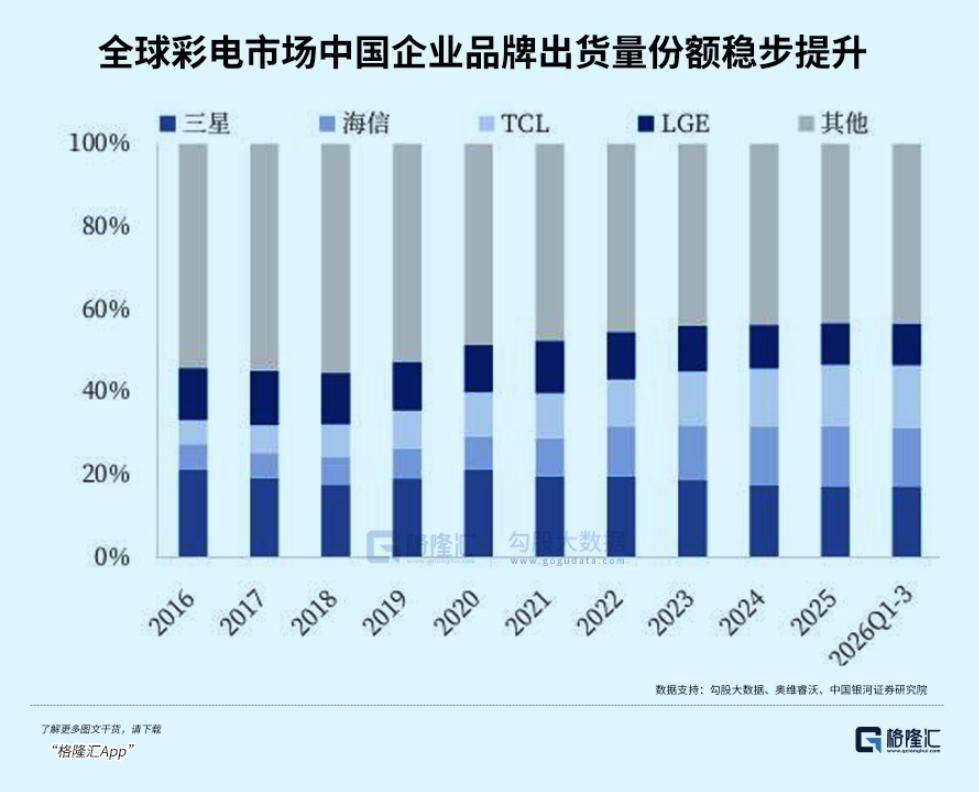
In the past few years, Samsung swung between MiniLED and OLED, and LG focused excessively on OLED, which gave Hisense a time window to build a generational gap along the MiniLED technology route.
Hisense took the lead in mass-producing RGB-MiniLED in 2025, jumping from monochrome backlight to three-color backlight, followed by Samsung and Sony.
In an industry where the technical route has not been fully finalized, the ability to mass-produce a technology with perceivable differences and control its cost also constitutes its own unique technical barrier.
With the mass production of MiniLED, the core problems that the color TV industry has been criticized for in the past have been partially resolved here.
For a long time, the valuation of the black home appliance sector has been firmly suppressed below that of the white home appliance sector, and an unavoidable reason is that its business model is too tough.
Panels account for a high proportion of the cost, brand premium is thin, net profit margin has long been at the single-digit level, and the industry pattern is far more fragmented than that of white home appliances.
When a TV is sold, most of the money goes to the upstream panel manufacturers, and the brand owners only earn hard money from assembly and distribution channels.
However, the large-scale application of MiniLED has changed this situation —
Because consumers are more sensitive to parameters such as the number of backlight partitions, peak brightness and color gamut control, and are willing to pay for them, the brand's pricing power has thus changed.
The valuation logic of the home appliance sector may also change accordingly.
03
For many years in the past, the pricing logic of color TV stocks in the capital market has shown strong cyclical characteristics —
When panel prices rise, the gross profit of complete machine manufacturers is under pressure; when panel prices fall, profit elasticity is released.
Large fluctuations in sales volume dominate profit expectations, and valuations rise and fall accordingly.
AVC predicts that the domestic color TV market size in 2026 will be about 27 million units, almost halved compared with the peak in 2016. Low growth or even slight decline in total volume will become the norm, and the industry total volume may find a new weak balance around 27 million units.
Under such a total volume background, it is almost impossible for the color TV industry to return to the era driven by sales growth, but this does not mean there is no investment narrative.
At present, the average size of color TVs in China is 64.8 inches, which has led the global average of 54.1 inches.
However, compared with the physical space of the consumer's living room wall, the penetration of TVs above 75 inches and even 85 inches still has visible room for growth, which means that the ceiling of large-screen development is far from being reached.
While the penetration rate of MiniLED is approaching 40% from 28.9% in 2025, RGB-MiniLED has opened up a new ASP (average selling price) increase channel in the sub-high-end price range.
In the past, the market gave low valuations to black home appliances because they had no differentiated advantages, profits were concentrated in the upstream, and the final pattern was highly uncertain. But now, the situation is changing in many aspects.
The unit value of large-screen and MiniLED TVs is much higher than that of ordinary LCD TVs. When the weight of these two types of products in revenue rises, even if total sales do not grow, the profit base will be raised, and the profits of complete machine manufacturers will no longer be completely determined by marginal fluctuations in panel prices.
Hisense Visual Technology achieved nearly double-digit profit growth in 2025 with almost flat revenue, which has proved the existence of this buffer effect.
Secondly, the competitive pattern is converging.
Previously, Samsung dominated the global TV market, with Chinese brands playing supporting roles.
Now, the gap between the three top players Samsung, TCL and Hisense has narrowed sharply, and Chinese brands have formed local technical discourse power in MiniLED, large-size panels and laser display.
The integrated TV policy promoted by the National Radio and Television Administration has gradually entered the large-scale promotion period. The set-top box function is built in the form of software, the universal remote control can directly access live broadcast with one click, and boot ads and nested charging items are cleaned up.
If this round of experience optimization can be implemented, it may have a certain pulling effect on the boot rate and replacement willingness of TVs.
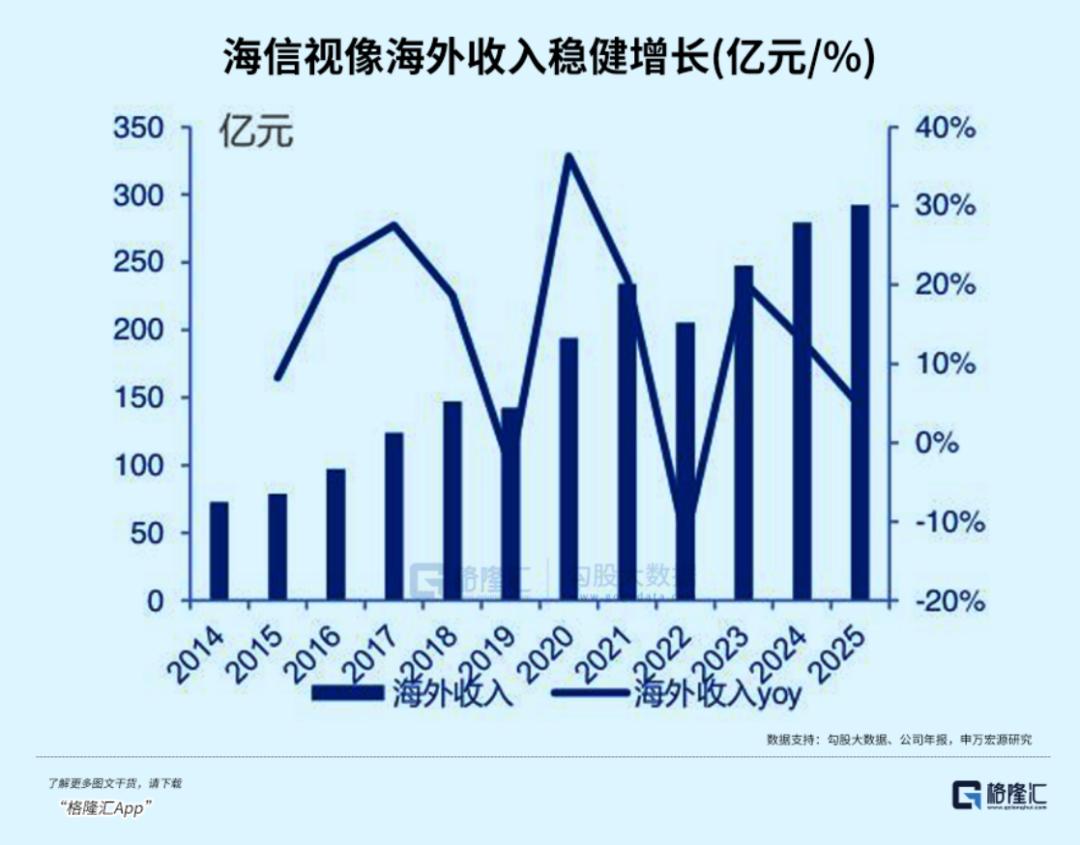
Overseas markets are also bringing more certain increments.
At the 2026 FIFA World Cup in the United States, Canada and Mexico, Hisense, as the official sponsor for three consecutive sessions and VAR display technology partner, has seen its overseas brand awareness rise from 37% to 58%.
In recent years, Hisense's overseas revenue has also been growing steadily.
However, at present, the overall PE center of the black home appliance industry is not low.
The PE of Shenwan Black Home Appliance Index is about 28 times, which does not look cheap. The reason is that some companies in the sector with low profit base or large differences in business structure have pushed up the overall average.
If we take leading complete machine manufacturers such as Hisense Visual Technology and TCL Electronics as the anchor, the actual PE operating range of sector leaders is 12-15 times.
In the past, the low prosperity of the industry's total volume led to suppressed valuations, while structural upgrading and overseas expansion have left room for correction of the valuations of leading players that were once suppressed to the extreme.
But this space is also gradually narrowing.
After the national subsidy faded in the second half of 2025, domestic retail volume fell by 20% in a single half-year, and domestic shipments in 2026 are expected to drop by another 6% to 8%.
Although panel prices were relatively moderate in 2025, data from Omdia shows that the cash cost of 65-inch LCD Open Cell is expected to rise from 112 US dollars in 2025 to 116.8 US dollars in 2026, and further rise to 124.55 US dollars in 2027.
The panel is the largest single cost item of a TV, and price increases will put pressure on the whole industry.
If panel costs continue to rise beyond