Mathematicians from Company A used Claude to prove another Millennium Prize Problem, bringing to light a 940-page fully human-written manuscript that had been worked on for 12 years.
The news of the Riemann Hypothesis has not been fully digested, yet another Millennium Prize Problem has been proven by the same mathematician, who also collaborated with Claude on the proof.
On one side is the Riemann Hypothesis, which concerns the distribution of prime numbers; on the other side is the Navier–Stokes existence and smoothness problem, which focuses on whether the equations describing the motion of water and air can always yield smooth solutions.
Behind both claims is 34-year-old Levent Alpöge, a mathematician at Anthropic.
On November 20, Alpöge and Tristan Buckmaster, a professor at New York University, published a paper claiming to have proven finite-time blowup of the 3D Navier–Stokes equations without external force.
The paper totals 79 pages, and the Lean formal proof code is also made public at the same time.
Terence Tao has also published a dedicated post discussing this work. He believes that the general strategy of this NS proof is clear, but it still needs to be further organized into a standardized, professional proof text. Whether the two claims can stand firm will depend on independent verification in the next step.
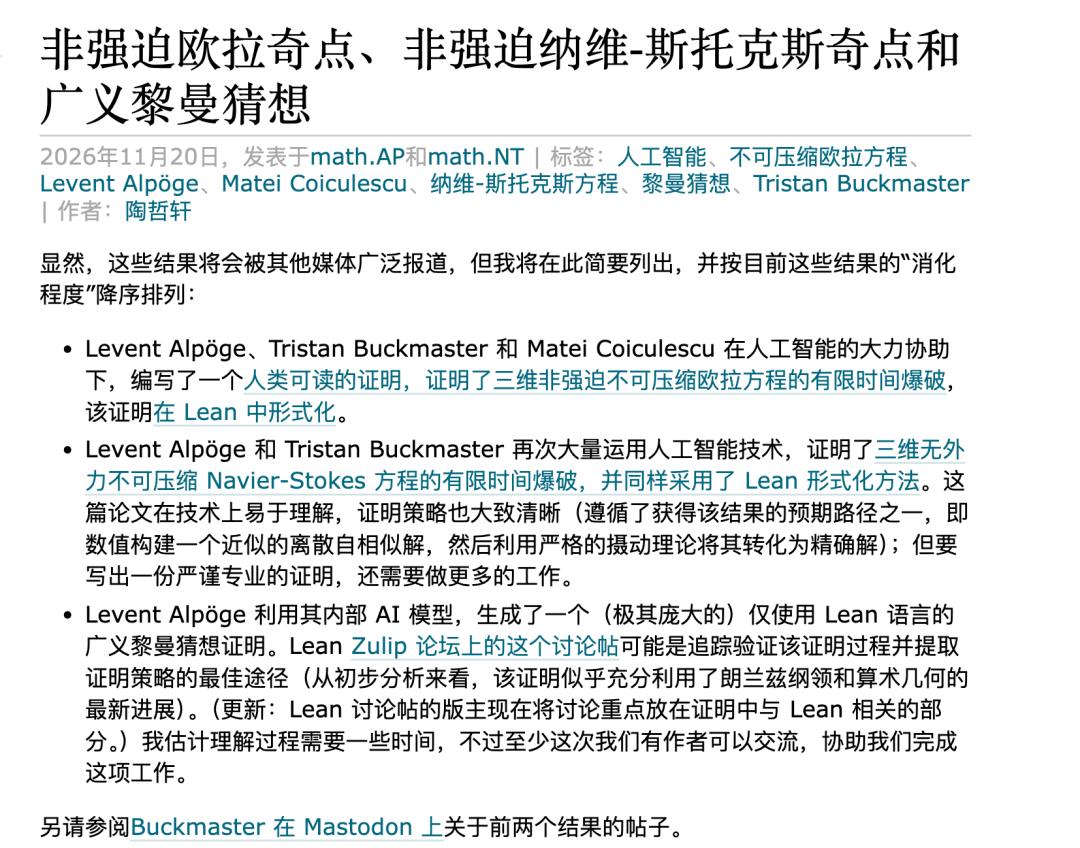
A mathematician working at Anthropic, joined by university peers and partnering with Claude, released proof claims for two Millennium Prize Problems in a single day — this leaves no time for other mathematicians who still insist on "manual derivation" to catch their breath...
But human mathematicians are not showing weakness, and they have already started to "fight back"!
Alessandro Maria Masullo, a mathematician based in Rome, Italy with a PhD in mathematics from Stanford University, released a "version for all humanity" draft proof of the Riemann Hypothesis on the same day.
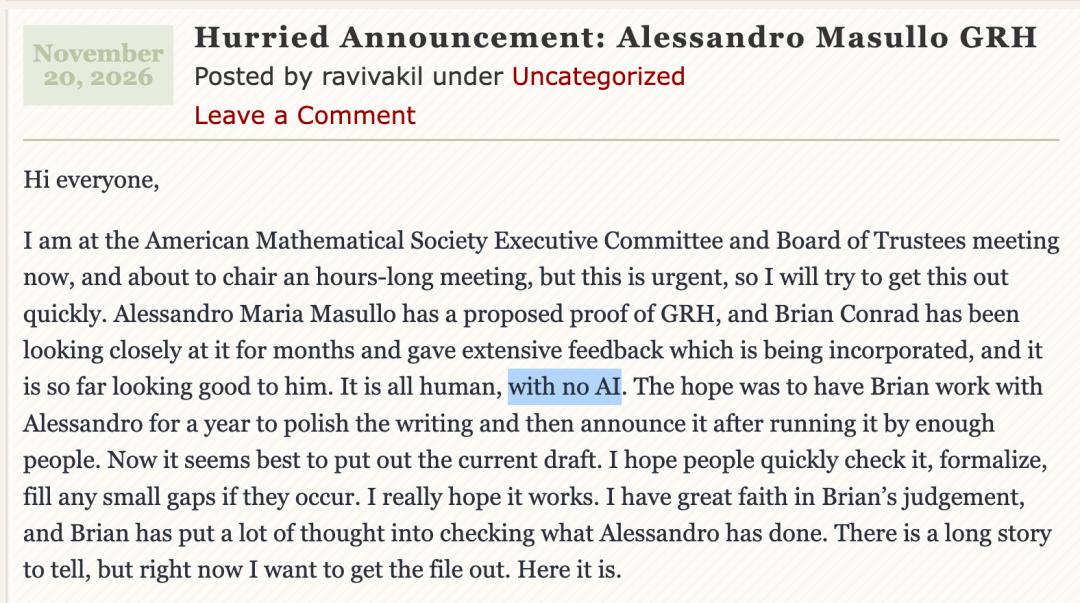
Ravi Vakil, president of the American Mathematical Society (AMS) who released the draft on his behalf, emphasized that this proof draft does not use AI.
Alessandro Maria Masullo wrote in the acknowledgements that this research took nearly 12 years in total. He originally planned to revise it slowly, clarify his ideas, and formally publish it after more colleagues had checked it. But under the current research environment, he followed the suggestion and released the existing version first.
He left a sentence for mathematicians who feel frustrated by the current research rhythm and atmosphere, which roughly means:
"We are still here, and we will not leave."
The breakthrough of AI is impacting the mathematics community, but there are still scholars who insist on doing research, writing decades of accumulation into thick manuscripts, and continuing to find answers to the problems that have plagued humanity for a long time.
So inspiring! Right?
No external disturbance, can fluid also "blow up"?
First let's talk about what this paper is actually studying.
Navier–Stokes, abbreviated as NS, is a set of equations describing how fluids such as water and air move. It focuses on: how the fluid flows initially, and how the velocity and pressure at each position will change afterwards.
This problem can be roughly understood as follows:
Stir the water first, then take away the spoon and stop applying external force. As the mass of water moves on its own, will an extreme situation occur at a certain moment, which will invalidate the originally applicable mathematical model and make it impossible to continue to accurately describe the change of water flow?
The "blowup" mentioned here refers to this situation. More specifically, near a certain finite moment, the velocity may become unbounded, and the original smooth solution cannot be extended further.
Mathematicians want to know whether flows that meet the specified conditions can remain smooth forever.
The answer given by Alpöge and Buckmaster this time is: counterexamples exist.
In this 79-page paper, Alpöge and Buckmaster claim that they have constructed such a flow: it is smooth at the beginning, with no continuous external force driving it, but singularities will appear in finite time afterwards.
This claim involves both the ordinary 3D space and the periodic space scenarios.
This is also where the value of this problem lies — to negate the statement that "all flows that meet the conditions can remain smooth forever", finding one strictly valid counterexample is sufficient.
Image generated by AI
What they claim to have provided is a negative answer to the Millennium Prize Problem of NS existence and smoothness.
This is not their first study on fluid blowup.
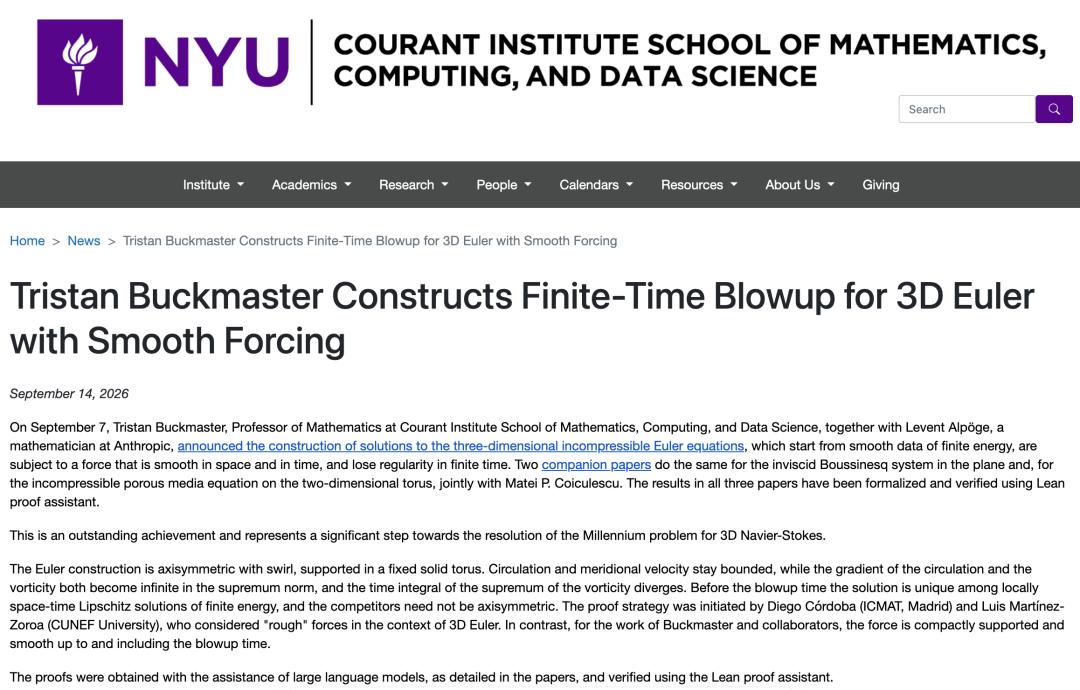
In September this year, the two have already announced the blowup result of the 3D Euler equations with smooth external force. The Euler equations do not consider viscosity, while the NS equations retain viscosity, which is the property that friction is generated inside the fluid and dissipates the kinetic energy of motion.
The change this time is: the external force is removed, the viscosity is retained, and they still claim to have found an example of blowup.
It seems that only a few words of the conditions have been modified, but the obstacles that the proof needs to cross have changed. This new proof shows that even without external force driving, viscous fluids may also develop singularities.
Therefore, this theory can be applied to more scenarios, and it also shows that it is more reliable than previously thought.
A number theorist, how did he start researching fluid dynamics with Claude
The same name appears in two consecutive high-profile major problems, what is the background of Alpöge?
His resume belongs to the type that was noticed by the mathematics community very early.
He studied as an undergraduate at Harvard, majoring in mathematics, graduated with a perfect 4.0 GPA, and also obtained a master's degree in physics at the same time. After that, he went to Princeton to pursue a PhD in mathematics, with his supervisor being Fields Medal winner Manjul Bhargava.
After graduating with a PhD in 2020, he worked as an NSF postdoctoral fellow, and became a Junior Fellow of the Harvard Society of Fellows.
In 2015, he also won the Morgan Prize, which recognizes undergraduate mathematics research. This award is given based on the research results that have already been achieved.
His academic accumulation is mainly in number theory, including elliptic curves, as well as the problems of integer points and rational points of polynomial equations. Among the works listed on his personal website, there is also a co-authored paper with Bhargava, Wei Ho and Ari Shnidman that studies Hilbert's tenth problem on the ring of integers of number fields.
In other words, before this round of news, he already had a solid research resume.
When he crossed over to fluid equations this time, his collaborator Buckmaster has long studied partial differential equations and fluid problems, and won the Clay Research Award in 2019.
One has a background in number theory and AI, the other is familiar with fluid equations, and the collaboration between the two has a clear professional origin.
After introducing the professional backgrounds of the two, the next question that everyone is most concerned about is: what role did Claude play?
The public excerpt from the AI statement in the paper gives a clear message: This NS work used Anthropic's Claude model throughout the whole process, and no other models were used.
Judging from public materials, Claude has participated in the generation, organization and rewriting process of the proof.
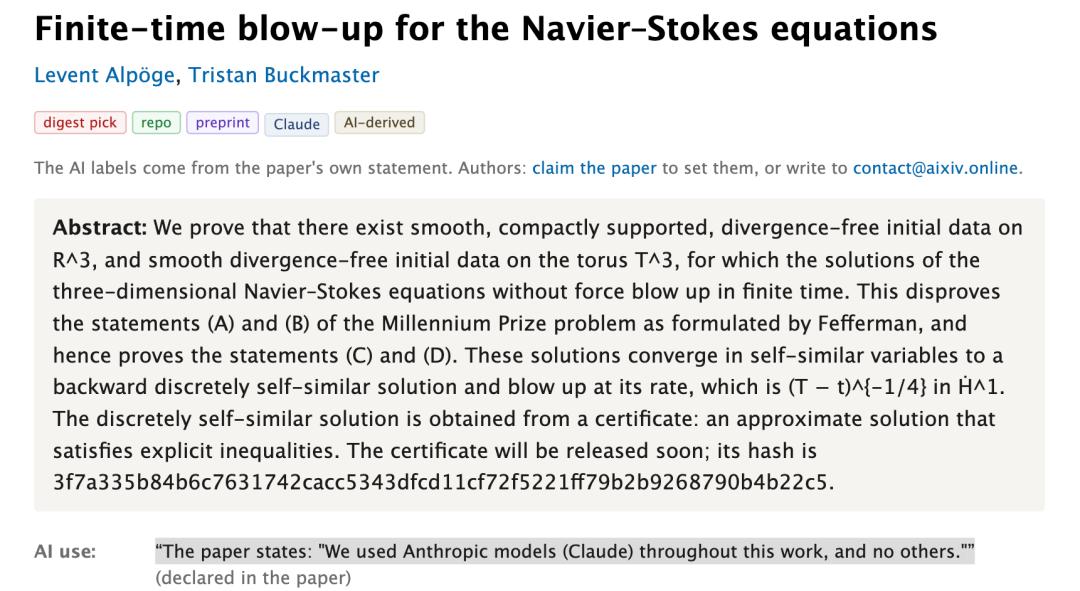
The writing sequence this time is also very interesting.
The authors disclosed that they had the Lean formal proof first, then generated the first draft of the paper based on it, and continued to rewrite afterwards, replacing some lengthy proofs with existing standard results, and simplifying some arguments.
The public paper statement also mentioned that the first draft used the tool developed by Scott Armstrong to convert Lean proofs into natural language papers, and then the authors guided Claude to rewrite it.
The goal of this set of tools made public by Armstrong is to organize formal code into proof texts that mathematicians can read, check and learn from.
Therefore, AI has participated in links such as proof generation, formal content organization and paper rewriting. Mathematicians continue to guide and revise the arguments, and organize the machine-generated content into communicable mathematics.
As for how this proof specifically constructs the fluid, Terence Tao gave a general route: first find an approximate flow with a special self-similar structure through numerical methods, and then use rigorous perturbation theory to prove that there does exist a real solution satisfying the equation nearby.
In simple terms, it is to find a candidate first, and then prove that it is indeed valid. What "looks like" on the computer has to be turned into mathematical "definite existence".
This is not the first time Alpöge has appeared in mathematical achievements together with Claude this year.
Haider has compiled a list on X starting from July, covering multiple directions such as the Jacobian conjecture, Hadamard matrices, elliptic curves, and fluid equations.
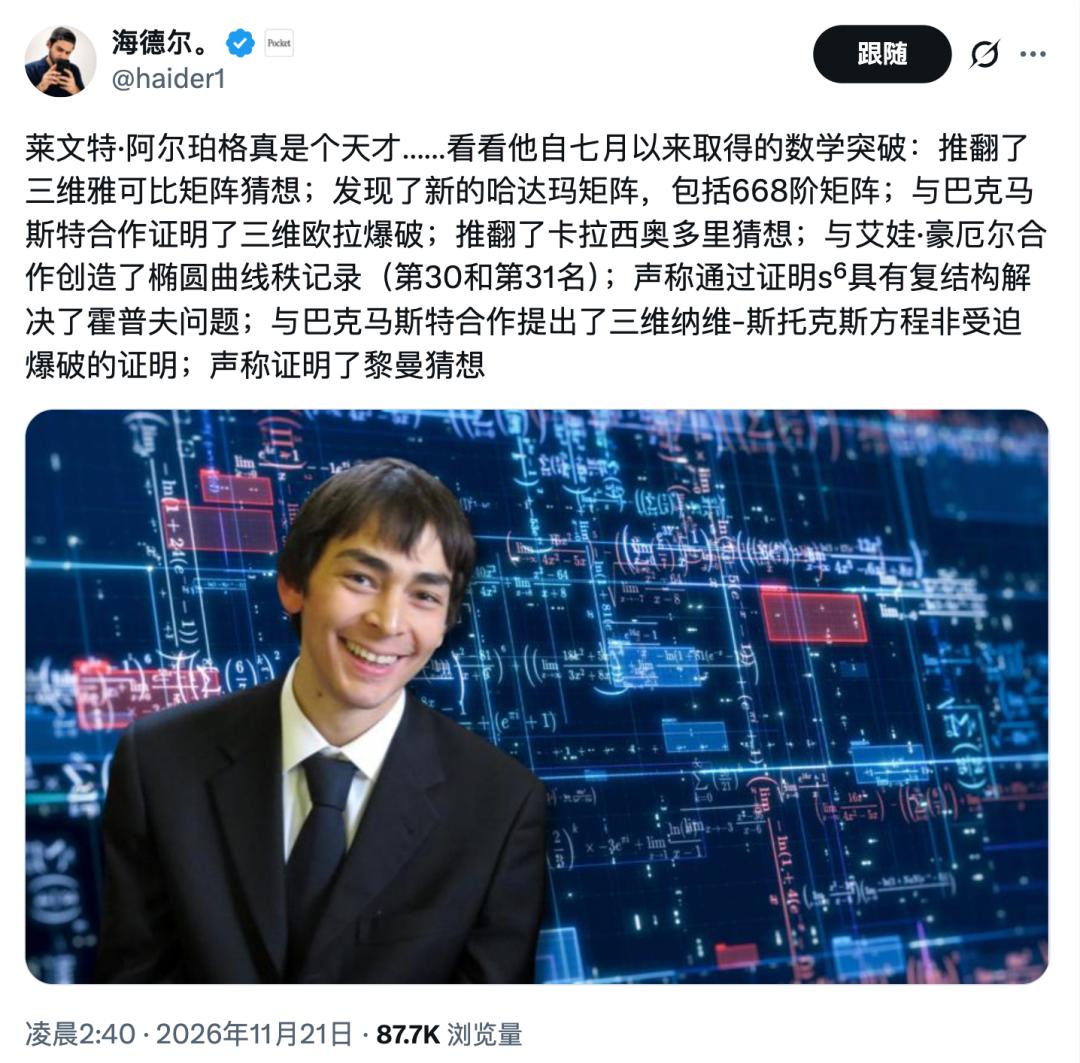
However, the public and verification status of these projects are not consistent, and they cannot be directly combined into "all eight major problems have been solved".
One of the works whose original paper can be clearly traced back took place in August.
In the paper published by Alpöge and Ralph Furman, the lower bound of the proportion of non-trivial zeros of the Riemann function that can be proven to be both simple zeros and located on the critical line is pushed to more than two-thirds.
The paper clearly notes that the proof was independently discovered by Claude, and the listed authors are responsible for verification and communication.
In September, it was the fluid equation blowup work he cooperated with Buckmaster.
On November 20, the full proof claims of the Riemann Hypothesis and unforced NS blowup were made public on the same day.
Two Millennium Prize Problems appeared on the same day, and mathematicians also started to play memes
Scott Armstrong, a mathematician who serves as a CNRS research director at Sorbonne University in France and has long studied partial differential equations, probability theory and mathematical physics, used a highly contrasting opening when he reposted this achievement:
"In lesser news".
It can roughly be translated as "there is also a small piece of news".
In front of the proof claim of the Riemann Hypothesis, even news as important as unforced NS blowup cannot make the headlines.
Another Spanish mathematician Gonzalo Cao-Labora, who studies partial differential equations, also reposted this achievement, deliberately capitalizing "UNFORCED" to emphasize that this time the unforced scenario is processed.
However, for all the excitement, mathematics is a rigorous science, and subsequent inspection of arguments and independent rechecking of calculations must be carried out step by step.
Terence Tao listed the three works published at the same time in order according to the current degree of understanding and digestion: unforced Euler, unforced NS, and the generalized Riemann Hypothesis.
For NS, he believes that the general proof strategy of the paper is clear, but it still needs to be further organized into a standardized, professional proof text.
This evaluation not only shows that the work already has a specific route that can be discussed, but also retains its state of being yet to be perfected.
The publicly opened repository of the authors also lists the parts that the outside world cannot fully verify at present.
Image generated by AI
The most critical one is that the numerical certificate supporting the proof construction has not been made public. It can be understood as a set of specific data that needs to be strictly calculated to confirm that it indeed meets the conditions required by the proof.
The repository notes that this set of data and related verification calculations are not yet included in the public version. In addition, the Lean package that was patched on the release day has not been rebuilt when the repository is assembled.
Therefore, "having a paper and having Lean code" cannot be directly simplified as "the outside world has completed full verification".
What we need to see next is when the certificate will be made public, whether the calculation can be reproduced, whether the formal code can be independently checked, and whether experts can confirm that the paper, code and the claimed conclusion do correspond to each other.
If all these links can withstand inspection, the significance of this result will naturally be extremely great.

Image generated by AI
At present, there is already a gap between the progress of AI participating in generating proofs and the progress of human understanding and verifying these proofs. After Alpöge and his collaborators released the paper, there are still many things for peers to do next.
One More Thing
On the same day, there was another mathematician who presented his nearly 12 years of research to the outside world.
His name is Alessandro Maria Masullo, who holds a PhD in mathematics from Stanford University, and his research involves number theory and arithmetic geometry. This time he presented a 940-page draft proof of the generalized Riemann Hypothesis titled "The Music of Primes".