Just now, Claude's proof of the Riemann Hypothesis has passed verification! A Fields Medalist responded to the statement that "Mathematical research no longer exists".
Report from Zhidx on November 22: Today, Lean FRO, the core R&D and maintenance body for Lean, and Mathlib Initiative, the ecological support and coordination body for the Mathlib ecosystem, released a joint statement on the Lean formal proof verification of the Riemann Hypothesis, stating that Levent Alpöge's proof of the Riemann Hypothesis is correct and congratulating him on achieving this milestone.
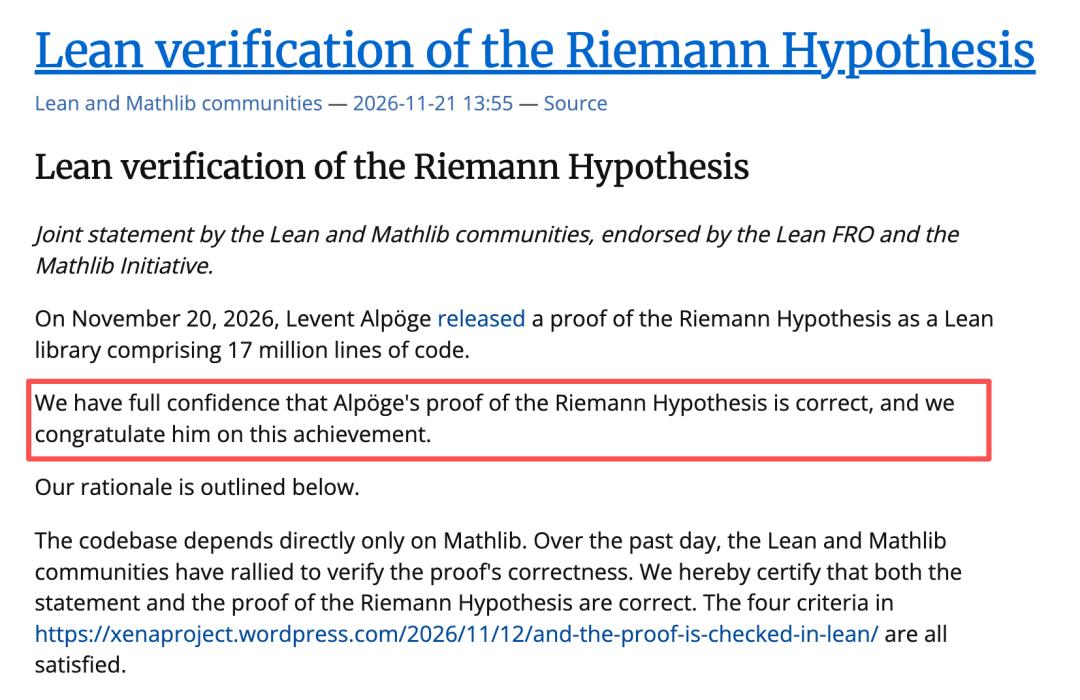
▲ Joint statement from the two institutions
After the Lean verification, Ngô Bảo Châu, the 2010 Fields Medalist and recipient of the Clay Research Award, endorsed Levent Alpöge's proof of the Riemann Hypothesis, and commented that people who prematurely claim that mathematical research is approaching its end are likely wrong. AI will instead promote further prosperity of mathematics and realize the democratization of mathematics.
He pointed out that the competitiveness of future mathematical research will no longer mainly depend on the ability to build complex proof chains, but on the ability to raise good questions, observe and explore. Machines may already be better than humans at proving difficult problems, but mathematicians do not need to be frustrated by this. Instead, they should regard AI as a new research tool and information source, and extract new theories and insights from it.
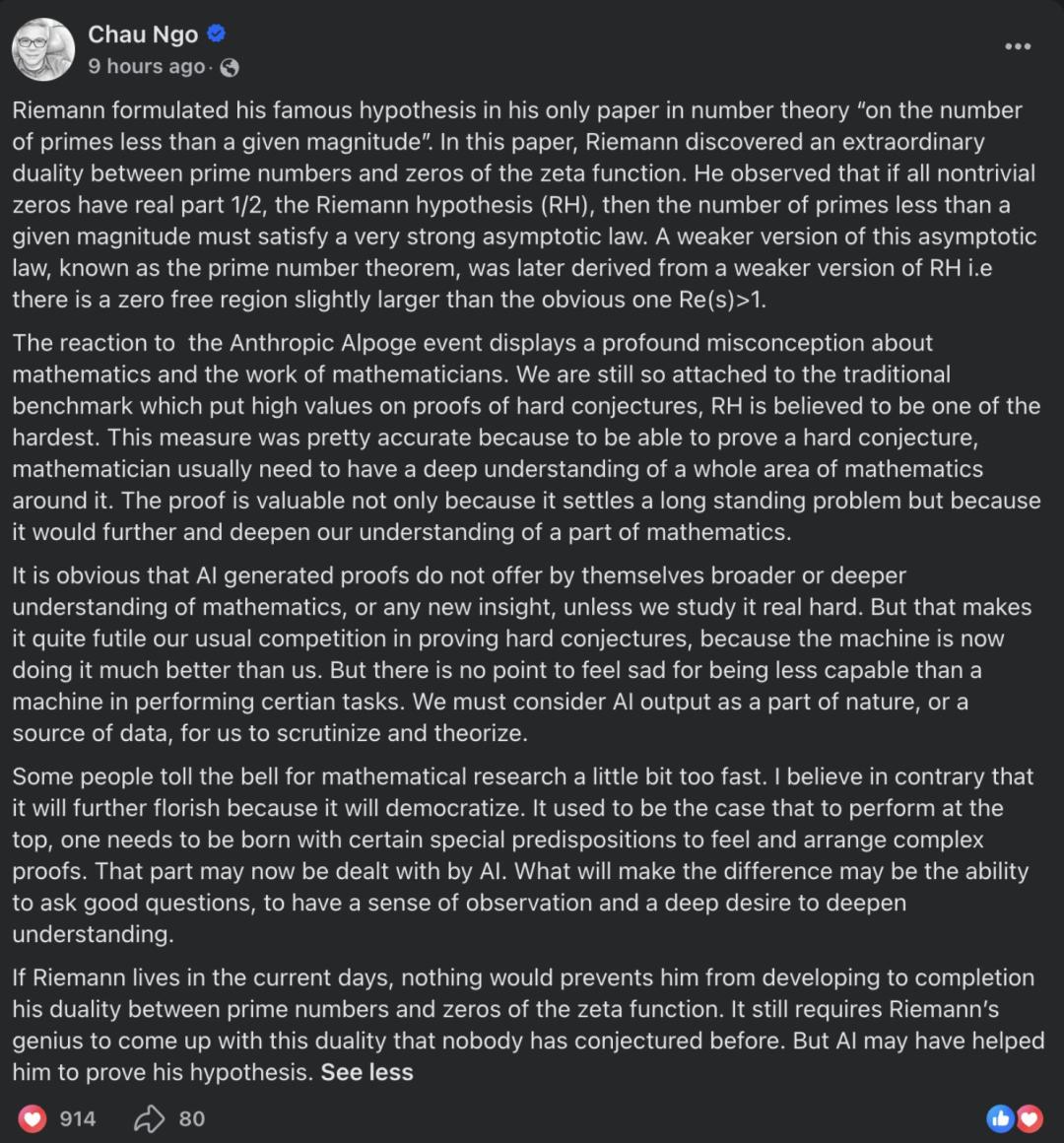
▲ Evaluation from Ngô Bảo Châu (Image source: Internet)
Earlier on the evening of November 20, Levent Alpöge, a mathematician at Anthropic, released a statement on his personal website, claiming that he collaborated with Claude to find a proof method for the Riemann Hypothesis and its stronger version, the Generalized Riemann Hypothesis (GRH).
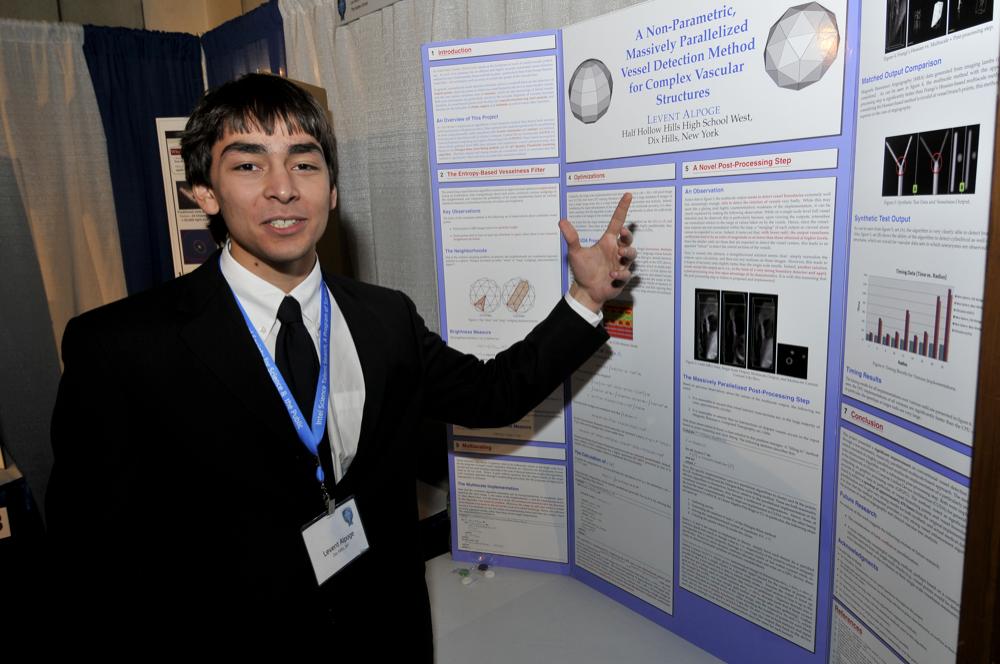
▲ Levent Alpöge, mathematician at Anthropic (Image source: Personal homepage)
Alpöge revealed that the text proof generated by him and Claude exceeds 250,000 pages, which was not finally made public due to its excessive length and difficulty in reading. Instead, a 4-page description and Lean formal proof code divided into 14 compressed files were released. This set of code has about 17 million lines.
It is also worth noting that Ravi Vakil, president of the American Mathematical Society, announced on the same day a candidate proof of the Generalized Riemann Hypothesis of about 940 pages written by mathematician Alessandro Maria Masullo, and emphasized it is all human, with no AI.
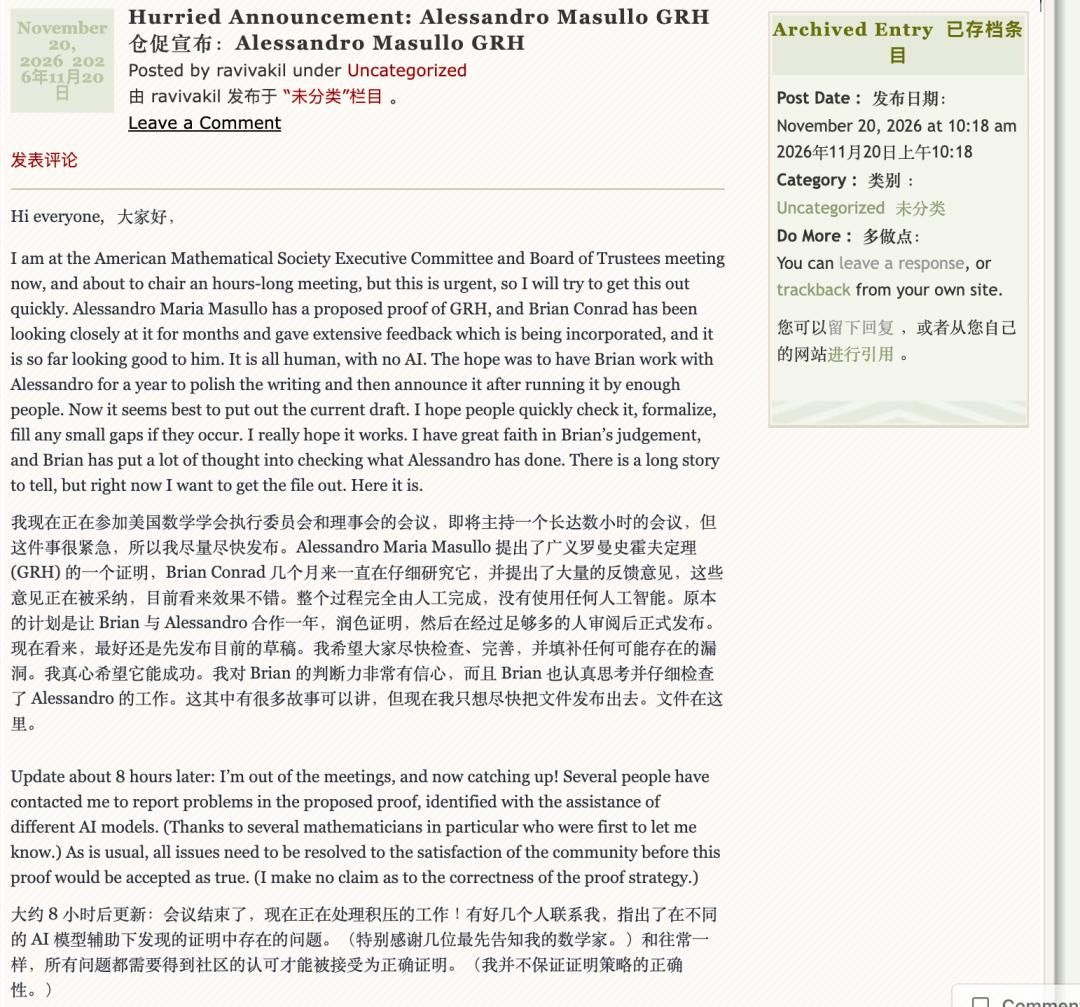
▲ Screenshot of the original Ravi Vakil announcement
However, about 8 hours later, Vakil updated the announcement: many people have found problems in the manuscript with the help of different AI models. He made it clear that he does not guarantee the correctness of the proof strategy, and all problems must be solved and recognized by the mathematical community before the proof can be accepted.
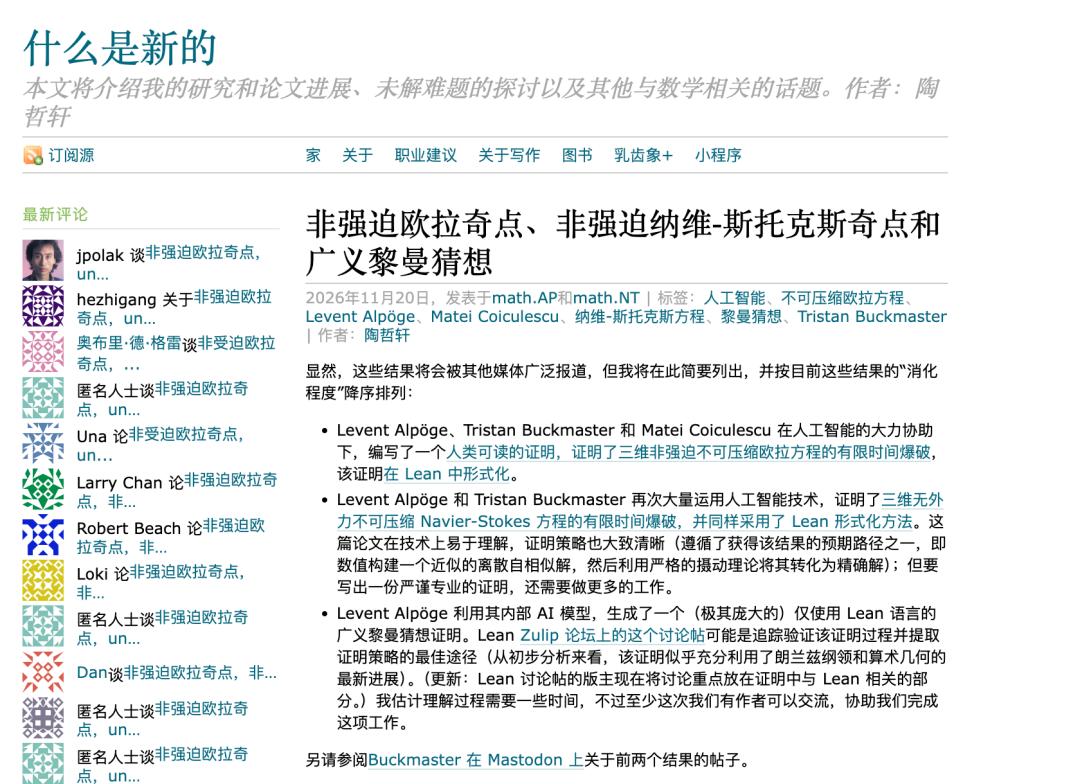
▲ Terence Tao's personal blog
Terence Tao, the 2006 Fields Medalist also published an article on his personal blog, paying attention to the progress of Claude's proof of the Riemann Hypothesis. He said that preliminary analysis shows that this proof seems to comprehensively apply modern research results in the fields of Langlands Program and arithmetic geometry. At present, the mathematical community is trying to verify the correctness of the proof and sort out its core ideas. He expects this process will take some time.

▲ Image source: Internet
A suspected chat screenshot of Deng Yu, the 2026 Fields Medalist evaluating this proof is also circulating on the Internet. In response to relevant questions, Sayaka replied: "I won't even look at it until at least a 500-page version is released." This sentence roughly means that the 250,000-page original draft is too large to meet the review conditions, and the author needs to first extract a streamlined version of about 500 pages before it is worth investing energy in verification. (For more details: Is the Riemann Hypothesis really proven by Claude? Fields Medalists including Terence Tao and Deng Yu have responded!)
For his own proof, Alpöge said that it contains a complete formal proof of the Generalized Riemann Hypothesis, but this result still needs further inspection by the mathematical community.
The statements from Lean FRO and Mathlib Initiative are exactly the demonstration of the verification results.
According to public information, Lean FRO was founded in 2023. It is the core R&D and maintenance organization for the Lean tool, a non-profit research organization under Convergent Research, co-founded by Lean founder Leonardo de Moura and engineer Sebastian Ullrich, responsible for the upgrade and bug fix of the Lean language, proof kernel and verification tools.
The judgment of this institution on whether the proof can pass the Lean kernel and whether the verification tool is reliable belongs to the most authoritative level in the Lean ecosystem.
Mathlib Initiative is backed by Mathlib, the most core mathematical library of Lean, and works closely with its maintenance team. Mathlib is a formal mathematical infrastructure built jointly by mathematicians all over the world, so its endorsement of the accuracy of proposition expressions and mathematical definitions carries great weight.
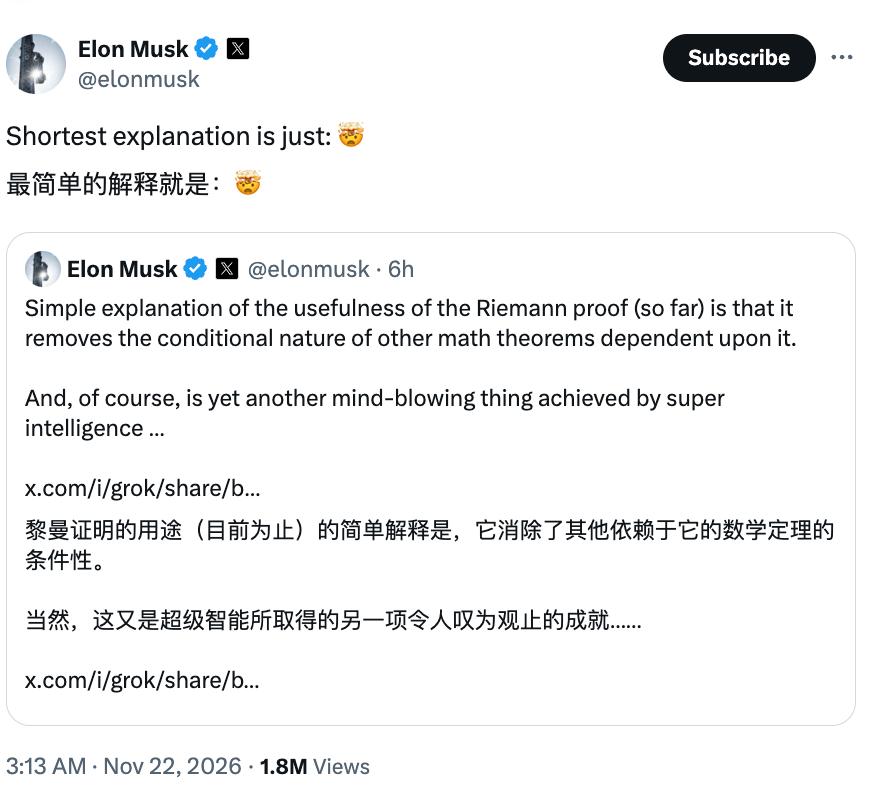
Regarding the proof of the Riemann Hypothesis, Elon Musk previously posted that "This is another breathtaking achievement achieved by superintelligence".
In his latest post, Musk used a 🤯 emoji to express his shock again.
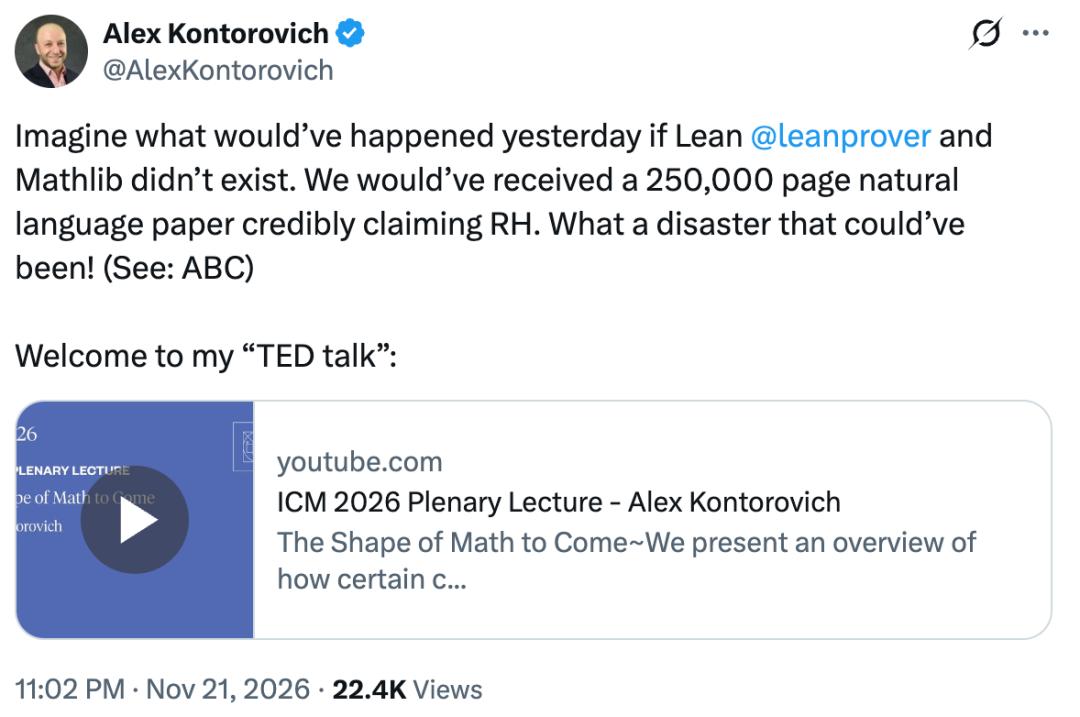
At 11 o'clock last night, Alex Kontorovich, distinguished professor of mathematics and head of the Department of Mathematics at Rutgers University, expressed admiration for the work of the two institutions, and joked: "Imagine what would happen if there were no Lean and Mathlib yesterday. What we received might be a 250,000-page paper written in natural language that seemingly plausibly claims to prove the Riemann Hypothesis (RH). What a disaster that could cause!"
This sentence actually emphasizes that Lean FRO and Mathlib Initiative have helped the mathematical community avoid an expensive "manual peer review disaster".
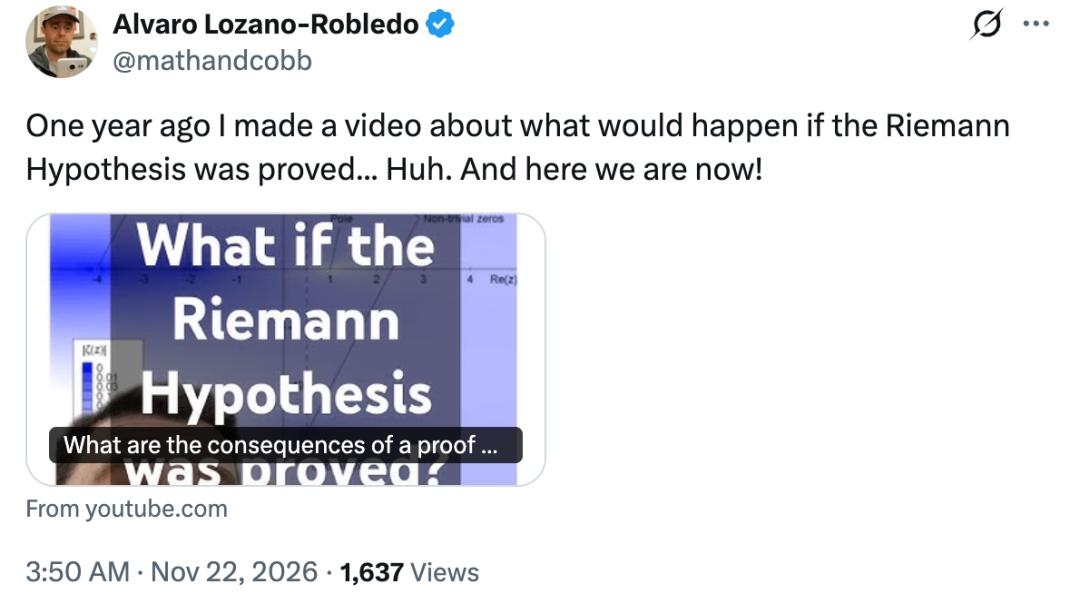
Earlier this morning, Álvaro Lozano-Robledo, a professor of mathematics at the University of Connecticut, seemed to have believed that the Riemann Hypothesis was proven, and exclaimed: "A year ago I made a video discussing what would happen if the Riemann Hypothesis was proven, and now, we are actually witnessing all this!"
Specifically, the statements of Lean FRO and Mathlib Initiative include the following four points:
The proposition expression is correct
The proposition adopts the existing definition in the Mathlib library, and the statement says that this definition has been reviewed by Lean and number theory experts.
The code can be fully compiled
Dozens of people independently compiled the code without errors or build failures, and reproduced the same exported original proof file.
What is proven is not a proposition with the same name but weaker
The community independently extracted the Riemann Hypothesis proposition that only depends on Mathlib, and then compared it with two independent tools, comparator and con-leche –compare, to confirm that the theorem actually proven by Alpöge is completely consistent with this proposition.
The Lean formal proof is valid
The exported original proof has been verified by multiple proof checkers, including the official Lean kernel, con-leche and con-ron checkers, and multiple independent checkers contributed by third parties and implemented in different programming languages.
At the end of the statement, Lean FRO and Mathlib Initiative also pointed out that the con-leche and con-ron checkers come with a set of formal proofs relative to set theory, which can ensure that they will not accept wrong proofs, so as to dispel people's concerns that there are loopholes in the Lean logic system itself and this proof may exploit such loopholes.
They also revealed that the above verification was run on the interaction-free exported file of the proof, which is not affected by potential malicious code in the Lean proof source code.
In addition, the two institutions also released the URL of the real-time updated verification file of the Lean formal proof of the Riemann Hypothesis. The website shows that Andrew Sutherland, a mathematician at the Massachusetts Institute of Technology, used Claude Code to perform the verification task, and the page was last updated at 20:55 yesterday.
Earlier, it was Andrew Sutherland who mentioned to *American Scientist Magazine*: "This is truly a historic moment. The world has changed... In my opinion, this is a victory for humanity, and it is a day worth celebrating."
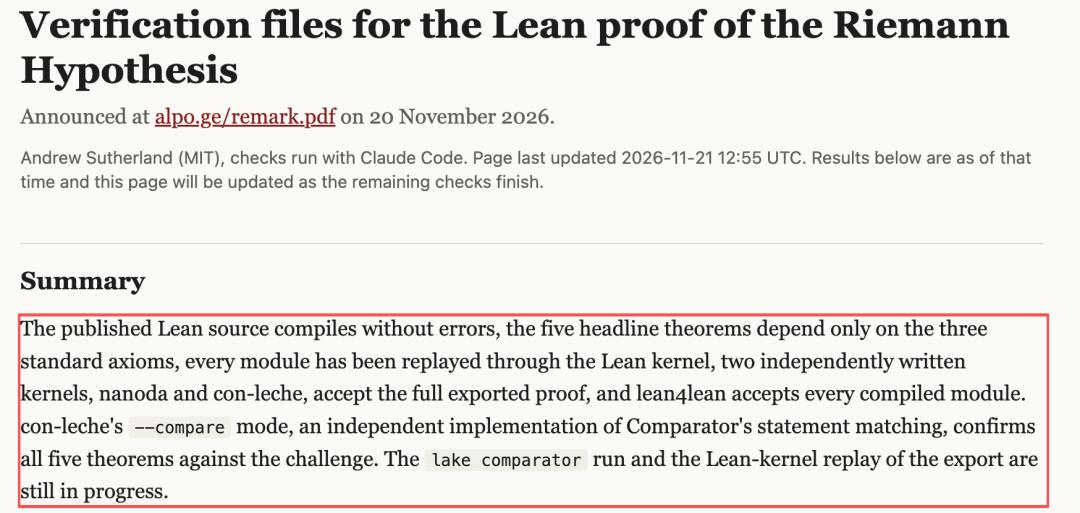
▲ Andrew Sutherland's verification file
At the very beginning, the website wrote the conclusion: The Lean source code released by Levent Alpöge compiles without errors, and the five main theorems are proved using only three standard axioms.
All modules of the proof have been replayed and verified by the Lean kernel. The two independently written kernels, nanoda and con-leche, also accept the fully exported proof, and finally lean4lean also accepts all compiled modules.
The --compare mode of con-leche is an independent implementation of the Comparator proposition matching function, which confirms that all five theorems are consistent with the propositions to be verified. The complete check of the lake comparator and the replay verification of the exported proof using the Lean kernel are still in progress.
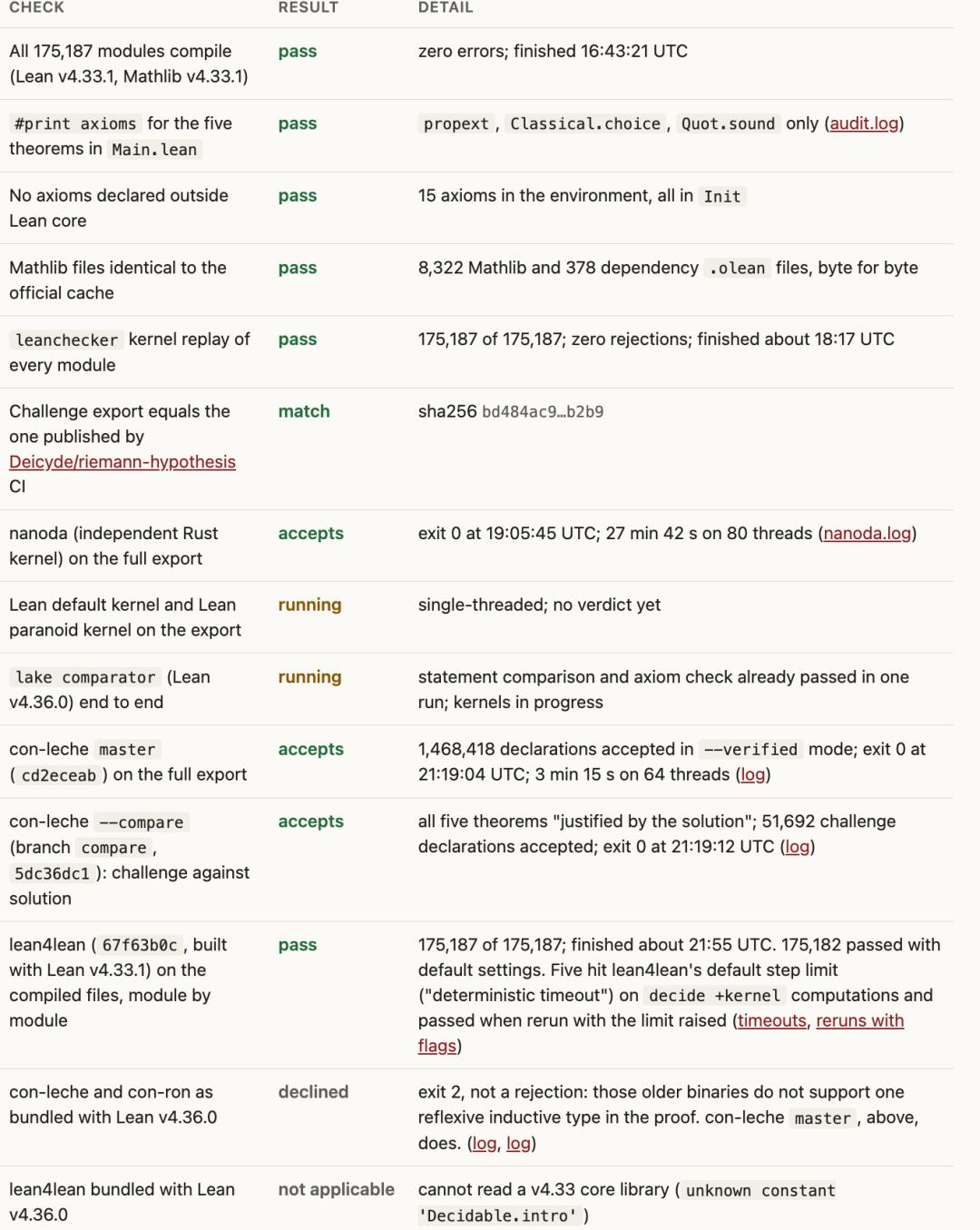
▲ Andrew Sutherland's verification process
At the bottom of the web page, more than a dozen verifications including calculation results have basically been completed.
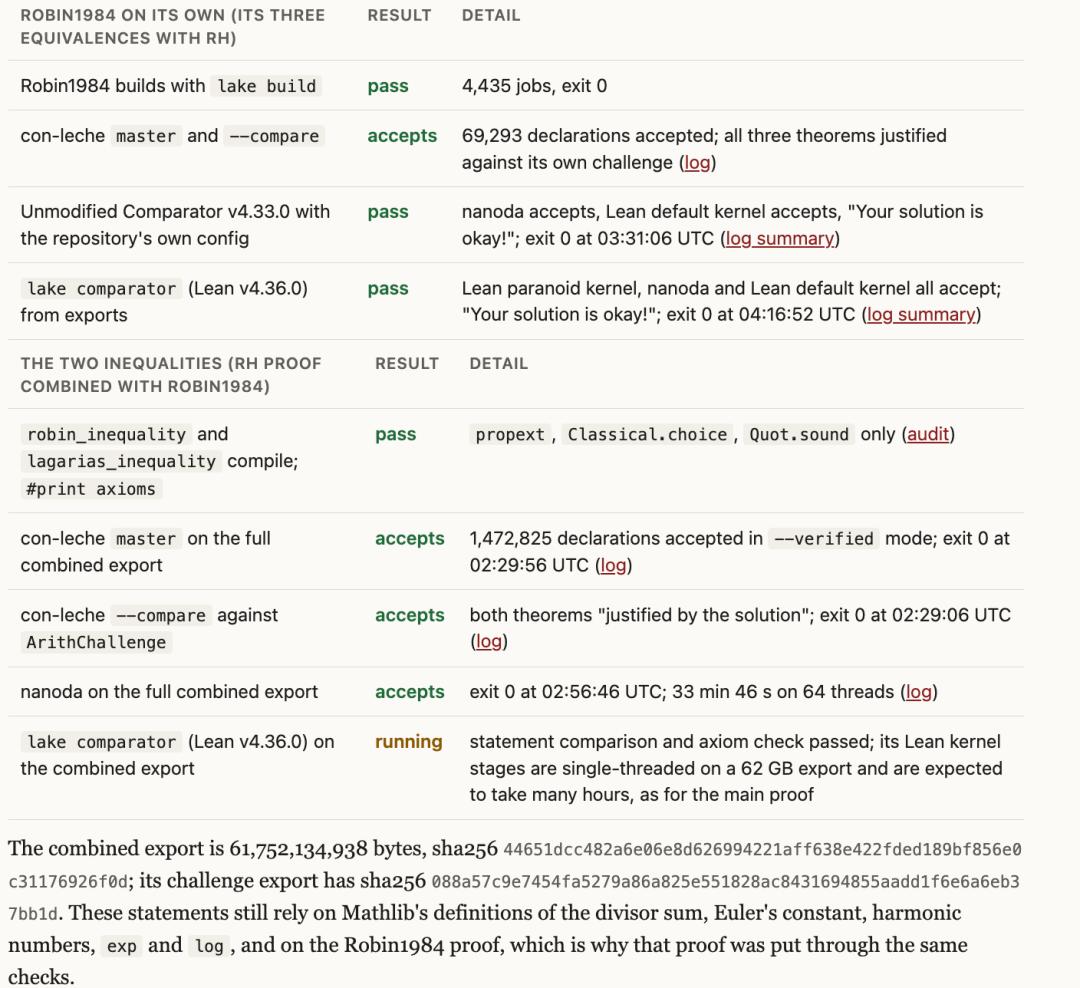
▲ Andrew Sutherland's calculation results
Let AI tell us in a concise way what the completion of these verifications means:
- Audit of axioms passed
No "cheating" by relying on unproven assumptions.
- Proposition comparison passed
The proof is indeed the standard Riemann Hypothesis proposition to be verified.
- Multiple independent kernels accept the proof
The derivation process conforms to Lean's formal logic rules, and the conclusion is not only supported by a single checker.
