Anthropic rose by 17% on the first day of its listing, with its market capitalization once surging to 2 trillion US dollars. How long can the AI boom last?

Anthropic is inextricably linked with tech giants

Article | Liu Sijie
Cover Source | Unsplash
On November 19, Anthropic (Nasdaq: ANT) officially debuted on the Nasdaq, with the final IPO price set at $83, opening at $111.50, and surging to an intraday peak of $115.10. On a fully diluted basis, its market cap once reached approximately $2.08 trillion, and around $1.51 trillion based on issued shares, closing at $97.17, roughly 17% higher than the IPO price at market close.
Its fundraising amount also surpassed that of SpaceX, hitting $813 billion and setting a new global IPO fundraising record. At its intraday peak, Anthropic once became the sixth largest listed company by market cap globally (on a fully diluted market cap basis), ranking after Apple, Microsoft, Nvidia, Alphabet and Amazon.
As of September 30, 2026, it had approximately 5,300 employees. Calculated based on its peak intraday market cap, that means each employee created a market cap of $392.5 million, roughly 4.7 times that of Nvidia. According to the prospectus disclosure, revenue generated per capita in the past 12 months exceeded $6.6 million. Calculated at the peak intraday stock price, the total net worth of its seven co-founders exceeded $190 billion.
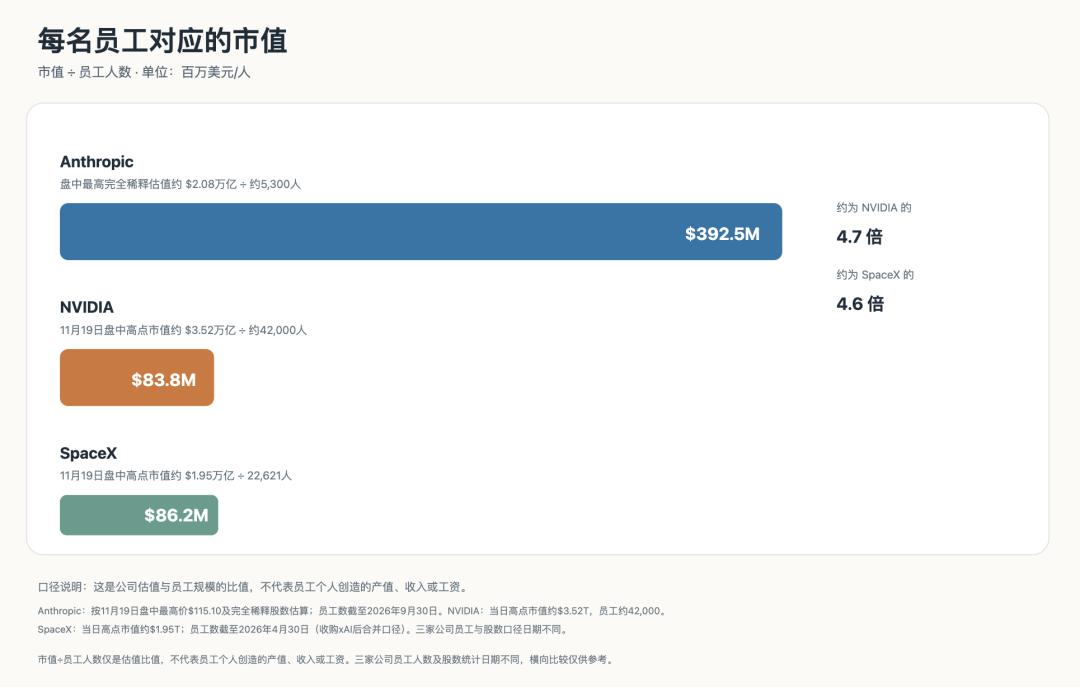
Market cap created per employee of Anthropic, Nvidia and SpaceX (data calculated based on each company's peak market cap on November 19)
Previously, there was widespread concern in the industry that Anthropic's listing signaled the burst of the AI industry bubble. In October, investors were still discussing that Anthropic's listing valuation could reach around $2 trillion. As the listing approached, market discussions fell back to the $1.2 trillion to $1.4 trillion range. By the time of its listing, the market cap surged back to $2 trillion.
The fluctuation of market sentiment was also reflected in the stock price on the first trading day, which finally closed down at $97.17. The three major US stock indexes all closed lower as well: the Dow Jones Industrial Average fell 2.19%, the S&P 500 Index dropped 2.02%, and the Nasdaq Composite Index declined 2.25%. Although Anthropic's closing price on the first day was still higher than its IPO price, the overall market was selling off stocks, which shows that investors remain cautious about high-valued tech stocks and AI-related risks.
At present, the policy environment adds a layer of uncertainty to the development of AI. After the US midterm elections, the Democratic Party will gain a majority in Congress next January. Recent policy discussions within the party have placed more emphasis on strengthening accountability for AI companies, protecting workers and consumers, and paying attention to the impact of data centers on power supply, the environment and local communities.
Looking through Anthropic's prospectus, you can see two different facets of the AI industry expansion: while revenue is growing rapidly, investment in computing power and infrastructure is also expanding sharply. Anthropic has signed large-scale multi-year computing power procurement and leasing arrangements, and also uses convertible notes and other methods to finance part of its computing power leases.
From a business perspective, for AI giants like Anthropic, the biggest problem is not continuing to raise capital and build computing power, but rather worrying about whether huge investments can continue to deliver commercial returns under the triple pressure of fluctuating demand, high costs and tightening policies.
Has the AI bubble burst?
Starting from Anthropic's financing, industrial chain relations, revenue and computing power commitments, this article analyzes what supports this AI capital feast and at which links it will encounter pressure.

From $124 million Series A financing to $2 trillion market cap, how did Anthropic grow step by step?
The earliest publicly disclosed financing of Anthropic was its 2021 Series A round, led by Jaan Tallinn, Skype co-founder and investor, raising $124 million. As the financing scale expanded, investors expanded from early individual investors and venture capital firms to large funds, sovereign wealth funds and tech companies.
The 2025 Series E and Series F rounds raised approximately $35 billion and $130 billion respectively, while the 2026 Series G and Series H rounds raised $300 billion and approximately $650 billion respectively. After the Series H round, the company's disclosed post-money valuation reached $965 billion. The simultaneous surge of financing scale and valuation in a short period of time is the most intuitive feature of this financing history.
It is clear that starting from 2025, investors' expectations for its model capabilities, customer growth and future market size have risen significantly.
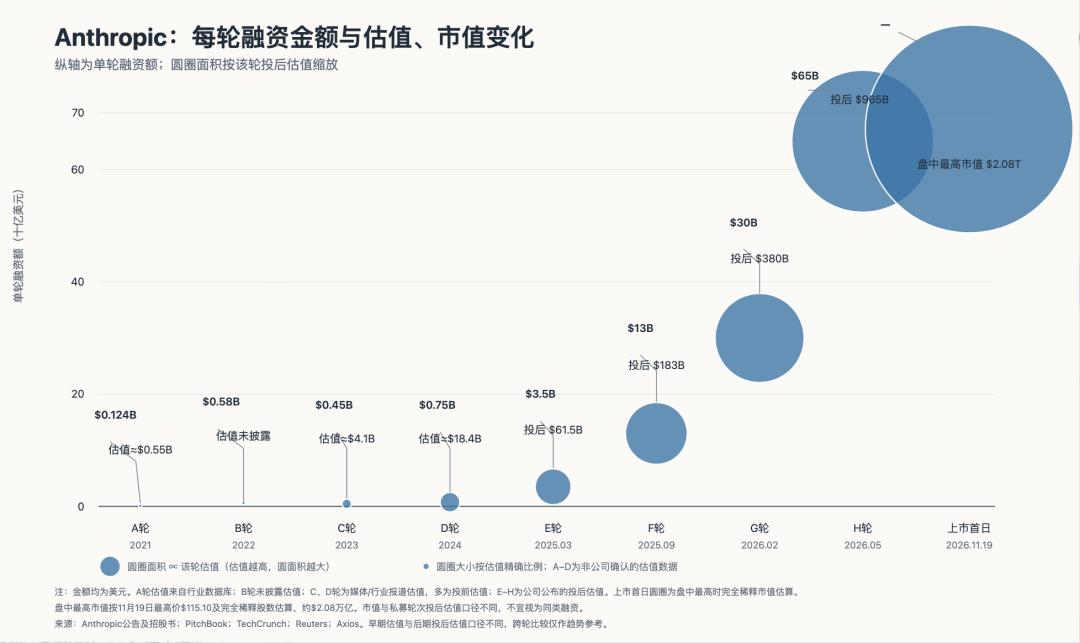
Chart of changes in financing scale and market cap
Anthropic's financing surge took place against the backdrop of global capital flowing intensively into AI.
According to statistics from the Organization for Economic Co-operation and Development (OECD), AI companies received approximately $258.7 billion in venture capital in 2025, accounting for 61% of the total global venture capital, twice the proportion in 2022.
In the first half of 2026, according to statistics from the World Intellectual Property Organization (WIPO), the proportion of AI financing in global venture capital has risen to 77%, with OpenAI, Anthropic and xAI alone accounting for nearly 43%.
The financing boom has not benefited the entire AI industry evenly, and it is increasingly concentrated in a small number of leading companies and super large transactions.
The rise of Anthropic's valuation is exactly benefiting from this capital concentration game.

Investing companies are also selling computing power, cloud services and sales channels
A multi-layered intertwined relationship has formed between Anthropic and tech giants: they may be investors, and also cloud service, computing power or chip suppliers. In some cases, they may also provide funds through convertible bonds or financing lines.
Take Amazon as an example. Before its IPO, Amazon invested approximately $18 billion through convertible bonds and preferred shares.
It not only invested in Anthropic, but also served as its cloud service and training partner. AWS also provides sales channels for Claude through Bedrock. At the same time, Anthropic has committed to purchasing a large amount of computing power from AWS in the future.
After capital flows in, Anthropic has to use a considerable part of the funds to purchase cloud services and computing power provided by the same group of giants. The investment relationship and the supply chain relationship are thus connected.
This relationship network also extends to other large US tech companies. It can be seen that among the "Magnificent Seven" of US stocks, the seven companies that account for nearly 40% of the total market cap of the S&P 500 Index, four of them have investment and cooperative supply chain relationships with Anthropic.
——Amazon, Google, Microsoft and Nvidia are all involved in different ways, either as investors, or providers of cloud services, chips or sales channels.
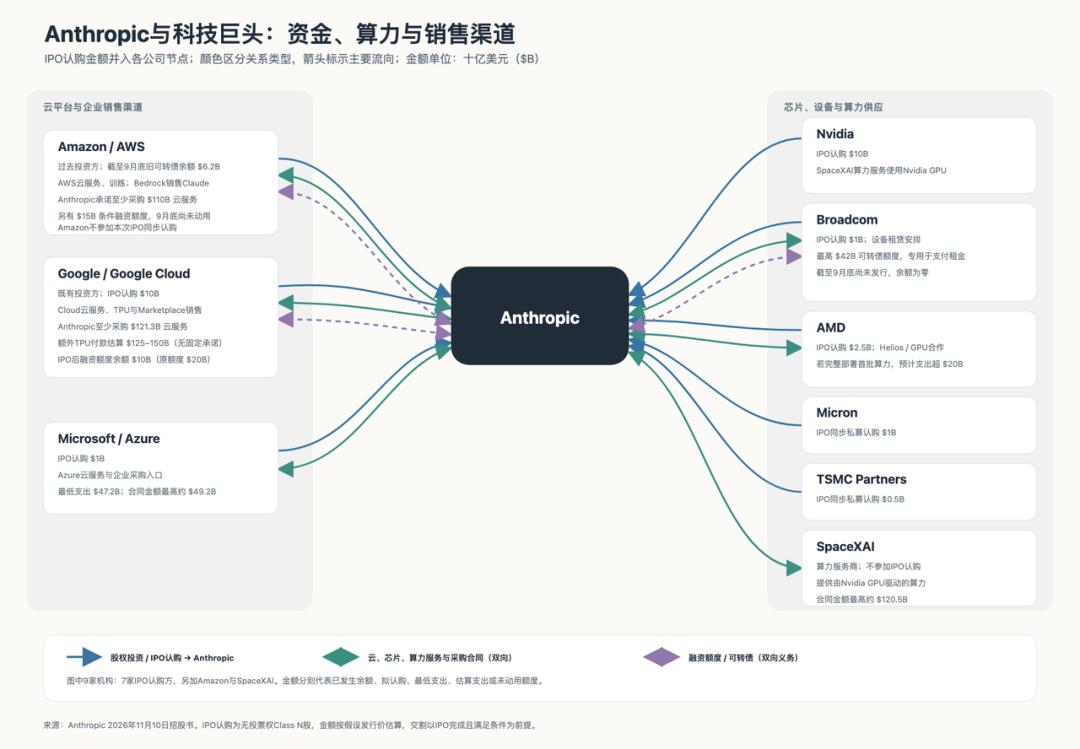
The intricate relationship between giants and Anthropic
At present, cloud platforms are still important sales channels for Claude. The proportion of revenue generated by purchasing Claude through cloud service providers' marketplace rose from 11% in 2023 to 47% in 2025, and stood at around 44% in the first nine months of 2026. For Anthropic, selling Claude through these cloud platforms can leverage the established enterprise customer relationships, procurement processes and cloud infrastructure of these platforms, making it easier for enterprise customers to try, purchase and access Claude.
For Anthropic, these relationships help it obtain the capital, computing power and enterprise customer access it needs for expansion. For the giants, it may bring equity returns, cloud service revenue, chip demand or a position in the model ecosystem.
This intertwined relationship also extended to the listing stage. According to Anthropic's latest prospectus released on November 10, seven companies including Google, Nvidia and Microsoft agreed to collectively purchase $26 billion of non-voting Class N shares at the IPO price concurrently with the IPO.
Anthropic's growth is thus deeply linked to the capital and infrastructure of large tech companies. The giants are interdependent and profit together in this carnival.

Can revenue prove that the demand is real?
According to the prospectus disclosure, in the nine months ended September 30, 2026, Anthropic's revenue was $33.242 billion. Among them, usage-based revenue was $26.306 billion, accounting for about 79%. Subscription revenue was $6.936 billion, accounting for about 21%. In other words, the bulk of its revenue comes from fees generated by large customers calling Claude and consuming computing power.
This means that the more customers use it, the higher Anthropic's revenue may be. If customers reduce calls, switch to cheaper models, or tighten their budgets, this part of revenue may also fluctuate.
Anthropic regards customers who spent more than $100,000 in the past 12 months as a core indicator to measure the penetration rate of the enterprise-level market. As of the end of September 2026, such customers contributed about 74% of the revenue in the past 9 months, and the number exceeded 11,900.
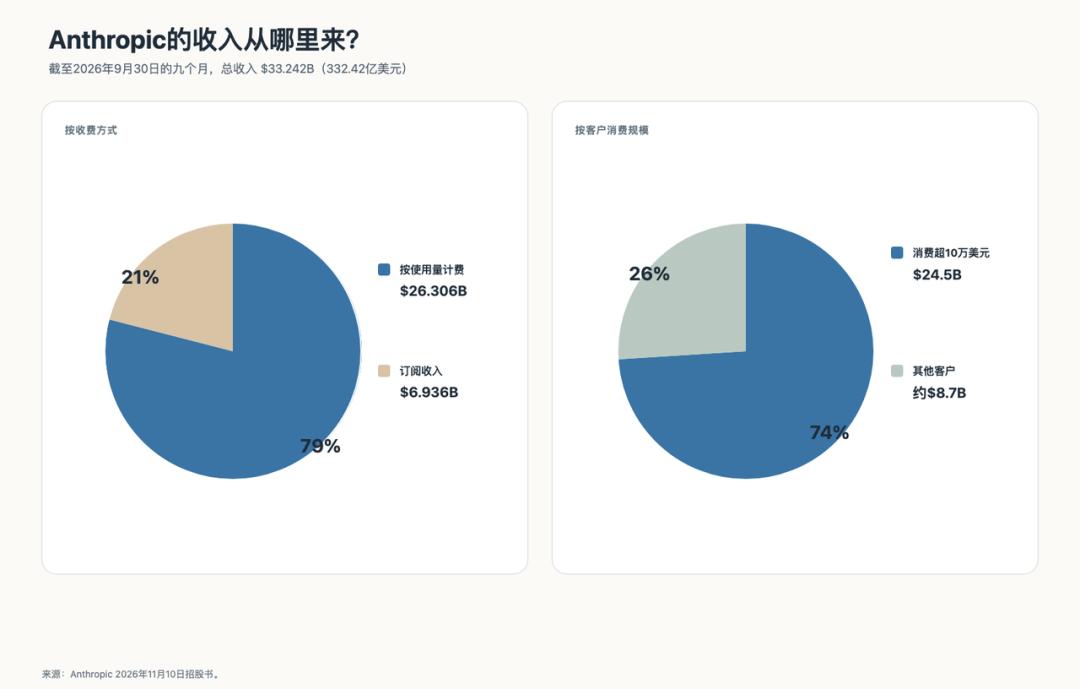
Proportion of various types of revenue
Whether Anthropic's story can continue depends on whether large customers can keep using Claude, so that revenue can cover long-term computing power investment.

Computing power pressure, debts owed to the future
In the nine months ended September 2026, Anthropic recorded an operating loss of approximately $1.26 billion and a net loss of approximately $104.039 billion.
However, approximately $94.324 billion of the net loss came from fair value changes of items such as convertible bonds, derivatives and SAFE, which are mainly book adjustments brought about by the rise in financing valuation, and do not equal the same amount of cash that the company actually spent in these nine months.
In the same period, the company's operating cash flow was positive at approximately $6.6 billion.
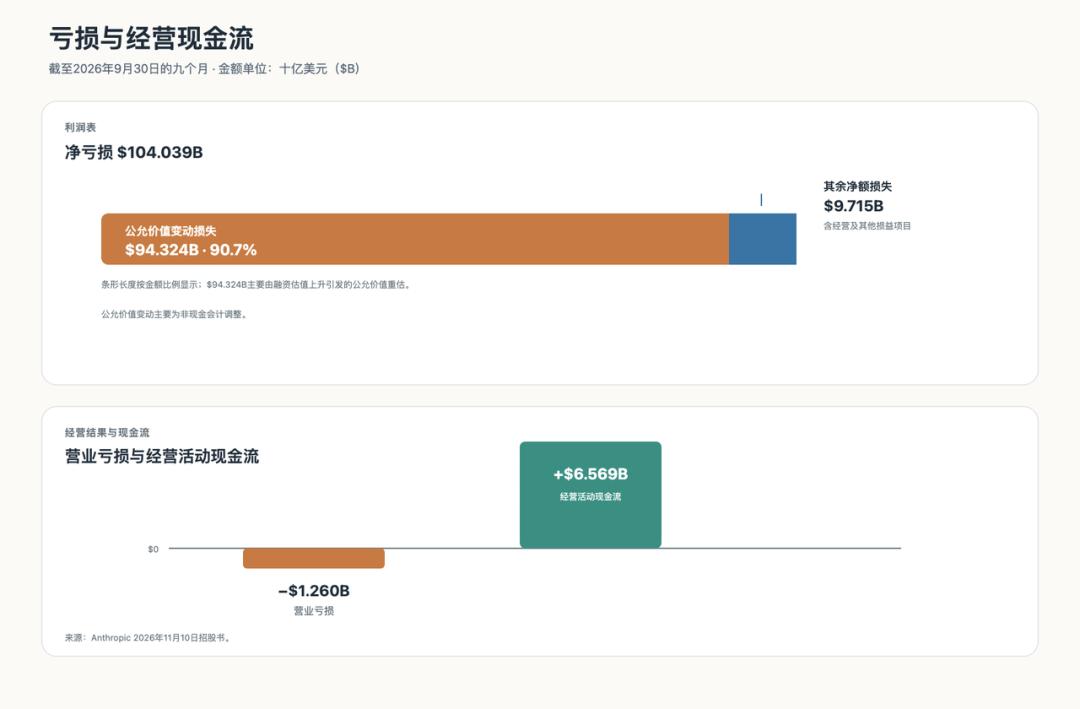
Chart of loss sources, compared with cash flow
The more tangible operating pressure lies in computing power costs. Anthropic disclosed that its computing power and infrastructure expenses in the first nine months of 2026 were approximately $18.8 billion, equivalent to about 57% of revenue in the same period, and stated that this expense is expected to remain the largest operating expense for the foreseeable future.
The prospectus discloses that