NVIDIA uses investment as a weapon, but its capital still cannot be invested in the Chinese mainland this year.
Nvidia is one of the companies with the highest market capitalization worldwide. It is not only engaged in the GPU business, but also a high-speed operating investment machine. Over the past decade, this ecological bundled investment has brought it customers and revenue, serving as a powerful tool for its growth.
As of November 18, 2026, IT Juzi has recorded a total of 239 Nvidia investment and M&A events, including 220 equity investments and 19 mergers and acquisitions. Lock the timeline to 2026: it has made 71 investments this year, more than doubling from 30 in 2023, with an average of 6 to 7 investments per month. Its investment pace is denser than that of most first-tier VC institutions.
Beneath the surging figures lie three structural changes.
Investment targets are more diversified: expanding from AI star companies in the US dollar ecosystem to the physical infrastructure of computing power such as power, optical interconnection and data centers. For example, it is reported that Nvidia plans to invest up to 3 billion US dollars in Lancium Technologies, a company engaged in AI data center power infrastructure.
The betting approach is more focused: huge checks are only issued to a few foundational model companies such as OpenAI, while for most other AI startups, the investment amount remains within hundreds of millions of US dollars.
In terms of geographical layout, Nvidia puts its core chips on the United States, followed by the United Kingdom and South Korea. It has not made equity investments in China for nearly a decade. This year, it made a rare move to invest in Chinese companies, but both investments are "skirting the edge".
I. Not Only Investing in AI Companies, But Also in the Physical Infrastructure of Computing Power
Among Nvidia's 71 investments in 2026, more than 43 fall into the field of artificial intelligence, which makes it look like a pure AI investor. But looking through this account book, the structural difference is significant: the investment amount is completely concentrated in the head's mid-to-late stage financing, with a large number of early-stage investments and scattered funds.
For example, Nvidia contributed 30 billion US dollars in OpenAI's financing round that was finally closed at 122 billion US dollars this year, and also participated in Anthropic's 30 billion US dollars Series G round (of which Nvidia's committed share is up to 10 billion US dollars) and xAI's Series E round of about 20 billion US dollars.
In essence, these huge strategic investments are Nvidia's transfusion to its largest GPU customers. After getting the money, customers will turn around to purchase computing power, and the revenue will eventually return to Nvidia's books.
In addition to betting on AI, Nvidia has invested more in fields that it rarely touched three years ago this year, including 6 investments in integrated circuits involving optical interconnection, photonic chips and low-power interconnection; energy and power sectors have begun to appear intensively; there are even investments in aerospace and orbital computing.
Specifically, there are several lines as follows:
· Optics and Interconnection: Lumentum (optical modules and lasers), Coherent (photonic devices), Ayar Labs (inter-chip optical interconnection chips), iPronics (silicon photonic optical switching), Point2 Technology (low-power short-range interconnection).
The larger the GPU cluster, the more critical the interconnection bottleneck is, and Nvidia has invested in suppliers along this chain one by one.
· Power and Data Centers: IREN, Firmus Technologies, Lancium Technologies, Nscale, Nebius, GMI Cloud and other companies have been invested.
The constraint of computing power expansion has shifted from chip production capacity to power supply and computer room construction, and Nvidia's capital flows along with the bottlenecks.
· Upstream Materials and Chip Manufacturing: Nvidia subscribed for 3.5 billion US dollars of MediaTek's convertible bonds, and also invested in SiFive, a company based on RISC-V architecture.
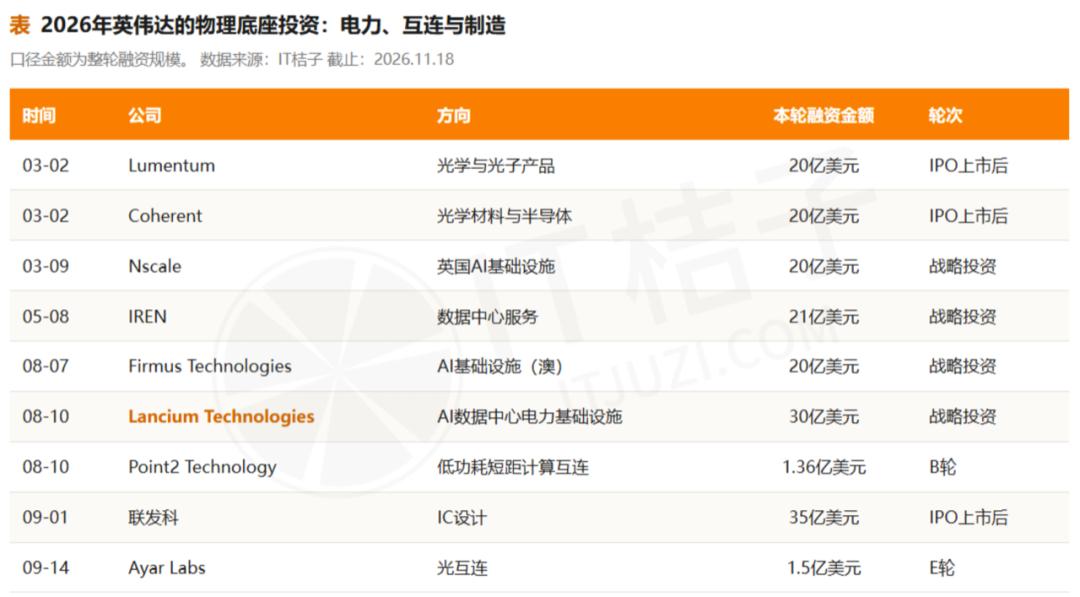
When a chip company begins to invest intensively in power plants, computer rooms and optical cables, its investment is extending the moat of GPU from the chip itself to the entire industrial chain. This is the most distinctive change in Nvidia's 2026 investment list compared with previous years.
II. Large Number of Investments, But Only a Few Companies Receive Continuous Betting
According to statistics from IT Juzi, throughout Nvidia's investment history, there are 40 companies that have been invested more than twice, and only 13 companies that have been invested more than three times, accounting for less than 10% of all invested companies, which are the best of the best.
Looking only at the investment targets in 2026, about 70% of the targets are new faces, and 30% are additional investments in existing projects; but almost all large checks are issued to old targets that have been repeatedly bet on.
Notable cases of continuous additional investment include:
1. Cohere, a Canadian NLP model platform: It has made additional investments for 5 consecutive rounds spanning 4 years.
In 2023, it invested 270 million US dollars in Series C round, and 500 million US dollars in Series D round in July 2024. After that, it continued to increase its investment. By November 2026, Cohere launched the Series E round with an upper limit of 7 billion Canadian dollars (about 5 billion US dollars), and the first closing was completed in the same month, supported by Nvidia and the Government of Canada. Nvidia has followed the company from the early stage to the late stage.
2. OpenAI, the leading large model company in the United States: It has continuously increased its investment for three rounds.
In October 2024, it participated in the 6.6 billion US dollar round; in September 2025, Nvidia signed a 100 billion US dollar investment letter of intent with OpenAI, agreeing to invest in installments along with the deployment of computing power; the new round of financing announced in February 2026 was closed in March, with a final scale of 1220 billion US dollars. Nvidia contributed 300 billion US dollars in this round, and Amazon contributed 500 billion US dollars, of which 350 billion US dollars are linked to OpenAI's listing or AGI milestones.
The transfusion of large models by US tech giants is still ongoing, but even the most powerful capitals have begun to attach conditions to their checks.
3. xAI, Elon Musk's large model company: Nvidia has continuously increased its investment for 3 rounds, and the last investment was the Series E round in early 2026 with a scale of about 200 billion US dollars.
4. Other companies that Nvidia has continuously increased its investment in: Poolside, Together AI, Runway, Nscale, Ayar Labs, VAST Data have each received additional investment for 3 rounds, and World Labs, SSI, Skild AI, Fireworks AI have each received additional investment for 2 rounds.
Note: The amounts listed above are the total financing scale of the whole round, reflecting the transaction scale of its participation, not the amount of capital contributed by Nvidia.
Looking at this list as a whole, Nvidia concentrates its capital on a number of AI unicorns that can continuously consume GPUs, especially foundational large model companies like OpenAI, which are also the world's largest GPU buyers.
The money raised by each financing round of these companies will eventually flow to computing power procurement, and Nvidia is the main supplier. This model where the invested list and customer list are highly bound makes investment, in a sense, a way to lock in demand in advance.
III. No Investment in Chinese Mainland for Nearly a Decade, Two Investments This Year Are Both Skirting the Edge
The geographical distribution of Nvidia's overseas investments in 2026 is very extreme: nearly 50 of the 71 investments are made in US startups, and the rest are mainly in countries such as the UK and South Korea. Chinese startups are very few, or even zero.
In fact, tracing back to the early years, we can find that Nvidia once invested in Chinese autonomous driving companies in its early days.
In August 2017, it participated in the Series B financing of TuSimple (operating in both China and the United States) in the way of "resources + capital", with a post-investment shareholding of about 3%. This was Nvidia's first investment in an autonomous driving company founded by Chinese entrepreneurs.
Almost at the same time, Han Xu, former vice president of Baidu and head of the Autonomous Driving Business Unit, left his job to start a business. Shortly after Jingchi Technology was established, Nvidia participated in its 52 million US dollars Pre-A round. After that, WeRide adopted Nvidia's GPU, DRIVE Xavier chip and Blackwell architecture system-on-chip to jointly develop the autonomous driving domain controller HPC3.0 and other products.
Unexpectedly, Nvidia held this equity for a long time. Until February 2025, the 13F position report submitted by Nvidia disclosed for the first time that it held about 17.386 million ADS of WeRide, with a corresponding market value of about 24.65 million US dollars.
Since then, Nvidia has almost disappeared from China's primary market for nearly a decade.
In 2026, it made two rare investments, but both are skirting the edge:
The first is to subscribe for 3.5 billion US dollars of convertible bonds issued by MediaTek, which is Nvidia's largest direct investment outside the United States. The target is a listed company in Taiwan, China, and it is a creditor's right before conversion. The advantage of the convertible bond investment method is that it retains upside potential and will not trigger shareholding review immediately.
The second is to participate in the 500 million US dollars Series F round of investments in Agibot, an embodied intelligence enterprise, but the lead investor is SoftBank, and Nvidia is one of the co-investors.
It is particularly noteworthy that Agibot is not a pure local Chinese company.
Founder Chen Zhaopeng has a background from Harbin Institute of Technology, and once served as deputy director of the Laboratory of Robotics and Mechatronics Institute of the German Aerospace Center (DLR). The company is headquartered and registered in Munich, Germany, with an operation team in Beijing. It has technical origin in Germany, mass production capacity in China, and compliance identity in Europe.
In addition, Agibot and Nvidia have jointly released the scientific research humanoid robot Agile ONE SN at the GTC in Berlin in October this year, and jointly launched the factory part sorting project with Audi and Dassault Systèmes. This also shows that this investment has clear business synergy endorsement, not a pure financial bet.
From TuSimple to Agibot, they are all typical transnational dual-headquarter models, rather than completely local companies in Chinese mainland. Therefore, strictly speaking, Nvidia's investment in China's mainland primary market this year is still zero.
Why is this situation? There are at least two levels of considerations.
The first is compliance and sanction risks.
The US chip export control against China has continued to tighten since 2022. As a core regulated enterprise, Nvidia's investment in Chinese AI and semiconductor companies may trigger the declaration or even prohibition obligation under the US Outbound Investment Security Program (OISP), and the cost and uncertainty of compliance review are very high.
The second is ecological isolation.
The essence of Nvidia's investment is "ecological pre-embedding": it hopes that the invested companies will buy more GPUs, use CUDA, and adopt NVLink later. However, the computing power supply of Chinese AI companies is being "localized", and more and more alternative solutions such as Huawei Ascend, Cambricon, and Biren are adopted. Even if it invests now, it is difficult to form business synergy.
What not to invest in explains the problem better than what has been invested.
In 2026, Nvidia invests in ecology and AI infrastructure, from power infrastructure to interconnection, from foundational models to robots. The investment map is coinciding with the boundary of geopolitics. This map lacks the Chinese mainland region, and the reasons behind it are complex. It is not necessarily that it does not want to invest, but more that it cannot invest.
For domestic entrepreneurs, this is also a realistic reminder: the companies that can receive checks from overseas chip giants are precisely those companies whose origin and registered address are not in Chinese mainland; the path of relying on overseas chip giants as strategic investors is becoming extremely narrow.
This article is from the WeChat official account "IT Juzi" (ID: itjuzi521), written by Wu Meimei, authorized for release by 36Kr.