"Abandon the United States and side with China"? The South Korean entertainment industry will usher in a "major shake-up" in 2027.
In mid-November, Shenzhen is exceptionally lively due to the APEC Summit. However, among a host of grand economic and trade topics, practitioners in the Chinese and South Korean entertainment industries are focusing intently on one specific line of text.
On November 18, taking advantage of the Shenzhen APEC Summit, the China-ROK summit was held. Shortly after, the Ministry of Commerce announced that the second-phase negotiations of the China-ROK Free Trade Agreement (FTA), which had lasted over 8 years and gone through 17 rounds of tug-of-war, had been "substantially completed". Under the negative list model, "cultural cooperation" has been clearly written into the specific implementation arrangements of the economic cooperation chapter.
The official statement remains restrained, emphasizing that text sorting and legal review are still required, and the pace will be "phased and gradual". But those in the industry have long sensed the coming trend. South Korean media quickly broke down details such as "South Korean films and games receiving most-favored-nation treatment" and "promoting joint production of film, television and variety shows"; editorials in Hong Kong media have already expressed concerns that the "concert event economy" supported by mainland music fans traveling south to Hong Kong specifically to see South Korean stars in the past few years will rapidly shrink as South Korean artists can directly hold performances in the Chinese mainland.
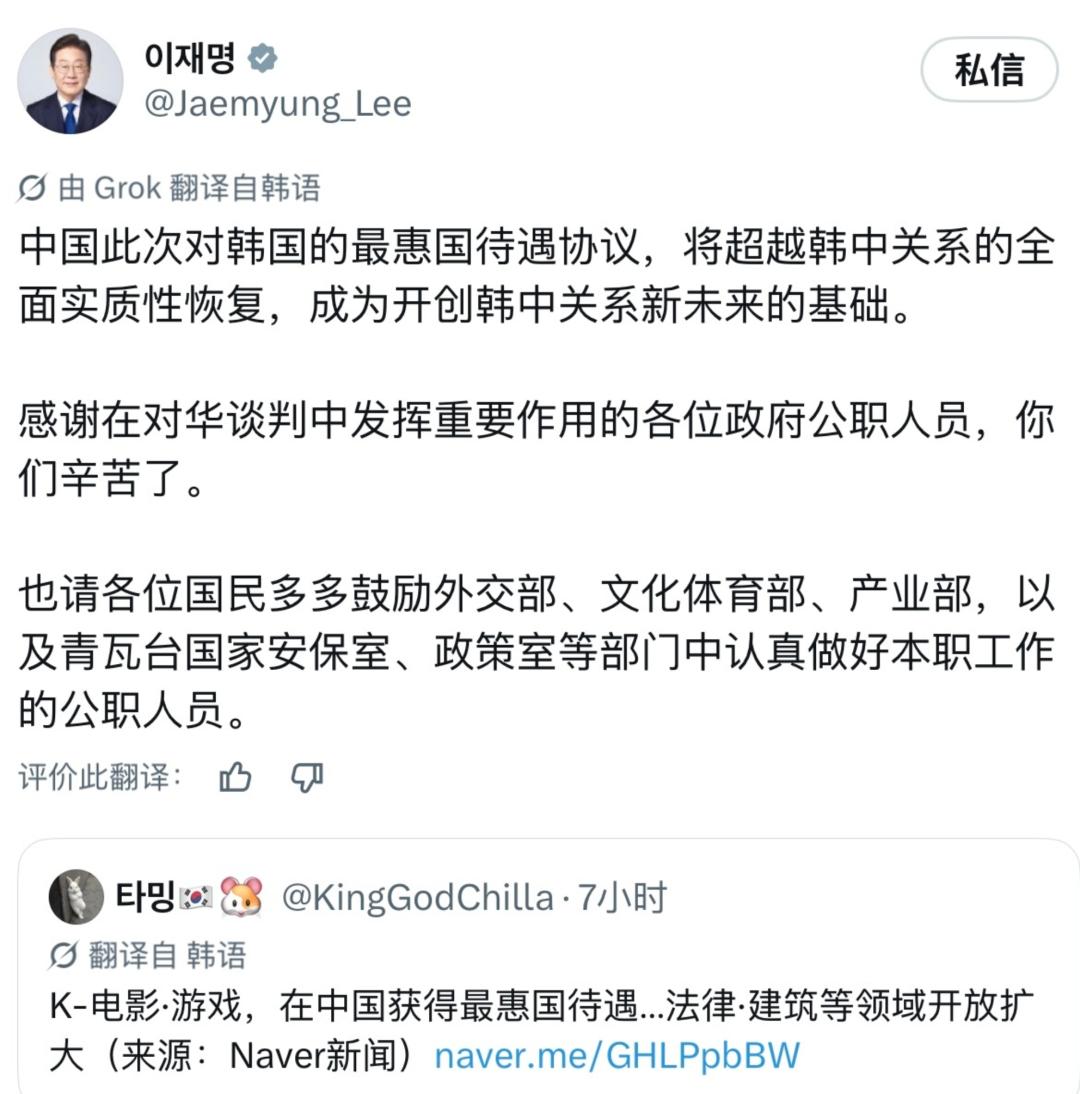
If you combine the news from the Shenzhen APEC with the official Q3 quarterly reports of South Korea's five major entertainment companies (HYBE, SM, JYP, YG, CJ ENM) that were fully disclosed in mid-November, you will find that the subtle clues of "shifting focus from the US to the Chinese market" have long been laid.
Over the past four years, Netflix has used an almost aggressive high-price procurement system to push South Korean content into the mainstream of global pop culture. However, at the settlement point of this four-year investment cycle in 2026, the Silicon Valley giant has personally pulled the previously soaring prices back down. At almost the same time, the "Chinese market" is no longer just a public relations slogan, but for the first time has become auditable financial figures, re-entered the official financial reports of South Korean entertainment giants.
In the third quarter of 2026, when old sponsors tightened their purse strings and new markets showed a glimmer of openness, the South Korean entertainment industry is undergoing an extremely drastic cash flow reshuffle.
China is back in financial reports: this is no longer a slogan, but verifiable accounts
Over the past four to five years, "returning to China" in the South Korean entertainment circle was more like a "cry wolf" story used to paint an optimistic picture for the secondary market. But after breaking down the official Q3 quarterly reports submitted by the five companies to South Korea's Financial Supervisory Service (DART) successively on November 13 and 16, we found that this time it is truly different.
For the first time, China-related businesses have appeared intensively in the balance sheets and income statements of South Korean entertainment giants as large-scale, auditable financial items.
The shift in trend has already shown signs in the earnings calls. At SM's Q3 performance briefing, the company rarely listed the tours of its Chinese boy group WayV in core Chinese cities including Beijing and Shanghai, as well as the Chinese single of NCT's Chinese member Zhong Chenle (scheduled for Q1 2027), directly into the key business plans for the next two quarters. This is the first time since the market restrictions ten years ago that the four major South Korean entertainment agencies have put the Chinese mainland tour plans on the table at an official performance meeting.
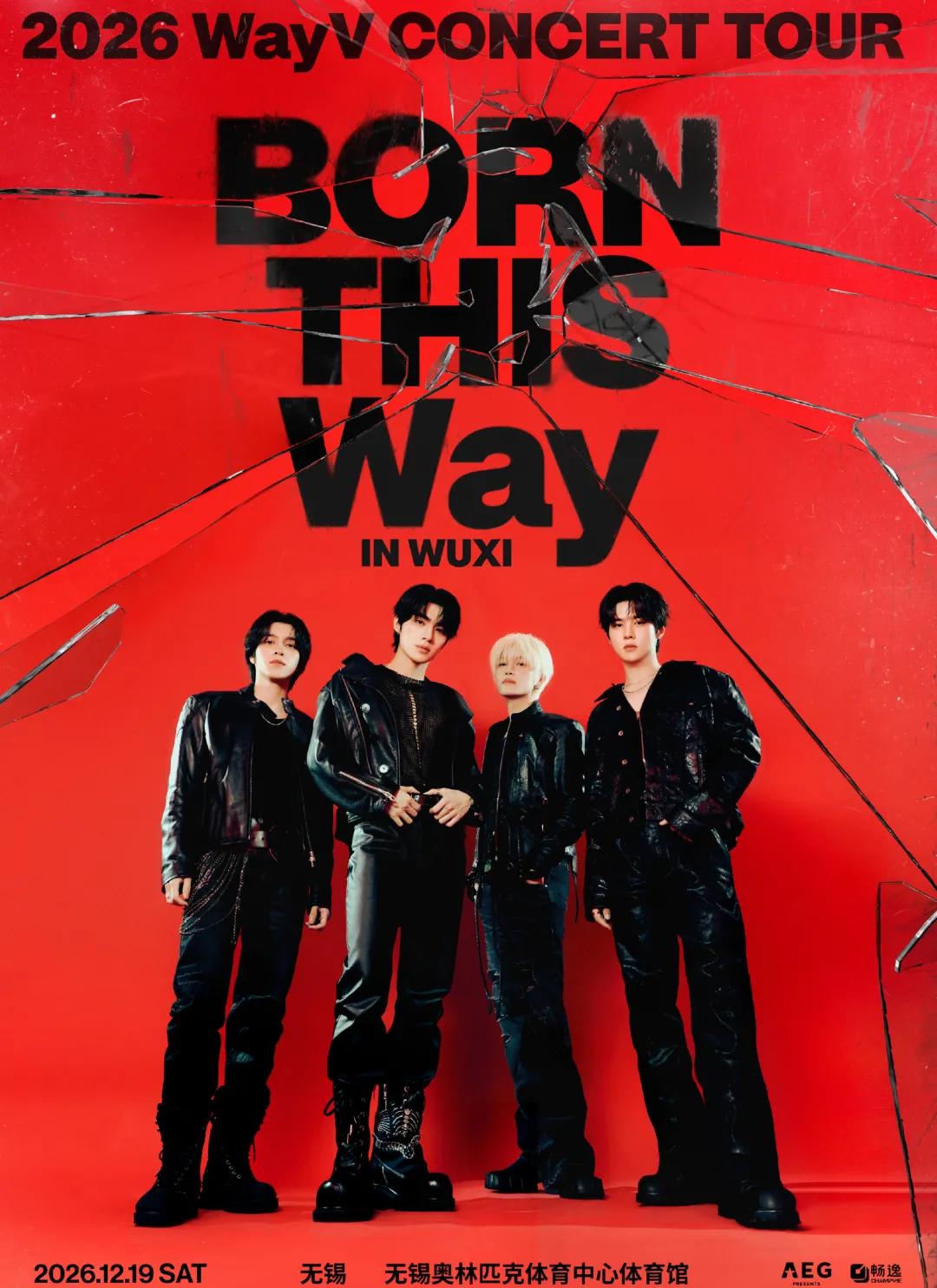
If the earnings call is still expectation management, then the figures in the official quarterly report are the real, tangible disclosure of actual performance:
HYBE is making money in China: In the official quarterly report supplemented on November 16, HYBE unprecedentedly disclosed the single-quarter financial data of two Chinese subsidiaries. Among them, HYBE CHINA's revenue in the third quarter was 17.27 billion won, a year-on-year surge of 2180.6%, and achieved a net profit of 555 million won, successfully turning losses into profits. The other 90%-owned subsidiary, Xingcan Shengshi, recorded Q3 revenue of 283.96 billion won (a year-on-year increase of 220.8%), with a single-quarter net profit of 3.606 billion won, doubling its profit.
SM is closely partnering with Tencent Music: In SM's quarterly report, the "related party transactions" column adds revenue from three entities under Tencent Music Entertainment Group (TME) located in Zhuhai, Shenzhen and Hong Kong, with a total revenue of 145.7 billion won in the first three quarters — while in the same period of 2025, the figures for these three items were all zero. In addition to the existing entities such as Kasim Shanghai and SM Beijing, STE, the joint venture established by SM and Tencent Music in Beijing, has clearly planned to launch a new boy group targeting the local Chinese market in the next two to three years.
JYP and CJ ENM are accelerating infrastructure construction: JYP disclosed the accounts of five Chinese subsidiaries in its quarterly report, with total revenue of 8.018 billion won in the first three quarters (a year-on-year increase of 29.2%). Although currently all of them are still loss-making except for "Beijing Xinsheng" (with a total net loss of about 1.6 billion won), the company is fully promoting the activities of its local boy group CIIU and artist Yao Chen in China, and even specifically updated the VIE structure risk warning for China's new foreign investment regulations in the financial report — only companies that are actually engaged in industrial operations will start to worry about compliance structures. On the other hand, CJ ENM also stated in the company history section of its financial report that it has teamed up with China's NCC Entertainment in February this year to establish ONECEAD, a Hong Kong-based management company 100% controlled by it. Only YG Beijing is slightly lagging behind, with Q3 revenue falling by nearly 40% to 639 million won, but its new girl group BABYMONSTER held two consecutive concerts in Macau in September this year, attracting nearly 18,000 attendees with additional shows sold out, still testing the waters in the Greater China market in a flexible way.
Of course, from a rigorous financial perspective, the five companies currently disclose data under the caliber of "subsidiaries in China" or "related party transactions", and none of them have dared to list "consolidated revenue of the Greater China region" separately in their financial reports. How much GMV is contributed by Chinese paying fans on Weverse, and how much copyright fees Studio Dragon can get from its dramas in China, are still hidden under the surface.
However, these surfaced subsidiary accounts send a very clear signal: before the "cultural cooperation" tone set by China and South Korean senior leaders at the Shenzhen APEC Summit was implemented, leading South Korean entertainment companies have quietly completed the establishment of all compliant entities, joint ventures and settlement channels in China. The framework is already in place, only waiting for the policy to open up.
Netflix has not divested, it just no longer acts as the "big spender"
This year, we previously analyzed in the article *JTBC Bankruptcy, Netflix Salary Cap: Three Major Repricing Events of the Korean Drama Industry in 2026* that the bitter consequences of the Korean drama boom are breaking out intensively. In 2023, Netflix spent lavishly, announcing that it would invest 2.5 billion US dollars in Korean content over the next four years. By 2026, this sum of money has reached its settlement point, and how much to invest and how to invest after 2027 has become the Sword of Damocles hanging over all South Korean production companies.
The perception on the production side is undoubtedly harsh. In the middle of this year, the industry spread the news that Netflix had strictly capped the per-episode salary of top South Korean actors at 400 million won, and in July, *Korea Daily* further exposed that this red line was reduced to 300 million won.
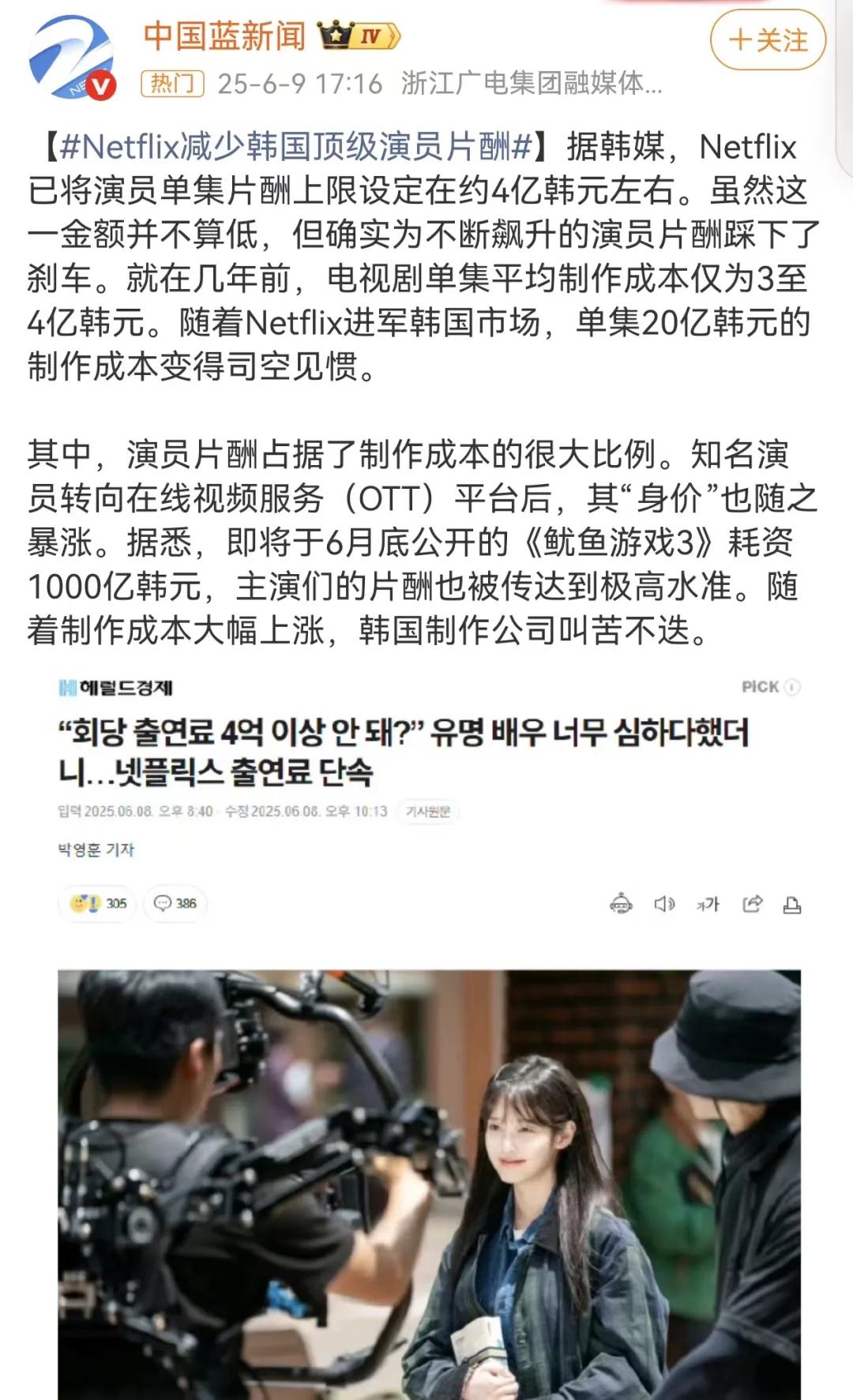
Not only are actors' salaries being cut, the platform's control over the production cost of a single project has reached an extremely strict level. A publication under the Korea Press Promotion Foundation calculated earlier this year: Netflix only reserves about 5% of the total production cost as handling fees for South Korean producers, which means the profit margin is strictly suppressed between 5% and 7%. What is more brutal is the supply-demand relationship — Netflix has no more than 15 slots for Korean dramas a year in total, but there are more than 2000 project proposals queuing up for submission.
"To get the salary level of two years ago, you have to go to Hollywood, but there is no reason for Hollywood to pay that price for South Korean actors; and the Chinese market is still not accessible now." In July this year, the complaint from a senior South Korean producer to the media expressed the grievances of the entire industry.
Interestingly, in response to the public opinion that "Netflix is going to withdraw from South Korea", the platform gave a different statement. At the "Next on Netflix 2026 Korea" press conference, Kang Dong-han, head of Korean content at Netflix, made it clear: since entering South Korea in 2016, investment has never stopped, and it still plans to launch 24 Korean original works in 2026. From the data point of view, Korean-language content has indeed performed well, remaining the second largest category on Netflix in terms of global viewing volume, second only to English content.
On one side, producers are complaining about poverty, on the other side, the platform guarantees that it will not reduce investment. Who is lying?
In fact, both sides are telling the truth. Netflix has not withdrawn the money from its total budget, but it has abandoned the previous extensive pricing model of "betting on global hits with sky-high prices".
Looking through Netflix's internal documents for its 10th anniversary in South Korea, we can find that between 2024 and 2026, more than one third of its Korean works were assigned to new directors or new screenwriters. At the beginning of November this year, when Netflix trained hundreds of local practitioners in Seoul, the word it repeatedly emphasized was "Local First" — starting from the daily emotions of local audiences, and then looking for global resonance. Bae Jong-byung, senior director of drama content, did not shy away from saying: "Compared with a lineup of big stars, we now value the story itself more."
To put it bluntly, when the proportion of Korean-language content in Netflix's non-English original dramas rose from 12% in 2024 to 20% in 2025 (data from Ampere), and the market share of South Korean local OTT platform TVING (13%) was far outpaced by Netflix (46.7%), a buyer's market has fully taken shape. Since there is no shortage of content sources and no competitor can take over the market, Netflix naturally changed the rules of the game from "paying a premium for top casts" to "building a content pipeline with new talents and strict cost control".
Extend the timeline: the drama sector is hit hard, while K-pop is surging
When Netflix rolled back its high-price system, who was hurt the most? If we extend the timeline and look at the overall South Korean cultural and entertainment market in the past three to four years on an annual basis, we will see a very fragmented scene: the production chain of Korean dramas is collapsing, but the overall overseas export of the entire South Korean entertainment industry is hitting a record high.
Let's first look at the harsh side. According to statistics from the Korea Drama & Television Producers Association, the annual output of local South Korean TV dramas has dropped from a peak of 141 in 2022 to 123 in 2023, 107 in 2024, and shrunk to about 80 in 2025, cutting 40% of production capacity in just three years.
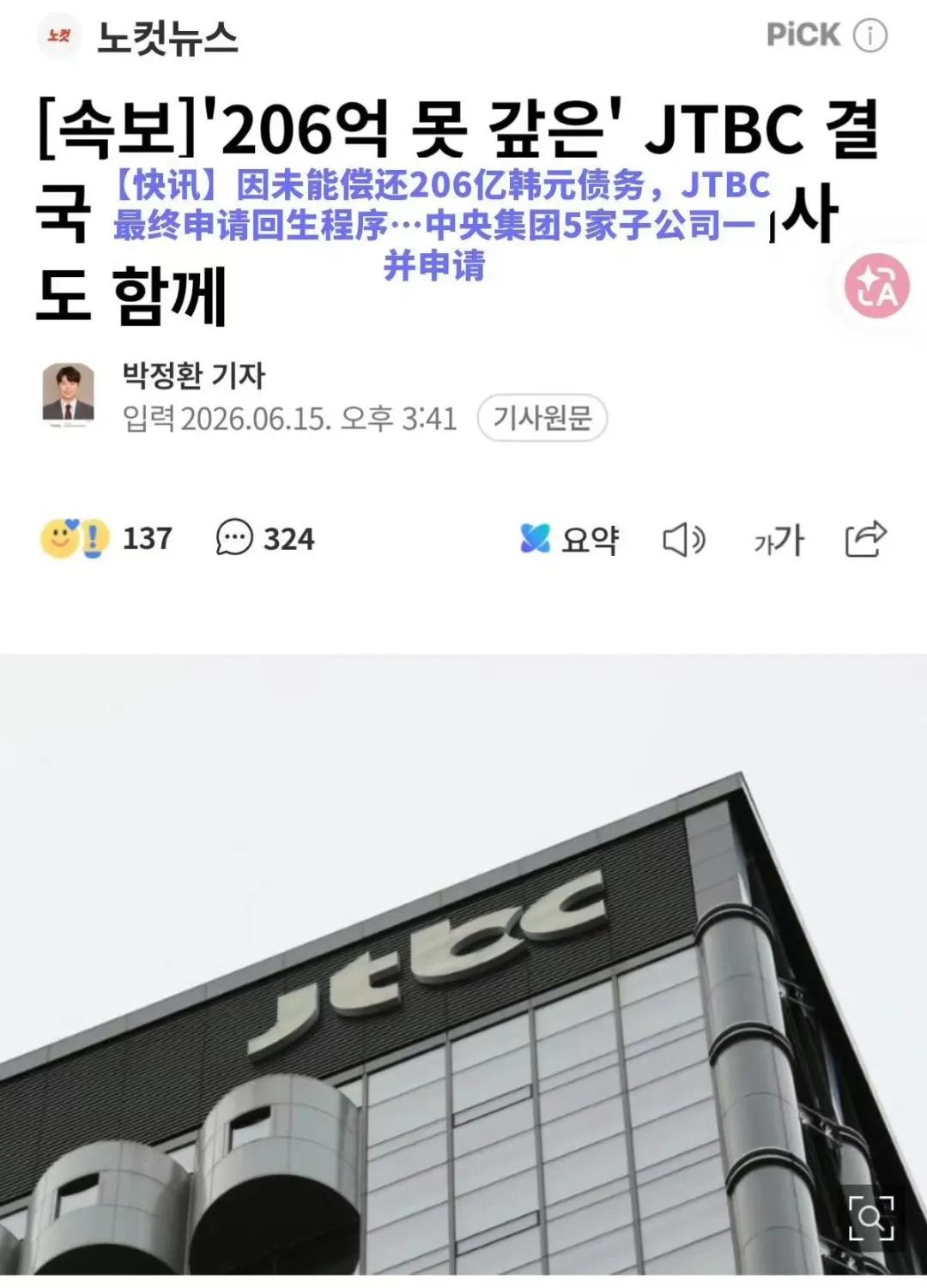
The production costs that were inflated by Netflix over the past years (with an average of 1 billion to 3 billion won per episode) have become the last straw that crushed the traditional TV channels. The annual broadcast volume of the three major terrestrial TV stations has dropped sharply from more than 90 ten years ago to just over 30. In 2025, terrestrial TV stations fell into operating losses for the third consecutive year, with the loss expanding by nearly 40% year-on-year to 117.4 billion won. In June this year, JTBC, which has produced many hit Korean dramas, directly entered bankruptcy restructuring procedures due to a 20.6 billion won loan default, which is the most brutal footnote to this bubble burst.
But if you open the *2025 Content Industry Trend Analysis Report* released by the Korea Creative Content Agency, you will see a different scene: in 2025, the total export value of South Korea's content industry reached a record 14.958 billion US dollars.
In addition to games (8.6 billion US dollars) which have long accounted for the largest share, music is the sector that has achieved explosive growth. In 2025, South Korea's music exports surged to 2.385 billion US dollars, a year-on-year increase of 32.4%; while the export value of broadcasting and video including TV dramas was only 1.349 billion US dollars, with a growth rate of only 7.3%.
This is the core background for examining the South Korean entertainment industry in 2026: the drama production chain that relies on "platform payment" is losing bargaining power, while tours, peripheral products and music sources that rely on "direct payment from fans" have become the new growth pole supporting the cash flow of the entire South Korean entertainment industry.
Looking at the five Q3 quarterly reports together: who is thriving and who is struggling?
The Q3 financial reports of the five major South Korean entertainment companies released intensively in the first week of November have turned this major industrial differentiation into the joys and sorrows on the books of each company.
In this quarter, HYBE is the one that has maximized the "selling to fans" business model. On November 3, HYBE handed over its transcript, with single-quarter revenue breaking through the 1 billion US dollar mark for the first time in history, reaching 1.5257 trillion won, a year-on-year surge of 109.8%. Accumulated in the first three quarters, HYBE has achieved total revenue of 3.674 trillion won, and this year it will most likely become the first giant in K-pop history with annual revenue exceeding 4 trillion won.
It is the offline monetization capability of its ace IP that drives this heavy chariot. BTS's *ARIRANG* world tour alone contributed 726.8 billion won in concert revenue for the company in the third quarter (a year-on-year surge of 196.7%); while holding 31 consecutive shows in 12 cities in North America, it sold about 2 million official peripheral products in just 45 days. However, aggressive overseas expansion is also accompanied by financial fluctuations. Dragged down by factors such as exchange losses, HYBE recorded a slight loss of 6.84 billion won in net profit attributable to owners in its official quarterly report, earning impressive revenue but taking a hit on profit margins.
