Has a brand new product category sprung up between "keep your hands off your phone" and "go learn AI"?
Introduction:
This generation of parents is going through an unprecedented split.
On one hand, AI is reshaping all industries at a speed visible to the naked eye, and no parent dares to let their child miss out on it; on the other hand, there are more and more young myopia patients in ophthalmology clinics, and every night stolen by short videos.
They are afraid that their children will miss the AI era, and even more afraid that their children will be ruined by screens. These two fears have been almost unsolvable in the past three years.
Until the last year, a seemingly niche category has suddenly exploded intensively: children's AI voice printers, AI painting projectors, AI sticker machines, AI-native 3D printing learning machines...
In North America, Stickerbox, which can turn children's voice descriptions into coloring stickers, is priced at 129 US dollars and has been sold out 13 times since its launch. In August this year, toy giant Spin Master acquired the company behind it at a valuation of 35 million to 50 million US dollars.
In China, Zhiti Technology, which started its business by manufacturing intelligent in-vehicle terminals for taxis and has Lenovo behind it through equity penetration, has quietly warmed up a children's AI voice printer called "Huahuabao"; while Zhixiaobai, which started with 2D printing software, sells an AI-native 3D printing learning machine for 999 yuan, calling it "the foundation of family science and innovation education".
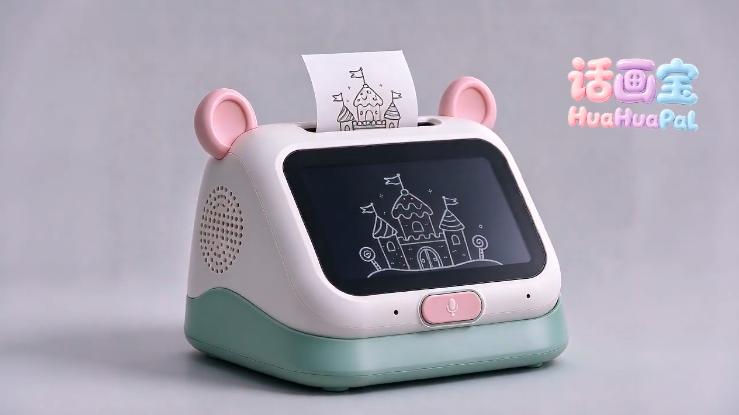
These products have different forms, but their underlying logic is surprisingly consistent: Let children get in touch with AI, but not touch the screen. Therefore, it may be reasonable to draw a conclusion that the first group of large-scale payers for AI hardware are not geeks, but parents who are wary of screens.
01 Afraid of children falling behind, and also afraid of children getting myopia
To understand this category, you must first figure out where this generation of parents are caught in the middle.
Over the past decade, educational consumption in Chinese families has gone through several rounds of migration: from offline tutoring classes, to online large-group classes, and then to learning tablets and dictionary pens.
Behind every round of migration is a variation of the same anxiety: fear that children will fall behind.
However, the structure of anxiety in the AI era has changed.
It is no longer just "what other people's children have learned", but superimposed with an unprecedented panic: AI is rewriting the definition of almost all occupations, and no one knows what abilities will still be valuable ten years later.
At the same time, parents are getting clearer about another account. The negative correlation between screen time and vision, concentration, and sleep has been repeatedly verified by countless studies and every specific family night.
This forms a seemingly unsolvable contradiction. Letting children embrace AI is roughly equivalent to handing children over to screens; letting children stay away from screens is roughly equivalent to letting children swim naked in the AI era.
Three years after the outbreak of generative AI, if we take stock of its application scenarios, we will find a slightly awkward fact: it has entered office software, search boxes, and customer service systems, but has not really entered living rooms and bedrooms for a long time. The only place it has entered unimpeded is the children's room.
Why?
02 The product philosophy of hiding AI in physical objects
The answer lies in the common form of this batch of products.
If you take a closer look at the children's AI hardware that has been launched intensively this year, you will find that they almost share the same set of product grammar: Voice input, physical output.
The child presses and holds the voice key and says "I want a dinosaur that can eat rainbows". On Stickerbox, it turns into a sticker that can be colored, collected and pasted at will. On myFirst's Insta magiBox, it turns into an illustration with six optional styles or a picture-and-text story containing four scenes within ten seconds. On Luka AI from Lingyuzhou, it turns into a painting outline projected on the paper for children to trace, color and expand freely, and AI will continue to tell the story along with the child's painting. On Zhixiaobai's Explorer One, it simply turns into a real 3D printed physical object that can be picked up from the table.
No screen is the center of the experience, AI steps back behind the scenes, and physical objects come to the front stage. The subtlety of this set of grammar is that it completes three things at the same time:
First, it minimizes the presence of AI. There is no dialog box, no information flow, and what children face is not a talking machine, but a "magic pen";
Second, it brings interaction back to the physical world. Coloring, collage, tracing, and building are all hand movements, all real activities with low stimulation and slow feedback;
Third, it gives parents a reason to convince themselves. This is not another electronic pacifier, this is a "creativity tool".
There is already a long list of participants. Zhiti Technology, which makes Huahuabao, is mainly engaged in intelligent empowerment for more than 50,000 taxis, covering more than 100 cities across the country; Gongfudou Technology behind Zhixiaobai is a 2D printing software and content provider that has served more than 100 million parent users; myFirst started with children's cameras and children's smartwatches, and just received more than 8 million US dollars in financing in March this year; Stickerbox was acquired by a Canadian children's entertainment giant.
None of them are traditional education companies, but they all rushed here with the same sense of smell: In the AI toy boom, "more than just conversation" is the most valuable part of differentiation.
Pure conversation AI toys usually can't maintain novelty for more than two weeks. Children will soon find that at the end of the conversation, there is still a screen, or a voice bubble with no follow-up. And "generating a physical object" provides a closed loop for every AI interaction: displayable, collectible, and giftable.
A work that can be held in the hand is the reason why children keep speaking.
03 Turning "slowness" into the most valuable education entry
However, if this category is only understood as an "anti-addiction solution", it will be underestimated. Zhixiaobai's Explorer One is a sample worthy of in-depth analysis.
This AI-native 3D printing learning machine with a launch price of 999 yuan seemingly realizes screen-free interaction: children describe their ideas by voice, AI generates 3D models, the self-developed "Xuanji AI Intelligent Creation Engine" is responsible for processing the models into a real printable form, and the AI camera monitors the whole printing process, identifies abnormalities and pauses automatically.
But the design that truly reveals its ambition is another feature: printing a model often takes tens of minutes or even longer, and Zhixiaobai has specially developed the AI reading companion function. During the long waiting time, AI actively asks questions, imparts knowledge and tells stories around the model being printed.
In other words, it turns the biggest shortcoming of 3D printing — slowness, into the biggest entry of educational content — time.
Behind this is a sharper insight. What parents really fear is never the screen itself, but the posture of children in front of the screen: slumping, scrolling, passively consuming content produced by others. Facing AI in the same scenario, "asking AI for an answer" and "letting AI help you turn imagination into a physical object" are two completely different postures.
The former feeds the laziness of asking questions, while the latter trains the complete chain of creation: imagination, description, generation, modification, manufacturing and display.
Zhixiaobai has built another layer of system on this basis. The teaching research team has converted some knowledge points in Chinese, mathematics and English for grades 1 to 6 of primary school into printable models, equipped with real-person explanation videos, plus modeling courses and science and innovation inquiry courses, forming a "3+3 Learning and Creation Growth System".
The teaching research team first judges which abstract knowledge points are suitable to be turned into 3D teaching aids, then evaluates with the modeling team whether the household equipment can realize it, and repeatedly conducts proofing tests. This process is completely opposite to directly calling AI to generate content.
Up to here, the true face of this business has emerged. The money parents pay for educational AI hardware is ostensibly for "screen-free experience", but in fact, it is for the initiative of children when facing AI.
04 Thoughts from Taoli Finance: The outpost of a larger migration
Of course, hot tracks never lack bubbles.
The hidden worries of this category are almost as obvious as its advantages. After the novelty fades, will children continue to use it? Can consumables and content support a healthy repurchase model? When all manufacturers shout "AI + printing" and the hardware capabilities converge, what will the competition focus on?
Guo Dongxu, general manager of Zhixiaobai, has a judgment worth recording: Time is the biggest barrier. Hardware capabilities may gradually converge, and the key to competition will shift to software and content systems.
This logic has actually been verified repeatedly in the history of educational hardware. Point reading machines died due to depleted content, learning tablets are trapped in being reduced to "legal game consoles", and dictionary pens won by achieving the ultimate tool efficiency.
The life and death of each generation of educational hardware ultimately does not depend on the hardware itself, but on whether it can grow from a "tool" to a "system", from a one-time transaction to a long-term content relationship.
Therefore, when Stickerbox is sold out 13 times a year, when Lenovo-affiliated companies shift from taxi dispatching screens to children's drawing paper, when a 3D printer calls itself "the foundation of education", what we see is actually the outpost of a larger migration: AI is moving from "conversations in the screen" to "creation in hands", and parents' wallets are voting for this migration.
Partial references:
1. Domestic Consumer-grade 3D Printing Takes 90% of the Global Market Share
2. 2026 China Consumer-grade 3D Printer Industry Chain, Market Status, Enterprise Pattern, Key Enterprises and Investment and Financing Analysis
3. The Outbreak of the Children's 3D Printer Market: From Geek Toys to Family STEAM Education Tools
4. Zhixiaobai Launches AI-native 3D Printing Learning Machine, Can It Open Up the Family Science and Innovation Market?
This article is from the WeChat official account "Taoli Finance", author: Taoli Editorial Committee, published with authorization from 36Kr.